Snapshot
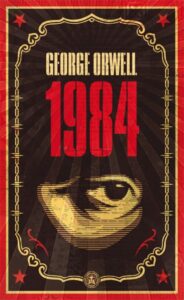
1984 by George Orwell, shows a world where the central government controls every aspect of people’s lives; not just their actions, but their thoughts, too. In this society, individuality is completely crushed, and truth is manipulated to serve the government’s goals. Orwell’s warning is that, in the face of totalitarian power, personal freedom and identity become invisible, leaving people entirely subject to the government’s will.
Summary
A World Where Even Your Thoughts Aren’t Yours Anymore
Winston, a 39-year-old clerk in the Ministry of Truth, walks onto the street on another dark, cloudy day. Everywhere he looks, there’s a poster with an enormous face gazing from the wall. Under the figure, the caption reads: “Big Brother is watching you.”
It was one of those pictures that are so contrived that the eyes follow you about when you move. Big Brother is watching you, the caption beneath it ran. (Page 1)
This dystopian future is set in 1984, where the government controls every aspect of life, rewriting history, manipulating truth, and crushing any form of individual thought or rebellion. Telescreens(devices that are both televisions and surveillance cameras) dominate everyday life. They are installed in homes, workplaces, and public spaces, making sure that everybody is being monitored at all times.
Nobody has ever seen Big Brother. He is a face on the hoardings, a voice on the telescreen. We may be reasonably sure that he will never die, and there is already considerable uncertainty as to when he was born. Big Brother is the guise in which the Party chooses to exhibit itself to the world. His function is to act as a focusing point for love, fear, and reverence, emotions which are more easily felt towards an individual than towards an organization. Below Big Brother comes the Inner Party. Its numbers limited to six millions, or something less than 2 per cent of the population of Oceania. Below the Inner Party comes the Outer Party, which, if the Inner Party is described as the brain of the State, may be justly likened to the hands. Below that come the dumb masses whom we habitually refer to as ‘the proles’, numbering perhaps 85 per cent of the population. (Page 69)
One Man Who Still Remembers What It Means to Be Human
But Winston is too humanely fragile to keep his intuitions under control in the face of this oppression. In this dystopian world’s terms, Winston has doublethink: the ability to hold two mutually opposite beliefs at the same time and accept both as true. This is a concept put forward by the government to control people’s thoughts.
He’s tired, skeptical, annoyed, and angry. He knows something is terribly wrong with this system.
But it’s hard to put his feelings into perspective in a world where there is no space for individual freedom in the first place. So he starts doing something people have done over the centuries to free themselves from social oppression: writing down his thoughts.
He writes:
Even the literature of the Party will change. Even the slogans will change. How could you have a slogan like “freedom is slavery” when the concept of freedom has been abolished? The whole climate of thought will be different. In fact there will be no thought, as we understand it now. Orthodoxy means not thinking — not needing to think. Orthodoxy is unconsciousness.’ (Page 17)
A Small Rebellion Begins With a Diary and a Dangerous Hope
This is Winston’s first act of rebellion; putting his mind into a diary.
As small a rebellious act as this seems, in Oceania, this is a punishable crime: to think in private, which they call thoughtcrime. Writing in his diary is the only way he can let his rationality resurface, even though he might get caught. While doing this, Winston lives his normal life as a minor clerk at the Ministry of Truth.
One day, a girl he’s seen many times at work passes him a little note secretly. The note reads: “I love you.” This gives birth to a passionate love story, in a world where passion is considered a crime, showing us a juxtaposition between individual freedom versus totalitarian control. Orwell points out here that the human condition always finds ways to become more curious, tender, and defiant, no matter how hard we try to suppress it.
The Party Doesn’t Want Obedience—It Wants Your Mind
But this love story comes to a tragic end when Julia and Winston get caught by the thought police. What follows is a series of tortures of Winston for his crime. These scenes are in the book for their shock value; showing how corrupt a government can get and showing how the government can rewrite and control truth while crushing the individual in order to do so.
When Truth Dies, Freedom Dies With It
At the end of the novel, Winston completely surrenders to the government.
This is Orwell’s warning that individual freedom can be completely crushed if we collectively allow the pursuit of absolute power.
‘But the rocks are full of the bones of extinct animals — mammoths and mastodons and enormous reptiles which lived here long before man was ever heard of.’ ‘Have you ever seen those bones, Winston? Of course not. Nineteenth-century biologists invented them. Before man, there was nothing. (Page 89)
Ideas that resonate with me
Why is this book banned in some countries?
A book, one that shows how government control can go horribly wrong, getting banned by a real government is alarming. But it’s true.
The Belarusian government ordered 1984 to be banned in 2022.
The order reads: “All editions of G. Orwell’s ‘1984’ to be withdrawn from the market. Report on the implementation to be submitted no later than May 19.”
This seems like a scene straight out of the book itself.
Belarus isn’t the only government to ban 1984 either: it was banned until 1988 by the Russian government. In the United States, this book is often pulled off shelves even though there’s no nationwide ban. And in China, 1984 is heavily restricted, and has been for a long time.
Right after the ban was lifted in Russia, this book became a bestseller in the country.
Language does more than communicate; it helps shape clear thought
Orwell shows how language is one of the government’s key tools for social control.
In this dystopia, the government creates a new language—Newspeak—that limits freedom of speech. But the oppression doesn’t stop there.
Newspeak is designed to limit thinking, too.
In the Oldspeak, the natural language used before the government took over, people had messy, expressive words that let them think for themselves. That’s obviously not something this new government wants. So Newspeak isn’t just about taking away the freedom to speak; it’s about making sure people can’t think for themselves.
This is a theme I’ve seen in other dystopian novels as well, like The Giver by Lois Lowry, The Handmaid’s Tale by Margaret Atwood, and Brave New World by Aldous Huxley.
For example, some of the words in Newspeak make the oppression obvious. Even thinking against the government becomes impossible, or illegal, just by the way the language is structured.
| Word | Meaning |
|---|---|
| Thoughtcrime | Independent or rebellious thoughts against the government. |
| Doublethink | Holding two contradictory beliefs simultaneously and accepting both of them (this is a tool used by the government to prevent thoughtcrime). |
| Crimestop | Stopping yourself from thinking rebellious thoughts. |
| Facecrime | A facial expression that unintentionally shows doubt, disbelief, or disloyalty toward the government. |
| Goodthink | Approved thinking that fully aligns with the government’s ideology. |
| Goodthinkful | Someone incapable of unorthodox thoughts; naturally loyal in their thinking. |
| Ownlife | Individualism or privacy; any action toward ownlife is suspicious and may lead to punishment. |
| Newspeak | The controlled language designed to limit free speech and thought. |
| Prolefeed | Low-quality entertainment and propaganda used to distract and pacify the masses. |
| Unperson | Someone erased from existence (Winston’s job is to remove personal profiles to ensure everything aligns with the government). |
| Blackwhite | Believing whatever the government says, even if it’s false; calling something the opposite of what it is (for instance, in the final chapters, Winston is tortured until he genuinely loves Big Brother). |
Orwell’s writing in 1984 has a quietly humorous touch
I couldn’t shake the fact that Orwell intentionally created those Newspeak words not just to show oppression, but also to ridicule it.
I’ve seen this kind of carefully thought-out ridicule in another book too: The Metamorphosis by Franz Kafka. Orwell knew of Kafka’s work from his early years, though that doesn’t necessarily mean he was influenced by him.
Nonetheless, both writers explored dehumanizing systems and authoritarianism.
What’s even more interesting is how they go about it. They don’t just show what could happen when ideologies are pushed to extremes. They also slip in their own opinions in the subtlest way possible, ridiculing these systems without ever being overt.
1984 and the Brave New World
The more I think about this dystopian world that Orwell created, the more I’m convinced that other similar books(Brave New World, The Giver, The Handmaid’s Tale) give us the exact same warning, even though the visions behind the oppression are completely different.
In these worlds, individuality gets completely crushed when society tries to maintain collective stability.
Take Brave New World by Aldous Huxley, for example. In this dystopian world, human emotions are controlled, or engineered, to create a so-called utopian society. But unlike in 1984, the government doesn’t use fear or punishment. It does the opposite: it removes fear, oppression, and any negative feelings entirely.
Even though the mechanisms in these two dystopias are completely opposite, Winston in 1984 and John in Brave New World end up in the same situation.
For example, here’s a quote from 1984:
‘I hate purity, I hate goodness! I don’t want any virtue to exist anywhere. I want everyone to be corrupt to the bones.’ (Page 41)
And here’s a quote from Brave New World:
“But I like the inconveniences.”
“We don’t,” said the Controller. “We prefer to do things comfortably.”
“But I don’t want comfort. I want God, I want poetry, I want real danger, I want freedom, I want goodness. I want sin.” (page 240)
Their words echo the same frustration.
Their individuality is completely crushed.
Here’s a full comparison of the concepts from the two books:
| Category | 1984 (Orwell) | Brave New World (Huxley) | Comments |
|---|---|---|---|
| Type of Control / Power | Fear and oppression | Pleasure and comfort | Shows different ways societies maintain control through force, consent, or emotional engineering |
| Freedom vs. Individuality | Free speech is completely suppressed, to the point where even thinking negatively about the government is considered a crime | Emotional depth and choice are removed; people don’t challenge their idea of freedom because they are genetically engineered not to | Highlights what it means to be human and the cost of surrendering freedom. |
| Truth and Knowledge | Truth is rewritten; reality is controlled | Knowledge is irrelevant; critical thinking is frowned upon | Explores how control over knowledge shapes perception, values, and society |
| Rebellion / Resistance | Rebellion arises from misery and oppression | Rebellion arises from existential emptiness | Shows the human drive to resist rigid systems |
| Human Connection and Emotion | Love is forbidden; relationships are monitored | Emotions are engineered out | Shows how control of intimacy and feelings is central to totalitarian power |
Parts that left a mark on me
The problem was how to keep the wheels of industry turning without increasing the real wealth of the world. Goods must be produced, but they must not be distributed. And in practice the only way of achieving this was by continuous warfare. (Page 64)
The essential act of war is destruction, not necessarily of human lives, but of the products of human labour. War is a way of shattering to pieces, or pouring into the stratosphere, or sinking in the depths of the sea, materials which might otherwise be used to make the masses too comfortable, and hence, in the long run, too intelligent. (Page 64)
War, it will be seen, accomplishes the necessary destruction, but accomplishes it in a psychologically acceptable way. In principle it would be quite simple to waste the surplus labour of the world by building temples and pyramids, by digging holes and filling them up again, or even by producing vast quantities of goods and then setting fire to them. But this would provide only the economic and not the emotional basis for a hierarchical society. What is concerned here is not the morale of masses, whose attitude is unimportant so long as they are kept steadily at work, but the morale of the Party itself. Even the humblest Party member is expected to be competent, industrious, and even intelligent within narrow limits, but it is also necessary that he should be a credulous and ignorant fanatic whose prevailing moods are fear, hatred, adulation, and orgiastic triumph. In other words it is necessary that he should have the mentality appropriate to a state of war. (Page 64)
How did the book change the way I think?
Truth and individual freedom are recognized necessities. They are not guaranteed; they must be actively protected.
Coffee chat
What is Newspeak in 1984?
Newspeak is a modified version of English, designed by the totalitarian government.
It’s built not just to suppress people’s freedom of speech, but also their freedom to think.
For example, “bad” becomes ungood, and instead of words like “excellent,” “fantastic,” or “wonderful,” Newspeak uses “plusgood” or “doubleplusgood.”
At first, it seems almost comical. And I think that’s partly Orwell’s intention. But it also clearly shows how language can suppress human thought.
With a vocabulary like this, the different shades of emotion are reduced to one flat, uniform word.
How does 1984 end?
Winston, the main character of the novel, is caught by the government for his “crimes.”
He’s tortured until he gives in, until he becomes loyal to the government.
After this, Winston is released from prison. He lives his life the way the government wants him to, believing the “truth” that is imposed by the state and doing what they want him to do.
This ending is Orwell’s warning to us, the readers: if we don’t take action, or at least actively think about how manipulative a government can get, we risk becoming nothing more than a tool to advance their agenda, with our individuality completely crushed in the process.
Why does Big Brother matter?
Big Brother is both a figure and a symbol at the top of the government hierarchy in this story.
He’s the face of oppression, the embodiment of absolute authority. The government uses him to personalize control.
Signs are everywhere, with quotes like “Big Brother is watching you” and “Big Brother loves you.”
The government wants to communicate these messages, but they do it through an imaginative person, making total control feel focused through a single figure.
What is doublethink in 1984?
Doublethink is the ability to hold two contradictory ideas in your mind and accept both at the same time.
For example, the government’s motto is: “War is peace. Freedom is slavery. Ignorance is strength.”
Clearly, these ideas contradict each other. Yet citizens are expected to believe them anyway.
This is designed so that when the government decides what “truth” is, which might not be the truth at all, people will habitually accept it, because they’re already trained to agree with contradictory ideas.
How does the memory hole work?
A memory hole is a small chute found in offices and record-keeping centers.
If a document contains content that doesn’t align with the government’s ideals, it’s thrown into the memory hole and destroyed.
Citizens are then expected to completely forget its contents forever, as if it had never existed in history at all.
Why rewrite history in 1984?
In this story, the truth is controlled by the government.
It’s a chilling and disturbing idea because truth should be something anyone can verify for themselves.
But the government defines truth to align with its own views, even when it’s false.
This naturally creates conflict, because people can challenge or falsify it.
One solution the government comes up with, among many, is to rewrite history and destroy the truths that don’t fit its ideology.
What is the Thought Police?
In this dystopian world, people are being monitored everywhere they go, even in their own homes.
The government uses hidden microphones, telescreens (camera devices), and informants to keep tabs on everyone.
These informants are called the Thought Police. Their job is to arrest, torture, and “re-educate” anyone who commits a thoughtcrime, that is, anyone who has rebellious thoughts about the government.
What is the main theme of 1984 by George Orwell?
Truth and individual freedom are recognized necessities. They are not guaranteed; they must be actively protected.
How does surveillance shape life in 1984?
Telescreens(devices that are both televisions and surveillance cameras) dominate everyday life. They’re installed in homes, workplaces, and public spaces, making sure everyone is being monitored all the time.
Beyond the telescreens, there are hidden microphones everywhere, trying to catch people who are actively trying to sabotage the government, or even just thinking about it.
Why is 1984 considered a warning about totalitarianism?
1984 shows a world where the central government controls every part of people’s lives, not just their actions, but their thoughts too.
It’s a world where individuality is completely crushed, and the truth is manipulated to serve the government’s goals.
Orwell’s warning to us, the readers, is that in the face of a totalitarian regime, individuality doesn’t just fade; it gets completely destroyed.
