Table of Contents
Snapshot
48 Laws of Power by Robert Greene has a cult-like following.
It has sold over 1.2 million copies in the United States alone since its release in 1998 and has been translated into 24 languages.
Despite all this success, people still have three major reservations about the book.
First, is it evil?
Some of the advice is undeniably dark. At times, it reads like a villain’s handbook.
Second, are the stories even relevant?
Many of Greene’s examples are ancient, dusty, and hard to connect to modern life.
Third, do the laws contradict each other?
Law 1 says “never outshine the master,” while Law 28 says “enter with boldness.”
Law 4 says “always say less than necessary,” while Law 6 says “court attention at all costs.”
Trying to apply all of this at once wouldn’t give you power; instead, it would strip away the power you already have.
This review is my attempt to make sense of all three reservations.
In this post, the laws are organized into five categories. Then, each law is broken down using the same structure:
- Insights – the human behavior and psychology behind the law
- Real-world application – how does it show up in everyday life, and how to protect yourself from manipulation rather than practice it
- Favorite quote – the most ethical and impactful quote(s) from each law
To explain the contradictions, in the 'Power Types' section, I group the laws into different flavors of power. Each one has its own psychology and its own set of laws that work together.
The laws aren’t meant to be used all at once. They’re situational. The right question isn’t which law should I follow? but what kind of power am I trying to build around myself?
When used correctly, this book becomes an extremely useful framework for navigating everyday life; not as a weapon, but as armor.
Categorized 48 laws
1. Mastering Influence & Social Dynamics
Law 2: Never Put Too Much Trust in Friends — Learn How to Use Enemies
Insights
Friendships and professional relationships always carry some friction.
But the danger doesn't come from relying too much on friends in a professional setting. It comes from having emotional attachment with friends while trying to balance professional life, which is always a power game.
These emotional attachments create blind spots.
Because you tend to trust blindly where you should've verified the facts, and you excuse the shortcomings where you should've confronted them.
Greene argues that enemies, on the other hand, make much more convenient allies. Having been enemies before, both sides now have something to prove to each other: mutual loyalty.
A person who has something to prove will move mountains for you (p. 13)
Real-World Applications
| The Situation | The Right Move | The Wrong Move |
|---|---|---|
| You're starting a company and your best friend wants to join as a co-founder. | You have honest conversations about roles, expectations, and what happens if things don't work out, treat it like you would with anyone else, maybe even more carefully. | You skip the hard conversations because you trust each other, then discover six months in that you have completely different visions and now the friendship is at risk too. |
| Someone on your team has been challenging your ideas consistently, but not aggressively. | You recognize their pushback means they're engaged and thinking critically, so you give them a meaningful project where their skills can shine. | You write them off as difficult and only work with people who agree with you, missing out on someone who could have brought valuable perspective. |
| A friend asks you to recommend them for a job at your company even though you're not sure they're the right fit. | You're honest about your concerns and help them find opportunities that actually match their strengths, even if it's not at your workplace. | You recommend them anyway to avoid awkwardness, then watch them struggle in a role they weren't ready for while you're stuck managing the fallout. |
Favorite quote
The key to power, then, is the ability to judge who is best able to further your interests in all situations. Keep friends for friendship, but work with the skilled and competent (p. 13).
Law 7: Get Others to Do the Work for You, but Always Take the Credit
Insights
The key idea of this law is outsourcing.
It's really about recognizing the limits of time, energy, and personal skill.
We, as individuals, can't do everything on our own. And most importantly, there's no reason to. Unlike most species, we're the only few who've specialized in specific fields.
So benefiting from this system we've built over thousands of years is extremely important for achieving our goals. Not using it is, in fact, a waste.
We more often than not take pride in trying to "do it all." But that kind of pride eventually collapses under its own weight.
Outsourcing isn't laziness. It's the only path to creating anything larger than yourself.
Real-World Applications
| The Situation | The Right Move | The Wrong Move |
|---|---|---|
| You’re leading a group project, and someone on the team is exceptionally good at data visualization. | You let them handle the parts they’re great at, and the whole project looks stronger because of it. | You insist on doing every part yourself “to make sure it’s perfect,” and end up exhausted with a weaker final result. |
| A friend offers a surprisingly clever solution to a problem you’ve been stuck on for days. | You fold their idea into the bigger project and keep things moving efficiently, acknowledging where it came from. | You ignore the help, waste days trying to force your own approach, and miss deadlines. |
| Your workplace has specialists who can handle tasks you’re not skilled at(design, coding, writing, analysis). | You delegate the pieces they’re naturally good at and build momentum around the combined effort. | You try doing everything yourself because you feel responsible for every detail, and nothing gets finished at the deadline. |
Favorite quote
If you think its important to do all the work yourself, you will never get far, and you will suffer the fate of the Balboas and Teslas of the world. Find people with the skills and creativity you lack (p. 59).
Law 8: Make Other People Come to You — Use Bait if Necessary
Insights
The real power doesn't come from manipulation, at least not in its pure sense, but from mastering emotional steadiness.
This is what this law is really about.
To gain power, Greene points out two conditions have to be met.
First, you yourself must learn to master your emotions and never be influenced by anger.
Second, you should be aware that most people don't do this part themselves. This means they're most likely to reveal their true selves when they get frustrated and angry.
This action-reaction combo keeps you in power where others fail to maintain their composure.
One of the harmless ways to reveal someone's intentions is to say less than necessary. This makes people uncomfortable and leads them to act out of their default mask, revealing their true intentions.
This is what "letting them come to you" means in this context; letting their own emotions lead them where they were already heading.
Real-World Applications
| The Situation | The Right Move | The Wrong Move |
|---|---|---|
| You’re in a group project and someone keeps demanding you change your part immediately. | You keep your tone calm, stay unmoved, and let them overextend. Eventually they reveal exactly what they want. | You react emotionally, rush to defend yourself, and end up doing work on their timeline instead of yours. |
| A colleague subtly tries to provoke you in a meeting so you’ll expose frustration in front of others. | You stay composed and let their irritation make them look unreasonable while you keep the strategic upper hand. | You take the bait, snap back, and give them the emotional reaction they wanted in the first place. |
| A friend is rushing you to make a decision. | You stay patient, slow the pace, and let the pressure shift back to them until they reveal their priorities. | You let urgency push you into choosing quickly, surrendering control of the situation. |
Favorite quote
The reason for this pattern is that the aggressive person is rarely in full control. He cannot see more than a couple of moves ahead, cannot see the consequences of this bold move or that one (p. 64).
Law 11: Learn to Keep People Dependent on You
Insights
Law 11 sits at the intersection of the book's two great anxieties: the fear of being used and the fear of being discarded.
When a company is downsizing, the ones who still hold their jobs are the ones who have something unique to offer—someone with a skillset that can't be easily replaced, or at least isn't worth the money to hire and train someone new for.
This is what this law is about: irreplaceability.
In other words, the ultimate form of power isn't independence but interdependence.
Goodwill and your past contributions will be quickly forgotten, but it's the ongoing necessity that keeps you relevant.
The completely independent man would live in a cabin in the woodshed would have the freedom to come and go as he pleased, but he would have no power (p. 85).
But this begs the question: Is it possible to have both freedom and power?
Looking at Law 20 (Do Not Commit to Anyone), Greene signals that it is.
This seems contradictory.
But Greene is talking about two types of power. There's a certain power you can gain through interdependence, and there's a certain type of power you can gain through independence. These are discussed in more detail in the "Power Types" section.
Real-World Applications
| The Situation | The Right Move | The Wrong Move |
|---|---|---|
| You're the only person on your team who knows how to use a particular software tool. | Train others on the basics but become the expert who solves the complex problems and develops new applications. | Keep all knowledge to yourself and make every task require your involvement. |
| You've built strong relationships with key clients who trust you personally. | Introduce team members to clients while staying involved in strategic decisions and relationship development. | Prevent anyone else from building client relationships or having direct access. |
| Your manager relies on your detailed knowledge of a long-running project. | Document the essentials but position yourself as the person who can navigate complications and make judgment calls. | Refuse to document anything and create confusion so only you can figure things out. |
Favorite quote
Be the only one who can do what you do, and make the fate of those who hire you so entwined with yours that they cannot possibly get rid of you. Otherwise you will someday be forced to cross your own Bridge of Sighs (p. 83)
Law 12: Use Selective Honesty and Generosity to Disarm Your Victim
Insights
A genuine act of honesty and generosity can create much more trust than a hundred consistent but unremarkable interactions.
It's human nature to be suspicious of people who want something from them. A gift disarms them from that suspicion because by giving a gift, we're appealing to their self-interest.
There are two use cases Greene discusses under this law: the defensive use, where you give something small to protect something large (admitting a minor flaw until you figure out a solution for a major flaw), and the offensive use, where generosity becomes the setup for a larger ask later.
However, people can easily see through it if you're dishonest. In this case, instead of gaining power, you lose power.
So this is something that should be done honestly and purposefully.
Real-World Applications
| The Situation | The Right Move | The Wrong Move |
|---|---|---|
| You need a colleague's help on a tight deadline after weeks of minimal interaction. | Offer to help them with something they're struggling with first, then ask for what you need a few days later. | Just ask for the favor straight away without building any goodwill or connection first. |
| Someone asks you a probing question about your project's progress during a meeting. | Admit one minor challenge you've already solved while emphasizing your overall progress and plan. | Either deflect completely and seem defensive or overshare every problem and concern. |
| You're negotiating with a client who seems wary of your proposal. | Voluntarily point out one limitation of your approach and how you'd address it, showing balanced judgment. | Only highlight positives and hope they don't notice any drawbacks on their own. |
Favorite quote
Unless you can make the gesture seem sincere and heartfelt, do not play with fire (p. 93)
Law 13: When Asking for Help, Appeal to People’s Self-Interest, Never to Their Mercy or Gratitude
Insights
We're rarely motivated to do a good deed for others if there's nothing in it for us.
We're all fighting our own battles.
So it's better to ask for help with a promise that they'll get something back, too. This is what actually turns the wheels.
In other words, appealing to someone's self-interest, respectfully and clearly, can open doors that appeals to kindness alone rarely do.
it is always best to speak pragmatically to a pragmatic person. And in the end, most people are in fact pragmatic they will rarely act against their own self-interest (p. 98)
Real-World Applications
| The Situation | The Right Move | The Wrong Move |
|---|---|---|
| You need a colleague to cover a shift at work. | Show how helping you will make their schedule easier or earn them favor with the manager. | Beg them out of sympathy or remind them of all the times you’ve helped them. |
| Asking a friend to support your project or idea. | Explain how your project aligns with their own goals or interests. | Rely on your friendship or guilt them for past favors. |
| Seeking advice from a mentor or senior. | Highlight how your success reflects positively on them or benefits them in the long run. | Plead for mercy or invoke past kindness they’ve shown. |
Favorite quote
Most people never succeed at this because they are completely trapped in their own wants and desires. They start from the assumption that the people they are appealing to have a selfless interest in helping them. They talk as if their needs mattered to these people who probably couldn't care less.
Sometimes they refer to larger issues: a great cause, or grand emotions such as love and gratitude. They go for the big picture when simple, everyday realities would have much more appeal.
What they do not realize is that even the most powerful person is locked inside needs of his own, and that if you make no appeal to his self-interest, he merely sees you as desperate or, at best, a waste of time (p. 98).
Law 14: Pose as a Friend, Work as a Spy
Insights
This is one of those laws that seems cynical on the surface.
But more often than not, we're all spies, even though we don't realize it.
For example, we tend to test the waters to find someone's true intentions; casual talk, small disclosures, stray questions that give away what someone values or fears.
The mistake isn't trusting people. The mistake is letting every warm tone trick you into transparency. In real life, the smartest readers of people aren't cold manipulators; they're simply patient observers who let others speak first.
This comes in handy in both personal and professional life. Knowing someone's true intentions allows us to gauge who we're dealing with—both to not let ourselves down and not to let down the people who depend on us.
Real-World Applications
| The Situation | The Right Move | The Wrong Move |
|---|---|---|
| A new coworker eagerly shares office dynamics, and you sense they’re testing what you’ll reveal in exchange. | Stay warm but measured, letting their own words tell you more than you tell them. | Overshare early and end up giving away more about yourself than they ever revealed. |
| A friend-of-a-friend keeps asking detailed questions about your plans, goals, or frustrations. | Keep the conversation light and shift to topics that don’t expose your personal life. | Mistake curiosity for loyalty and hand them personal information they can easily pass along. |
| A colleague asks how you feel about a decision the team hasn’t fully discussed yet. | Listen closely to their points, but stay independent as to not to talk behind someones back. | Take the question at face value and reveal your position before you understand theirs, eventually making a bad reputation for yourself. |
Favorite quote
What's the point of winging it, of just hoping you may be able to charm this or that client? It's like shooting ducks blindfolded. Arm yourself with a little knowledge and your aim improves (p. 102).
Law 20: Do Not Commit to Anyone
Insights
Once you commit to a person or a cause, you inherit their baggage.
This, in return, leads you to lose your power because it limits your options and makes you much more predictable.
This law is more about keeping your distance than cutting people off entirely.
When people can't gauge your loyalty, they naturally become cautious about doing anything against you. On the other hand, they'll be generous about making you part of them, because it's more attractive to have fewer strings attached—it echoes independence and confidence.
Those who use this strategy often notice a strange phenomenon: People who rush to the support of others tend to gain little respect in the process, for their help is so easily obtained, while those who stand back find themselves besieged with supplicants. Their aloofness is powerful, and everyone wants them on their side (p.149).
The execution of this law hinges on the balance of two forces.
They are: (1) external pressure (people demanding you choose sides) and (2) internal impulses (our natural desire to belong in a group).
The law is divided into two sections.
Part 1: Do not commit to anyone, but be courted by all
Part 2: Do not commit to anyone—stay above the fray
Part 1 is about making yourself desirable to multiple parties so they compete for your favor, treating your independence as a prize to be won. Part 2 is about being neutral in conflicts, refusing to be part of a conflict that will drain your energy no matter which side wins.
Real-World Applications
| The Situation | The Right Move | The Wrong Move |
|---|---|---|
| Two senior leaders at your company are in a power struggle and both want your support. | Stay cordial with both, focus your discussions on work rather than politics, and let your results speak for themselves. | Publicly back one leader and hope they win, tying your future to their success or failure. |
| Friends are pressuring you to take a side in their dispute with another friend. | Listen to both perspectives, stay in touch with everyone, and let them know that you care about both of them, letting them figure out a solution on their own. | Jump in to defend one friend immediately and cut off the other. |
| Your industry has two competing standards and vendors are pushing you to commit to one. | Keep both options viable, try out and see what works from each, and wait to see which gains more traction. | Go all-in on one standard early, betting your project's future on one horse. |
Favorite quote
You have only so much energy and so much time. Every moment wasted on the affairs of others subtracts from your strength. You may be afraid that people will condemn you as heartless, but in the end, maintaining your independence and self-reliance will gain you more respect and place you in a position of power from which you can choose to help others on your own initiative (p. 154).
Law 21: Play a Sucker to Catch a Sucker—Seem Dumber Than Your Mark
Insights
This law is based on one of the fundamental weaknesses of human nature: people feel most comfortable and least guarded around those they believe they're smarter than.
Nobody wants to be the least smart person in the room.
And if people feel their competency is threatened, they're willing to throw away all their belief systems, all their goodwill, just to secure it.
This means sometimes, even if you can consciously gauge that you're smarter than someone, it's best to appear lower on the intelligence scale—especially if they're your superiors.
The ego relaxes when you act the fool.
Whether we like it or not, most people's insecurity levels are way higher than their competency levels.
If we, especially as a subordinate, cross that boundary, bad things will happen. They'll do anything in their power to diminish ours.
Being wary of this and making a point not to cross people's insecurity levels is crucial to holding the power on our side.
Real-World Applications
| The Situation | The Right Move | The Wrong Move |
|---|---|---|
| A colleague is explaining their strategy and you immediately see the flaws in their approach. | Ask simple clarifying questions that let them keep talking and spot the problem without realizing you've spotted the problems. | Point out the flaws right away and show you understood their strategy better than they did. |
| You're negotiating and the other person assumes you don't understand the technical aspects. | Let them believe that, ask them to explain more, and gather information about their priorities and constraints. | Correct their assumption and prove your expertise, putting them on guard. |
| Someone is trying to impress you with knowledge about a topic you know well. | Play the interested student, ask questions, and let them feel smart while you learn something in return, that is, how another person would approach that topic. | Match their knowledge or one-up them to establish that you're equally or more informed. |
Favorite quote
The feeling that someone else is more intelligent than we are is almost intolerable. We usually try to justify it in different ways: "He only has book knowledge, whereas I have real knowledge." "Her parents paid for her to get a good education. If my parents had had as much money, if I had been as privileged…" "He's not as smart as he thinks." Last but not least: "She may know her narrow little field better than I do, but beyond that she's really not smart at all. Even Einstein was a boob outside physics" (p. 159)
Law 24: Play the Perfect Courtier
Insights
Subtlety, awareness, and intelligence give you more power than forced authority.
In the ancient court, this is what playing a courtier meant.
In modern life, this plays out in everyday office politics, networking events, and social gatherings.
Being modest, adaptive, and positive creates a magnetic presence that draws others to you, without ever needing to force your dominance.
The law is categorized as follows:
- Avoid Ostentation: Modesty wins you more respect than showing off ever could.
- Practice Nonchalance: Make everything you do look effortless, like it's just who you are, not something you had to work for.
- Be Frugal with Flattery: Compliment people by being modest about yourself, not by laying it on thick about them.
- Arrange to be Noticed: Find a way to stand out without making it obvious.
- Alter Your Style and Language According to the Person You're Dealing With: Read the room and adjust how you talk and act, because treating everyone the same will offend someone.
- Never Be the Bearer of Bad News: Don't be the messenger who brings problems to powerful people.
- Never Affect Friendliness and Intimacy with Your Master: Keep professional distance with those above you, because getting too comfortable makes them uncomfortable.
- Never Criticize Those Above You Directly: If you have to point out a mistake, specially someone above you, doing it indirectly helps you hold on to your power.
- Be Frugal in Asking Those Above You for Favors: Don't ask for too much, too often. Save your requests for when they really matter.
- Never Joke About Appearances or Taste: People's egos are fragile about how they look and what they like, so just don't go there.
- Do Not Be the Court Cynic: Being negative all the time makes you exhausting to be around, and powerful people will avoid you.
- Be Self-Observant: Know your strengths and weaknesses well enough that you don't accidentally expose yourself.
- Master Your Emotions: Control what you show on your face, because every reaction gives people information about you.
- Fit the Spirit of the Times: Adapt to the current mood and trends, because fighting against the zeitgeist is a losing battle.
- Be a Source of Pleasure: Make people feel good when they're around you, and they'll want to keep you close.
From all these, 3 that fits well today are:
- Avoid Ostentation
- Alter Your Style and Language According to the Person You're Dealing With
- Be a Source of Pleasure
Below examples are tailored to these three scenarios:
Real-World Applications
| The Situation | The Right Move | The Wrong Move |
|---|---|---|
| At a team meeting, you just led a successful project. | Share the credit modestly, pointing out that it's a team effort rather than boasting about your personal brilliance. | Brag about your personal contributions and accomplishments in a way that overshadows others. |
| Meeting a new client who prefers formal communication. | Adjust your tone and language to match their level of professionalism and style. | Speak casually or use slang without gauging their preferences, which can come off as disrespectful or careless. |
| Socializing with coworkers after hours. | Be cheerful, supportive, and encouraging. Make people feel good and enjoy your company. | Focus on complaining, criticizing, or being negative, which drives people away. |
Favorite quote
It is never good to seem to be trying too hard—it is as if you were covering up some deficiency. Fulfilling a task that has not been asked of you just makes people suspicious. If you are a crown-keeper, be a crown-keeper. Save your excess energy for when you are not in the court (p. 186).
Law 27: Play on People’s Need to Believe to Create a Cult-Like Following
Insights
This law feels less like a tactic and more like an observation about how groups naturally organize themselves around meaning.
Even though it seems like it on the surface, this law isn't about manipulation. It's about planting hope in other people's minds.
When done correctly, this can be one of the most powerful ways to inspire action.
People don't walk around searching for leaders, but they do search for meaning and purpose. When someone steps in to fill that gap with a story, even a modest one, they become others' confidante.
When done with accuracy and goodwill, this hope can do wonders for people.
But if we want to do something good for other people, if we have good intentions, we still have to convince them of those good intentions.
More often than not, clear thinking and making logical arguments about why something is good for people doesn't appeal to them.
Instead, if we wrap that logical clear thinking in a bit of enthusiasm—that is, hope—they're ready to follow us without hesitation.
In other words, creating a cult-like following helps you help others.
Real-World Applications
| The Situation | The Right Move | The Wrong Move |
|---|---|---|
| A team at work feels uncertain about a confusing project and looks to someone for clarity. | Offer a simple, steady narrative that helps everyone feel the project makes sense. | Overload the team with chaotic details that make the project feel even more directionless. |
| A group of friends debates future plans for a trip, and you know you can plan this better than anybody in the group. | Lean into the role by giving the group a coherent plan they can trust. | Undercut the moment by acting indecisive and leaving everyone more confused. |
| A community club is losing momentum and members want a reason to stay involved. | Provide a motivating vision that helps people feel part of something slightly bigger than routine meetings. | Point out flaws and frustrations in a way that drains whatever collective hope is left. |
Favorite quote
We simply cannot endure long periods of doubt, or of the emptiness that comes from a lack of something to believe in (p. 216).
Law 31: Control the Options—Get Others to Play with the Cards You Deal
Insights
People like to be in the know. They don't like confusion.
If you can take the time to communicate the choices available to other people clearly and humanely, you're in control. You become the one who moves things forward.
This is much less cold manipulation and more a good way to reduce the decision time and move things forward.
Here are some ways to do this:
- Color the choices - When presenting options, highlight why your recommendation makes sense while being honest about why the alternatives might fall short.
- Force the resister - Sometimes people need to see what happens if they do nothing. Show them the natural consequences so the decision becomes clear on its own.
- Alter the playing field - Bring in new information or a fresh angle that shifts how someone sees the whole situation.
- The shrinking options - Walk through the options together and cross off the ones that clearly won't work, so the right path becomes obvious.
- The weak man on the precipice - Catch and redirect people when they're already questioning their approach.
- Brothers in crime - Get small buy-ins first. Once someone's taken a few steps with you, they're more invested in seeing it through.
- The horns of a dilemma - Give two solid options that both work in your favor. Takes the pressure off them, and they feel good about either choice
Real-World Applications
| The Situation | The Right Move | The Wrong Move |
|---|---|---|
| Color the choices — Friends can’t decide where to eat after a long day. | Offer two restaurants you actually like so people pick between pleasant options. | Leave the floor open and let the group flounder until someone blurts out a poor choice. |
| Force the resister — A teammate keeps saying “maybe” about joining a meeting. | Give two concrete meeting times so they must pick one or decline. | Keep asking vague “when works for you?” questions that let them avoid committing. |
| Alter the playing field — Family calendars never line up for a visit. | Propose a few dates that already fit most people’s schedules. | Try to please every single schedule and end up with no plan at all. |
| The shrinking options — Your landlord asks if you’ll renew and you’re indecisive. | Decide the non-negotiables and set a polite deadline. | Keep every possibility open until the offer expires. |
| The weak man on the precipice — A friend is paralyzed choosing a major or career path. | Reduce the choice to two sensible paths and compare them side by side. | Flood them with endless alternatives and let overwhelm win. |
| Brothers in crime — You and a coworker share responsibility for a small error. | Frame the fix as a joint action so neither person stands exposed alone. | Hope the problem disappears and let blame quietly go away. |
| The horns of dilemma — Someone pressures you to pick a side in a dispute. | Recast the question around solving the underlying problem rather than picking people. | Choose a side under pressure and get pulled into unnecessary conflict. |
Favorite quote
This unwillingness to probe the smallness of our choices stems from the fact that too much freedom creates a kind of anxiety. The phrase "unlimited options" sounds infinitely promising, but unlimited options would actually paralyze us and cloud our ability to choose. Our limited range of choices comforts us (p. 258).
Law 33: Discover Each Man’s Thumbscrew
Insights
Everyone has a pressure point; an insecurity, some deep desire that secretly shapes how they act and react to anything.
People do everything in their power to hide it. Because this is their weakest point, they naturally want to protect it.
Understanding this and being able to align our actions to relieve their insecurities can lead to great friendships or good working environments.
The truth of the law isn't about manipulation; it's about paying attention. It's about noticing what actually moves people, rather than what we assume should move them.
- Pay attention to gestures and unconscious signals - Watch how people act, not just what they say. Body language and tone reveal what they truly feel.
- Find the helpless child - Notice when someone still carries an unmet need from their past, maybe they're still seeking approval or validation they never got.
- Look for contrasts - Pay attention when someone's behavior suddenly changes or seems volatile. This usually reveals what they're insecure about.
- Find the weak link - In any group or person, there's usually one vulnerability that stands out more than the rest. That's where they need the most support
- Fill the void - People are drawn to whoever gives them what's missing in their life. Be the person who provides what they're looking for.
- Feed on uncontrollable emotions - When someone is feeling intense emotions (excitement, fear, frustration), they become more open and honest. This is when you learn the most about them.
Real-World Applications
| The Situation | The Right Move | The Wrong Move |
|---|---|---|
| A coworker always volunteers for tasks that give them visibility, even if they’re overloaded. | Notice that recognition motivates them and approach discussions in a way that respects that need. | Push them toward low-visibility tasks without acknowledging what drives them. |
| A friend gets defensive whenever plans change last minute. | Understand that certainty matters to them and present alternatives with clarity. | Treat their reactions as irrational or dismissive without understanding their sensitivity. |
| A family member lights up when someone asks about a long-term hobby they’re proud of. | Recognize that appreciation unlocks their cooperation and warmth. | Ignore or belittle the hobby and then wonder why conversations feel tense. |
Favorite quote
People's need for validation and recognition, their need to feel important, is the best kind of weakness to exploit. First, it is almost universal; second, exploiting it is so very easy. All you have to do is find ways to make people feel better about their taste, their social standing, their intelligence (p. 279).
Law 41: Avoid Stepping into a Great Man's Shoes
Insights
We sometimes forget how much the past shapes the present and the future.
When you step into a role held by someone else, you inherit not just the job but also that person's personality and other people's expectations of them.
The key idea of this law is to find the optimum balance between avoiding this pull, so you're not trapped inside someone else's narrative, but not overdoing it so much that you lose the goodwill and support you need.
Greene suggests two ways to do this.
One is to escape the shadows of the past by pointing out the mistakes, by stirring up the young against the old.
Kennedy, for instance, would not play the dull and fatherly game of golf—a symbol of retirement and privilege, and Eisenhower's passion. Instead he played football on the White House lawn (p. 353).
Second is to symbolically distance yourself from the established norms. This could be a fashion choice, a change in workplace rituals, or a shift in how you communicate your ideas.
Never let yourself be seen as following your predecessor's path. If you do you will never surpass him. You must physically demonstrate your difference, by establishing a style and symbolism that sets you apart (p. 353).
Real-World Applications
| The Situation | The Right Move | The Wrong Move |
|---|---|---|
| Case 1 — Stirring up the young against the old: You join a team where the previous leader was admired, and everyone keeps comparing you to “how things used to be.” | You make the past feel distant but harmless, gently showing people that a fresh chapter can be exciting rather than nostalgic. | You treat the past as sacred or try to imitate it so closely that you disappear under its weight. |
| Case 2 — Symbolic distance from the predecessor: You take over a project with a strong identity shaped by the person before you. | You introduce one clear symbolic change—a new style, a new format, a new rhythm—to let everyone feel the shift without forcing it. | You keep everything identical and hope people “naturally notice” your differences. |
| Case 3 — The legacy expectation: You’re handed responsibility for something that carries someone else’s strong reputation, like replacing a top student leader. | You reframe the role around what you can uniquely bring, even if that means narrowing the scope at first. | You chase the predecessor’s exact style, hoping people won’t notice the difference. |
Favorite quote
Power depends on the ability to fill a void, to occupy a field that has been cleared of the dead weight of the past (p. 352).
Law 42: Strike the Shepherd and the Sheep Will Scatter
Insights
In any group, conflict and disruptions don't spread evenly. There's always a focal point.
In workplaces or any other communities, trouble can always be traced down to a single source, often unhappy and always dissatisfied.
And this person stirs up dissatisfaction throughout the whole group.
The best way to deal with this is to address this person directly instead of dealing with the entire group.
The law isn't about aggression, it's about understanding influence and recognizing that removing or neutralizing the key instigator often restores harmony more efficiently than broad interventions.
Greene discusses two cases where this approach proves effective.
Case 1: Within any group, trouble can most often be traced to a single source; the unhappy, chronically dissatisfied one who will always stir up dissension and infect the group with their unease.
Case 2: Find one head that matters, the person with willpower, or smarts, or most important of all, charisma. Whatever it costs you, lure this person away. Once they're absent, their powers will lose their effect.
Real-World Applications
| The Situation | What Works | What Doesn't Work |
|---|---|---|
| Negative coworker in a team: One person constantly complains and spreads anxiety, making everyone else feel stressed. | Address this specific person. Either limit their influence or redirect their energy so the rest of the team can refocus on the task in hand. | Try to reassure every team member one by one, or just ignore the source while their negativity keeps spreading. |
| Dominant club member: One charismatic person drives all decisions and controls what the group does. | Reduce their control strategically. Give them other responsibilities or share leadership so the group becomes less dependent on them. | Try to guide the group without dealing with this central figure, leaving their power untouched. |
| Disruptive forum user: One vocal person constantly sets the tone for debates and starts arguments online. | Limit their reach or address them directly. This will calm down the whole space and allows better conversations. | Moderate random small posts or ban minor participants while this person keeps changing everything without any agreement with others. |
Favorite quote
Once you spot them do not try to reform them or appease them—that will only make things worse. Do not attack them, whether directly or indirectly, for they are poisonous in nature and will work underground to destroy you.
Do as the Athenians did: Banish them before it is too late. Separate them from the group before they become the eye of a whirlpool. Do not give them time to stir up anxieties and sow discontent; do not give them room to move.
Let one person suffer so that the rest can live in peace (p. 360).
Law 43: Work on the Hearts and Minds of Others
Insights
People value validation above anything else.
Your success in a community, at work, or any social circle largely depends on how well you can appeal to other people's hearts and minds.
Because power isn't just about authority, it's also about meaningful connections.
Leadership is as much about empathy and engagement as it is about strategy or skill.
Real-World Applications
| The Situation | The Right Move | The Wrong Move |
|---|---|---|
| You’re managing a team where some members are disengaged or skeptical about a new project. | You take time to understand their concerns, show appreciation for their strengths, and appeal to their interests to earn genuine commitment. | You issue orders or rely solely on rules and deadlines, ignoring personal motivations, which breeds resentment. |
| In a social group, one person feels left out and begins drifting away from the circle. | You engage them personally, acknowledge their value, and create opportunities for meaningful contribution, strengthening bonds naturally. | You let them drift without attention, assuming loyalty or inclusion will happen automatically. |
| A volunteer organization is facing low morale because members feel their efforts go unnoticed. | You celebrate achievements publicly, highlight individual contributions, and communicate the purpose behind the work to inspire ongoing participation. | You focus only on tasks or results, ignoring recognition, which leaves motivation and trust to erode. |
Favorite quotes
If they expect pain and you give them pleasure, you win their hearts. Creating pleasure of any kind, in fact, will usually bring you success, as will allaying fears and providing or promising security (p. 373).
The people who are best at appealing to people's minds are often artists, intellectuals, and those of a more poetic nature. This is because ideas are most easily communicated through metaphors and imagery. It is always good policy, then, to have in your pocket at least one artist or intellectual who can appeal concretely to people's minds (p. 374).
Law 44: Disarm and Infuriate with the Mirror Effect
Insights
People are trapped in their own minds and their own perspectives.
When you tell them something, they hear criticism. But when you mirror their behavior, they feel the experience directly.
The mirror bypasses ego defenses entirely because people can't argue with their own reflection.
But doing this can produce opposite outcomes: you can seduce someone with the Narcissus Effect or infuriate them with the Moral Effect (described below).
Most people use different versions of this unconsciously, matching other people's behaviors to see how they react to it.
The Neutralizing Effect: You copy what your enemy does exactly so they can't figure out your strategy.
The Narcissus Effect: You look deep into someone's soul and reflect back their desires, values, and tastes so they feel like you're just like them.
The Moral Effect: You give people a taste of their own medicine by mirroring their bad behavior back at them so they realize how it feels.
The Hallucinatory Effect: You create a perfect fake copy of something real (like an object, place, or person) that fools people because it looks exactly like the real thing.
The four situations below show examples for each effect in the same order.
Real-World Applications
| The Situation | The Right Move | The Wrong Move |
|---|---|---|
| Someone keeps switching their debate style, emotional one moment, logical the next, in a group discussion. | You match their tone calmly so the conversation stays level and they can’t throw you off balance. | You react to every shift with frustration, which lets them control the entire direction of the discussion. |
| You’re talking to someone who cares deeply about sustainability and lights up when discussing it. | You reflect their values in the conversation, showing real interest in the things they care about. | You ignore their cues and change the topic to whatever you prefer, making the connection feel flat. |
| A friend who often interrupts others does it to you multiple times during a conversation. | You lightly mirror the interruptions once so they notice the pattern and become more aware of how they come across. | You call them out harshly or get annoyed, turning a small habit into unnecessary conflict. |
| You create a mock-up design for a club event that looks exactly like the official school posters. | You present the mock-up confidently to help people picture the real thing and get everyone aligned quickly. | You show a rough, confusing draft that doesn’t resemble the real design and leaves everyone unsure of your idea. |
Favorite quote
Instead of haranguing people verbally, create a kind of mirror of their behavior. In doing so, you leave them two choices: they can ignore you, or they can start to think about themselves (p. 385).
2. Crafting Your Image & Public Presence
Law 1: Never Outshine the Master
Insights
We all carry a certain amount of ego. It's inevitable.
The people above you measure their comfort by the gap between their expertise and yours. The bigger that gap, the more comfortable they feel.
When this gap narrows—when you're showing off—they get concerned. When you cross the line, bad things start happening to you.
Sounds harsh, but it doesn't take much effort to validate this on your own.
People who often get punished aren't incompetent. They're openly competent.
The best way to handle this isn't to hide your expertise but to be mindful about how you present yourself in front of your superiors.
Instead of trying to challenge their position, frame your expertise as something that makes them look good.
Real-World Applications
| The Situation | The Right Move | The Wrong Move |
|---|---|---|
| You solve a major problem at work that your boss has been struggling with. | Present it as building on their initial approach and ask for their input on final details. | Announce your solution in a meeting and demonstrate how much better your approach is. |
| Your idea gets implemented and people are praising it. | Thank them and mention how your manager's guidance helped shape your idea. | Accept all the credit and talk about how you came up with it on your own. |
| You notice your boss made a mistake in their analysis during a presentation. | Quietly mention it to them privately afterward as something to double-check. | Correct them in front of others to show you caught what they missed. |
Favorite quote
They do not care about science or empirical truth or the latest invention; they care about their name and their glory. Galileo gave the Medicis infinitely more glory by linking their name with cosmic forces than he had by making them the patrons of some new scientific gadget or discovery (p. 4).
Law 4: Always Say Less Than Necessary
Insights
Power is measured not by what you decide to say, but by what you decide not to say.
The more you talk, the more people learn about your intentions, the more common you appear, and the less power and control you have.
On the other hand, if you say less than necessary, you keep people hooked. There's less chance of saying something foolish.
The impulse to over-explain comes from our own insecurities and the natural need to be liked and to belong.
Keeping ourselves composed by saying less and listening more opens up so many opportunities, including:
- You learn what other people really think about certain matters.
- It gives you more authority (often the smartest person is the one who knows how to control their mouth).
- Your words carry more weight, so it allows you to get other people on board easily.
The law isn't about being cryptic for its own sake. It's about economy of expression, where every word has been filtered for necessity and impact rather than spoken on impulse.
Real-World Applications
| The Situation | The Right Move | The Wrong Move |
|---|---|---|
| Your boss asks how a project is going and you've hit a snag but have a plan. | Say "We're handling a challenge, should be resolved by Friday" and stop there. | Launch into a detailed explanation of every problem, why it happened, who's involved, and all the backup plans. |
| A friend asks why you turned down an invitation to their event. | Say "Had something I couldn't move, would've loved to make it" and leave it there. | Explain your entire schedule, why the conflict matters, justify your priorities, and apologize repeatedly. |
| Someone at a meeting asks your opinion on a controversial decision. | Give a clear, two-sentence take and let others respond. | Fill the silence with caveats, examples, counter-arguments, and think out loud for five minutes. |
Favorite quotes
The more Coriolanus said, the less powerful he appeared; a person who cannot control his words shows that he cannot control himself, and is unworthy of respect (p. 33).
But the human tongue is a beast that few can master. It strains constantly to break out of its cage, and if it is not tamed, it will run wild and cause you grief. Power cannot accrue to those who squander their treasure of words (p. 33).
The less he said about his work, the more people talked about it. And the more they talked, the more valuable his work became (p. 35).
By saying less than necessary you create the appearance of meaning and power. Also, the less you say, the less risk you run of saying something foolish, even dangerous (p. 35).
Law 5: So Much Depends on Reputation—Guard It with Your Life
Insights
Once you've built a solid reputation, you can get pretty much anything you want.
A good reputation opens doors to every room, makes every interaction pleasant, and gets you the benefit of the doubt. Opportunities show up without you even trying.
On the other hand, if you have a damaged reputation, every move you make gets questioned, every good intention gets doubted, and climbing back up becomes ten times harder.
What people believe about you shapes how they act around you and react to you.
It's also important to understand that the reputation is both sticky and fragile. It takes only one small mistake to damage a reputation you've built over several years.
The law isn't about vanity or obsessing over appearances. It's about recognizing that your reputation either makes everything easier or makes everything harder. And it affects every single interaction you have.
Real-World Applications
| The Situation | The Right Move | The Wrong Move |
|---|---|---|
| Someone spreads a false rumor about you at work. | Address it once with facts to the right people, then let your work speak for itself. | Ignore it completely hoping it goes away naturally, or obsessively defend yourself to everyone who'll listen. |
| You're offered a big project with a client known for unethical practices. | Decline politely and maintain your standards, keeping your reputation clean. | Take the money and hope nobody notices who you're working with. |
| A colleague takes credit for your idea in a meeting. | Calmly clarify your contribution without making it a battle, then document your work going forward. | Let it slide repeatedly until you're known as someone whose ideas get taken, or blow up dramatically. |
Favorite quotes
In the social realm, appearances are the barometer of almost all of our judgments, and you must never be misled into believing otherwise (p. 40).
In the beginning, you must work to establish a reputation for one outstanding quality, whether generosity, honesty, or cunning. This quality sets you apart and gets people talking about you. You then make your reputation known to as many people as possible—subtly, though, building slowly and on a firm foundation—and watch as it spreads like wildfire (p. 41).
As they say, your reputation inevitably precedes you, and if it inspires respect, a lot of your work is done for you before you arrive on the scene or utter a single word (p. 41).
Law 6: Court Attention at All Costs
Insights
Attention is the ultimate currency of power.
Whether we like it or not, it doesn't matter if it's negative attention or positive attention. Whoever gets it holds the power of who reacts.
This is what we see every day on social media, in politics, and in any competitive field where visibility matters more than quiet competence.
The point is that people naturally pay more attention to what's vivid, dramatic, or unusual.
Quiet competence often goes unnoticed, but someone who creates a strong impression tends to stay in people's minds even though their expertise is quite mediocre.
That's why presentation, sometimes even a bit of theatrics, is less about vanity and more about shaping how others remember you.
A more constructive way to act on this human nature is to make as much effort marketing your work as you do working on it—communication matters.
Greene shows two approaches people use to make this work.
Part 1: Surround your name with the sensational and scandalous
To create an audience around you, you have to make yourself seen. One effective way to do this is by doing something out of the norm.
Part 2: Create an air of mystery
If there's a quality that's unique to you, the best way to use it to your advantage is to publicize it, not hide it. By doing this, you create an aura around yourself because people always prefer unpredictability and a sense of mystery over mediocrity.
Real-World Applications
| The Situation | The Right Move | The Wrong Move |
|---|---|---|
| You're launching a new project and need people to know it exists in a crowded marketplace of ideas. | Create a unique presentation, with a unique angle that makes your project memorable. Use striking visuals, an unusual approach, or a metaphors that hook the audience. | Launch quietly with minimal announcement, assuming that quality alone will make people to discover your work. |
| You're in a professional field where most people do similar work and you want to differentiate yourself to attract better opportunities. | Develop a recognizable point of view or signature approach that makes you memorable. They can be: writing publicly, speak at events that get you noticed in your industry. | Keep your head down doing excellent work without ever making yourself visible, hoping someone will eventually notice your competence organically. |
| You're building a personal brand or creative practice and need to grow an audience that currently doesn't know you exist. | Show up consistently with content or work that has a distinctive voice or style, perhaps occasionally taking risks that create conversation or debate to break through the noise. | Post sporadically without any clear identity or point of view, blending into the background and wondering why nobody pays attention despite your genuine efforts. |
Favorite quote
Society craves larger-than-life figures, people who stand above the general mediocrity. Never be afraid, then, of the qualities that set you apart and draw attention to you (p. 48).
Law 34: Be Royal in Your Own Fashion—Act Like a King to Be Treated Like One
Insights
Power doesn't come from hard work alone, but from a combination of hard work and how you market that work.
To do this effectively, Greene introduces a strategy: the Strategy of the Crown.
The Strategy of the Crown is based on a simple chain of cause and effect: if we believe we are destined for great things, that belief will radiate outward, just as a crown creates an aura around a king (p. 287).
You have to believe you're on track for something great, and then you have to make others believe in your belief.
The more you believe in yourself, the more other people will believe in you. People unconsciously mirror confidence.
And people will gather around you to support you because they can sense you're genuinely onto something great.
A good example of this is Amy Cuddy's TED talk: Fake It Till You Make It.
Another great modern-day example of this is Kobe Bryant.

Real-World Applications
| The Situation | The Right Move | The Wrong Move |
|---|---|---|
| You’re in a meeting pitching a project idea. | Speak confidently, highlight your unique perspective, and present a clear value proposition to the decision-maker. | Downplay your idea, apologize excessively, or aim only for blend in with your peers. |
| You want your manager to notice your work. | Give a small, thoughtful acknowledgment to them (a brief update or a concise report showing what you're working on) while aiming for visibility in important projects. | Overload them with trivial updates or try to impress only with quantity, not quality. |
| Networking at a professional event. | Approach the most influential person respectfully, make a bold but genuine introduction, and offer something valuable (like insight or help). | Stick only to peers, avoid engaging higher-ups, or act timidly without contributing anything meaningful. |
Favorite quote
It is within your power to set your own price. How you carry yourself reflects what you think of yourself. If you ask for little, shuffle your feet, and lower your head, people will assume this reflects your character (p. 286).
Law 37: Create Compelling Spectacles
Insights
People remember unanticipated moments and striking impressions far more than facts or arguments.
The power is therefore gained by showing, not telling.
But these spectacles don't have to be flashy or manipulative. They're more about good presentations, clarity, presence, and storytelling.
Images are an extremely effective shortcut: bypassing the head—the seat of doubt and resistance—they aim straight for the heart. Overwhelming the eyes, they create powerful associations, bringing people together and stirring their emotions (p. 311).
Words put you on the defensive. If you have to explain yourself, your power is already in question. The image, on the other hand, imposes itself as a given. It discourages questions, creates forceful associations, resists unintended interpretations, communicates instantly, and forges bonds that transcend social differences (p. 313).
Even a small unique gesture during a presentation, an unexpected opening to a meeting, or a memorable closing line can leave a long-lasting impression.
No matter how good the content, the way it's presented often determines whether it's remembered or not.
Real-World Applications
| The Situation | The Right Move | The Wrong Move |
|---|---|---|
| You are giving a short presentation at work about a new project idea. | Use a clear visual example or story to illustrate your idea, making it memorable for your peers. | Reading dry slides without any structure, leaving the audience disengaged. |
| You are sharing a personal achievement with friends or family. | Frame it as a story with context, showing the effort and result, rather than just stating facts. | Boast plainly without any narrative or context, which makes it forgettable. |
| You are posting a new project that you are working in social media. | Present it with a striking image or headline that immediately communicates the essence and draws attention. | Upload it with minimal description or visual impact, blending in with everything else. |
Favorite quote
The truth is generally seen, rarely heard (p. 314).
Law 38: Think as You Like but Behave Like Others
Insights
When people see that you reject norms and rise above shared conventions, it messes with their minds.
People don't like contrarians because they make them insecure about themselves.
Nobody likes the black sheep.
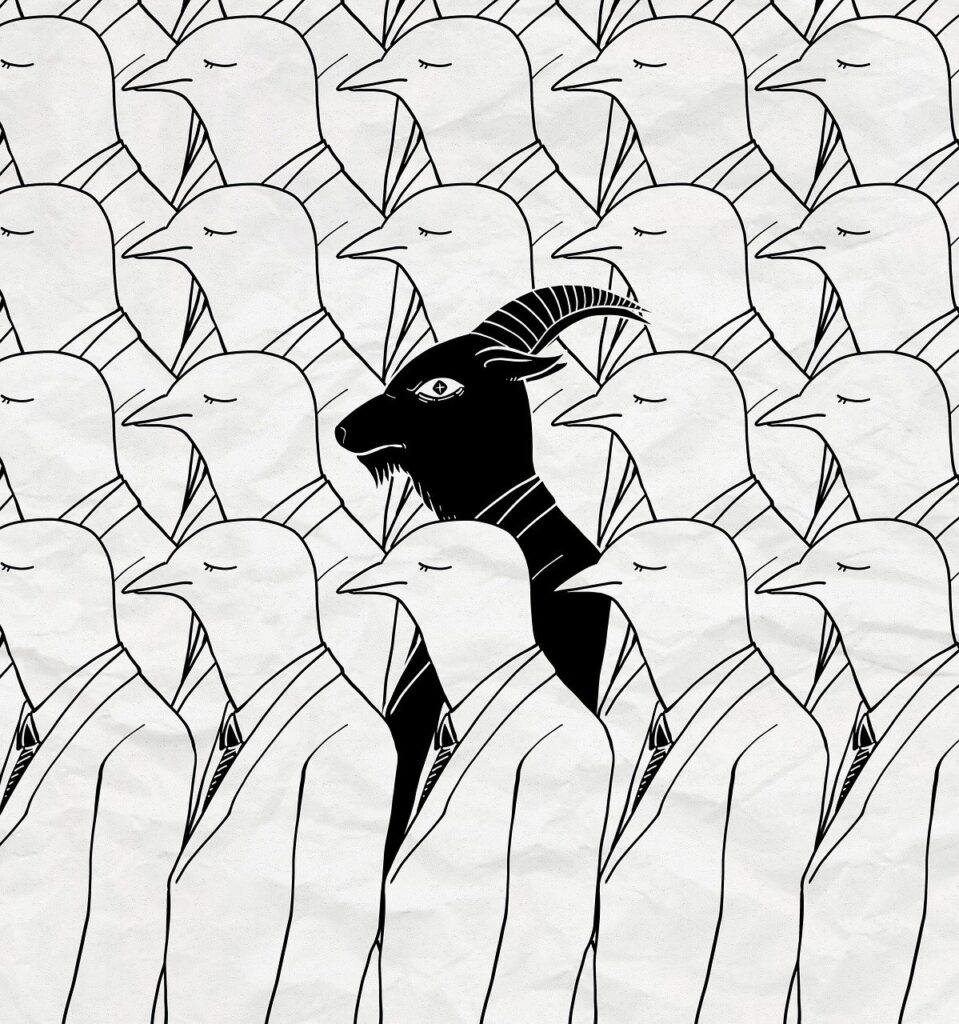
The easiest way to see this human nature at work is to listen to any successful person talk about how others saw them when they started with a contrarian idea.
They're almost always negative at first. They only become positive when they see the idea is actually going to work.
Contrarian ideas make people uncomfortable. They challenge everything people believed, everything they've spent their careers working on.
The best way to deal with this is to play it safe.
If you have an unconventional idea that you think is going to work, it's best to keep it under wraps. Work on it in the shadows until it's undeniable.
If you bring it out too early, the only thing you do is make people uncomfortable, and in return, make them feel small.
So they'll do everything in their power to stop you.
It's best to share your originality only with close friends and the people who genuinely wish the best for you.
Real-World Applications
| The Situation | The Right Move | The Wrong Move |
|---|---|---|
| You're at a company meeting and everyone's excited about a direction you know for a fact that's not going to work. | You nod along, participate constructively, and save your real concerns for a private conversation with the right person later. | You speak up right there about why everyone's wrong, which makes the whole room defensive and now they see you as the negative person who doesn't get it. |
| Your extended family has strong political views you don't share and they bring it up at dinner. | You stay neutral, change the subject smoothly, and keep things pleasant. | You challenge their views and try to change their minds, which just turns dinner into an argument and makes every future gathering awkward. |
| You're starting at a new workplace and you notice they do things differently than you're used to. | You observe how things work, adapt to their style at first, and earn trust before suggesting any changes. | You immediately start explaining how your old company did it better, which makes everyone think you're arrogant and not a team player. |
Favorite quote
The reason arguments do not work is that most people hold their ideas and values without thinking about them. There is a strong emotional content in their beliefs: They really do not want to have to rework their habits of thinking, and when you challenge them, whether directly through your arguments or indirectly through your behavior, they are hostile (p. 322).
Law 46: Never Appear Too Perfect
Insights
What really sells in today's world isn't expertise but vulnerability.
If you sell yourself as perfect and invincible, people come to resent you.
On the other hand, if you admit your struggles, your uncertainties, your mistakes, people come to help you.
Humans are problem-solving machines. If we see a problem, we get attached to it and sympathize with it.
When you appear too perfect, your success punctures others' self-image. They realize they're not as talented or smart as they thought. This stirs up envy and feelings of inferiority. But when you show your flaws, your struggles, your humanity. You deflect that envy. You become relatable instead of threatening.
Greene suggests two ways to deal with other people's envy.
First, we have to accept that there are some people who will surpass us in some way. Instead of being envious, we can turn this energy into something constructive. We can use this as fuel to better ourselves, to surpass them, if that aligns with our goals.
Second, when we surpass other people, we should understand that people behind us will inevitably envy us. They might not show it, but the envy is there, quietly affecting how they treat us. The biggest problems don't happen because you surpass others; they happen because we overlook the fact that they're now envious of us.
The biggest challenge is figuring out where the limit is.
Because if you overdo vulnerability, you'll appear incompetent or needy.
But if you appear to be perfect, nobody will offer help to you.
This balance is unique to each person and depends on both our personality and the environment we're in.
This balance is something we each have to figure out for ourselves.
Real-World Applications
| The Situation | The Right Move | The Wrong Move |
|---|---|---|
| You've consistently delivered excellent results at work and are being considered for promotion over several colleagues. | Occasionally admit to minor challenges you're working through or ask a colleague for input on something outside your main expertise, showing you're still learning. | Present yourself as having everything figured out, never asking questions or acknowledging any area where you could improve. |
| You're hosting a dinner party and pride yourself on your cooking skills, wanting to impress your guests. | Share a lighthearted story about a past cooking disaster or mention one element of tonight's meal that didn't turn out quite as planned. | Make sure everything is absolutely flawless and let guests know how effortlessly perfect everything came together. |
| You're in a creative community where you've been winning most of the recognition and opportunities lately. | Genuinely celebrate others' work, share credit where it's due, and occasionally mention projects that didn't go as you hoped or skills you're still developing. | Constantly showcase your achievements, maintain an image of uninterrupted success, and position yourself as the standard everyone else should aspire to reach. |
Favorite quotes
Only a minority can succeed at the game of life, and that minority inevitably arouses the envy of those around them (p. 402).
Never be so foolish as to believe that you are stirring up admiration by flaunting the qualities that raise you above others. By making others aware of their inferior position, you are only stirring up "unhappy admiration," or envy, which will gnaw away at them until they undermine you in ways you cannot foresee. The fool dares the gods of envy by flaunting his victories. The master of power understands that the appearance of superiority over others is inconsequential next to the reality of it (p. 405).
3. Strategic Moves & Long-Game Planning
Law 3: Conceal Your Intentions
Insights
Transparency is a strategic liability.
When people know what you're after, they can prepare defenses, form counter-strategies, or just use their power to block your path.
Open clarity about your goals paradoxically makes those goals harder to achieve.
Greene separates this law into two parts: Conceal Your Moves and Deception.
Concealing your moves is about strategic silence and misdirection; hiding your true goals. Deception, on the other hand, is about actively fabricating something completely different from your actual goals.
Greene also makes the case about the relationship between speech and power: the more you say, the more likely people will figure out your goals and intentions.
The diplomatic way to put this law into practice is to think about it this way: concealing your intentions frees you from having to justify your actions to other people.
This gives you an edge to correct yourself on your way to achieving your goals without having to deal with external scrutiny.
Real-World Applications
| The Situation | The Right Move | The Wrong Move |
|---|---|---|
| You want to launch a new project at work that needs resources from other teams, and you need people on board. | Talk to people first. Ask about their priorities. Understand what matters to them before you show them your full plan. | Announce everything immediately, every detail, every resource you need. Now the people who don't like it have time to build a case against you before you've built any support. |
| You're thinking about moving to a new city sometime in the next year, but you haven't decided for sure yet. | Keep it to yourself while you explore. Visit places. Figure out if it's actually possible. No external pressure, no commentary. | Tell everyone you're planning to move. Now you're drowning in unsolicited advice, dealing with everyone's reactions, and if you change your mind, you look flaky. |
| You're negotiating something important, a job offer, a project, a big purchase, and you know what you want. | Ask questions. Show interest in understanding what's possible. Don't reveal what matters most to you or what your limits are. | Tell them your bottom line right away. Show them exactly what you need and what you'll settle for. Now you have zero room to maneuver. |
Favorite quote
More important, by being unabashedly open you make yourself so predictable and familiar that it is almost impossible to respect or fear you, and power will not accrue to a person who cannot inspire such emotions (p. 20).
Law 9: Win Through Your Actions, Never Through Argument
Insights
A win you gain through an argument leaves a bitter taste in the other person's mind.
Sooner or later, you'll be challenged because you've hurt the other person's self-esteem.
If you win through your actions, however, you create space for other people to agree with you.
You let them see your expertise through your actions, not by being told by someone else.
To quote from law 37 (Create Compelling Spectacles):
The truth is generally seen, rarely heard (p. 314).
This law is a sub-law to Law 1 because they both have the same argument: Don't let your master feel insecure.
The difference is that this law applies to anybody, including your peers, not just your superiors.
It is not simply a question of avoiding an argument with those who stand above you. We all believe we are masters in the realm of opinions and reasoning. You must be careful, then: learn to demonstrate the correctness of your ideas indirectly (p. 71).
Real-World Applications
| The Situation | The Right Move | The Wrong Move |
|---|---|---|
| Your team doubts your proposed approach to a project. | Implement it on a small scale, show the results, then expand based on what works. | Spend hours in meetings trying to convince them why your approach will work on the long run. |
| Someone criticizes your work method as inefficient. | Keep using your method, deliver quality results on time, and let your track record speak. | Engage in a lengthy debate about why their criticism is unfounded and your way is better. |
| A colleague claims they could do your job better. | Focus on doing excellent work and let your consistent performance show your value. | Argue with them about your qualifications and try to prove why you're more capable. |
Favorite quote
When aiming for power, or trying to conserve it, always look for the indirect route. And also choose your battles carefully. If it does not matter in the long run whether the other person agrees with you, or if time and their own experience will make them understand what you mean, then it is best not even to bother with a demonstration. Save your energy and walk away (p. 73).
We should choose our battles carefully.
Some battles aren't worth fighting for when you consider the winning outcome.
Most of the time, the urge to win an argument just comes from our own ego, even though it doesn't lead to any constructive outcome.
This is our ego at work, trying to make a name for itself.
Law 10: Infection—Avoid the Unhappy and Unlucky
Insights
This one, on the surface, seems downright evil.
But you can frame this law around influence rather than manipulation.
The law connects with the well-known idea that you're the average of the five people you spend the most time with.
If you associate with people who don't share your goals, it's hard to reach them, especially in the long run. You're unconsciously absorbing their attitudes and habits.
The law identifies two types of infected: the unhappy and the unlucky.
The unhappy are pessimists who find something negative in everything. The unlucky draw the wrong card even when they're given the best hand.
Greene's argument is that both types are dangerous, not because they're bad people, but because their behavior is infectious. Eventually, and unconsciously, you'll become them.
Of course, it's your moral obligation to help people get out of their miseries. But it's wise not to make them the pillars of your inner circle or your daily life.
Real-World Applications
| The Situation | The Right Move | The Wrong Move |
|---|---|---|
| A friend constantly complains about their life but never takes action to improve it. | Gently reduce how much time you spend with them while making sure to direct to a path where they can start solving their problems. | Keep spending hours listening to the same complaints, trying to help, and absorbing their negativity. |
| A colleague has been through several projects that failed and is now on your team. | Stay professional but don't become their close collaborator or let their reputation attach to yours. | Partner closely with them and defend them to others, tying your success to theirs. |
| Someone in your social circle always has a volatile presence and seems to attract chaos. | Keep interactions brief and at surface-level, don't get pulled into their problems. | Get deeply involved in their crises and become a part of their personality. |
Favorite quote
Humans are extremely susceptible to the moods, emotions, and even the ways of thinking of those with whom they spend their time (p. 79).
Law 19: Know Who You’re Dealing With—Do Not Offend the Wrong Person
Insights
People rarely show their true self in public. There's always a mask, if not many, that they wear every day.
A person might seem neutral on the surface, but we'll never know how they'd react if we offend them until we do.
Some will shrug it off, but others, some you'd never guess, will come after you.
Knowing who you're dealing with is, therefore, a critical survival skill.
Greene argues that a lot of strategic failures happen because you misjudge who you're dealing with. You assume they'll be reasonable or let things go, but some people just don't work that way.
They hold grudges forever, or they fixate on some small thing you did, and suddenly what seemed like nothing becomes this major ongoing problem.
It takes far less effort to create an enemy than to neutralize one.
So it's better to be on the lookout for different personality types.
These types are:
- The Arrogant and Proud Man
- The Hopelessly Insecure Man(Related to the proud and arrogant type, but harder to spot because more often than not, they are not violent)
- Mr. Suspicious(This is the person who makes their own opinion and worldviews without any facts, and usually has a negative take on everything; this person sees the worst in others.)
- The Serpent with a Long Memory(A person who holds grudges)
- The Plain, Unassuming, and Often Unintelligent Man(This person would not probably hurt you, but they will waste your time and energy)
Greene gives two words of caution when dealing with a situation like this:
First, never rely on instincts. Instead, make time to study the person you're dealing with.
Second, never trust appearances because more often than not, people hide their true selves and put on a mask when dealing with the public.
Real-World Applications
| The Situation | The Right Move | The Wrong Move |
|---|---|---|
| A coworker who holds grudges says something wrong in a meeting. You know the right answer. | Let it go or talk to them privately later. Being right in public isn't worth making them hate you forever. | Correct them in front of everyone. You get to feel smart for two seconds, but now you have an enemy who'll try to mess with you whenever they can. |
| You're negotiating with someone new. They get defensive at every little question and take everything personally. | Be more careful with how you say things in front of them. Stay nice and collaborative so you don't set them off while still getting what you need. | Just negotiate normally like you would with anyone else. You accidentally hurt their feelings and now they want to kill the deal because you bruised their ego. |
| Someone important in your industry makes a choice you think is unwise, and you want to call them out publicly. | Keep your mouth shut or give private feedback. Making enemies with powerful people will hurt you for years, and it's not worth it for one opinion. | Post your criticism publicly. You don't realize they're the type who remembers these things and will quietly block opportunities for you down the road. |
Favorite quote
The ability to measure people and to know who you're dealing with is the most important skill of all in gathering and conserving power. Without it you are blind: Not only will you offend the wrong people, you will choose the wrong types to work on, and will think you are flattering people when you are actually insulting them (p. 143).
Law 23: Concentrate Your Forces
Insights
Bruce Lee once said, "I fear not the man who has practiced 10,000 kicks once, but I fear the man who has practiced one kick 10,000 times."
Focusing your energy on one thing—something you're really good at, at a deeper level—eventually pays off. If not in the short term, definitely in the long term. That beats doing everything else at the surface level.
What is concentrated, coherent, and connected to its past has power. What is dissipated, divided, and distended rots and falls to the ground. The bigger it bloats, the harder it falls (p. 172).
This doesn't only help you. It helps you make a bigger impact on other people's lives, too.
Everything we do is a battle against time. We all have only 24 hours a day.
The danger of doing many things at once isn't just exhaustion. It's invisibility.
When your effort is spread across many things, you become average at everything you do.
And being average means being ignored. You've pushed yourself into the ordinary.
People remember and value singular excellence far more than they appreciate generalists. Depth signals commitment, mastery, and reliability. Breadth often signals lack of conviction.
When you push yourself into the ordinary, you lose your power entirely.
But if all your energy is focused on one thing, sooner or later, people will recognize you for your work. And that recognition gives you power.
Real-World Applications
| The Situation | The Right Move | The Wrong Move |
|---|---|---|
| You're good at design, writing, and coding, and your family and friends expect you to pursue all three. | You pick one, let's say design, and tell people that's what you do now, then spend the next year getting so good that when someone needs design work, your name comes up first. | You keep saying yes to all three because you don't want to close doors, but now you're mediocre at everything and people can't tell what you actually do or why they'd hire you over someone specialized. |
| You're building a side project and you have ideas for three different apps you could make. | You choose the one you care about most and put everything into making it stand out, solving one problem deeply instead of kind of solving three problems. | You split your time between all three, and six months later you have three half-finished apps that don't work well and nobody uses because none of them are good enough to matter. |
| Your company wants you to work on multiple initiatives across different teams to "broaden your impact." | You politely ask to focus your efforts on the one project where you can make the biggest difference, become the critical person there, and let your results speak for themselves. | You agree to spread yourself thin, deliver okay work on everything, and end up with no ownership or recognition because you weren't essential to any single outcome. |
Favorite quote
"I have always believed," he later wrote, "that when a man gets it into his head to do something, and when he exclusively occupies himself in that design, he must succeed, whatever the difficulties. That man will become Grand Vizier or Pope." (p. 175)
Law 28: Enter Action with Boldness
Insights
People react naturally to our energy much more than to our actual competence.
It shouldn't be this way, but Greene suggests that this is human nature, whether we like it or not.
This is the premise this law is based on.
Here's how people use this principle to influence others and how it works in practice.

The Bolder the Lie, the Better – When you lie boldly, the sheer audacity makes it more believable because people can't imagine someone would be that brazen if it wasn't true. Adolf Hitler is a good example of this. He even had the quote: "The broad masses of a nation are always more easily corrupted in the deeper strata of their emotional nature than consciously or voluntarily; and thus in the primitive simplicity of their minds they more readily fall victims to the big lie than the small lie."
Lions Circle the Hesitant Prey – Weakness attracts aggression. When you hesitate or show you're willing to back down, you invite people to push you around.
Boldness Strikes Fear; Fear Creates Authority – A bold move makes you seem bigger and more powerful than you are, and it intimidates people into being defensive around you.
Going Halfway with Half a Heart Digs the Deeper Grave – If you attempt something without full commitment, you create confusion and obstacles for yourself that wouldn't exist if you just went all in.
Hesitation Creates Gaps, Boldness Obliterates Them – When you pause to think, you give others time to think too, which creates awkward energy and doubt. Boldness leaves no room for reflection.
Audacity Separates You from the Herd – Being bold makes you stand out and get noticed, while timid people fade into the background and are forgotten.
Real-World Applications
| The Situation | The Right Move | The Wrong Move |
|---|---|---|
| You have an idea for an initiative that you know will work, but not sure how others would see it. | You present it with conviction, explain why it matters, and ask for the resources to try it out. | You hedge every sentence with "maybe" and "I'm not sure but," which makes people think you don't believe in it, so they don't either and the idea dies before you even test it. |
| You're launching a side project and you're scared nobody will care about it. | You put it out there like it's already successful, talk about it confidently, and act like of course people will want this. | You apologize for it before anyone even sees it, say things like "it's probably not good but," and now people expect it to be bad before they even look. |
| You need to ask for a raise but you're worried they'll say no. | You walk in, state what you want clearly, and explain why you've earned it, no apologizing, no softening the ask. | You start with "I know this might not be a good time" and "if it's too much I understand," which tells them they can say no easily and you won't push back. |
Favorite quote
If boldness is not natural, neither is timidity. It is an acquired habit, picked up out of a desire to avoid conflict. If timidity has taken hold of you, then, root it out. Your fears of the consequences of a bold action are way out of proportion to reality, and in fact the consequences of timidity are worse (p. 234).
Law 29: Plan All the Way to the End
Insights
Knowing what your end goal is benefits you in two ways.
First, if we know what we want and have planned until the end, no matter what obstacles we face, we're always in control because we have our eyes on the prize.
When competitors make a move on you, when the market changes, we know exactly what to do because we know where we want to be. We have a clear-cut target in mind.
What good is it to have the greatest dream in the world if others reap the benefits and the glory? Never lose your head over a vague, open-ended dream—plan to the end (p. 239).
Second, and most importantly, we know when to stop.
Knowing when to stop is important because most failures happen not at the beginning or the middle but at the end.
People run out of resources and energy trying to achieve a goal that keeps shifting in ways that don't stick.
Most men are ruled by the heart, not the head. Their plans are vague, and when they meet obstacles they improvise. But improvisation will only bring you as far as the next crisis, and is never a substitute for thinking several steps ahead and planning to the end (p. 239).
There is a simple reason why most men never know when to come off the attack: They form no concrete idea of their goal. Once they achieve victory they only hunger for more (p. 240).
It's better to quit while you're winning.
The goal should be accompanied by a well-thought-out strategy that accounts for multiple scenarios.
This is how success works: the difference between winners and losers isn't just talent or the momentum they build at the beginning of the venture, but the ability to hold steady through the obstacles in the middle stages and navigate the complexity of completion.
Real-World Applications
| The Situation | The Right Move | The Wrong Move |
|---|---|---|
| You're starting a big project at work with a tight deadline. | Map out all the phases, identify dependencies, and build in buffer time for unexpected problems before you start. | Dive in enthusiastically, figure you'll handle problems as they come up, and realize it's too late and you're stuck. |
| You're thinking about a major purchase that stretches your budget. | Calculate not just the purchase price but ongoing costs, maintenance, and what happens if your income changes. | Focus on whether you can afford it right now without thinking through the full financial commitment over time. |
| You're planning to confront someone about a difficult issue. | Think through how they might respond, what you'll say to different reactions, and what outcome you're willing to accept. | Prepare how you're going to open the conversation but not the full conversation, getting caught off guard by their responses. |
Favorite quotes
So much of power is not what you do but what you do not do—the rash and foolish actions that you refrain from before they get you into trouble. Plan in detail before you act—do not let vague plans lead you into trouble (p. 242).
The ending is everything. It is the end of the action that determines who gets the glory, the money, the prize (p. 242).
Law 30: Make Your Accomplishments Seem Effortless
Insights
When someone appears to be working so hard, it doesn't make them look diligent and honest; it makes them look weak, as if anyone who practiced and worked at it could do what they do.
When you reveal the inner workings of your creation, you become just one more mortal among others (p. 251).
Instead, when someone performs at the highest level without seeming to make much effort, it gives them a godlike appearance. People start to wonder: if they can do such a hard task with such ease, what could they achieve when they try their best?
This, of course, doesn't mean that people who achieve great things do them effortlessly. But they've made the choice not to let the inner work show.
A good example of this is tennis legend Roger Federer.
After his retirement, in his 2024 commencement address at Dartmouth, Federer says:
"I realized winning effortlessly is the ultimate achievement. I got that reputation because my warmups at the tournaments were so casual that people didn't think I'd been training hard, but I had been working hard before the tournament when nobody was watching."
He continues: "Effortless is a myth. I mean it. I say that as someone who has heard that word a lot. Effortless. People would say my play was effortless. Most of the time, they meant it as a compliment, but it used to frustrate me when they would say, 'He barely broke a sweat,' or, 'Is he even trying?' The truth is I had to work very hard to make it look easy."

However, this law seems to contradict Law 34 (Be Royal in Your Own Fashion—Act Like a King to Be Treated Like One).
Instead of hiding the hard work, Law 34 is built around the idea that power is gained by doing the complete opposite; by showing it all.
And both of these approaches give you a tremendous amount of power.
However, studying these two laws closely, there's no contradiction because this list of laws isn't about "what works" but "what kind of power do you want to build around you?"
In that regard, if someone wants to associate themselves with king-like power (prestige), Law 34 serves them well. But if they want to appear with godlike power (ghost), this law (Law 30) is the way to go.
These different power types are discussed in detail in the "Power Types" section.
Real-World Applications
| The Situation | The Right Move | The Wrong Move |
|---|---|---|
| You deliver a polished presentation after days of preparation. | Present it smoothly, handle questions with ease, and don't mention how much time you spent preparing. | Talk about how many hours you worked on it and all the versions you went through before getting it right. |
| You solve a complex problem that others struggled with. | Walk through the solution clearly and make it seem logical and straightforward. | Emphasize how difficult it was, how many failed attempts you had, and how close you came to giving up. |
| Someone compliments your cooking after you spent all day on a meal. | Thank them warmly and talk about how much you enjoy cooking, not how exhausting it was. | Detail every challenging step, the recipe you followed three times, and how stressed you were about timing. |
Favorite quote
The more mystery surrounds your actions, the more awesome your power seems. You appear to be the only one who can do what you do—and the appearance of having an exclusive gift is immensely powerful. Finally, because you achieve your accomplishments with grace and ease, people believe that you could always do more if you tried harder. This elicits not only admiration but a touch of fear. Your powers are untapped—no one can fathom their limits (p. 252).
Law 35: Master the Art of Timing
Insights
Power is gained not just by what we do, but also when we do it. Timing matters.
Always seeming to be in a hurry signals to others that we're volatile and insecure.
Instead, being patient and making the right move at the right time rewards you with both the prize and, ultimately, the power that comes with it.
There are three key lessons to master the art of timing:
Lesson 1: You must always work with the times, anticipate twists and turns, and never miss the boat.
Lesson 2: Rather than ride the resting wave of the moment, wait for the tide's ebb to carry you back to power.
Lesson 3: Without patience as your sword and shield, your timing will fail and you'll inevitably find yourself a loser.
There are three kinds of time we come to deal with and should handle with care:
The Long Time: The drawn-out, years-long kind of time that must be managed with patience and gentle guidance.
The Forced Time: The short-term time we can manipulate as an offensive weapon, upsetting the timing of our opponents.
The End Time: Time when a plan must be executed with speed and force. We've waited, found the moment, and must not hesitate.
Real-World Applications
| The Situation | The Right Move | The Wrong Move |
|---|---|---|
| You want a promotion but the company is going through restructuring. | Wait patiently, keep continuously delivering strong work, and ask when things stabilize back again. | Push for the promotion now when budgets are frozen and leadership is distracted. |
| A colleague keeps interrupting you in meetings and you want to address it. | Catch them right after they do it next time and have a quick, direct conversation. | Wait weeks to bring it up formally, or interrupt them back to teach them a lesson. |
| You've been building a relationship with a potential client for months and they finally ask about working together. | Move immediately with a clear proposal while their interest is hot. | Say you'll get back to them in a few weeks, or act unsure about whether you're ready. |
Favorite quote
Power rarely ends up in the hands of those who start a revolution, or even of those who further it; power sticks to those who bring it to a conclusion (p. 292).
Law 36: Disdain Things You Cannot Have—Ignoring Them Is the Best Revenge
Insights
Losses become louder when we point at them.
Some goals aren't possible to achieve at all.
If we know for certain that we can't have something, the worst thing we can do is draw attention to our failure and disappointment.
This law applies not only to goal setting but also to dealing with people. If someone, especially a superior, openly criticizes us, how people react to it—including the offender—depends on how we react to it.
We can easily choose not to notice the irritating offender and make it seem like we weren't bothered by it at all.
This act signals confidence, and confidence breeds power.
It's up to us to let things bother us.
People react to your energy, not necessarily to your raw competence.
There are two approaches to deal with people and situations like this:
Sour-grapes approach: If there's something you want but realize you can't have, the worst thing you can do is draw attention to your disappointment by complaining about it.
Look-away approach: When you're attacked by an inferior, deflect people's attention by making it clear the attack hasn't even registered. Look away, or answer sweetly, showing how little the attack concerns you.
Real-World Applications
| The Situation | The Right Move | The Wrong Move |
|---|---|---|
| You applied for a job you really wanted, but someone else got it. Now everyone at work keeps asking how you feel. | Keep it casual and change the subject. Show them this one job doesn't define who you are. | Get defensive or say "I didn't really want it anyway." This just shows everyone you're actually hurt about not getting it. |
| A coworker who's jealous of you makes a snide comment during a meeting. | Stay calm and act like their comment didn't even register. Maybe smile a little. | Get angry, defend yourself, or look annoyed. This shows them their comment actually got to you. |
| A friend group leaves you out of something you wanted to be part of. | Move on like it's no big deal and focus your time on other things. Act like it doesn't matter. | Ask them why they excluded you or confront someone about it. This just proves you care way more than you want them to know. |
Favorite quote
Contempt is a dish that is best served cold and without affectation (p. 307).
Law 48: Assume Formlessness
Insights
In this final law, Greene points out the volatility of the laws themselves.
Nothing is certain. Everything changes from one minute to the next.
If we can't adapt to them, if our strategy is fixed, sooner or later, we'll be left behind.
In the movie World War Z, Brad Pitt's character, Gerry Lane, says to a family who temporarily gave them a place to stay: "Movimiento es vida" (movement is life).
People who move survive. Those who don't, well, anyone who's watched the movie knows what happens next.
People weighed down by a system and inflexible ways of doing things cannot move fast, cannot sense or adapt to change. They lumber around more and more slowly until they go the way of the brontosaurus. Learn to move fast and adapt or you will be eaten (page 422).
We, of course, don't live in a zombie land, but this insight is very much applicable to our everyday life.
Change is chance.
If we're not flexible enough to adapt, to become intuitively unpredictable, others will anticipate our moves, figure out our patterns, and neutralize our power.
When we're powerless, it's really hard to get ourselves back up.
But it's important to make the distinction between formlessness and going with the flow. Formlessness is a tool. It's best used when we need to hold on to our power, not just to create inner harmony or peace.
Real-World Applications
| The Situation | The Right Move | The Wrong Move |
|---|---|---|
| Your company's main product is showing signs the market is changing. Competitors are doing things differently. | Pay attention to what's changing. Try new things. Be ready to change direction even if the old way still kind of works. | Keep doing what made you successful before and say "this is just who we are." Then watch your competitors steal your customers while you're stuck doing things the old way. |
| You've built your career around one skill, but you notice the industry is moving toward something new. | Start learning the new skill now while you still have time, even if it means your main skill might not matter as much anymore. | Fight the change and insist your way is better. This works until it doesn't, and now you're way behind everyone who learned the new thing early. |
| You have a work routine that's always worked well, but now you're in a new situation that needs a completely different approach. | Change how you work to fit the new situation, even if it feels weird. The goal matters more than sticking to what you like. | Keep doing what you've always done because it worked before. You don't realize that forcing your old way onto a new problem is exactly why it's failing. |
Favorite quote
In the evolution of species, protective armor has almost always spelled disaster. Although there are a few exceptions, the shell most often becomes a dead end for the animal encased in it; it slows the creature down, making it hard for it to forage for food and making it a target for fast-moving predators. Animals that take to the sea or sky, and that move swiftly and unpredictably, are infinitely more powerful and secure (p. 421).
4. Conflict Mastery & Staying Untouchable
Law 15: Crush Your Enemy Totally
Insights
Conflicts rarely fade on their own. Half measures just pause issues but don't end them. Better to go all the way.
But we don't have to take this law at face value, to destroy someone.
Ending a conflict "totally" in normal life simply means bringing something to a real conclusion instead of letting it hang in the air.
If there's a conflict with a coworker, a business partner, or a friend, the best thing to do is to talk it out and completely resolve it so that it won't come back later and poison the relationship.
That said, this law echoes what Law 19 suggests: know who you're dealing with—don't offend the wrong person.

Vladimir Schetinin, the former head of Inspection Tiger and an expert on Amur tiger attacks on the Siberian border of Russia, says:
“There are at least eight cases that my teams and I investigated, and we all arrived at the same conclusion: if a hunter fired a shot at a tiger, that tiger would track him down, even if it took him two or three months.” (p. 138, The Tiger by John Vaillant)
We interact with people like this in real life. They're like tigers. They'll hunt you down if you've offended them at some point.
It's best to keep your distance with such people. There's nothing to gain by winning a battle against someone who's that bitter anyway.
To let him go would be like rearing a tiger—it will devour you later (p. 109).
Real-World Applications
| The Situation | The Right Move | The Wrong Move |
|---|---|---|
| A coworker you’ve had ongoing tension with keeps reopening old disagreements long after you thought things were settled. | Close the issue cleanly and finally, so there’s nothing left for them to poke at. | Leave the problem half-resolved and let the old conflict keep resurfacing in small ways. |
| A friend you’ve drifted from continues to bring up past arguments whenever you talk to them. | Draw a clear line, either reset the relationship or let it end, so the cycle stops. | Maintain a vague, strained middle ground that keeps the resentment alive for the long run. |
| A rival in a group setting habitually undermines you, even after you've tried to make peace with them. | Create firm boundaries that leave no space for the old dynamic to resurface. | Keep patching things up lightly and let them chip away at you again later. |
Favorite quote
There will be people you cannot win over, who will remain your enemies no matter what. But whatever wound you inflicted on them, deliberately or not, do not take their hatred personally. Just recognize that there is no possibility of peace between you, especially as long as you stay in power (p.113).
Law 16: Use Absence to Increase Respect and Honor
Insights
Here's what Denzel Washington has to say about Daniel Day-Lewis in Grey Goose's "OFF SCRIPT" series where Jamie Foxx interviews him (Timestamp: 6.30).
Foxx: Do you think that some of the actors and actresses that are, you know, constantly saying, “Come see me. Come see me.” Do you think that's a mistake?
Washington: I think if you drink too much water you'll drown.
You wanna keep some mystery, keep things quiet so that you build up to that next movie. “Where is he?” I mean, when's the last time you saw Daniel Day-Lewis?
Branding for an actor is being good, not being known. Your brand is whatever you did, was it any good? Now how many “likes” you got.

But it's equally important to work so hard behind the curtain that when the curtains finally open, you make sure you're one of the best, if not the best to ever do it.
And this is why Daniel Day-Lewis is the best example of this. Being a three-time Academy Award winner, he lets others know he's the best at what he does and then disappears; hardly any interviews, rarely makes public appearances, and protects his privacy fiercely.
Here are two other examples of people who used this law to their advantage:
J.D. Salinger, the author of The Catcher in the Rye
After The Catcher in the Rye turned him into an overnight sensation, he suddenly stepped out of public life, moving to a remote New Hampshire farmhouse, refusing interviews, declining film deals, and eventually stopping publication altogether. Strangely, the more he made himself elusive, the larger he became, the more books he sold.
He turned himself into a myth and turned it into profit.
The Catcher in the Rye spent 30 weeks on the New York Times bestseller list and has gone on to become a global publishing phenomenon: lifetime sales are estimated to be about 65 million copies, and about 200,000 copies are still sold in the US every year.
Luke Nichols, YouTube channel Outdoor Boys
From very early on, Luke closed the comment section for his YouTube videos, which isn't what most creators would do. At first glance, it seems like people would stop engaging, but his content is so good that viewers still want to talk about it. Now that they can't do it under the video, they head elsewhere to discuss it. This actually spreads the channel even more: more people discover it through those side conversations happening everywhere else. In hindsight, his growth would've been slower if the comments had been left open.
Absence, in this case, created more value.
As mentioned before, it's really important to remember that this law only works in your favor if you're already good at what you do.
This means that for someone just starting out any venture or career, this strategy won't work.
In the beginning, make yourself not scarce but omnipresent. Only what is seen, appreciated, and loved will be missed in its absence (p. 122).
Real-World Applications
| The Situation | The Right Move | The Wrong Move |
|---|---|---|
| You’ve spent months being omnipresent, helping, showing up, contributing for a group event, and you sense people have begun to take your presence for granted. | Step back briefly so your absence highlights the value you quietly built through consistent presence. | Keep inserting yourself everywhere until people see you as background noise rather than someone whose presence matters. |
| Your social group expects you at every gathering and now barely notices when you’re there. | Skip a couple of events so your return feels intentional, not automatic. | Keep showing up out of habit and let your presence fade into routine invisibility. |
| At work, you’re the dependable go-to person, but colleagues now assume you’re always available. | Create selective distance, a day off, quieter weeks, fewer open-door moments, to reset expectations. | Remain constantly accessible, reinforcing a dynamic where others feel entitled to your time. |
Favorite quote
"Love never dies of starvation," she wrote, "but often of indigestion"(p. 119)
Law 17: Keep Others in Suspended Terror—Cultivate an Air of Unpredictability
Insights
People are creatures of habit. And we expect the same behavior from others to feel connected, to become familiar. But this, in return, lowers your power.
If your work is routine and predictable, they lose their wariness and begin to take you for granted. Your predictability gives them a sense of control over you.
Because predictability signals that you can be easily manipulated.
On the other hand, when people can't anticipate your next move, they naturally become wary of you. They always give you the benefit of the doubt.
So the terror isn't created by you. It's created by themselves for themselves.
To keep power intact and sustaining, practice routine unpredictability. That is, break your routine once in a while, or respond in a way that seems out of character.
Like Law 16, this law works best when you've built a certain reputation around you. When you're in a subordinate position, what your superiors expect from you is reliability more than anything else. This is the reversal of the law.
The best calculation is the absence of calculation. Once you have attained a certain level of recognition, others generally figure that when you do something, it's for an intelligent reason. So it's really foolish to plot out your movements too carefully in advance. You're better off acting capriciously (p. 127).
Real-World Applications
| The Situation | The Right Move | The Wrong Move |
|---|---|---|
| You're leading a team that's gotten too comfortable with how you work. Deadlines keep getting missed. | Mix things up. Be really direct in one meeting, then surprisingly calm and laid back in the next. Keep them on their toes. | Do everything the exact same way every time. Your team knows exactly how you'll react, so they know how much they can slack off and when they need to fix it. |
| You're negotiating with someone who's trying to figure out your strategy. They're waiting for you to give in like you usually do. | Surprise them. Stand firm on something unexpected or change what you care about most. Make it hard for them to predict what you'll do. | React exactly like you always do. They can predict every move you'll make and plan their whole strategy around how predictable you are. |
| You're in a creative field where people expect a certain style from you. | Sometimes drop work that's different from what people expect. Take your craft in a new direction. Keep your audience interested and guessing. | Give people exactly what they expect every single time. Your work becomes so predictable that people stop paying attention because they already know what you're going to do. |
Favorite quote
One master said, "He doesn't just look for the best move. He looks for the move that will disturb the man he is playing" (p. 125).
Law 18: Do Not Build Fortresses to Protect Yourself—Isolation Is Dangerous
Insights
The world is changing at an increasing rate. Being overly conservative about this and completely isolating yourself makes us vulnerable.
After all, power isn't something we hold for ourselves; it's something other people hold for us.
If we're not in sync with others, there's no power to even begin with.
Freedom isn't necessarily power.
When we make a point to get continuous feedback, on the other hand, we have a better chance of being successful at whatever we do, and therefore keep the power in our hands.
A good example of this is how Andy Weir wrote one of the most popular sci-fi books in history.

Ten years before The Martian became a big hit, Andy Weir started a small blog and began writing the chapters of the book as blog posts.
Over the years, he accumulated roughly 3000 subscribers.
Once he published a chapter, the subscribers would give him their feedback—mostly minor but very important for making the book enjoyable.
Then he'd make these changes to the chapter.
Because of this feedback loop, he says: "The book was pretty solid by the time it was done."

The Martian became a huge hit and eventually a movie. With the same momentum, now knowing what works, he wrote another even more popular book, Project Hail Mary, which is again being made into a movie that's set to release in 2026.
Keeping ourselves in the loop, understanding the dynamic nature of social trends, gives you a competitive edge rather than being completely isolated and working so hard on something that might be out of trend by the time it's done.
Real-World Applications
| The Situation | The Right Move | The Wrong Move |
|---|---|---|
| You got exhausted by workplace politics and now you want to avoid everyone and stop having casual conversations with coworkers. | Keep talking to people, but be smarter about it. Stay connected but think more carefully about what you tell people and who you trust. Use these relationships to know what's going on. | Pull away completely. Only talk to people when you absolutely have to. Cut yourself off from the informal networks where you'd hear about opportunities or problems before they hit you. |
| You're going through a tough personal time and feel overwhelmed by everyone's opinions and social pressure about what you should do. | Take some time for yourself, but keep your closest people in the loop. Be honest that you need space without completely disappearing from their lives. | Cut everyone off, friends and family. Think that being totally alone is the only way to think straight. You lose the outside perspectives and support that could actually help you figure things out. |
| You're writing a book and wondering if you should share early chapters or ideas publicly to get feedback before you publish. | Show your work to people you trust or a small group. Get their feedback to make the book better and stay connected to what your audience actually cares about. | Don't show anyone anything until the book is 100% done and published. Work completely alone and miss the chance to test your ideas, catch mistakes, or get people excited about what you're working on. |
Favorite quote
The danger for most people comes when they feel threatened. In such times they tend to retreat and close ranks, to find security in a kind of fortress. In doing so, however, they come to rely for information on a smaller and smaller circle, and lose perspective on events around them. They lose maneuverability and become easy targets, and their isolation makes them paranoid (p. 134).
Law 22: Use the Surrender Tactic—Transform Weakness into Power
Insights
Sometimes, yielding is the better strategy than resisting.
When we hit a wall, have no other options in our favor, we still feel the urge to keep going for honor's sake.
But this only makes us weaker.
When you're weak, there's nothing to gain by fighting a useless fight. No one comes to help the weak.
Surrendering, on the other hand, gives you time to recover, time to refocus, and time to plan your next move.
Also, this makes others think you've given up.
And this creates a sense of control for you because others don't know what your next step is—you've become unpredictable.
Real-World Applications
| The Situation | The Right Move | The Wrong Move |
|---|---|---|
| Your manager wants to go in a direction you think won't work, but they're set on it and have backing from above. | You share your thoughts once, make it clear, then execute their plan, and if things go wrong later, you're ready with your original approach. | You keep pushing back and turn it into an argument, which just makes you look difficult and the manager defensive, even if you're right about the matter. |
| A colleague takes credit for your idea in a meeting and everyone just accepts it. | You let it slide right there, then reach out to the key people later and share your work directly so they see what you actually did. | You call them out in front of everyone, which makes the whole room uncomfortable. |
| You're negotiating with someone who has way more leverage than you and they're making demands you can't meet. | You give in on what matters to them while keeping what's most important to you, which builds trust for when you need something later. | You refuse to go in and either hit a wall or get forced into something worse, and now there's no room to fix anything. |
Favorite quote
Power is always in flux—since the game is by nature fluid, and an arena of constant struggle, those with power almost always find themselves eventually on the downward swing. If you find yourself temporarily weakened, the surrender tactic is perfect for raising yourself up again—it disguises your ambition; it teaches you patience and self-control, key skills in the game; and it puts you in the best possible position for taking advantage of your oppressor's sudden slide. If you run away or fight back, in the long run you cannot win. If you surrender, you will almost always emerge victorious (p. 169).
Law 32: Play to People’s Fantasies
Insights
Nobody has a perfect life. We're always worried about something.
So people are always trying to find ways to relieve their anxieties.
Being a source of pleasure makes people automatically like you.
The law shows how people use this to manipulate others and gain power.
Greene discusses four cases where people create a fantasy by bending reality.
Case 1
The Reality: Change is slow and gradual. It requires hard work, a bit of luck, a fair amount of self-sacrifice, and a lot of patience.
The Fantasy: A sudden transformation will bring a total change in one's fortunes, bypassing work, luck, self-sacrifice, and time in one fantastic stroke.
Case 2
The Reality: The social realm has hard-set codes and boundaries. We understand these limits and know that we have to move within the same familiar circles, day in and day out.
The Fantasy: We can enter a totally new world with different codes and the promise of adventure.
Case 3
The Reality: Society is fragmented and full of conflict.
The Fantasy: People can come together in a mystical union of souls.
Case 4
The Reality: Death. The dead cannot be brought back, the past cannot be changed.
The Fantasy: A sudden reversal of this intolerable fact.
It's important to understand that this is what politicians, advertisers, and cult leaders do to manipulate reality so that we can stay away from them.
Real-World Applications
| The Situation | The Right Move | The Wrong Move |
|---|---|---|
| You're pitching a new project to your team and they're burned out from the last one that took forever. | You frame it as a fresh start with a clear path and quick wins, make it feel like this time will be different and more exciting. | You lay out all the realistic challenges and timeline issues upfront, which just reminds them how hard it's going to be and kills their enthusiasm before you even start. |
| You're helping a friend who's frustrated with their career progress and feeling stuck. | You focus on the possibility of change and help them imagine what could be different, giving them hope and energy to take action. | You tell them the honest truth that it'll take years of grinding and most things won't work out, which just makes them feel worse and doesn't help them move forward. |
| You're launching a product and people are tired of the same old solutions in your space. | You position it as a breakthrough that solves the problem in a new way, making them feel like this is what they've been waiting for. | You explain that it's basically the same as other products but with minor improvements, which gives them no reason to care or try something different. |
Favorite quote
To gain power, you must be a source of pleasure for those around you—and pleasure comes from playing to people's fantasies (p. 266).
Law 39: Stir Up Waters to Catch Fish
Insights
Anger and intense emotions are always counterproductive.
The calmest person is always the most powerful person in the room.
Now, the law shows what would happen if you go one step further—trying to make someone else lose their composure so they reveal their true self in return.
The first question is: should we do this at all? What are the benefits of stirring up emotions?
There is a benefit to this.
By knowing who we're actually dealing with, we gain the opportunity to protect ourselves and make better decisions.
The second question is: this is productive, but is there a way to do this in a non-manipulative way?
There is, and that's by applying Law 4: always say less than necessary.
You don't stir the water. You just wait until the fish comes to you.
Why does this work?
When we don't speak, when we say the absolute minimum, it immediately puts us in a position of power. And in return, this makes people uncomfortable and confused.
They try to fill your silence with their projection of you.
Through this projection, for a brief time, they show their true self.
Because how can someone project something that's not from their original self?
The mask that most people wear comes off at this moment.
So when someone is frustrated and becomes explosive, we have to keep in mind that it's not a reflection of you but a projection of them.
This is done, of course, not to manipulate somebody but to understand someone's true intentions—to know who you're actually dealing with.
Real-World Applications
| The Situation | The Right Move | The Wrong Move |
|---|---|---|
| You're negotiating with someone and you suspect they're not being fully honest about their constraints. | You calmly ask a question that challenges their story, then stay quiet and let them fill the silence, often they'll reveal more when they feel pressured to explain. | You accept their story at face value and negotiate from there, missing the real information about what they actually need and what they're willing to give. |
| Someone at work keeps taking credit for team ideas and you need to understand their motivations. | You praise them publicly for something specific, then watch how they react, whether they return the credit or eagerly accept it tells you a lot about their character. | You ignore it and hope it stops, which means you never really understand what's driving their behavior or how to address it effectively. |
| You're trying to gauge whether a potential business partner is reliable under pressure. | You introduce a small complication or constraint early in the relationship and see whether they stay composed or immediately get defensive or volatile. | You assume they'll handle pressure well because they seem professional in easy situations, then discover too late they fall apart when things get difficult. |
Favorite quote
If a person explodes with anger at you (and it seems out of proportion to what you did to them), you must remind yourself that it is not exclusively directed at you—do not be so vain (p. 329).
Law 40: Despise the Free Lunch
Insights
The valuable components of power are independence and flexibility to do whatever we want.
If you pay half price, we lose both of them, and so the power itself.
There are two fundamental properties of money:
First, money has to be circulated to gain power. Because what money can buy, in order to gain power, isn't things but people's loyalty.
Second, the key property of a gift is to make sure that the one who receives it is an equal at the very least.
Some of the self-destructive personality types who don't understand this and end up losing their power are:
The Greedy Fish: The ones who only care about money and will do any wrongdoing to get it, so eventually nobody wants to work with them. They end up alone and easy targets for scams.
The Bargain Demon: The ones who waste hours trying to save a few bucks and obsess over whether they could've gotten something even cheaper. In return, they lose most of the bargains and lose money in the long run.
The Sadist: The ones who use money to control other people, thinking that giving someone money means they can treat others however they want.
The Indiscriminate Giver: The ones who give to everyone because they desperately need to be loved. But since they give to everyone, they end up holding no power because they appear to be common.
Real-World Applications
| The Situation | The Right Move | The Wrong Move |
|---|---|---|
| A coworker offers to "help" with your project but later expects to have a say in your decisions. | Realize that "free" favors usually come with hidden costs. | Take the help thinking they're just being kind. |
| Someone gives you a free shortcut for something you've been struggling with. | Notice that shortcuts often make you dependent on them or stop you from actually learning how to do it yourself. | Use the shortcut without thinking about what strings might be attached later. |
| A friend always insists on paying for everything when you hang out, and it starts feeling out of place. | See that when someone keeps giving you stuff, it quietly changes who has power in the relationship. | Assume their generosity is totally innocent with no future expectations. |
Favorite quote
The more your gifts and your acts of generosity play with sentiment, the more powerful they are. The object or concept that plays with a charged emotion or hits a chord of sentiment has more power than the money you squander on an expensive yet lifeless present (p. 344).
Law 45: Preach the Need for Change, but Never Reform Too Much at Once
Insights
Human beings are creatures of habit.
We find comfort in the familiar, even though we continuously improve ourselves to become better, to change.
Because of this, a sudden change makes us uncomfortable.
There's always a gap between rational arguments and emotional acceptance of them.
The one who gains the most power is the one who bridges this gap in other people's minds.
The best way to do it, to bridge that gap, is by doing it slowly.
It has to be gradual, and most importantly, it has to align with the old ways—at least at first—to make a smooth transition and not make people uncomfortable.
Real-World Applications
| The Situation | The Right Move | The Wrong Move |
|---|---|---|
| You get promoted to lead a team that's been doing things the same way for the longest time. You can see many opportunities to change. | Point out what they're already doing well, then introduce one new process at a time. Frame it as making their good work even better. | Show up your first week and announce you're changing everything. Tell them the old ways are wrong and force completely new systems on them all at once. |
| Your family has always had holidays at your parents' house, but it's become an issue for everyone as lives have changed and they live in different places. | Suggest trying one holiday at your place as a test run. Make it clear you're keeping all the traditions everyone loves, just at a different location. | Tell everyone the old way doesn't work anymore and demand you start rotating houses immediately. |
| You're teaching a workshop and people are stuck using methods that don't really work and hold them back. | Show them one new technique that fits with what they already know. Explain how it makes their current approach better, not how it replaces it. | Tell them everything they learned before is not working and they need to throw it all away and only use your system instead. |
Favorite quotes
Change can be pleasant and even sometimes desirable in the abstract, but too much of it creates an anxiety that will stir and boil beneath the surface and then eventually erupt (p. 394).
The past is powerful. What has happened before seems greater; habit and history give any act weight. Use this to your advantage (p. 396).
A new scientific truth does not triumph by convincing its opponents and making them see the light, but rather because its opponents eventually die, and a new generation grows up that is familiar with it (p. 398).
Law 47: Do Not Go Past the Mark You Aimed For—In Victory, Learn When to Stop
Insights
Victory, when not controlled, can easily be the beginning of defeat.
You work so hard to climb up a hill and finally get there. You get a sense of release, and with that quickly follows a sense of pride and arrogance.
This, in return, pushes you past the goal to achieve more with the same momentum.
The problem with this is that if we try to climb another hill the same way we climbed the first one, we become common and predictable.
Once we become predictable, once others learn how to predict our next move, we inevitably lose the power we gained from the first victory.
So the one who holds the power is the one who knows when to stop, recompose, and climb the next hill with a different set of goals and a different approach.
When you attain success, step back. Be cautious. When you gain victory, understand the part played by the particular circumstances of a situation, and never simply repeat the same actions again and again. History is littered with the ruins of victorious empires and the corpses of leaders who could not learn to stop and consolidate their gains (p. 412).
Real-World Applications
| The Situation | The Right Move | The Wrong Move |
|---|---|---|
| You won an argument with your partner and they've admitted you were right. | You accept it gracefully, maybe even acknowledge something they got right too, and let it end there so nobody feels hurt. | You keep explaining why you were right and bring up other times you were right, which turns their concession into resentment and starts a new fight. |
| Your team delivered a successful project and now leadership is asking what else you can take on. | You're honest about capacity limits and consolidate the win instead of immediately volunteering for three more things while you're riding high. | You say yes to everything because you feel unstoppable right now, then burn out your team and fail at the new projects, erasing the goodwill you gained from the success. |
| You negotiated a good deal and the other side agreed to most of what you wanted. | You close it there and build the relationship, knowing you'll work with them again and they need to feel okay about the outcome. | You push for one more concession just because you think you can get it, which makes them regret the deal and look for ways to back out or never work with you again. |
Favorite quote
As they say in riding school, you have to be able to control yourself before you can control the horse (p. 415).
5. Reinvention & Self-Mastery
Law 25: Re-Create Yourself
Insights
Identity is something we're born with.
It's already been established by other people for us, until we create a new one for ourselves.
This law is less about strategy and more about self-authorship.
But this doesn't mean having a fake front. Rather, it's refusing to be trapped by how the world sees you.
However, in today's world, creating a unique self-image is becoming much harder, especially with what social media does to our sense of identity and authenticity.
Today the concept of self-creation has slowly filtered down to the rest of society and has become an ideal to aspire to (p. 196).
Greene suggests a two-step process to get out of this conformity loop and make yourself unique.
Step 1: Self-consciousness – Being aware of yourself as an actor and taking control of your appearance and emotions.
Step 2: Self-creation – The creation of a memorable character, one that compels attention, that stands out above the other players on the stage.
Real-World Applications
| The Situation | The Right Move | The Wrong Move |
|---|---|---|
| You feel boxed in at work because everyone sees you as “the quiet one.” | You slowly shift how you show up, clearer voice, sharper boundaries, letting people see a new version of you. | You keep performing the old role even as it frustrates you, hoping others will magically notice. |
| A friend group has come to expect you as the mediator, even when you’re exhausted. | You redefine your presence by stepping back occasionally, showing that your role isn’t fixed. | You keep saying yes to maintain the old image even though it strains you. |
| You’ve been posting one type of content online for years and feel uninspired by it. | You pivot your tone or subject matter, signalling a quiet shift toward something truer. | You cling to the same formula because changing feels risky, even though it drains you. |
Favorite quote
The world wants to assign you a role in life. And once you accept that role, you are doomed. Your power is limited to the tiny amount allotted to the role you have selected or have been forced to assume (p. 195).
Law 26: Keep Your Hands Clean
Insights
Appearance matters more than expertise, whether we like it or not.
If you have something to offer, to help other people as a service, and you see possible commercial value in it, it's equally important to work on how to market what you have to offer and how to market yourself.
If we associate ourselves with negative impressions, we lose our power. In return, others won't be interested in whatever you have to say about anything.
Now, this law provides some negative advice, but it can be put into practice in a non-negative way.
Part 1: Conceal your mistakes—have a scapegoat around to take the blame
When something goes wrong, people look for someone to blame and someone to carry their mistakes.
The power move is not to fall into the position of the scapegoat. Think a couple of steps ahead and stay away from the people who would frame you to become the scapegoat.
Part 2: Make use of the cat's paw
A risky action can make or break your professional relationships. That, in return, takes all of your power.
However, without being manipulative or using someone else to do something risky for you, you can neutralize the risk by testing ideas through collaborative discussion before committing fully.
Real-World Applications
| Situation | The Right Move | The Wrong Move |
|---|---|---|
| Your team is close to a deadline, but the original plan isn’t working and you need to change direction, but this delays the project. | Explain the change as an adjustment based on new information. Let a manager present the new plan as something they discovered, so it feels smart, not like a mistake. | Publicly admit you approved a bad plan and take full blame in a way that makes others doubt your judgment going forward. |
| You need to give tough feedback to a partner, which could hurt the relationship. | Have someone else share the data and concerns during a regular meeting. Step in afterward to smooth things over and work toward a solution. | Personally deliver the criticism in a direct meeting, making you the face of the conflict. |
| A vendor isn’t performing well, and you need to switch to another one, but they’re well connected in your industry. | Let your team handle the switch using clear, objective reasons. You stay friendly and professional with the vendor. | Send a personal message explaining the decision, creating a record that could be shared or taken out of context. |
Favorite quote
Occasional mistakes are inevitable—the world is just too unpredictable. People of power, however, are undone not by the mistakes they make, but by the way they deal with them (p. 202).
Power types
When I first picked up the book and read through the first ten laws or so, it confused me.
One law tells you to gain power through visibility, another through invisibility. One says to be bold, another says be cautious. The contradictions piled up until I couldn't make sense of any of it.
So I threw the book back on the shelf.
It stayed there for two years. Then I picked it up again, but this time with the intention of writing a review. So I read all forty-eight laws carefully, trying to understand the contradictions that had frustrated me before.
Now, reading all the laws, I understood something that I'd missed the first time: the book doesn't talk about a singular type of power. It talks about different flavors of power.
Take Law 30, for example: Make your accomplishments seem effortless. The idea is to make everything you do look effortless, like it's just who you are, not something you had to work for.
Roger Federer is a good example of this. His power came from grace, ease, and effortlessness. He made the impossible look simple. That calm mastery gave him a different kind of authority. It made him untouchable.
By Mike McCune from Portland - Roger Federer @ BNP Paribas 2012 Open vs FedererUploaded by flickrworker, CC BY 2.0, Link
Now compare that to someone like Kobe Bryant. Kobe built his power on visibility, on making sure everyone knew how hard he worked, how obsessed he was, how much he outworked everyone else. The "Mamba Mentality" wasn't about looking effortless. It was about showing the grind. And it worked. That relentless, visible dedication became its own kind of intimidation. This is what Law 34 says: Be Royal in Your Own Fashion—Act Like a King to Be Treated Like One.
So both laws work in real life, even though they contradict each other.
These are just two examples of two contradictory laws. Other laws contradict both of these in some ways, too.
My confusion came from asking the wrong question.
The question isn't which law is right. The question is: what kind of power do you want to associate yourself with?
Do you want to live like a king, out in the open, through presence and visibility? Or do you want to be treated like a god, distant, mysterious, and untouchable?
That's the real insight Greene doesn't spell out directly. The laws aren't a checklist. They're a menu. And the power you gain depends entirely on which ones you choose and how you combine them.
It’s like walking into a 24-hour diner and wondering why the menu has both pancakes and pizza. You wouldn’t order scrambled eggs at midnight or a burger at 7 a.m.
Here are five different types of power Robert Greene talks about in this book.
| Archetype | Primary Power Axis | Secondary Axis | Covers |
|---|---|---|---|
| The Spider | Psychology | Low visibility | All emotional & manipulation laws |
| The Architect | Structure | Low visibility | All planning, positioning, trap-setting laws |
| The Charmer(king) | High visibility | Psychology | All charisma, attraction, spectacle laws |
| The Ghost (God) | Low visibility | Identity | All mystique, unpredictability, distance laws |
| The Leader | Structure | High visibility | All system + reputation + leadership laws |
To test out my theory, I arranged all 48 laws into these five categories on a mind map.
Each box in this mind map represents an archetype. And the laws inside them are the corresponding laws for that archetype.
Then I connected every law to the one that's most similar or complementary, and the most contradictory one.
The similar ones are connected with green arrows, and the contradictory ones are connected with orange arrows.
When I zoom out of the map, the map shows me something really interesting.
The green arrows never left the box they started in, whereas all the orange arrows left the box they started in.
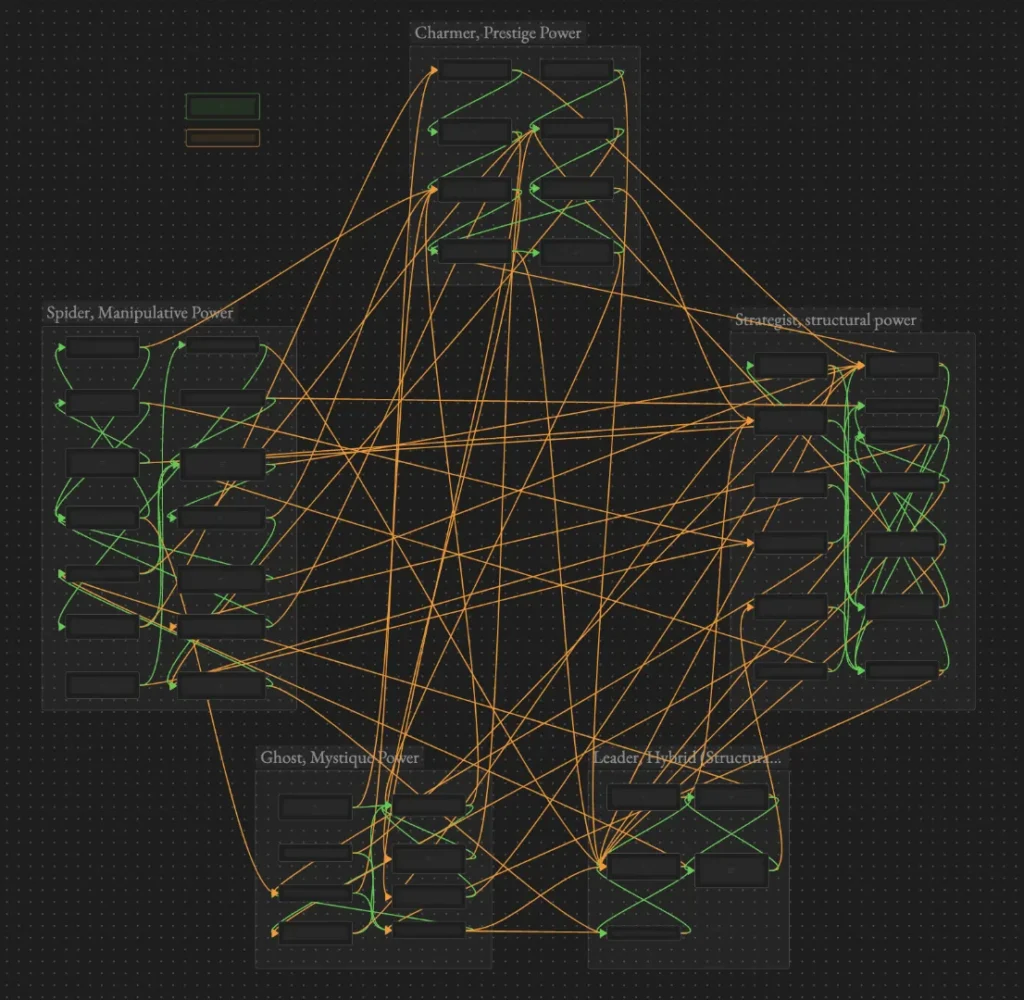
What this means is that the laws within a certain archetype are their own ecosystem. They work together in harmony and against the laws in the other archetype categories.
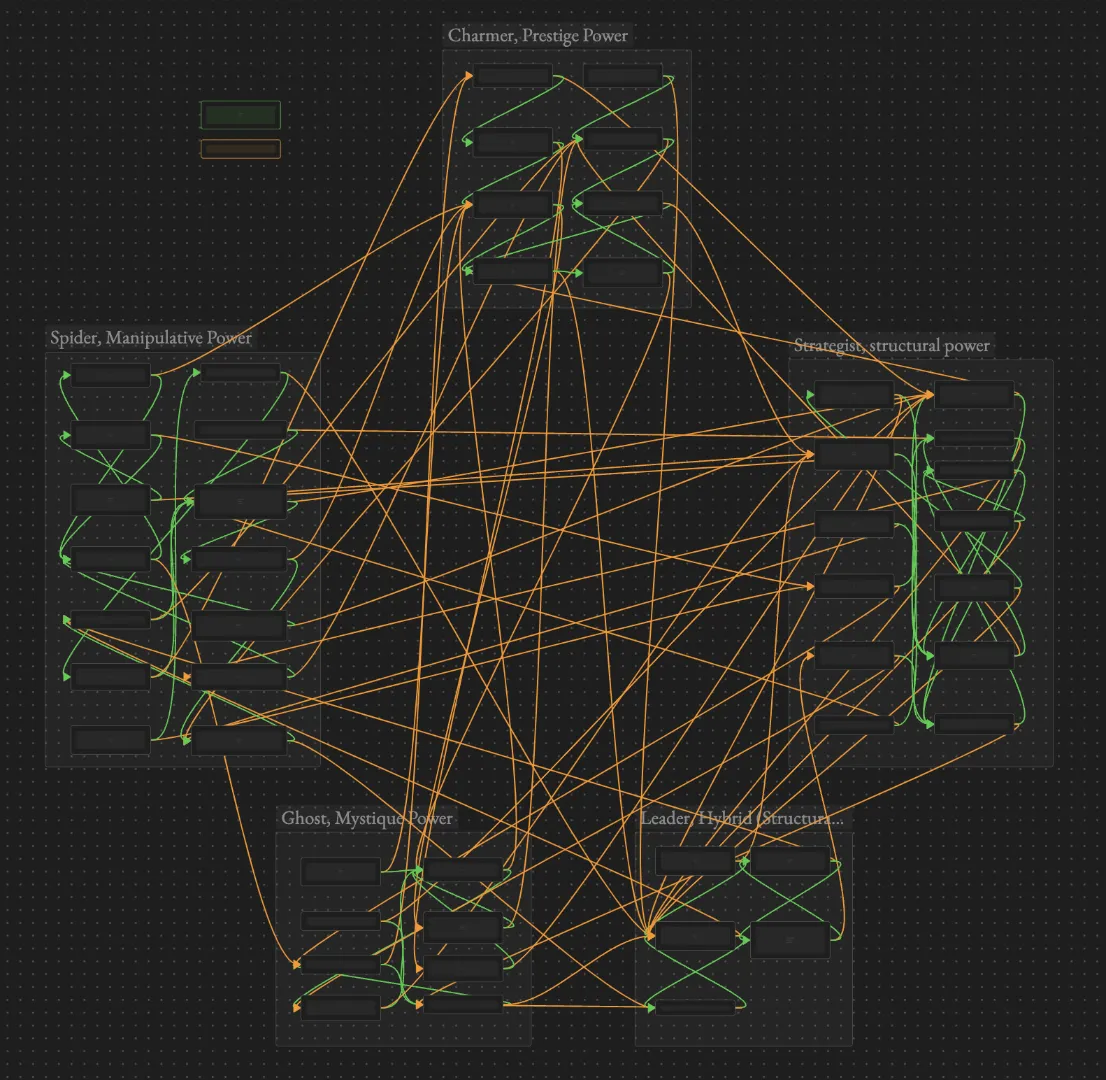
The ultimate takeaway is this: if we try to put all the laws into practice, instead of gaining power, we'll lose power, because some of the laws are contradictory. Instead, we have to define what kind of power we want to associate ourselves with, and then primarily focus on the laws that support this specific type of power.
Ideas that resonate with me
Why the Machiavellian stories?
The game of power doesn't change as technology does. The strategy a CEO uses to gain power in the workplace today is identical to what a courtier did in ancient times.
So why choose the Machiavellian stories, not the modern ones?
Because Machiavellian stories strip power down to its raw form. They remove the moral noise by creating a temporal distance between us and the story, removing our bias. If Greene used stories from recent times, we'd have had our own version of the events. We'd have said that's biased, or that person deserved it.
Using ancient stories, however, gives us perspective. We've analyzed this for a long time, and we know how it ends. The distance lets us see the mechanisms, not just the outcome.
When the story happened centuries ago, we stop arguing about who was right and start seeing how power actually works.
These insights are useful in post processing
We're still going to make mistakes. We can't just read this book and put it into use perfectly from the get go.
But the real value of these insights comes after you make the mistakes, and that's not a bad thing. Most people wouldn't even know why they pissed someone off or why they lost their ground. But having the knowledge of how the world works, we get that ah-ha moment where we understand why and how we made the mistake.
That's a head start. Because now we can avoid the same mistake again.
The most important laws for any power type
We all need power, whether we like to admit it or not. And it's important to understand what type of power we pursue so we can align ourselves with it.
That said, these are the laws that matter no matter what type of power you're after.
law 1:Never outshine the master
law 4: Always say less than necessary
law 16: Use absence to increase respect and honour
law 23: Concentrate your forces
law 28: Enter actions with boldness
Law 29: Plan all the way to the end
law 38: Think as you like but behave like others
Using "The 48 Laws of Power" as a Defense Manual
A colleague takes credit for your work in a meeting. Your boss believes them. You say nothing because you don't want to "play politics."
Three months later, they get the promotion you deserved.
You're left wondering: what went wrong?
This happened because you didn't see the game being played. The 48 Laws of Power maps all these power games. Not so you can play it, but so you can recognize it when others do.
The book's reputation
Yes, this book has a reputation. And not necessarily a good one. Read a few pages and it's hard to deny—the advice can be ruthless. Some call it evil, and I get why.
But here's what's interesting: it has sold over 1.2 million copies in the United States since 1998, has been translated into 24 languages, and has become a modern cult classic. Books that resonate this deeply aren't dismissed as "just evil" and forgotten.
So why do people keep reading it?
Because it shows something uncomfortably true about how the world actually works.
Our default setting
Strip away the advice and what remains is an uncomfortable truth: human beings tend toward power-seeking, self-interest, and manipulation.
It's our default setting.
That doesn't mean we want to be evil. It means we're predisposed to it. There's a difference. Something can be morally ugly and still factually accurate.
So the real question isn't whether the world is evil. It's this: If the world operates this way, how do you stay good without being crushed by it?
That's where this book becomes useful; not as a weapon, but as armor.
Defense over offense
In the game of boxing, the winner is rarely the one who throws punches nonstop. It's the one who knows how to block, dodge, read patterns, and conserve their energy.
Blocking isn't aggression. Dodging isn't violence. Reading your opponent's patterns isn't cheating. It's survival. The same rules apply in real life.
This book isn't about throwing punches; it's about not getting knocked out.
There's an old idea that good people eventually win just by being good. Maxim Gorky wrote:
"Good people, made unhappy and oppressed by bad people, were always less successful and clever. But in the end, something unexpected always overthrew the wicked, and the good won."
— Maxim Gorky, In the World
But here's what Gorky didn't say: how long do the good people have to survive before "the end" arrives? And what skills do they need to last that long?
We need to remain standing until the aggressor has nothing left to give and collapses under their own weight. In other words, we need to know all the tricks being played.
Knowing the rules doesn't mean using them. It means recognizing them when others do.
How to use this book without becoming what you hate
Yes, this book can be misused. Some laws feel morally backward.
Read it as a guide, however—to understand how people actually behave—not how they should behave, and everything falls into place. Used this way, the book helps you stay in the game long enough for aggression to exhaust itself, without you becoming aggressive in return.
What is the ultimate point of gaining power?
During the Euro 2020 press conference, football legend Cristiano Ronaldo sits down to answer questions. He sees two Coca-Cola bottles in front of him. He moves them out of the frame and says, "Drink water."
Coca-Cola's market value fell by about 1.6% because of this. He moved two bottles a couple of inches, and Coca-Cola's value dropped from $242 billion to $238 billion. That's a $4 billion loss.
This is what real power looks like.
But most of us will never move markets by moving a bottle on a table. Still, the question remains the same at every scale: once we gain power—however modest—what do we do with it? How do we use it without being consumed by it?
It starts with understanding that we inevitably crave power, whether we like to admit it or not. We're a million years old, genetically hardwired machine. And we're hardwired to seek dominance. It's our default setting. It doesn't make us evil, it just makes us human.
So the question is: what do we do with what we have? How can we use this power to do something good in the world?
The way I see it, we must first work on the things we're good at. Doing something we like, first of all, makes us comfortable in our own skin. That in return makes us confident, and confidence—combined with expertise—leads to success, and success gives us power.
Once we have the power, we feed it back to ourselves to fuel up this biological machine of ours. Now that it's well and running, we harness our expertise to do something good, to help a person. Goodwill harnesses more power, and we funnel all of it back into the system to help another.
The circle is complete. The balance between taking and giving is maintained. We're fulfilled as individuals, but also collectively as a society.
FAQs
Is The 48 Laws of Power worth reading
This is a book that's very much worth reading. It helps you understand the power games people play and how they work in real life. Strip away some questionable bad-willed advice, and the book reveals the true nature of human beings; our power hunger and how it's been the same over centuries on end.
However, it's far from being a moral guide. It's best used as a defense manual, to protect yourself from manipulators and hold on to your power.
What are the 48 Laws of Power
The 48 Laws of Power are strategies and insights distilled from 3,000 years of history about acquiring and maintaining power. They are:
1. Never Outshine the Master
2. Never Put Too Much Trust in Friends, Learn How to Use Enemies
3. Conceal Your Intentions
4. Always Say Less Than Necessary
5. So Much Depends on Reputation — Guard It With Your Life
6. Court Attention at All Costs
7. Get Others to Do the Work for You, but Always Take the Credit
8. Make Other People Come to You — Use Bait If Necessary
9. Win Through Your Actions, Never Through Argument
10. Infection: Avoid the Unhappy and Unlucky
11. Learn to Keep People Dependent on You
12. Use Selective Honesty and Generosity to Disarm Your Victim
13. When Asking for Help, Appeal to People’s Self-Interest, Never to Their Mercy or Gratitude
14. Pose as a Friend, Work as a Spy
15. Crush Your Enemy Totally
16. Use Absence to Increase Respect and Honor
17. Keep Others in Suspended Terror: Cultivate an Air of Unpredictability
18. Do Not Build Fortresses to Protect Yourself — Isolation Is Dangerous
19. Know Who You’re Dealing With — Do Not Offend the Wrong Person
20. Do Not Commit to Anyone
21. Play a Sucker to Catch a Sucker — Seem Dumber Than Your Mark
22. Use the Surrender Tactic: Transform Weakness into Power
23. Concentrate Your Forces
24. Play the Perfect Courtier
25. Re-Create Yourself
26. Keep Your Hands Clean
27. Play on People’s Need to Believe to Create a Cultlike Following
28. Enter Action with Boldness
29. Plan All the Way to the End
30. Make Your Accomplishments Seem Effortless
31. Control the Options: Get Others to Play with the Cards You Deal
32. Play to People’s Fantasies
33. Discover Each Man’s Thumbscrew
34. Be Royal in Your Own Fashion: Act Like a King to Be Treated Like One
35. Master the Art of Timing
36. Disdain Things You Cannot Have: Ignoring Them Is the Best Revenge
37. Create Compelling Spectacles
38. Think as You Like but Behave Like Others
39. Stir Up Waters to Catch Fish
40. Despise the Free Lunch
41. Avoid Stepping into a Great Man’s Shoes
42. Strike the Shepherd and the Sheep Will Scatter
43. Work on the Hearts and Minds of Others
44. Disarm and Infuriate with the Mirror Effect
45. Preach the Need for Change, but Never Reform Too Much at Once
46. Never Appear Too Perfect
47. Do Not Go Past the Mark You Aimed For; In Victory, Learn When to Stop
48. Assume Formlessness
Is The 48 Laws of Power manipulative
The book is designed to show how people manipulate others to gain power. Then it links to advice on how to keep that power for ourselves, showing examples, mostly from the Machiavellian era, of how people put this advice into practice and gained power.
Some of this advice is manipulative. For example, here are some manipulative, offensive-type laws in the book:
- Law 14 — Pose as a Friend, Work as a Spy (Build trust to gather information. Highly manipulative because it exploits openness and goodwill.)
- Law 27 — Play on People’s Need to Believe to Create a Cultlike Following (Uses belief, illusion, and emotional dependence to gain control over other people.)
- Law 33 — Discover Each Man’s Thumbscrew (Find people’s weaknesses, fears, or desires and use them as leverage.)
- Law 39 — Stir Up Waters to Catch Fish (Deliberately create chaos or emotional reactions so others lose control while you gain advantage.)
- Law 15 — Crush Your Enemy Totally (An aggressive offensive law focused on eliminating threats completely rather than managing them.)
However, whether it's "manipulative" depends on how you use the knowledge. You can use it to avoid being the victim of people who put these manipulative laws into practice. You can learn these tactics defensively to protect yourself.
Do the 48 Laws of Power contradict each other
Yes, many laws seem to contradict. For example, Law 6 says "Court Attention at All Costs" while Law 38 says "Think as You Like but Behave Like Others." Law 28 says "Enter Action with Boldness" but Law 1 warns "Never Outshine the Master." Take Law 30: "Make Your Accomplishments Seem Effortless" versus Law 34: "Be Royal in Your Own Fashion—Act Like a King to Be Treated Like One."
This is only confusing when we ask the wrong question.
The question isn't which law is right. The question is: what kind of power do you want to associate yourself with?
Do you want to live like a king, out in the open, through presence and visibility? Or do you want to be treated like a god—distant, mysterious, and untouchable?
This is the insight Greene doesn't spell out directly. The laws aren't a checklist. They're a menu. And the power you gain depends entirely on which ones you choose and how you combine them.
Which laws from The 48 Laws of Power are most important
We all need power, whether we like to admit it or not. And it's important to understand what type of power we pursue so we can align ourselves with it.
That said, these are the laws that matter no matter what type of power you're after.
They are:
law 1:Never outshine the master
law 4: Always say less than necessary
law 16: Use absence to increase respect and honour
law 23: Concentrate your forces
law 28: Enter actions with boldness
Law 29: Plan all the way to the end
law 38: Think as you like but behave like others
How can I apply The 48 Laws of Power ethically without becoming manipulative or unethical
Each law has two layers.
The first layer describes a pattern of human nature as it relates to power dynamics. The second layer offers strategic prescriptions—advice on how to act—which can sometimes be unethical.
This doesn't mean the first layer is unethical. Observation is not manipulation.
Facts, by themselves, are neutral. They only become unethical when paired with exploitative action. The most ethical way to apply these laws is to understand the human nature each law describes and use that knowledge defensively—not offensively.
Blocking isn't aggression. Shielding yourself isn't violence. Reading patterns isn't cheating. It's self-preservation.
For example, Law 1: Never Outshine the Master.
Descriptive layer (human nature): People in positions of power are deeply sensitive to anything that makes them feel insecure, diminished, or replaceable; even if it's unintentional. This is a fact about human psychology, not advice.
Prescriptive layer (potentially unethical use): Deliberately downplaying others, manipulating ego, or strategically dimming yourself to gain advantage. This is where manipulation enters.
The ethical way to put this into practice: you recognize that outshining a superior may trigger resentment, so you share credit with superiors, avoid public one-upmanship, and choose when and where to display competence.
You're not exploiting anyone. You're avoiding predictable backlash by being strategic. That's not manipulation; that's situational awareness.
What are the main criticisms of The 48 Laws of Power and are they valid
By far, the most common criticism is that this book is written to give unethical advice. The second most frequent criticism is that some of the laws contradict each other.
For the first point: even though there's some unethical advice, the book can be used to understand human nature and prevent and dodge the power moves that other people impose on us, without us being manipulative and unethical.
To the second point: some of the laws seem contradictory if we treat them as a universal rulebook. This book, however, discusses laws for different types of power. It all depends on what kind of power you want to associate yourself with.
Take Law 30, for example: "Make Your Accomplishments Seem Effortless" versus Law 34: "Be Royal in Your Own Fashion—Act Like a King to Be Treated Like One." These two laws completely contradict each other. However, both of them work in real life. You can gain power by following either of them.
The important point is that trying to follow both at the same time would backfire. So it's better to stick with one that associates with the type of power you want.
Do you want to live like a king, out in the open, through presence and visibility? Then Law 34 suits you best. A good example of this is the late basketball player Kobe Bryant.
Or do you want to be treated like a god; distant, mysterious, and untouchable? Then Law 30 is the way to go. A good example of this is the former tennis player Roger Federer.
Should I read The 48 Laws of Power as a beginner to power dynamics or is it too advanced
The book is designed to give a concise summary of how the world works, the games people play to gain power. And they're paired with historical stories to show them in action.
It's therefore well suited for beginners who want to learn about human nature. But it's best to be careful not to put some of the manipulative, unethical advice into practice.
This book is better used as a shield to protect yourself from manipulators than as a weapon to become one.
