The 48 Laws of Power by Robert Greene was destined to become a cult classic.
It’s a no-nonsense, straightforward guide to understand how the world really works.
On top of the well-researched reality checks presented in the book, Greene writes them with masterful clarity. If you read carefully, you’ll see a pattern in each law.
Greene starts with a story and brings it to a single point. Then he distills it into a few sentences before moving to the next story.
These quotes hold the essence of each law, the core truths about human nature.
Here are 10 most powerful 48 laws of power quotes and their interpretations.
Table of Contents
Law 1: Never Outshine the Master
They do not care about science or empirical truth or the latest invention; they care about their name and their glory (p. 4).
We all carry a certain amount of ego. It’s inevitable.
The people above you measure their comfort by the gap between their expertise and yours. The bigger that gap, the more comfortable they feel.
When this gap narrows—when you’re showing off—they get concerned. When you cross the line, bad things start happening to you.
Sounds harsh, but it doesn’t take much effort to validate this on your own.
People who often get punished aren’t incompetent. They’re openly competent.
The best way to handle this isn’t to hide your expertise but to be mindful about how you present yourself in front of your superiors.
Instead of trying to challenge their position, frame your expertise as something that makes them look good.
Law 4: Always Say Less Than Necessary
But the human tongue is a beast that few can master. It strains constantly to break out of its cage, and if it is not tamed, it will run wild and cause you grief. Power cannot accrue to those who squander their treasure of words (p. 33).
Power is measured not by what you decide to say, but by what you decide not to say.
The more you talk, the more people learn about your intentions, the more common you appear, and the less power and control you have.
On the other hand, if you say less than necessary, you keep people hooked. There’s less chance of saying something foolish.
The impulse to over-explain comes from our own insecurities and the natural need to be liked and to belong.
Keeping ourselves composed by saying less and listening more opens up so many opportunities, including:
- You learn what other people really think about certain matters.
- It gives you more authority (often the smartest person is the one who knows how to control their mouth).
- Your words carry more weight, so it allows you to get other people on board easily.
The law isn’t about being cryptic for its own sake. It’s about economy of expression, where every word has been filtered for necessity and impact rather than spoken on impulse.
Law 5: So Much Depends on Reputation—Guard It with Your Life
As they say, your reputation inevitably precedes you, and if it inspires respect, a lot of your work is done for you before you arrive on the scene or utter a single word (p. 41).
Once you’ve built a solid reputation, you can get pretty much anything you want.
A good reputation opens doors to every room, makes every interaction pleasant, and gets you the benefit of the doubt. Opportunities show up without you even trying.
On the other hand, if you have a damaged reputation, every move you make gets questioned, every good intention gets doubted, and climbing back up becomes ten times harder.
What people believe about you shapes how they act around you and react to you.
It’s also important to understand that the reputation is both sticky and fragile. It takes only one small mistake to damage a reputation you’ve built over several years.
The law isn’t about vanity or obsessing over appearances. It’s about recognizing that your reputation either makes everything easier or makes everything harder. And it affects every single interaction you have.
Law 9: Win Through Your Actions, Never Through Argument
When aiming for power, or trying to conserve it, always look for the indirect route. And also choose your battles carefully. If it does not matter in the long run whether the other person agrees with you, or if time and their own experience will make them understand what you mean, then it is best not even to bother with a demonstration. Save your energy and walk away (p. 73).
We should choose our battles carefully.
Some battles aren’t worth fighting for when you consider the winning outcome.
Most of the time, the urge to win an argument just comes from our own ego, even though it doesn’t lead to any constructive outcome.
This is our ego at work, trying to make a name for itself.
Law 10: Infection—Avoid the Unhappy and Unlucky
Humans are extremely susceptible to the moods, emotions, and even the ways of thinking of those with whom they spend their time (p. 79).
This one, on the surface, seems downright evil.
But you can frame this law around influence rather than manipulation.
The law connects with the well-known idea that you’re the average of the five people you spend the most time with.
If you associate with people who don’t share your goals, it’s hard to reach them, especially in the long run. You’re unconsciously absorbing their attitudes and habits.
The law identifies two types of infected: the unhappy and the unlucky.
The unhappy are pessimists who find something negative in everything. The unlucky draw the wrong card even when they’re given the best hand.
Greene’s argument is that both types are dangerous, not because they’re bad people, but because their behavior is infectious. Eventually, and unconsciously, you’ll become them.
Of course, it’s your moral obligation to help people get out of their miseries. But it’s wise not to make them the pillars of your inner circle or your daily life.
Law 13: When Asking for Help, Appeal to People’s Self-Interest, Never to Their Mercy or Gratitude
Most people never succeed at this because they are completely trapped in their own wants and desires. They start from the assumption that the people they are appealing to have a selfless interest in helping them. They talk as if their needs mattered to these people who probably couldn’t care less.
Sometimes they refer to larger issues: a great cause, or grand emotions such as love and gratitude. They go for the big picture when simple, everyday realities would have much more appeal.
What they do not realize is that even the most powerful person is locked inside needs of his own, and that if you make no appeal to his self-interest, he merely sees you as desperate or, at best, a waste of time (p. 98).
We’re rarely motivated to do a good deed for others if there’s nothing in it for us.
We’re all fighting our own battles.
So it’s better to ask for help with a promise that they’ll get something back, too. This is what actually turns the wheels.
In other words, appealing to someone’s self-interest—respectfully and clearly—can open doors that appeals to kindness alone rarely do.
Law 23: Concentrate Your Forces
What is concentrated, coherent, and connected to its past has power. What is dissipated, divided, and distended rots and falls to the ground. The bigger it bloats, the harder it falls (p. 172).
Bruce Lee once said, “I fear not the man who has practiced 10,000 kicks once, but I fear the man who has practiced one kick 10,000 times.”
Focusing your energy on one thing—something you’re really good at, at a deeper level—eventually pays off. If not in the short term, definitely in the long term. That beats doing everything else at the surface level.
This doesn’t only help you. It helps you make a bigger impact on other people’s lives, too.
Everything we do is a battle against time. We all have only 24 hours a day.
The danger of doing many things at once isn’t just exhaustion. It’s invisibility.
When your effort is spread across many things, you become average at everything you do.
And being average means being ignored. You’ve pushed yourself into the ordinary.
People remember and value singular excellence far more than they appreciate generalists. Depth signals commitment, mastery, and reliability. Breadth often signals lack of conviction.
When you push yourself into the ordinary, you lose your power entirely.
But if all your energy is focused on one thing, sooner or later, people will recognize you for your work. And that recognition gives you power.
Law 30: Make Your Accomplishments Seem Effortless
When you reveal the inner workings of your creation, you become just one more mortal among others (p. 251).
When someone appears to be working so hard, it doesn’t make them look diligent and honest; it makes them look weak, as if anyone who practiced and worked at it could do what they do.
Instead, when someone performs at the highest level without seeming to make much effort, it gives them a godlike appearance. People start to wonder: if they can do such a hard task with such ease, what could they achieve when they try their best?
This, of course, doesn’t mean that people who achieve great things do them effortlessly. But they’ve made the choice not to reveal their inner work.
A good example of this is tennis legend Roger Federer.
After his retirement, in his 2024 commencement address at Dartmouth, Federer says:
“I realized winning effortlessly is the ultimate achievement. I got that reputation because my warmups at the tournaments were so casual that people didn’t think I’d been training hard, but I had been working hard before the tournament when nobody was watching.”
He continues: “Effortless is a myth. I mean it. I say that as someone who has heard that word a lot. Effortless. People would say my play was effortless. Most of the time, they meant it as a compliment, but it used to frustrate me when they would say, ‘He barely broke a sweat,’ or, ‘Is he even trying?’ The truth is I had to work very hard to make it look easy.”
Law 34: Be Royal in Your Own Fashion—Act Like a King to Be Treated Like One
The Strategy of the Crown is based on a simple chain of cause and effect: if we believe we are destined for great things, that belief will radiate outward, just as a crown creates an aura around a king (p. 287).
Power doesn’t come from hard work alone, but from a combination of hard work and how you market that work.
To do this effectively, Greene introduces a strategy: the Strategy of the Crown.
You have to believe you’re on track for something great, and then you have to make others believe in your belief.
The more you believe in yourself, the more other people will believe in you. People unconsciously mirror confidence.
And people will gather around you to support you because they can sense you’re genuinely onto something great.
Law 48: Assume Formlessness
In the evolution of species, protective armor has almost always spelled disaster. Although there are a few exceptions, the shell most often becomes a dead end for the animal encased in it; it slows the creature down, making it hard for it to forage for food and making it a target for fast-moving predators. Animals that take to the sea or sky, and that move swiftly and unpredictably, are infinitely more powerful and secure (p. 421).
In this final law, Greene points out the volatility of the laws themselves.
Nothing is certain. Everything changes from one minute to the next.
If you can’t adapt, if your strategy is fixed, sooner or later, you’ll be left behind.
Change is chance.
If you’re not flexible enough to adapt, to become intuitively unpredictable, others will anticipate your moves, figure out your patterns, and neutralize your power.
When you’re powerless, it’s hard to get back up.
But it’s important to make the distinction between formlessness and going with the flow. Formlessness is a tool. It’s best used when you need to hold on to your power, not just to create inner harmony or peace.
Conclusion
A well-thought-out sentence put together with just a few words can carry more weight than an entire paragraph.
These quotes from the most impactful laws in The 48 Laws of Power are a good example of this.
However, it’s also important to understand that some of these laws seem to contradict each other.
For example, Law 30 (Make Your Accomplishments Seem Effortless) says to make everything you do look effortless. But Law 34 says to show the grind boldly. Instead of hiding the hard work, Law 34 is built around the idea that power is gained by doing the complete opposite, by showing it all.
At first glance, these two laws seem to contradict each other. And there are many instances where this happens between other laws in the book.
But looking closely, there’s no contradiction. This list of laws isn’t about “what works” but “what kind of power do you want to build around yourself?”
If someone wants to project king-like power (prestige), Law 34 serves them well. But if they want to project god-like power, Law 30 is the way to go.
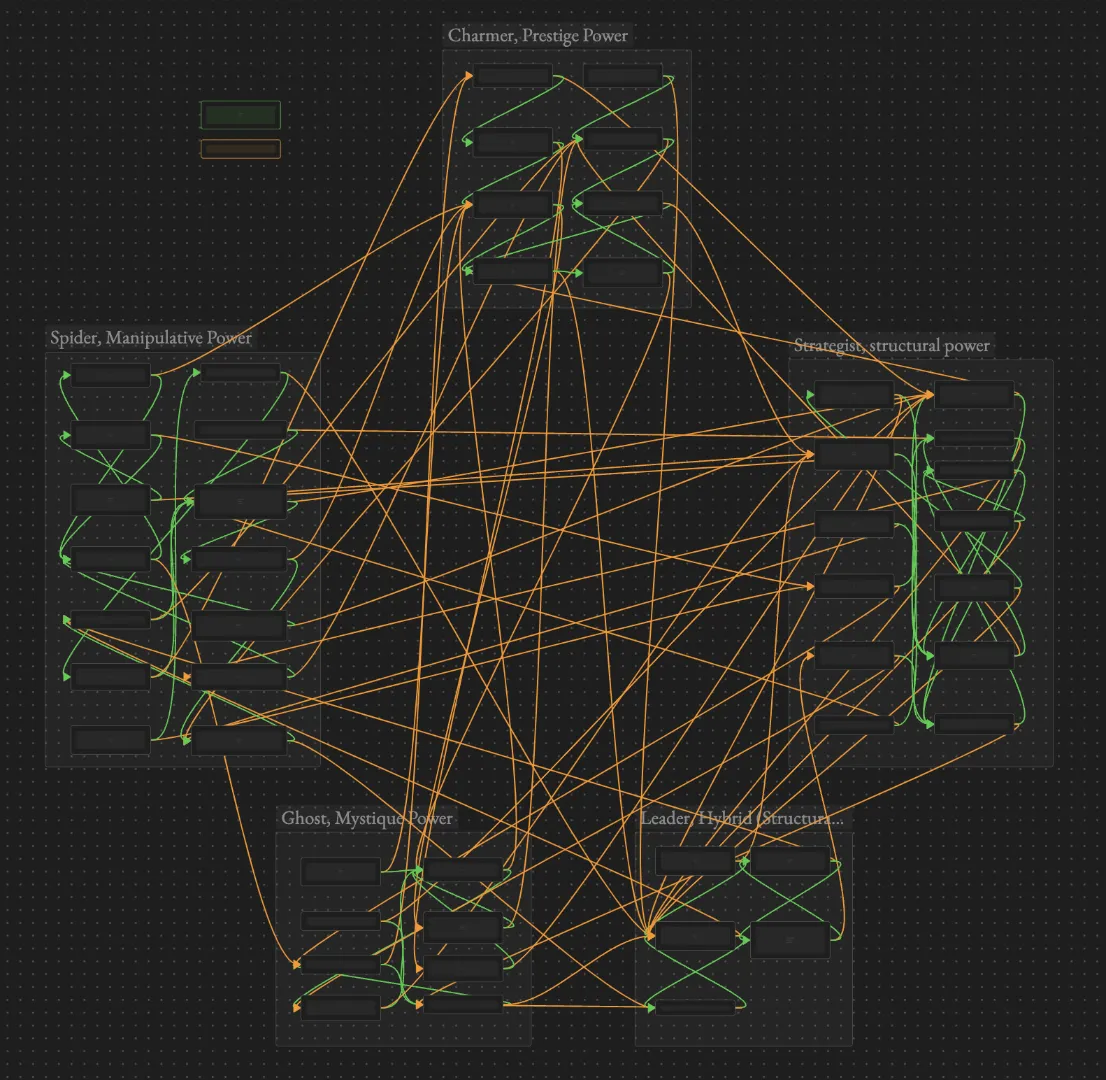
What Robert Greene didn’t directly mention is that these 48 laws fall into different power types.
For a more comprehensive guide on the different power types, read the full book summary and review here.