
One line takeaway
Good Science + Bad Fiction.
Snapshot
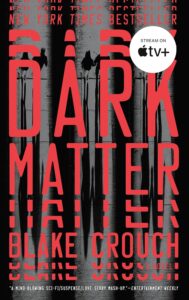
Dark Matter by Blake Crouch tells the story of a failed scientist who wakes up in a world where nothing around him makes sense.
So he turns to the only thing he knows to get help: physics.
But what follows isn’t answers but more questions, stranger realities, and a desperate race to find his way back to his own life.
Table of Contents
Review
At its core, Dark Matter is a novel about decision-making.
But the holes in the story keep it from feeling complete. The narrative feels like a puzzle made up of pieces from different boxes. No matter how hard you try to fit them together, they just don’t match.
On a more positive note, I found the style of writing refreshing. Blake Crouch writes in short sentences and sometimes one-liners, making the story really easy to follow. The characters aren’t overly complex, so they’re easy to understand without much effort. And the story’s linear, which kept me moving forward without getting lost. Crouch also creates suspense at the end of chapters, making you want to keep reading to see what happens next. But I stumbled upon a few instances of unnecessary scientific jargon sprinkled throughout the text.
“The gallery is a dozen blocks away, and I feel the tensile strength of my nerves hit the ceiling as we roll down Damen Avenue, a parking lot of cabs in the crest of the evening’s wavelength.(Page 82)”
But this is only the first 20 percent of the novel. It’s reasonably fast-paced and has good momentum.
At the end of that first 20 percent, the fiction fades, and the science takes center stage.
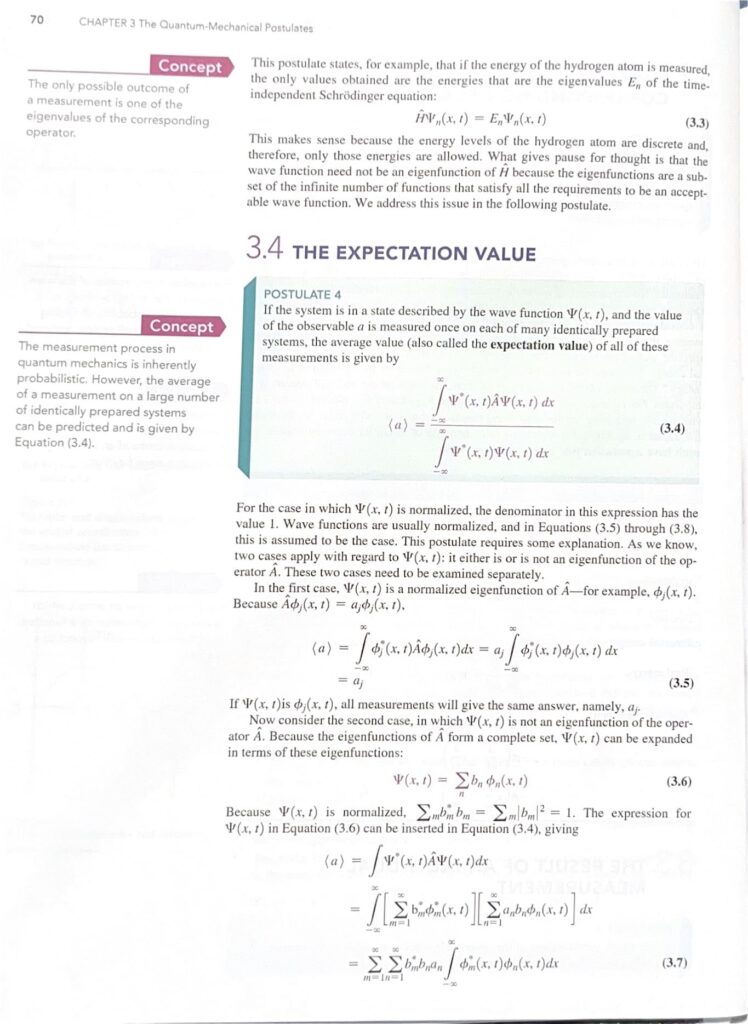
The scientific foundation of the book revolves around the fourth postulate of quantum mechanics, known as the expectation value. This principle is famously known as Schrödinger’s cat.
It’s funny that at the same time I was reading this book, I was the teaching assistant for the quantum chemistry and spectroscopy course my graduate supervisor was teaching.
So naturally, I enjoyed the scientific side of this novel.
To summarize, the concept is that a cat can be both dead and alive inside a box simultaneously until an observer opens it.
Once the box is opened and the observation is made, the cat’s either alive or dead. If the observer finds a living cat, what happens to the dead cat?
Does an alternate reality exist where the dead cat remains?
“And only when the box is opened, and an observation made, does the wave function collapse into one of two states. And it’s the act of our observing the cat that kills it—or lets it live.(Page 123)”
“Everything that can happen will happen. Everything.(Page 164)”
Now, if you replace the cat with a human, you have the core science behind this book.
While it’s not uncommon to use this concept in both novels and films, Crouch has crafted a uniquely compelling story around it, which I found genuinely original.
Unfortunately, instead of weaving this science into the story, the book takes a mundane turn in its final 40 percent.
It’s quite disappointing. In the first half of the book, Crouch breaks down a complex and fascinating quantum mechanics concept for a general audience, yet fails to stick the landing in the second half.
Most of all, this book highlights the problem I have with these new fiction books. I can’t shake the feeling that I’m reading a movie script. A book can be much more than that.
Highlights
I have vague suspicions of course, but suspicion leads to bias, and bias doesn’t lead to truth.
The gallery is a dozen blocks away, and I feel the tensile strength of my nerves hit the ceiling as we roll down Damen Avenue, a parking lot of cabs in the crest of the evening’s wavelength.
And only when the box is opened, and an observation made, does the wave function collapse into one of two states.
And it’s the act of our observing the cat that kills it—or lets it live.
But what about the occupant inside the box? Occupants are observers too. We live in a state of decoherence, in one reality, because we’re constantly observing our environment and collapsing our own wave function.
In some presentations of quantum mechanics, the thing that contains all the information for the system—before it collapses due to an observation—is called a wave function.
“Everything that can happen will happen. Everything.
I say, “This whole time, we’ve been wondering where the controls are—” “But we’re the controls.” “Yep. And if that’s the case, then we have the ability to go wherever we want. Including home.”
It’s a troubling paradox—I have total control, but only to the extent I have control over myself.
I thought I appreciated every moment, but sitting here in the cold, I know I took it all for granted. And how could I not? Until everything topples, we have no idea what we actually have, how precariously and perfectly it all hangs together.
Daniela says, “Life doesn’t work that way. You live with your choices and learn. You don’t cheat the system.”