
One line takeaway
An epic family saga that stretches across four generations, exploring the interconnected relationships between people and the nature around them.
Snapshot
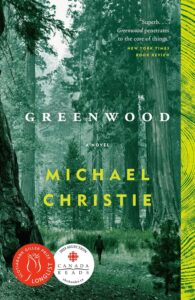
Greenwood by Michael Christie is an epic family saga that follows the Greenwood family across four generations, tracing their connection to forests, wealth, and environmental collapse from the past into a climate-ravaged future. The story shows how inheritance, exploitation, and care for the natural world shape both personal lives and collective survival.
What stands out to me about this book is how different it is from most novels that come out these days. The story has an almost everlasting quality to it, more like old Russian and American literature. It leaves a lingering taste after reading and resonates with me long after I’ve finished it.
Table of Contents
Summary and review
This book was a fortunate disappointment.
Many people recommended Greenwood to me as a good dystopian novel. So I immediately wanted to jump on it as I’d been on a streak of reading dystopian and utopian novels at the time.
But about 50 pages in, I realized there’s nothing dystopian about this book. The core essence of the novel revolves around industrial greed, climate catastrophe, familial bonds, and hope.
I kept going anyway because the plot pulled me forward.
I wasn’t disappointed at all at the end of it, though I was expecting something entirely different.
The plot
The plot has a perfect balance. It’s a smart puzzle, but not too complex to overwhelm the reader. Structured like the rings of a tree, the novel traces a family’s journey from the future to the present to the past, and then back again, recounting the story of one family and their continuing connection to the place that brought them all together. Each generation inherits the mistakes made by those who came before them, and every member of the Greenwood family struggles with the legacy left by their parents.
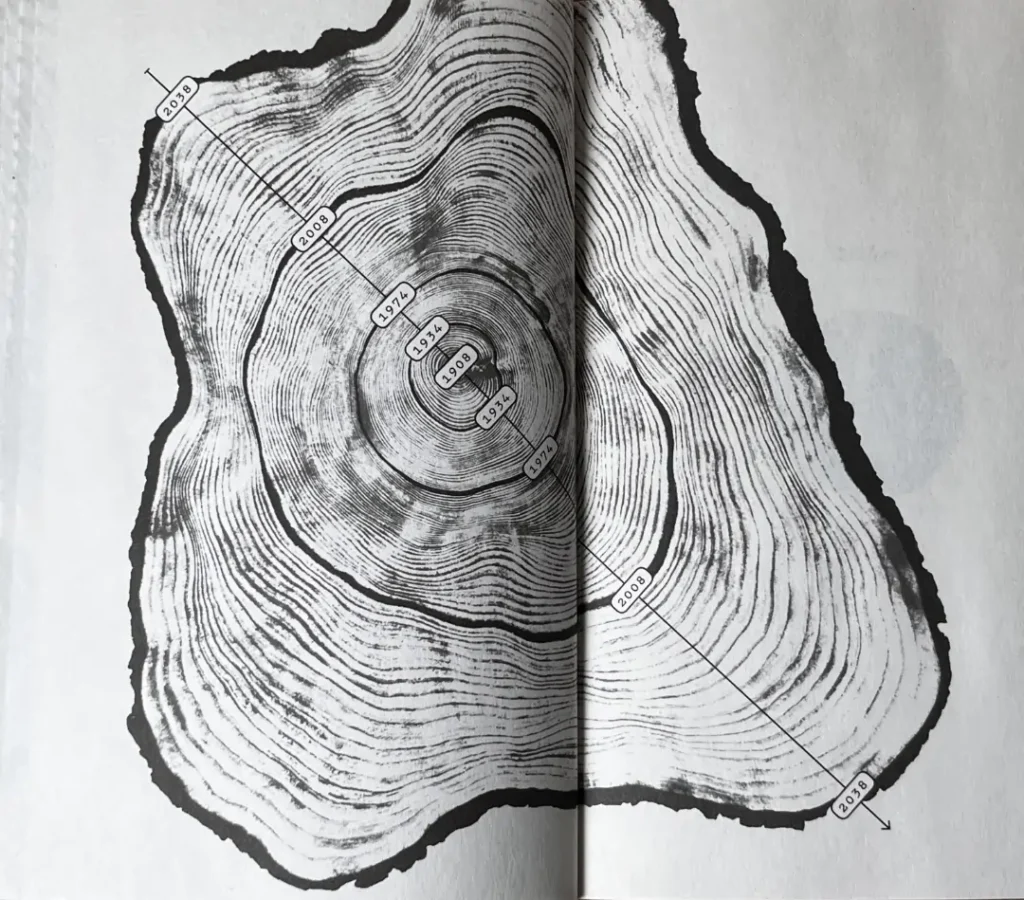
“Time…..is not an arrow. Neither is it a road. It goes in no particular direction. It simply accumulates—in the body, in the world—like wood does. Layer upon layer. Light, then dark. Each one dependent upon the last. Each year impossible without the one preceding it. Each triumph and each disaster written forever in its structure.”
The characters
While the plot is captivating on its own, it’s the characters that really drew me in: an abandoned child who interrupts one’s quiet life in the trees; another who makes a living chopping down those same trees; a bitterness between a father who built an empire felling forests and his daughter who vows to protect them; a son who works in timber to escape his mother’s troubled upbringing; a daughter who fights to preserve the last trees in a world vanishing around her, all distilled into a thrilling page turner.
The writing style
Michael Cristie has perfected his novel by balancing his writing, as well as being articulate enough to paint the characters in enough prose so that the reader can visualize the magnitude and the realness of the characters, but also not overdoing it to prevent the reader from seeing the characters from afar but among them, especially in the early stages of the book when character development takes place.
‘Yet despite Meena’s strong opinions, she couldn’t be more different than Willow: she’s disciplined, rooted, slow-moving, thoughtful, and chemically conservative—a single glass of white wine is the most reckless inebriation she’ll ever submit to’.(page 62)
For the year’s remainder, he’ll laze by the brook, entertaining half-thoughts, watching seed pods and whirlers drift on the slow water. It’s lonely living at times, yet peaceful—and after a long life of toil and struggle, he feels deserving of such leisure. (page 105)
Final thoughts
Although the plot jumps between 2038 and 1908, the novel is carefully structured and elegantly written to hook the reader. The transition from one generation to another doesn’t disturb the flow of the story at all.
There are two reasons that compelled me to complete the book. The first is Everett Greenwood, who connects generations and has a character arc that grabbed me emotionally. The second is the hope that’s planted at the beginning of the novel in 2038.
The events from 1908 to 1934 reinforce the story more than any other timeline. The reader learns the story of a tragic train accident and how it ignited an epic family saga that expands for four generations into the future.
One is subject to much talk nowadays concerning family trees and roots and bloodlines and such, as if a family were an eternal fact, a continuous branching upwards through time immemorial. But the truth is that all family lines, from the highest to the lowest, originate somewhere, on some particular day. Even the grandest trees must’ve once been seeds spun helpless on the wind, and then just meek saplings nosing up from the soil.(page210)
All in all, Christie has created a story of survival and resilience that is rich with fascinating characters whose lives are entwined with those of trees.
Who should read it
Read this if you:
- want a multi-generational story that shows how individual choices influence across centuries, over generations.
- are interested in environmental collapse-based stories, explored through character and narrative, rather than arguments
- are thinking about inheritance—of land, wealth, trauma, and responsibility—and how it shapes our moral choices
- enjoy fiction that stretches through centuries with interesting characters
- enjoy and open to familiarize yourself with climate fiction novels
Coffee chat
Give me a summary of the book Greenwood by Michael Christie
Greenwood is a family saga spanning from 1908 to 2038.
The story is structured like the rings of a tree. The book begins in the future, goes back to 1908, and then comes forward again to 2038.
The vessel that carries this family saga is a climate catastrophe. In the present, 2038, most of the world’s greenery has vanished in an ecological collapse called the Great Withering.
The story moves between history and the present, revealing many compelling characters in the Greenwood lineage and the timber empire the family built across four generations.
Is Greenwood by Michael Christie worth reading?
Yes, it’s very much worth reading for anyone who enjoys a well-structured novel with compelling characters.
What stands out to me about this book is how different it is from most novels that come out these days. The story has an almost everlasting quality to it, more like old Russian and American literature. It leaves a lingering taste after reading and resonates with me long after I’ve finished it.
Explain the ending of the book Greenwood by Michael Christie
At the end of the novel, Jake Greenwood comes to realize that she inherited an enormous wealth from her family, and yet she chooses to walk away from it. She burns the only evidence she has to prove her lineage: a diary that passed along generations from her ancestors.
Michael Christie leaves us with more questions than answers with this ending. Did she do it out of principle? Did she even know she was the rightful heir?
This is a perfect way to end the story in my opinion—a bit open-ended—matching the core theme of the book itself: ethics over fortune.
What is the Great Withering in Greenwood?
The Great Withering is a wave of fungal blights and insect infestations that completely decimated forests all over the globe, occurring ten years before 2038.
Christie based it on real events like the American chestnut fungus and the mountain pine beetle in British Columbia.
The event leaves most of humanity in dust-choked cities with a tuberculosis-like disease called rib-retch.
What is climate fiction?
Greenwood belongs to a somewhat newer type of dystopian fiction called CliFi, or climate fiction.
These stories show a near-future world with environmental collapse and use this scenario as a vessel to explore the consequences.
For example, in Greenwood, the environment collapses in what Christie named the Great Withering, caused by an insect infestation that completely destroys the forests. In the story, this happens only 15 years into the future from the year it was published, 2019.
Christie uses this world to show how it affected people’s lives, focusing on human resilience.
Can you explain the tree ring structure used in Greenwood by Michael Christie and how it affects the storytelling?
The story stretches across four generations, all the way from 1908 to 2038.
Christie structured these four generations to match the rings of a tree trunk. The story starts in 2038, then moves to 2008, 1974, 1934, and finally to 1908. Then it moves up again from 1908 to 2038 in reverse order.
This is such a brilliant structure. It creates an almost poetic symmetry between the different characters and their stories. As a reader, you get to see how all of those stories are interconnected to each other, not only the adjacent ones but every story all the way from 1908 to 2038, woven into one another.
What are the main themes explored in Greenwood, particularly around environmental destruction and family inheritance?
Inheritance versus ethics
Environmental preservation and environmental politics
Corruption and greed
Relationships and sacrifices
Addiction and trauma
How does Greenwood compare to other climate fiction novels like The Overstory by Richard Powers?
Both The Overstory, which won the Pulitzer Prize, and Cloud Atlas were reference points for Michael Christie.
All three books primarily revolve around trees.
Greenwood, however, places more emphasis on the story over the environmental themes, so it feels like you’re reading literary fiction more than a dystopian or climate fiction novel.
Could you provide a detailed explanation of the Greenwood family connections across the different time periods in the book?
The story spans from 1908 to 2038. Here are the main characters and their roles in the story:
1908: Brothers Harris and Everett Greenwood are orphaned in a train crash
1934: Everett finds an abandoned baby and names her Willow, who becomes an environmental activist rejecting her adopted father’s fortune
1974: Willow is released from jail after environmental protests against her father, Harris’s, timber empire, and picks up her uncle Everett from prison
2008: Willow’s son Liam becomes a carpenter and battles opioid addiction while building reclaimed wood installations for the wealthy
2038: Liam’s daughter Jake, discovers she may be the heir to the Greenwood Island and the family’s timber fortune
What is the significance of Jake’s decision at the end of Greenwood, and why do some readers find it controversial?
Jake rejects the ownership of Greenwood Island that was passed down to her through her family.
She isn’t the first one to make this choice. Willow Greenwood, her grandmother, who was an environmental activist, walked away from it all in 1974.
But this decision carries weight on both sides. There are strong reasons to accept the inheritance and strong reasons to reject it.
If Jake had accepted the ownership, she could have saved the trees. But she chose to walk away from the fortune, choosing to inherit the earth rather than wealth built from its own destruction.