
One line takeaway
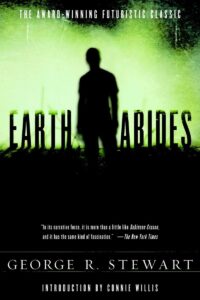
What happens to an ordinary person when the world around him suddenly turns into a wasteland? Earth Abides by George Stewart is this stark thought experiment, put to the test.
Snapshot
Isherwood Williams, a graduate student in geography at Berkeley, leaves town to do research in the Sierra Nevada. He’s studying the geography of the mountains, collecting data for his thesis.
After getting bitten by a rattlesnake and recovering alone in his cabin, he comes back to find out that the whole world, as he knew it, was entirely wiped out by a sudden plague.
As he walks through the dead bodies scattered around the streets, the houses, and the empty city, he realizes that the rest of his life is never going to be the same again.
Table of Contents
Summary and Review
“Now we have finished with the past,” he thought. These last few months, the tag-end of the year — we shall let the past have them. This is the moment zero, and we stand between two eras. Now the new life begins. Now we commence the Year One. The Year One!
Even though this paints a picture of a dystopian story, this novel isn’t a dystopia, at least not in the traditional sense.
It’s more complicated than that.
This is a masterfully crafted story about an ordinary man trying to cope with the world around him. But for an ordinary life to become a story, something extraordinary has to press in on the ordinary. Otherwise, why would anybody read this book?
This is where the dystopian element comes in.
The world this ordinary man is trying to cope with is empty and silent, a world where almost everybody has fallen ill and died because of a plague. But miraculously, he survives.
That throws ordinariness out of balance, because all of everyday life is now wrapped inside the most extreme circumstance possible: the end of the world.
This, I believe, is the genius of the novel.
For most of the story, nothing truly extraordinary happens in Ish’s life, and yet we as readers keep wanting to follow him. I find that quite remarkable.
Ish, or Isherwood Williams, is alone for much of the novel, both physically and emotionally. The world stands still with him, and we get to follow his philosophical journey through this emptied world. For long stretches, Ish sees little but dead bodies as he travels from Berkeley to New York and back across the country.
In this kind of story, the author has a great deal of space to develop character. After all, when the world has already ended, time itself seems to loosen. And Stewart uses that space well, carving out Ish’s character while raising profound philosophical questions.
In the face of a broken civilization, “What does it really mean to be human?”
Through Ish, the author also explores another possibility: that people born into this post-apocalyptic world do not ask the same deep questions, because they have no memory of what was lost and no real perspective on the future. The question I was left with was, “Is a past necessary to dream of a future?”
In the second part of the story, Ish empathizes with the newborns and tries to create a better future for them. At some point, though, he realizes that he is projecting onto them his own hopes and dreams, the ones that collapsed along with his civilization.
Parts of the book felt slow and plodding to me, perhaps because I was trying to work out my own interpretation between the lines. Still, I wish the author had developed Em’s character more, since she was as integral to the story as Ish was.
After all, at the very end of the novel, Em gets the respect she deserved.
“But as for Em, there is no need to explain, for we know that she was the strongest of us all. Yes, we needed many things…But most of all, I think we needed Em, for she gave us courage, and without courage there is only a slow dying not life.”
This book probably won’t make someone laugh out loud or shed a tear. But it’ll definitely leave people with a number of psychological and philosophical thoughts that will resonate for a long time and will lead to questioning our own morality and reality.
Quotes
“Perhaps there were too many people, too many old ways of thinking, too many books. Perhaps the ruts of thinking had grown too deep and the refuse of the past lay too heavy around us, like piles of garbage and old cloths. Why should not the philosopher welcome the wiping-out of it all and a new start and men playing the game with fresh rules? There would be perhaps, more gain than loss.”
“The intellect should not run ahead of the rest of the personality.”
“Men go and come, but earth abides”
Read this if you
- are interested in thinking about what actually happens after a civilization-ending event, especially after the adrenaline fades away and decades pass by
- are curious whether “saving knowledge” matters in a reboot of civilization when the next generation, who were born to the new world, doesn’t know what they lost in the first place
- want a slow, idea-driven story about community, leadership, and the limits of one person’s influence over culture
- like books that treat nature and time as the primary forces that govern and reshape human existence
- want a post-collapse novel that focuses more on meaning, continuity, and slow decay than on action, violence, or constant plot twists
Coffee chat
What is Earth Abides by George R. Stewart is about?
It’s about an ordinary graduate student (Isherwood Williams) who suddenly comes to realize that the world, as he knew it, has ended while he was recovering from a rattlesnake bite in his isolated mountain cabin.
The story follows Ish’s journey of survival, his search for other survivors, and his own struggles to make sense of the ethics of a world that’s fundamentally different from the old one.
What does the ending of Earth Abides mean?
The ending lands on a simple, singular idea: that the world moves on whether we’re ready for it or not.
Ish, who leads the ones who were born to a post-apocalyptic world, finds himself stranded, trying to bridge the gap between the old world and this new one.
But, as he gets older, he realizes that, in fact, there’s no gap to fill in the first place.
The culture, the knowledge, the way of life; all of it is shaped by the environment around us, not necessarily by what came before.
What are the main themes in Earth Abides?
Cultural shifts
Ecology and succession
Nature versus man
Endurance
Leadership
How is Earth Abides different from the TV series adaptation?
The TV adaptation is based on the novel, but it’s built for a different medium, with different pacing and a slightly different focus. If you’re deciding between them, the right question to ask is what you want.
The book is more reflective and long-horizon, while the show leans more on episodic drama and interpersonal conflict.
Having said that, you can watch the show without the book. Nothing about the adaptation requires any context from the book. Treat them as two versions of the same premise, not the same experience.
What happens to society over time in Earth Abides, and what is the book really trying to examine?
The end of the world, especially when it happens within such a small time, is obviously shocking.
Most of the books and movies capitalize on this shock. This is where this story is different. It explores what happens after that shock fades away, year after year, decade after decade.
The book is, in that sense, more about rebuilding civilization from the ground up than it is about survival or spectacle.
Ish, who has seen and carries the norms of the old world, who now has become the leader of the pack, finds himself in quite a turmoil as the ones being born to the new world fail to see the value in what he remembers.
The world has changed. In fact, it’s unrecognizable. So are the people.
At the end of the story, Ish realizes that the world never needed saving; it just needed to continue…
Can you explain the ending of Earth Abides in plain language and what it implies about the future of the community?
The ending reframes the scale of importance of individuality, especially when civilization is on a recent reboot. Ish’s generation carries the memory of the old world, and the next generation doesn’t carry it in the same way. That gap becomes the point, not a failure, and the story becomes a versatile tool to bring that idea to life.
The world has changed. Dramatically changed. So should the people. The feeling I got at the end isn’t closure but hope for continuity.
Why do readers describe Earth Abides as slow, and what does that pacing add to its themes?
One of the biggest reasons why I come back to this novel is how slowly the story moves forward. And that’s, in hindsight, the whole point.
It shows what would happen if the world ended abruptly, with the most realistic pacing imaginable.
As the years go by, year after year, decade after decade, we get to see the whole picture of possibly the most realistic reboot to civilization, which then starts to resonate right after you finish the book, even though you don’t get much action or spectacle while you’re reading it.
What does the title Earth Abides suggest about nature, civilization, and what lasts after collapse?
This book, in its essence, is about human versus nature.
The title is a reminder that the planet isn’t fragile in the way human systems are. People can’t destroy the earth; they can only destroy their own place on it.
So the title is actually the main thesis of the book, in two words.
Is Earth Abides worth reading today, and what kind of reading mood does it reward?
This book is, what I call, an evergreen book. It’ll never go out of style. It was relevant when it was written; it’s very much relevant today, and the relevance will only grow as time passes into the future.
So, yes, it’s very much worth reading.
This is one of those books you get to love and admire after you finish it, not while you’re in the middle of it. So reading is much more rewarding as it resonates with you long after you turn the last page.