
The Story phase
Lee Child, the British author behind the Jack Reacher series, said something in an interview that immediately caught my attention because it presses on a thought I keep returning to: maybe all of us are here to do something slightly different from one another, and maybe that difference isn’t superficial.
“I think you absolutely can learn to do it (writing), but that doesn’t mean that it can be taught. I don’t think you could take a completely untutored person, let’s say an intelligent person who is capable of lots of different things, and turn that person into an accomplished novelist. You either are, or you’re not. It’s a bit like being a musician: you’ve either got those pathways in your brain, or you don’t.
Structurally, biologically, our brains are all the same, obviously, but it’s almost like there are little tubes in my brain: some of them are big and fat and can let things through, and others are collapsed, like flat tires, that nothing will get through. Their brains are different. They’ve got different tubes open and different tubes closed. If you are a musician, you are. And if you’re not, you never will be.”
What makes his observation interesting is that, more often than not, it rings true. We can all become decent at many things. But at certain tasks, some people seem unusually at home, and often don’t even realize how unusual that is because it comes so naturally to them.
Most of us have seen some version of this in our own lives, if not as adults, then at least as children.
But that can’t be the whole story either, because human beings are not like stones! We change. We adapt. We train ourselves and become better at things over time.
That is part of what Howard Gardner was trying to get at in Frames of Mind. His argument was not that intelligence is one single thing measured on one scale, but that minds may differ in kind as well as degree. In the book, he proposed several forms of intelligence, including linguistic, logical-mathematical, spatial, bodily-kinesthetic, musical, interpersonal, and intrapersonal intelligence. And even if people are born with different strengths, those strengths are still shaped by education, culture, and experience.
So maybe the real question is not about nature versus nurture, but rather, the optimal point between nature and nurture.
How do we nurture ourselves to bring out the best of what nature provided?
If people are differently built, but still partly shapeable, what is the right way to think about the balance between uniqueness and trainability? And does training still matter when we choose something our natural wiring doesn’t seem to favor in the first place?
The Structure phase
One way to think about this more structurally is through critical windows.
To get there, we need one quick idea first: plasticity. In simple terms, plasticity is the brain’s ability to change through experience. It is why practice matters, why exposure to different experiences can refine the mind, and why human beings are not fixed at birth.
In other words, plasticity is one way scientists describe the nurture side of the story: how experience actually changes what a mind can do.
But there is one part of plasticity that changes the whole story, and that is this: it isn’t fixed. It changes across one’s lifetime.
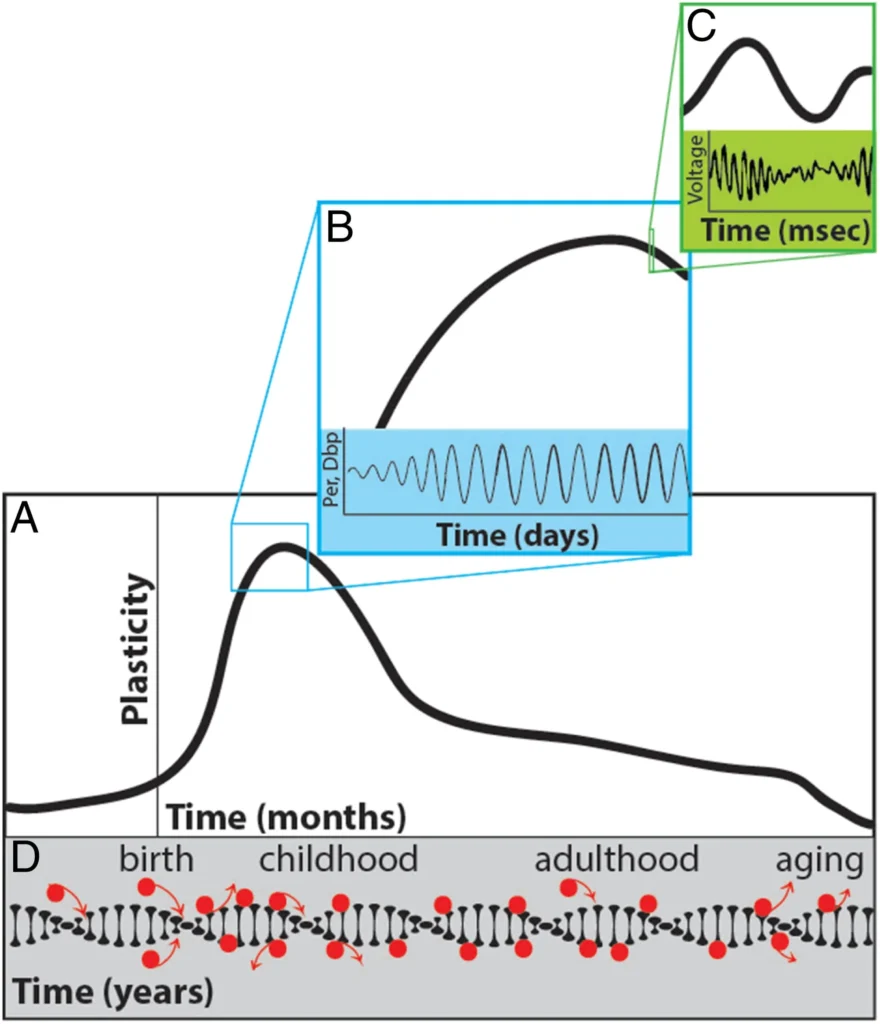
So this figure suggests three things:
- Plasticity is not constant across life; it rises, peaks, and then gradually changes over time
- Different capacities may be especially easy to improve at different stages of life
- Learning does not stop after those windows, but later in life, change may be slower, narrower, or take more effort
So the point is this: the brain is plastic, but not infinitely plastic, and not equally plastic at every age of life.
But also, training does not simply go to waste. It still matters. It just doesn’t act on identical people, at identical times, with identical intensity. Two people can receive the same training and still not be equally changed by it.
The interface
Seen this way, what Lee Child describes as “different tubes” can be understood, structurally, as pathways that are more open to change at some times than others.
The implication is that what looks like pure talent or pure failure may sometimes be a story about timing, exposure, and which pathways were opened early, late, or only halfway in life.
Getting good at anything is not impossible, but it is not equally possible at every stage of life either.
If this catches on to something you’ve been noticing, I’d love to hear where it shows up for you.