

There is no doubt that getting into your dream academic program is not a walk in the park. The amount of work involved in preparing and sending out applications can feel overwhelming at first.
Having gone through the same process myself, what I learned the hard way is that not every hour you spend on applications is equally valuable. It is easy to focus on the more visible parts of the process, like writing personal statements, CVs and preparing other documents, while overlooking the steps that lead up to them.
There is a whole other side to the process, and that is doing your research. In fact, this is often the part that determines whether the rest of your application will be strong or misdirected.
Seen this way, getting into graduate school is not a race but a marathon. And the first step, researching potential graduate programs, is possibly the most underrated one.
This blog post shows you why researching potential graduate programs properly is more important than most people realize, and how to do it the right way.
Table of Contents
Key Takeaways:
- Researching potential graduate programs is not a minor step. It is one of the most important parts of the entire graduate application process because it shapes every decision that comes after it.
- Not every hour you spend on applications is equally valuable. Writing statements and preparing documents are important, but they are far more effective when they are built on solid research.
- Graduate school is not a race but a marathon. Taking time at the beginning to think clearly can save you from wasting time, money, and energy later.
- A good program can be found everywhere, not just in a famous university. What matters more is whether the program, the faculty, and the research environment actually fit your long term goals.
- Programs with similar labels can lead to very different experiences. Looking at faculty research, mentorship style, and recent publications can reveal differences that are easy to miss at first glance.
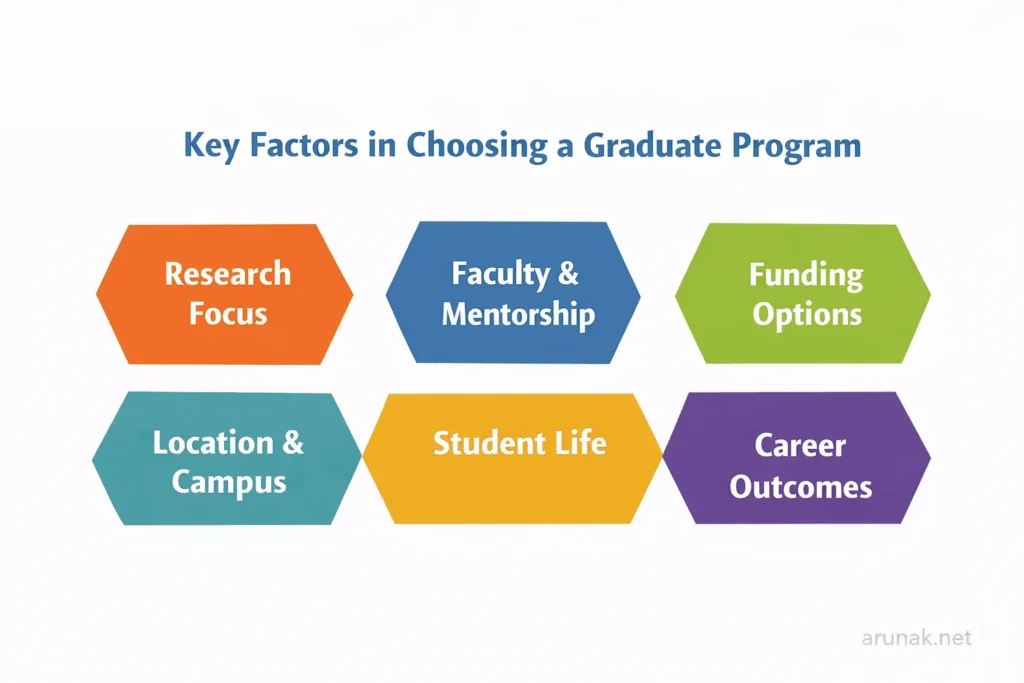
- Funding, location, and campus environment matter more than many students expect. These are not secondary details. They shape your daily life and your overall graduate school experience.
- Current students and alumni can tell you what official websites cannot. Their perspective can help you understand the culture, expectations, and reality of a program.
- The goal is not to find the highest-ranked program. The goal is to find the program that fits you best academically, professionally, financially, and personally.
Step 1: Define Your Goals and Priorities
No matter how hard you work, progress can feel painfully slow when you do not know where you are going. Before you begin researching potential graduate programs, it is important to determine what your goals actually are.
So, before delving into program specifics, take time to think carefully about what you want.
- Identify your academic and career goals, considering factors such as specialization, location, program length, and funding options.
- Your options may look very different depending on whether you want to pursue a master’s degree or a PhD. Even if the choice feels overwhelming, you should at least have a broad sense of the endpoint of your academic path. In the United States, for example, PhD programs often admit students directly from undergraduate study, but fully funded master’s programs are harder to find. In Canada and some European countries, funded master’s programs are more common.
- Think about what you want to do after the degree. Some programs are more specialized and work closely with industry, while others are more theoretical in nature. Having a clearer sense of the direction you want to move in will make it easier to evaluate programs later.
- Finally, consider your timeline and budget.
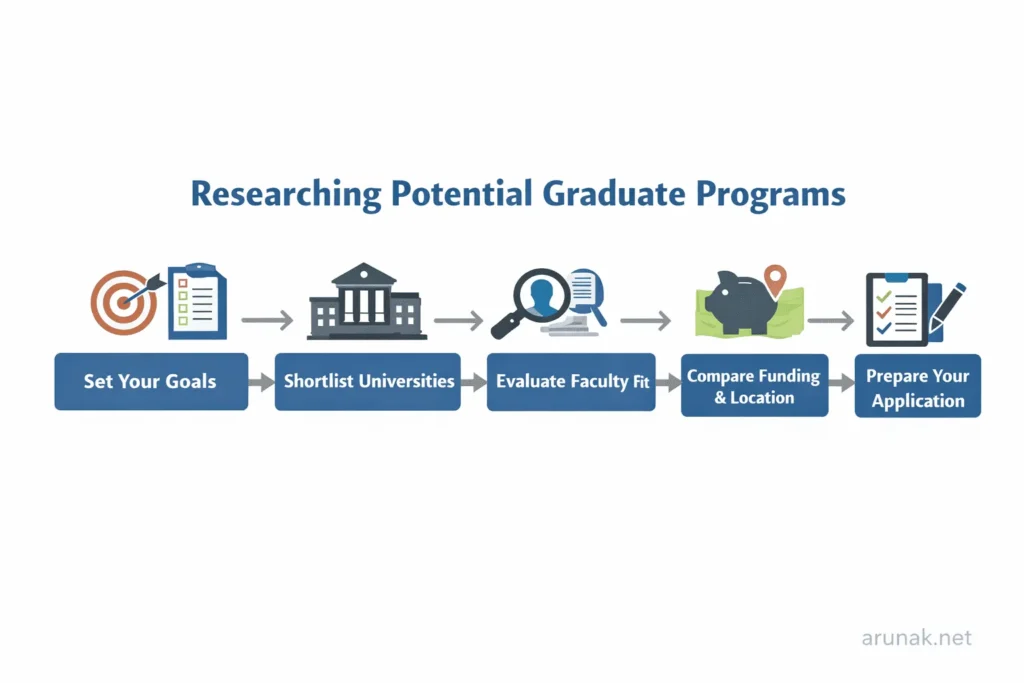
Step 2: Select a Set of Universities to Apply To
Once you have defined your goals, you can move to the next step of researching potential graduate programs, which is identifying universities and research groups that align with your interests.
At the beginning, it helps to consider a reasonably wide range of institutions in your area of interest. You can use university websites, online databases, and resources such as US News & World Report, QS World University Rankings, or specialized directory lists.
Once you have identified a set of institutions, look more closely at their programs and see which ones actually fit your academic and career goals. One of the most useful things you can do at this stage is contact the department secretary or graduate coordinator.
This matters for two simple reasons:
- You can ask specific questions about the program.
- In some cases, the professor you hoped to work with may no longer be taking students, and it is better to find that out early than to waste time and money.
Unlike emails to potential supervisors, inquiries to graduate secretaries are usually part of their role, so you are far more likely to get a reply.
Step 3: Program Requirements and Curriculum
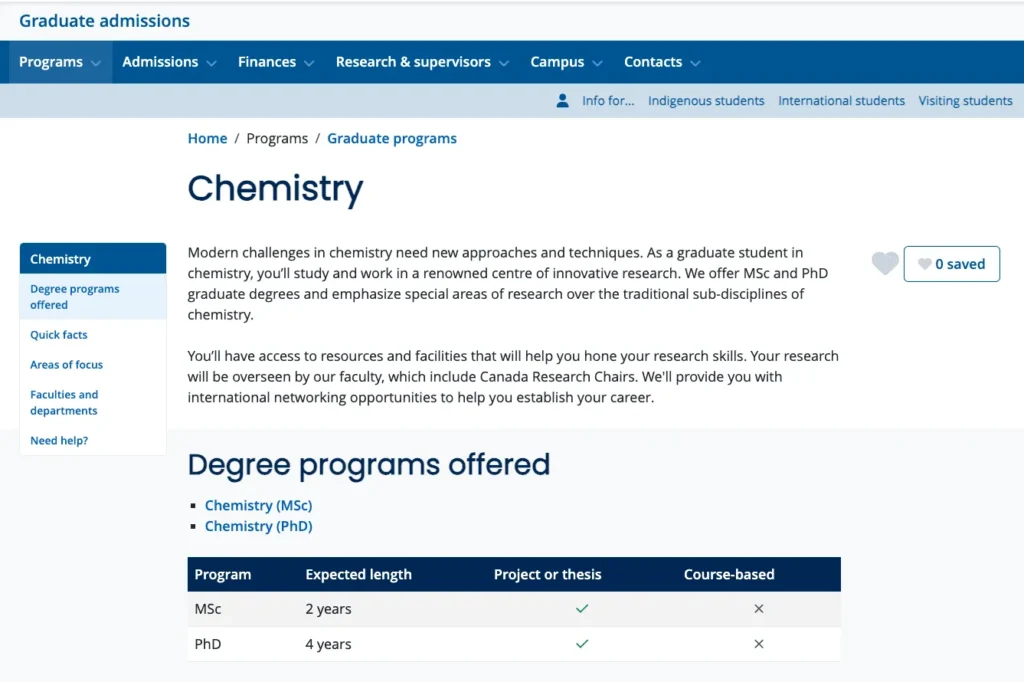
Once you have identified prospective institutions, look into the details of each program more carefully.
Explore the course structure, core subjects, electives, faculty profiles, research opportunities, and any prerequisites or admission requirements. If you still have specific questions, reach out to the graduate secretary, department head, or admissions team.
At the same time, try to speak with current students or alumni. This is one of the few ways to get a realistic sense of the program beyond what is presented on the website. Students can often tell you what the culture is actually like, how demanding the program feels in practice, and what daily life in the department looks like. That kind of knowledge is difficult to get from official materials alone.
Step 4: Assess Faculty and Research Opportunities
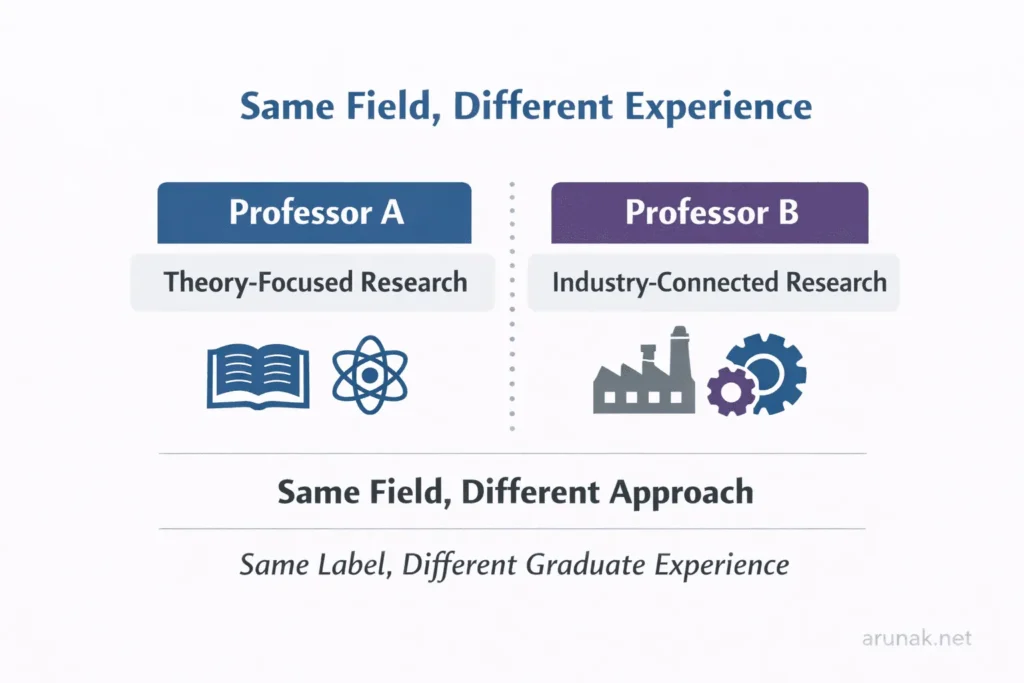
While researching potential graduate programs, keep in mind that even when two professors appear to work in the same field, the way they actually approach that work can be very different.
For example, two professors in materials science may both describe their work as being in polymer research. But one may focus on polymer chemistry, while the other may focus on polymer engineering and work closely with industry. Neither path is inherently better than the other. What matters is whether you can see the difference clearly enough to make a decision that fits your future plans. One of the best ways to detect these differences is to read the recent publications of the research group and look closely at the kinds of questions they are asking.
This is also the stage where faculty mentorship starts to matter. Research opportunities are important not only because they help you develop technical skills, but because they shape the relationships, habits of thought, and professional direction that will define much of your graduate experience.
Step 5: Consider Location and Campus Environment
When researching potential graduate programs, students often pay attention to the university and the supervisor, but not enough to the location itself. That is a mistake.
You may spend several years in that environment, and much of your academic and professional life will be shaped by the people, routines, and opportunities around you. Location matters more than many applicants think.
Consider factors such as climate, cultural environment, proximity to industry or employers, and the overall atmosphere of the campus. Also think about practical matters like transportation, housing, and accessibility.
For example, if a campus is located in a cold climate, that may affect your day-to-day experience more than you expect. If it is in a rural area with limited transportation, that may shape your ability to work, travel, or build a life outside the department.
Many graduate programs allow prospective students to visit before making a final decision. Some even pay for travel. If that option is available, try to take it.
Step 6: Financial Considerations
Graduate school funding is one of the first issues that comes up when researching potential graduate programs, and for good reason.
Some of the main financial factors to keep in mind are:
- Program costs
- Tuition fees
- Available scholarships, assistantships, and funding opportunities
- Cost of living in the area
It is important to think about these factors together rather than in isolation. A program with lower tuition may still be difficult to manage if the cost of living is too high. On the other hand, a more expensive program may be manageable if the funding package is strong.
If the funding structure is unclear, contact the university’s financial aid office or the graduate secretary in the department. The financial side of graduate school is too important to leave vague.
Step 7: Speak with Current Students and Alumni
One of the most valuable things you can do when researching potential graduate programs is to speak with current students and alumni.
Their firsthand experiences can reveal strengths, weaknesses, and realities that are hard to see from the outside. No one understands the program in the same immediate way as the students already living through it.
They can tell you what the program feels like, what the expectations are, how supportive the environment is, and what the curriculum is really like in practice. If you are applying to a graduate program at your own university, this may be even easier, since you may already have ways of meeting graduate students in the department.
In some cases, these conversations can also lead to referrals, practical tips, or a better understanding of employment opportunities after the degree. Even when they do not, they still help you make a more informed decision.
Step 8: Attend Information Sessions or Open Houses
In recent years, open houses and virtual tours have become much more common. Whenever possible, it is best to attend in person, because you will get a much better sense of the environment and the people.
If you cannot attend in person, make sure to attend the virtual version at the very least. These events can be surprisingly useful when researching potential graduate programs because they give you a more direct sense of the department you may eventually join.
They also tend to provide detailed information about the program, allow interaction with faculty, and offer a first glimpse of the campus culture. In many cases, they are also one of the easiest places to meet current graduate students.
Step 9: Evaluate Program Reputation and Accreditation
When researching potential graduate programs, many applicants focus heavily on the reputation of the university as a whole, while paying less attention to the reputation of the specific program. That distinction matters.
In the long run, your career will not be built only on the name of the institution. It will be built on the quality of your training, the people you worked with, the habits of thought you developed, and the work you are able to produce.
That is why the people around you matter so much. Working with serious scholars, thoughtful mentors, and people who can teach you to think independently has lasting value. In many cases, the reputation of the program and the people inside it matters just as much as the reputation of the university itself.
Accreditation, affiliations, and industry recognition also play an important role in shaping how your degree will be received and what opportunities it may open later.
Step 10: Prepare Application Materials and Deadlines
If you have done the earlier steps well, this final stage becomes much easier.
Once you have narrowed down your choices, review the application requirements, deadlines, and any supplemental materials with care. Start preparing well in advance so that you have enough time to write, revise, and polish your documents properly.
Proofread everything carefully before submitting. Make sure each application is complete, tailored, and sent on time. At this stage, strong preparation matters more than last-minute effort. And of course, you still need to submit the application before the deadline passes.
Conclusion
Researching potential graduate programs is a pivotal part of your academic and professional journey. The more seriously you take this stage, the more likely you are to make a decision that genuinely fits your goals, priorities, and future plans.
The point is not simply to find the highest-ranked program. The point is to find the program that fits you best academically, professionally, financially, and personally.
That takes time. But it is time well spent. And in many cases, it is this quieter early stage of the process that determines whether the rest of your application is built on solid ground.