
The story phase
I was struck by this line from Howard Gardner’s Multiple Intelligences:
“We all have these intelligences—that’s what makes us human beings, cognitively speaking. Yet at any particular moment, individuals differ for both genetic and experiential reasons in their respective profiles of intellectual strengths and weaknesses.”
Suppose that’s broadly right. An obvious question follows: with so many possible forms of intelligence, what about people who haven’t found their strengths at all? Are some of us simply born with no real natural ability?
That’s an absurd claim. But it’s worth figuring out why it’s absurd.
The better question isn’t whether some people have intelligence and others don’t. It’s why human ability shows up so differently from person to person, and why some strengths are easy to see while others stay hidden for a long time. It would be strange if human beings were routinely born with no useful potential at all. For most of human history, survival called for memory, judgment, imitation, communication, tool use, and sensitivity to other people. In that context, a lack of visible strength doesn’t mean a lack of usable potential.
So we’re each disposed toward some set of skills. But some of us have a harder time finding ours. And part of why that happens isn’t always about the person. Sometimes it’s about the setting in which the person is being judged.
It made me think about a simple question: what if some people look limited only because they are being judged in the wrong setting?
The structure phase
In ecology, an organism isn’t judged on its own. Whether it does well depends partly on fit. A trait that looks ordinary in one environment can become useful in another. The same organism can look weaker or stronger depending on where it’s placed. That doesn’t mean every organism can thrive anywhere. It just means one specific setting only tells you so much.
Something similar may be true of people.
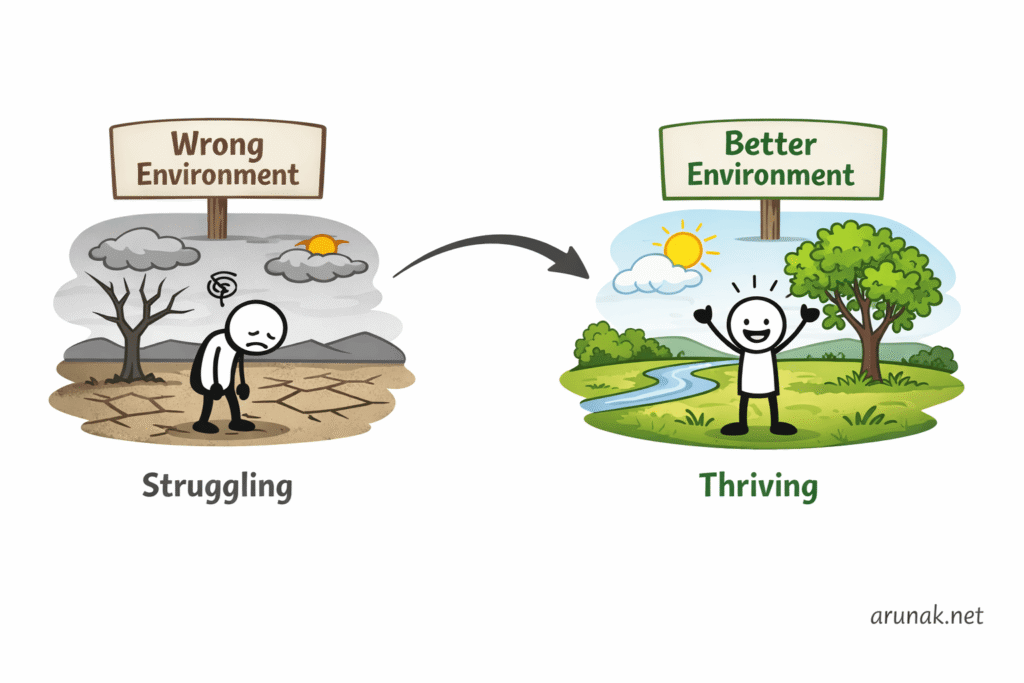
A particular environment rewards a particular slice of human ability. It makes some forms of competence easy to see and leaves others in the background. So when someone doesn’t stand out under one central standard, it may say more about the standard than about the person. We call it low ability when what we may really be seeing is just poor fit.
You can see this everywhere: in schools that reward one kind of student, in jobs that flatten people into narrow roles, and in relationships where someone is misunderstood because the setting never lets their better qualities appear.
That’s part of what still feels useful in Gardner’s idea, even if the theory itself is not fully settled. It makes it harder to treat any one narrow measure as final, which is, I think, both great news and a reason for hope.
A person can look ordinary in the wrong setting, not because they are capable of nothing, but because the setting doesn’t call much of it forth.
Misfit isn’t proof of absence.
The interface
So what looks like low ability may sometimes be the human version of judging an organism outside its niche. The point is not that everyone is secretly exceptional at something. It is that a poor match between a person and their setting can make real potential look much smaller than it actually is.
How much of what you call your limits is really just the judgment of the wrong environment?