
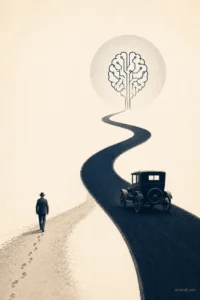
The Story phase
The growth of AI over the past couple of years has been almost vertical.
For comparison, the internet took about seven years to reach 100 million users. ChatGPT reached that same mark in about two months. And with all this, we all unconsciously and collectively ask ourselves the same question: am I going to get replaced by AI?
This is a fair question, but the anxiety that comes with it is not new.
We’ve seen this in another form before, in 1908, when the first Ford Model T came out.
Since we probably are only seeing the early rise of the AI era, yet we have lived through much of the automobile era, the Model T gives us a reasonable historical benchmark for thinking about what may unfold next.
So what happened when the first affordable car arrived in 1908?
It surely helped to reduce the time it took to go from A to B. So, undoubtedly, the structure of movement was revolutionized by the Model T.
The Model T helped make driving a mass activity and reorganized the world around it. A person who used to get from A to B on foot, or with a horse, could now move faster, farther, and more often. But that gain came with a new set of burdens: roads, traffic, fuel, maintenance, accidents, and the need to learn an entirely new competence: driving.
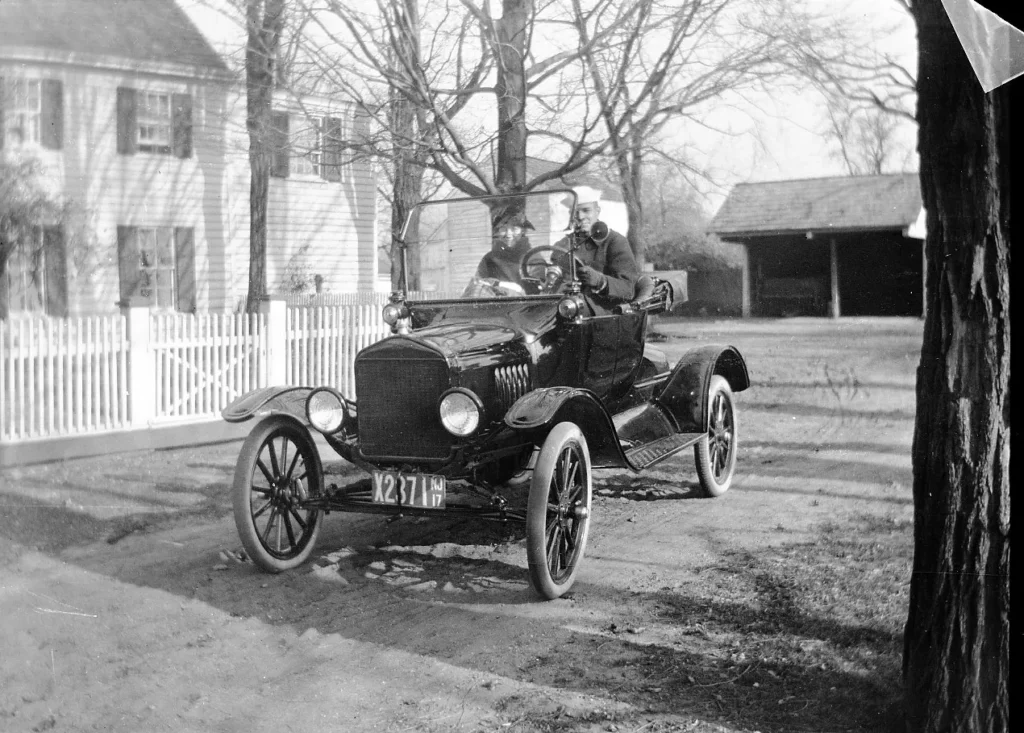
What the Model T did to movement is what AI is doing to skill.
So the better question to ask is not whether AI will replace us, but rather, what happens when AI makes a once-scarce skill more common.
The average execution of tasks, like drafting emails, summarizing documents, writing code, making first-pass designs, and answering routine questions, stops being rare. And, like in 1908, the whole world begins to reorganize around new bottlenecks in the advent of AI.
So the immediate next question becomes, if such skills become cheap, what becomes more valuable?
The Structure phase
Let’s go back to the Model T to find a more grounded answer to this question.
The Model T gives us a simple way to see what happens when a scarce capability suddenly becomes common.
These shifts make an old scarce capability cheaper and more available. But they also create a new layer of skills, risks, and supporting roles around that capability. They move value upward, away from bare execution and toward judgment, coordination, and distinction.
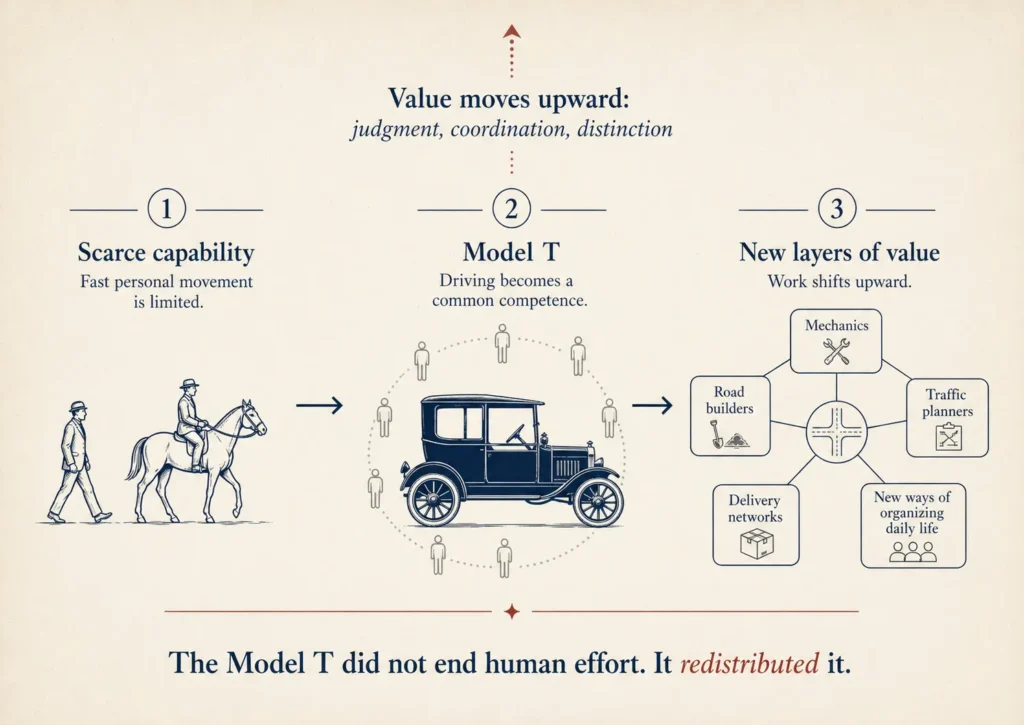
In simple terms, the old skill does not become obsolete, but rather, it becomes more common. And when it becomes more common, the definition of valuable work moves to somewhere else.
For example, after the Model T came out, not everyone became a professional driver.
Driving just became a common competence. But this new system of movement also created mechanics, road builders, traffic planners, delivery networks, and whole new ways of organizing daily life that people hadn’t even heard of or thought about before.
So the Model T did not put an end to human effort. It redistributed it.
The interface
That is why “AI will replace skill” is not an accurate prediction for what’s about to come.
Having said that, AI will surely make some forms of work abundant, and this abundance is brutal to the mediocre middle.
If the value you have been providing came mostly from producing only acceptable output, AI will eventually compress your advantage to the point where acceptable is no longer acceptable.
The labor that survives either has to compete with the cost of AI for the same task, or has to rise above the baseline through something that only you, a human being, can provide, which, I think, comes down to lived experience.
The real danger is not AI itself. It is carrying yesterday’s definition of skill into tomorrow’s labor market.
When something becomes more common, something else becomes scarce automatically.
So in this era where AI is rising rapidly, instead of asking whether AI will replace us, it may be better to ask what becomes scarce when competence gets cheap.
In your own field of work, are you still being paid for walking when the market has already moved on to driving?