

The Story phase
Russell Brunson, the entrepreneur and co-founder of ClickFunnels, has a line that resonates with me deeply: your dream customer is you from five years ago.
Ever since I heard him say it in an interview, I’ve noticed that most successful people, no matter the field they’re in, seem to operate by the same principle, in one form or another.
Morgan Housel, the author of The Psychology of Money, has a very similar idea about writing. He says he writes first for an audience of one: himself. He calls it “selfish writing.” If an idea is interesting enough to him, he trusts it will become interesting to others too. The millions of people who bought his books are his proof.
Then there’s Michael Arndt, who wrote Toy Story 3. In Creativity, Inc., he was quoted saying that “to make a great film, its makers must eventually pivot from creating the story for themselves to creating it for others.”
These are people who work in very different fields: business, writing, and film. And yet they’re all circling the same idea about how to create something valuable and meaningful for other people.
See the contradiction?
Meaningful for other people…
But it began in a selfish place: just for yourself.
You start with your own enthusiasm and your own taste, often trying to solve a problem in your own life. You know what you needed five years ago better than you know what a vague audience wants today. You know what would have saved you time. You know what you wish had existed.
But there’s a subtle danger in this process. At some point, whatever you’re making has to stop being just for you. It has to cross over. If it doesn’t, the work stays self-indulgent. It speaks only to the person who made it, and no one else can find their way in.
So when should the selfish work become something for everyone else?
Where exactly do you make that shift? And, most importantly, on what basis should you make it?
The Structure Phase
A surprisingly practical way to think about those questions is to look at how yogurt is made!
Yogurt begins with milk, but milk doesn’t become yogurt on its own. It needs a starter culture: a small amount of living bacteria introduced into the milk to begin fermentation.

In cheese, yogurt, bread, and other fermented foods, the starter culture is the living origin.
And for a significant while, almost nothing seems to happen.
Not because nothing is really happening, but because most of what’s happening at this phase is invisible.
In microbiology, this early stage is called the lag phase. The newly introduced microorganisms are adapting to their environment. They’re repairing themselves, producing enzymes and metabolites, and adjusting to the chemistry of the medium around them.
Only after this slow preparation do its effects become visible: the milk thickens, acidifies, and begins to become yogurt.
This happens at the transition point.
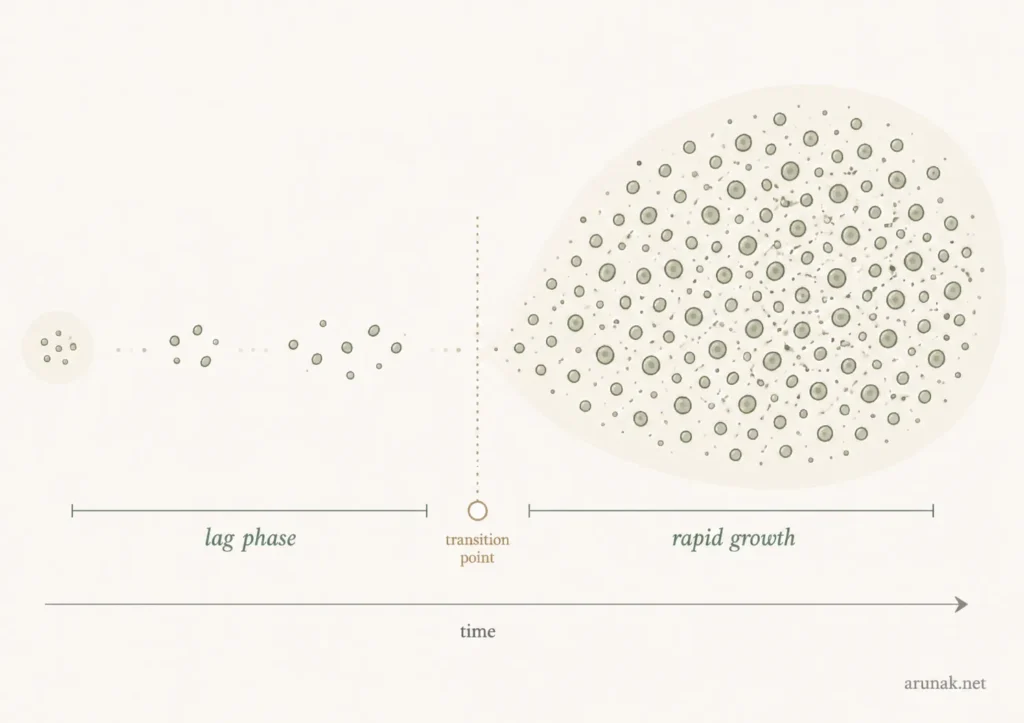
And the transition point isn’t simply a function of time. It’s a function of readiness. The culture has to reach the right state; the medium has to be suitable enough; the temperature, acidity, available nutrients, and microbial activity all have to align for growth to take off.
Any meaningful work that eventually becomes successful follows a similar pattern.
This is what Russell Brunson, Morgan Housel, and Michael Arndt are all talking about from different directions.
You start from a selfish place. You begin with your own confusion, your own taste, your own need, your own memory of what would have helped you five years ago.
But you can’t stay there forever…
You develop the idea privately for a while. Then you test it against your own life. You sharpen it. You remove what is merely personal, and keep what is transferable.
And at some point, you begin to ask a different question: can someone else benefit from what I’m building without needing to be me?
When the answer begins to look like yes, that’s the transition point.
The Interface
Seen this way, the selfish beginning of any meaningful work is very similar to a starter culture.
It’s simple, private, and fully alive.
But the point of a starter culture isn’t to remain a starter culture forever. It has to enter the milk. It has to change the medium around it. And then it has to become useful to other people: yogurt!
The important question, then, isn’t whether the work should begin selfishly.
It probably has to.
The question is whether you’ve developed the judgment to sense the transition point for whatever you’re working on privately.
Shift too early, and the work becomes too generic. No real value reaches anyone else.
Shift too late, and it stays self-indulgent. It may be important to you, but no one else can find their way in.
The art is knowing when the starter culture is stable enough to make yogurt.
When the thing that once helped only you is ready to help someone else.