The story phase
A couple of months ago, I started reading dystopian fiction books back to back. I started with the most popular one, 1984 by George Orwell, and then Brave New World by Aldous Huxley, followed by The Handmaid’s Tale by Margaret Atwood, The Giver by Lois Lowry, and finally The Dispossessed by Ursula K. Le Guin. I couldn’t get enough of them.
On the surface, these stories are very different from each other. One world is governed by continuous terror, and another by the complete opposite: comfort. Even with such drastically different structures, when I finished the final book on this list, to my surprise, a very common theme appeared. Regardless of the fact that how different the governing forces are in these worlds, they have been used to accomplish the same thing: to control and suppress individual freedom.
Then I began to question, “If governments and other similar forces try to crush individual freedom, what are they advocating for instead?” This is when I came to realize that individual freedom is not an entity that exists alone. Rather, it is one end of a spectrum, and at the other end lives “social stability.”
What happens in all these societies is that, through different types of oppression, the balance between individual freedom and collective stability is being moved more towards the latter.
This is very interesting, and obviously very important to understand.
But it took me a good couple of weeks to realize an even more important point that I completely missed the first time, that is, the most important thing to get a grip on is not these isolated entities—individual freedom and collective stability—rather, the balance between them.
For example, sometimes having complete individual freedom is not the ideal solution, nor is 100% collective stability of the society.
The real danger comes from us not having the understanding of how to balance them based on the situation we are in.
The structure phase
I like to think about this as how a photographer would use a camera on a regular basis. Let’s say our photographer is more interested in street photography, particularly daytime street photography. They set a relatively smaller aperture, which controls the hole of the camera through which light comes in, and low camera sensitivity, because there is enough daylight and just enough shutter speed not to blur the image.
But let’s say the photographer now has to do a street shoot at night. If they use the same settings they have been using in the daytime, they will probably end up with a completely black picture. The sensitivity of the camera should be adjusted, and so should the aperture size, to let more light in, with a relatively low shutter speed to compensate for these different settings.
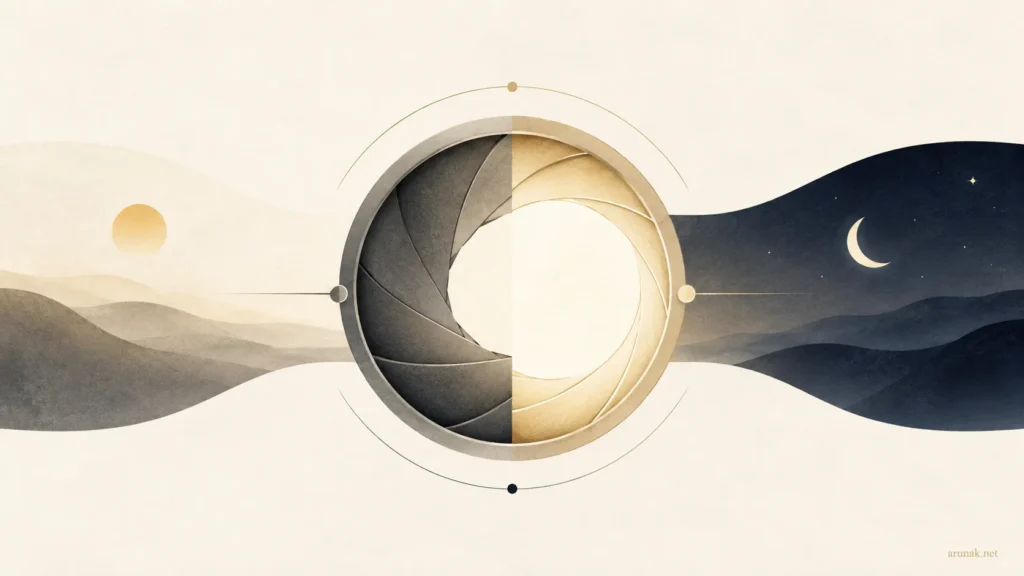
The balance between letting more light in and letting less light in is now being shifted from less to more, to end up with the best photo possible.
Like the camera settings, we also need to figure out what “settings” to use when life throws different kinds of problems at us. Sometimes, we need more freedom. But sometimes, what is actually needed is more order. Sometimes, we need more openness. But sometimes, what is actually needed is more protection.
How to set these up is by changing the balance point between the two entities mentioned in the story phase: collective stability and individual freedom.
The interface
So the fixed balance point that we’ve seen in dystopian fiction is very similar to looking at different problems through the same point of view. There are obviously good reasons why someone chooses to be a liberal, or conservative, or a pessimist or an optimist, or a minimalist, or a maximalist, or the one who takes bold decisions, or the one who is the most cautious.
The best kind of life lives in the grey areas, where we are able to alter the balance between two extremes, matched to the situation we are in.
On what issues, and in what kinds of situations, are you being too rigid, too permissive, or too attached to old principles that you know are no longer producing the best outcome?