
The Story Phase
In the past five years, the growth of AI in every aspect of our lives has been unprecedented. And there is no indication that it is going to slow down anytime soon, either. So, at this point, we are all wondering: are we going to get replaced?
A fair question, indeed. But the more AI gets integrated into our lives, the clearer it becomes that this is probably not what is going to happen. True, some tasks will get replaced, and maybe some of them should get replaced. But for most of the things we are worrying about, the real issue is not that they will be replaced by AI, but that their value will start to mean something very different.
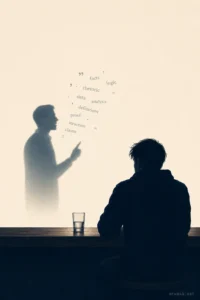
To explain this, there’s no better example than the famous bar scene from the movie Good Will Hunting.
Will Hunting, a janitor at MIT, lives in South Boston and goes to a bar near Harvard with his friends for some drinks. This is a bar where a lot of university students hang out. Will’s friend, Chuckie, starts trying to hit on one of the students, Skylar. A couple of minutes later, another student, Clark, comes over and starts asking him questions, trying to humiliate him by showing that he is lying. The scene escalates, and this is where Will takes over the conversation.
Clark’s strategy is to win the argument by repeating things he learned in class. Little does he know, Will Hunting is a genius in his own right. As Clark begins to realize that he is losing the argument and that Will is more than capable of answering him, he tries to come back by saying that at least he will have a degree, while Will will probably end up serving his kids food someday.
Then Will replies with what I believe is the best line in the whole movie, and probably one of the best movie lines ever:
“Yeah, maybe. But at least I won’t be unoriginal.”
The Structure Phase
This whole conversation reminds me of the conversation we are having about AI today. What Clark does in that scene is very similar to what AI is doing, and most importantly, only capable of doing. It is very good at producing the outer signs of intelligence. It can sound informed, confident, and well-polished. It can repeat the language of expertise very well, like what Clark does.
But Skylar chooses Will. And it makes sense to us.
Now replace Clark with AI, Skylar with a customer, and Will Hunting with any product, piece of work, or person the customer wants to choose.
I think, like Skylar, we as customers would not choose a Clark.
Because like Skylar, we are naturally drawn to associate ourselves with what makes us human, even if it comes with some flaws. And Will Hunting is obviously flawed. You can see that even in this small clip. What AI does, at least at the surface level, tends to remove those flaws.
But this is not to say that errors are the new value proposition in the age of AI. Of course not. But like Will Hunting, people will come to value competence that is wrapped in humanness. The value of meaningful work is going to be attached more and more to what makes us human in the first place.
These are things like origin, history, judgment, taste, and human presence. So the value will move from simple execution to who executed it, why they executed it, and what kind of human life stands behind it.
This, of course, will not apply to everything. Some tasks, like routine summaries, invoices, scheduling emails, basic product descriptions, formatting, and first-draft administrative work, will probably be done by AI. And all of us will use it for those things too. But any work that comes with trust, taste, identity, judgment, or emotional weight will inevitably demand a human touch.
In other words, when meaningful work becomes cheaply and endlessly reproducible, the power—or the value that comes with it—will move from the work itself to the systems that create and circulate it.
And when the work depends on trust or taste, people will usually choose the system they can relate to: humans…not AI.
The Interface
The currency of the world is about to change. So, this is the perfect time to think about how to position ourselves to be valuable in this emerging world.
As the saying goes, you are not going to be replaced by AI, but you might be replaced by someone who knows how to use AI better than you.
In a world where anybody can sound like an expert with the facts, the perception of real value will shift toward connecting facts with judgment, taste, and lived experience. That is something only a human being can do.
Seen this way, I don’t think it is overly optimistic to say that we are not in a recession of human value. Rather, we are in a repricing of human value.
So, in a world where people blindly aspire to be Clarks, we should be mindful enough to hold on to our humanness, but disciplined enough to become a good Will Hunting.