I remember the first time I thought about doing a PhD. It was back in 2020. I was in my final year as an undergraduate student. I had no doubt that this was what I wanted to do next.
But there was a bit of a problem. All the programs I wanted to get into were in chemistry. But I was an engineering student. So I had some ground to cover before applying.
Researching universities, finding potential supervisors, and preparing applications would all take time, too. “I could take about six months after graduating,” I thought, “and use them to fill the gaps in my chemistry knowledge before applying.”
Sounded like a great plan.
But almost immediately, I realized I’d overlooked something. I needed money to do all of this.
There were exams to pay for, study materials to buy, and application fees to cover. I also needed enough to live on while I was working on all these things. And now that I’d graduated, I had no income to pay for any of it.
The free time I had, I realized, was not really free. I had to buy it.
This is a dilemma many of us face when trying to change careers, or even move into a different field within the same profession, as I was doing. Having time to lay the groundwork certainly helps. But it’s hard to keep going when your savings are running low.
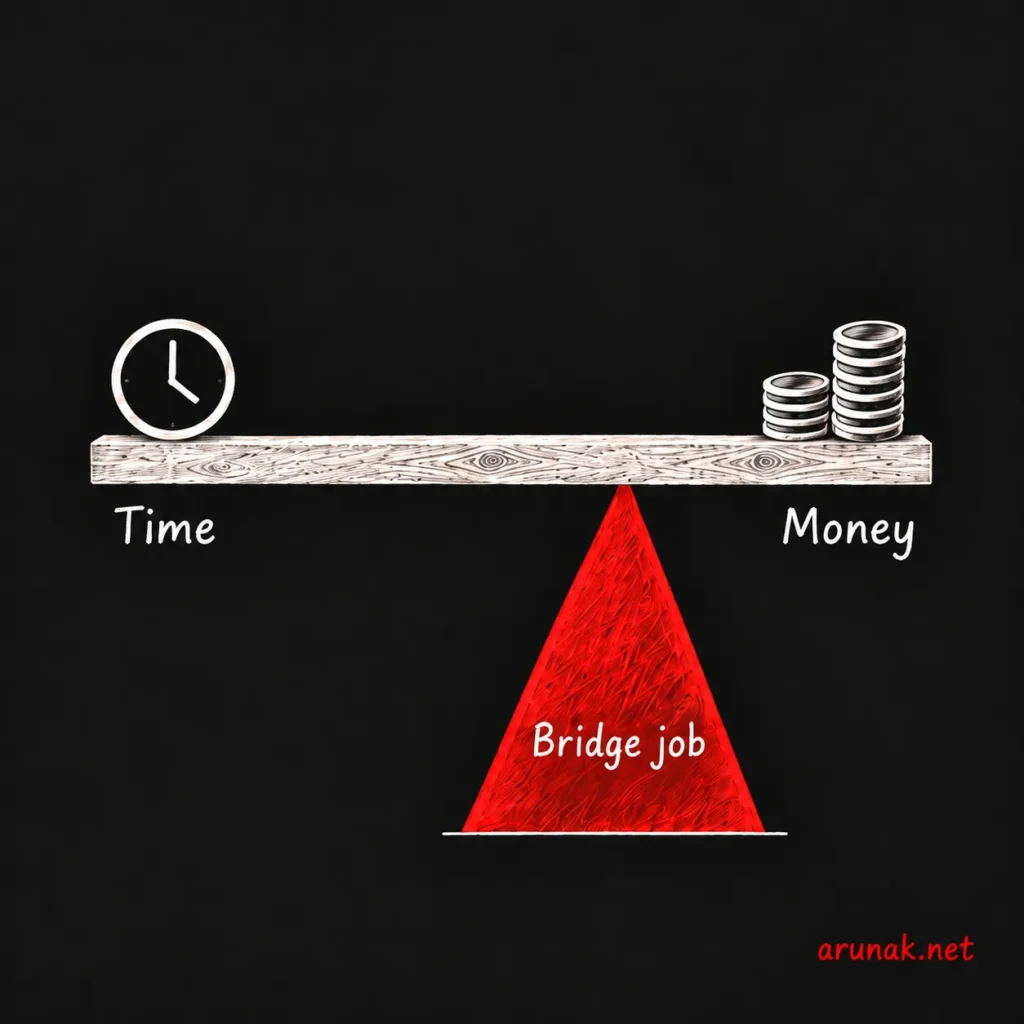
There’s a balance to maintain between earning enough money and having enough time to prepare for your next job. This is where a bridge job comes in handy.
What is a bridge job?
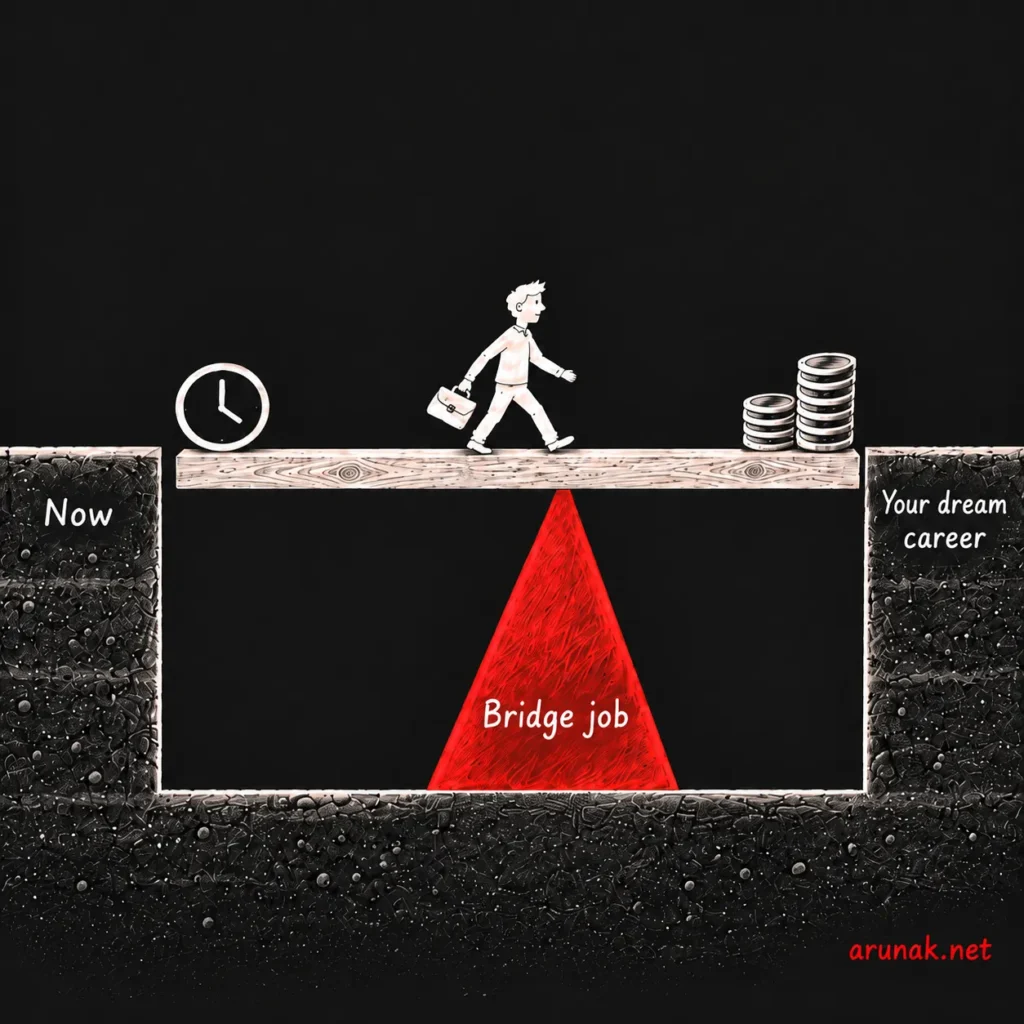
A bridge job does exactly what it says: it’s a job that helps you bridge the gap between you and your dream job. It is a career transition stabilizer.
For context, in the situation that I found myself in, the issue was that the balance between money and time was off. I had more than enough time to prep for exams and PhD programs, but money was running low. I needed to find a way to allocate some of that extra time to making money, a way to stabilize the process.
A bridge job does exactly that.1
Am I taking a step back?
But although it made perfect sense that I needed one, I also had my reservations. It was strategic, yes, but it sounded like I was taking a step back. It was as if I’d given up chasing my dreams.
And even if I took one, would I have enough time to prep for exams and get ready to apply to universities?
All these questions kept nagging at me. Ego, self-doubt, and second-guessing all crept in.
What I didn’t understand at the time was that I wasn’t alone making a decision like this. In fact, it’s quite a popular option that many people take.
Here are some examples:
- Harrison Ford decided to become a carpenter while trying to make his way into Hollywood.
- The renowned author Stephen King took up a teaching position to support himself and his family while finding his feet as a budding novelist.
- Philip Glass, the American composer, took not one but many bridge jobs before his music started to make any money.
How to choose a bridge job?
But this does not mean that any job that pays is a good bridge job.
Far from it.
For example, in my case, I was trying to shift domains: from engineering to chemistry. But my line of work was still the same: research. The time I needed to get up to speed on chemistry was far less of a concern than the money I needed for exams and applications.
Weekends and evenings were more than enough for me to get ready for the exams and get some research done on universities. Realizing this, I chose a full-time job as a research chemist, which also aligned with my long-term goals.
But the situation could be different for you. If what you need is more time than money to make a major career shift, it may make more sense to choose a part-time bridge job and use that extra time to work on developing your skills and qualifications.
The right bridge job for you is the one that balances your specific needs for time and money.
And they both have their own benefits.
Money buys back time
When you’re getting ready for a new career, no matter what stage you’re at in your current job, there will still be some skills to get good at, some opportunities to seek out, and some gaps in your experience to fill. All these things take time.
But if you just leave your current job to make that time, it may be short-lived. Because chances are you’ll still need money to cover your expenses.
So if the money is not coming in, and all you have is but time, it’s not going to be sustainable in the long run. You are going to eventually run out of time.
But money can buy back more of it.
For example, in Harrison Ford’s case, taking up carpentry helped him bridge the gaps between acting jobs. During this time, he was offered $485 a week to play Bob Falfa in George Lucas’s film American Graffiti.
But he refused. Because his carpentry gig was paying him more.
This bridge job gave him the financial breathing room to wait for better options. “That’s why I took up carpentry,” he explained in his Backstage interview, “so I could turn down acting jobs that I didn’t want to do.”
When picked right, a bridge job is an absolute win-win.
Time generates value
But on the other hand, just having financial security does not solve all the problems during a career shift. Time is important, too. If all you have is enough money to survive, but no time to lay the groundwork, you’re not going to get very far either.
Having this extra time on your hands is as important as having a steady income. You will need it to get familiar with the job you eventually want to get into and make new connections with people.
For example, Philip Glass recalled in an interview that, when he was running a moving business, he worked on weekends around the beginning of the month. This gave him long stretches of time in between to work on his music.
Apart from helping you prepare for the job you want, having that extra time on your hands allows you to slow down and gather your thoughts, which is pretty important in a situation like this where your professional life is up in the air.
Do not let your bridge job become a trap
If you get the balance between time and money wrong, instead of helping you move toward your dream career, a bridge job is totally capable of doing the complete opposite. It can trap you in.
For example, if the bridge job you chose gives you more money than you need but leaves you with no free time, or gives you plenty of free time but leaves you struggling to make ends meet, the stability you were hoping for starts to slip away. The bridge becomes a trap in itself.
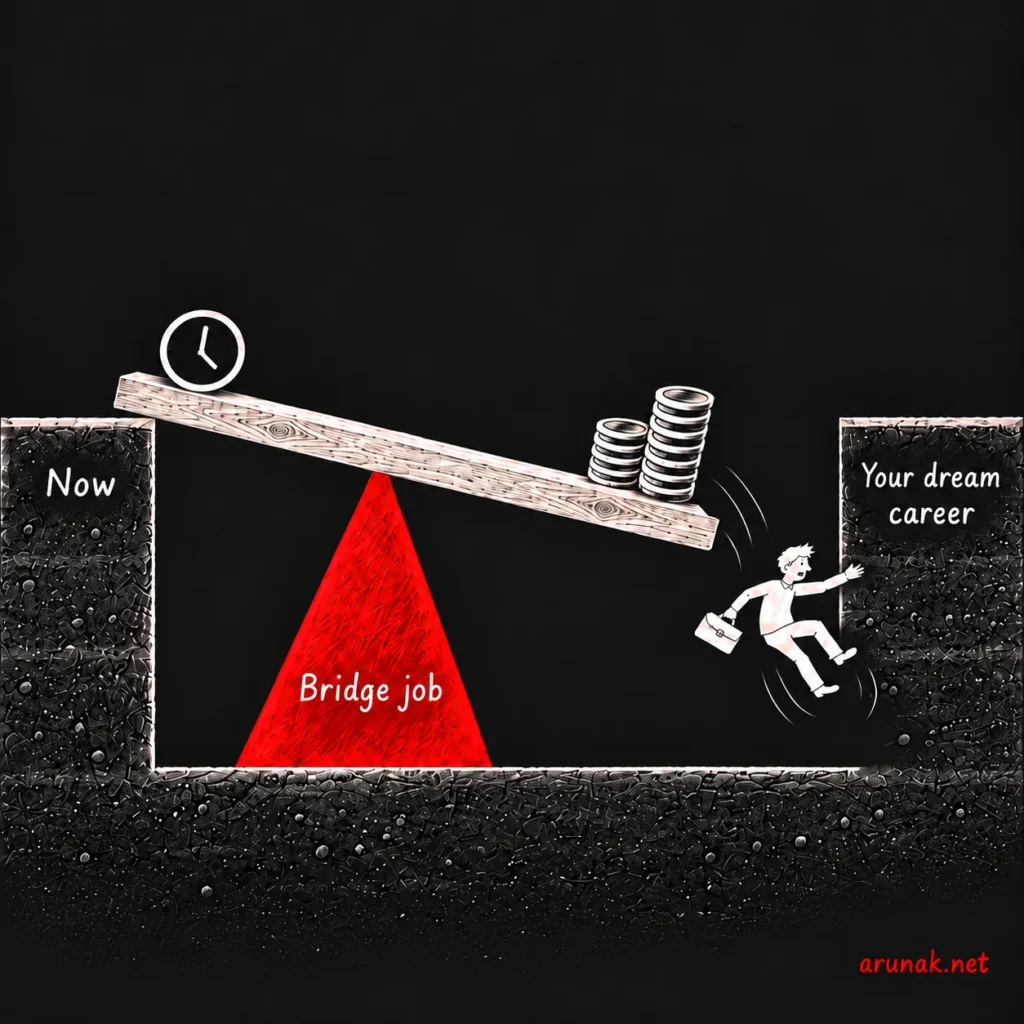
And you’re now stuck in a job that you only wanted to do temporarily. It’s not an ideal way to live. Because you’re not particularly passionate about what you’re doing, and it’s not something that you care much about or feel invested in.
It entails no real risk. Even if you fail at a bridge job or become quite successful in it, the consequences will probably be meaningless to you. That leads to an unfulfilling life.
How to keep your eyes on the prize
So how do you stop this from happening? How do you keep the bridge balanced? Here are some tips:
Start with an exit plan in mind.
Write down the things that you need to accomplish during the bridge job to get to the other side. And then set up milestones to get things done, allocating the money you’re going to earn from it and the free time you’re going to get from it.
Set deadlines and schedule the work.
Having just the milestones is only just a good start. If your day is not structured to help you achieve them at a steady pace, you may end up staying in your bridge job longer than you intended. This is why deadlines and a schedule are quite important. But it’s as important to be specific about your deadlines as it is to have them in the first place.
For example, “I’ll work on it this afternoon if I’m free” is not going to help you achieve your goals on time. Instead, set up a schedule like this: “After breakfast on Tuesdays and Thursdays, I will work on my CV and portfolio for four hours.”
Treat your free time as part of the job.
One of the main reasons to take a bridge job is to free up some time while still having a good enough financial buffer. But if you’re treating that free time as just “free time,” you’re losing your grip on the big picture.
This is not to say that all that time should be spent working. But to be able to shorten the time you spend working a bridge job—which is the whole point—you’ll have to treat at least some of that free time as “work.”
For example, if you’re working a part-time bridge job, you can make a point of going to the library or a nearby café after work for a set number of hours each day to work on your portfolio, CV, or applications before heading home.2
Conclusions
Bridge jobs are the stepping stones for anyone who’s looking to shift their careers. But not every job is a bridge job. It all depends on how you allocate money and time in them. Choose the wrong one, and you’ll find yourself trapped in a job that you wanted to just pass through.
If you’ve already taken on a bridge job or successfully made it to the other side, feel free to share your experience in the comment section below.
- Raffiee, J., & Feng, J. (2014). Should I quit my day job?: A hybrid path to entrepreneurship. Academy of Management Journal, 57(4), 936–963. https://doi.org/10.5465/amj.2012.0522 ↩︎
- Abel, M., Burger, R., Carranza, E., & Piraino, P. (2019). Bridging the intention-behavior gap? The effect of plan-making prompts on job search and employment. American Economic Journal: Applied Economics, 11(2), 284–301. https://doi.org/10.1257/app.20170566 ↩︎