Most career advice associates itself with the same type of questions.
What job fits you best? What kind of career would make you happy? What job suits your strengths?
These questions aren’t entirely useless, of course, but they’re often hit and miss. More often than not, they lead to surface-level matching.
Because you can have the right strengths for a job and still feel badly misplaced in it.
This is because these questions approach you from the vantage point of a job, not the other way around. And that is a problem, because many jobs can appear to fit your strengths while still being poor long-term translations of who you really are.
Over time, staying in a role that is not compatible with your core personality traits creates stress, friction, boredom, and a sense that your working life is moving in an entirely wrong direction, even when you are competent enough to do the job really well.
So, what are the right questions to ask, especially when you feel stuck in your current role, are considering a career shift, or are trying to choose a path in the first place? How do you choose a career that is not just a plausible match on paper, but a better expression of the kind of person you really are?
So the pursuit of finding a job that you’ll absolutely love has to start with you.
That’s what this career fit model is based on.
Career Fit Model
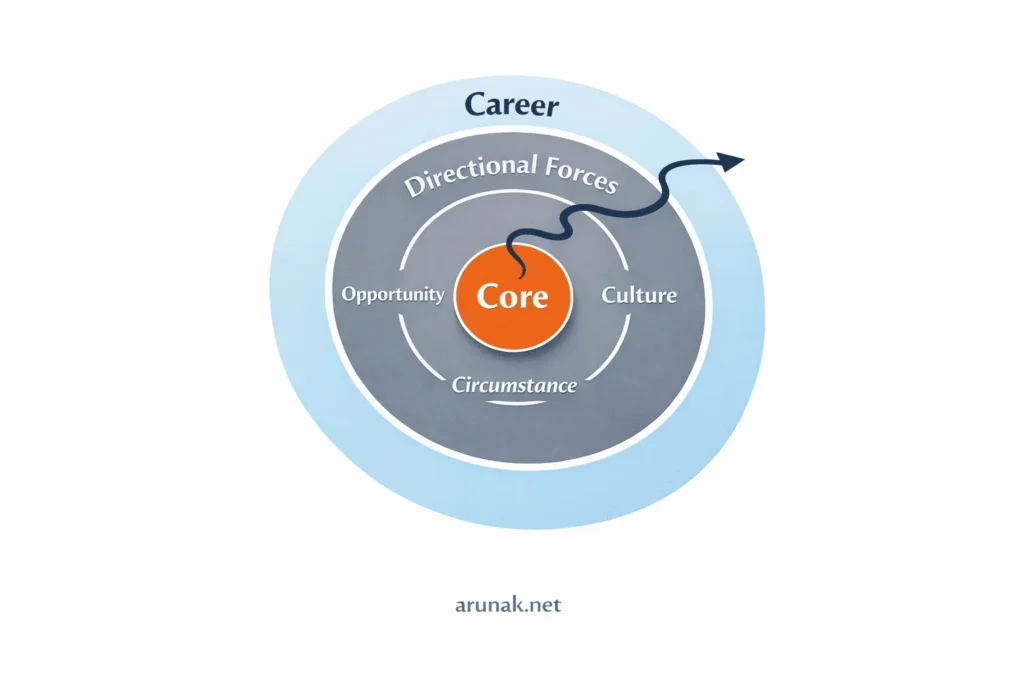
At the center is the person: the unique patterns of mind, motivations, and core capabilities.
From that center, a route is drawn outward. That route is shaped by the directional forces: opportunity, pressure, culture, and circumstance.
Where this route lands on the outer layer is the career, the point where the world sees what you do and what you stand for.
A well-sorted-out career is a path-dependent translation.
And when the translation is poor, the answer is not always to try harder within the same career, but to understand your core values, identify which directional forces are pulling you off course, and reposition yourself toward a career where you get to be yourself.
That’s the job with the most leverage.
Because nobody can ever be you.
Common career-related questions through the lens of the career fit model
But what if the kind of job I’m looking for does not really exist? Does this model support the idea that, in a case like this, we should break through the norms?
It does.
The framework above offers a clear path toward better career alignment. But this does not mean that someone has to align themselves with a predefined career.
Sometimes, when you figure out your core strengths, there is no existing career that puts them fully into practice. No role that harnesses their full capacity. The predefined options feel too narrow, too partial, or simply misaligned for you.
In a situation like this, the goal is not to find the right box to fit into. It is to figure out how to bend the directional forces so that a new kind of role becomes possible, one that did not exist before you came up with it, but that other people genuinely need. That is the condition that matters: whatever you build around your core strengths should create real value for others. When it does, the role sustains itself. When it does not, it just remains a personal project.
The core strengths are still intact, and the model still holds. What changes is that instead of navigating toward an existing career, you are using the directional forces to carve out a new one, one that matters to other people.
Why do high performers feel lost even though they are performing extremely well in their respective careers?
A person can have a strong set of abilities at Layer 1 but poor routing at Layer 2, which leads to a weak or distorted role at Layer 3.
From the outside, this can look like indecision or underachievement.
But the real problem is not always a lack of discipline. Sometimes, the person has simply never been translated into a career that fits them correctly.
When this happens, there is a persistent feeling that is hard to shake: I know I’m capable, but I can’t fully express myself through the career I’m in, even though I’m genuinely good at what I do.
I’m successful in my career, but still I feel like I’m lost. Why?
Tony Robbins once said in an interview (timestamp: 46:00) that “Success without fulfillment is the ultimate failure”:
This is the ultimate failure. ‘Cause if you go at something and you fail and you’re an achiever, you don’t fail. You go, ‘I learned something. I’ll just try something else. I’m going to still get there.’ But when you succeed, and you’re not happy, you’re technically screwed.
The outer role may look impressive while translating your core self really poorly. The world only sees the success. But what you feel inside is pure friction.
This is one reason conventional career advice often feels too shallow. It treats career attainment as proof of fit.
It is clearly not.
You can figure out your core strengths and direct them toward a career you actually want, or even toward a completely novel one. You might fail along the way. But as Robbins puts it, that kind of failure is not really failure. It is information. And each time, you get closer to where you actually want to belong.
Why other people often see you completely differently from how you see yourself
Other people mostly see Layer 3. They see the career, the output, the credentials, and the visible track record.
They usually don’t see the deeper person or the directional forces that produced your career in the first place.
That is why people often receive advice that sounds plausible but still misses the mark. Others are responding to the visible counterpart, not the real person underneath it.
What is the outcome of a model like this?
The idea for this post starts from a simple belief: many people are more capable than their current career might suggest.
Not because everyone is secretly exceptionally talented, and not because self-discovery magically erases structural constraints. But because human potential is often filtered through poorly designed systems, weak language, and directional forces that most people are never taught to see.
So the goal here is to build a better vocabulary for career alignment.
Not just a vocabulary of careers, but a vocabulary of core strengths and capabilities, directional forces, career translation, misalignment, and alignment.
That is the purpose of the career fit model.
It gives us a way to talk about career fit without reducing a person to a personality label or taking someone’s job role as the final verdict on who they are, helping more people find their way to careers that are not just plausible on paper, but genuinely theirs.