I remember sitting down for my first job interview.
It was back in 2020. I’d just finished my undergraduate studies. There were only three people in a long, cavernous conference room: me, the R&D manager I would report to if I got the job, and the HR manager, who led the interview.
I was nervous.

I remember the HR manager asking me in a reproachful tone: “So, you can only give us a one-year commitment?” “Yes,” I said, my heart in my mouth. “I plan to apply for graduate school next fall.” He leaned back in his chair, glanced at the R&D manager, then tipped his head back toward the ceiling. “That’s not good,” I thought to myself. When has it ever been a good idea to announce that you’re leaving soon before you’ve even got the job? But in hindsight, as risky as it was, saying upfront that I planned to leave was one of the best decisions I’ve made in my professional life.
At this point, even though I was applying for this position as an R&D engineer, I’d already set my sights on a PhD. But I couldn’t apply to graduate school right away. I needed some preparation time before applying. So this job I was applying for wasn’t my intended career destination; it was a bridge job that could potentially help me get there with less hassle.
What is a bridge job?
A bridge job is a temporary position that buys you time to get ready for your next career move. They give you breathing room to prepare for a career change while providing a financial cushion to support you through an otherwise bumpy transition.
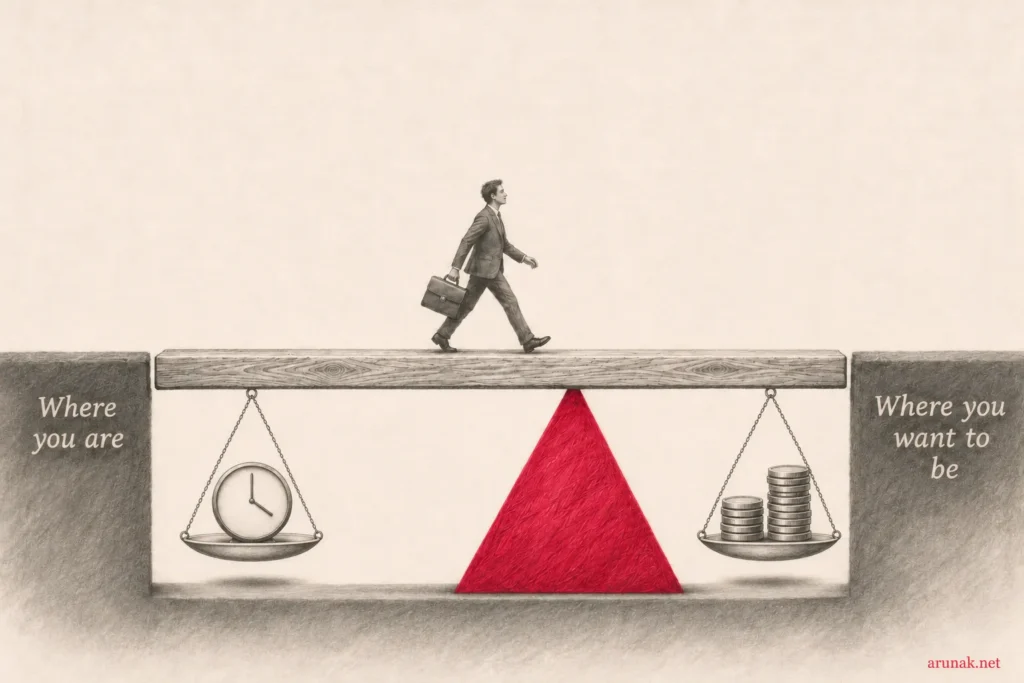
The right bridge job for you is the one that balances your specific needs for time and money.
In my case, I needed some extra time to get familiar with the type of research I was interested in doing as a PhD student, prepare for exams, and search for graduate programs and prospective supervisors. Even though I could have done this while unemployed, I realized I would eventually run out of money. I needed it not only for everyday living expenses, but also for exams, graduate applications, and eventually relocating to another country. This is the kind of situation where a bridge job comes in really handy.
The risk of getting trapped in a bridge job
They are the perfect stabilizers for a career transition. Not only do they help to make a smooth transition, but they also offer peace of mind. You know that money is coming in regularly, whatever the amount. This eases the fear of running out of money, helping you focus more on preparing for the career transition.
However, as convenient as they are in a situation like this, if you’re not careful enough, you risk falling and getting trapped in a bridge job. For example, about six months into my bridge job, I started getting too comfortable. I was fresh out of college, working my first job. For the first time, I was bringing home a paycheck. “So why would I go into graduate studies and be broke for five years?” I thought to myself. I was also fortunate enough to work with a great team, and things were getting more stable and comfortable by the day. At some point, I began to question myself: “Do I really need to risk all this for a job I don’t even know I can secure?”
With all these doubts swirling in my mind, I went ahead and extended my contract to 18 months. “Let’s stay here a little longer,” I thought to myself, “and see what happens.” It took me a while to realize that all that immediate comfort had clouded my long-term thinking. It had created a blind spot. This is why bridge jobs that are adjacent to your intended career can become traps. In the haze of their immediate comfort, you risk losing sight of your long-term goals.
As much as I liked the money coming in and the supportive environment I was fortunate enough to work in, I wasn’t on a career path I could see fulfilling me over the next 10 years. At this point, I’d already worked out that I would find career fulfilment in a job focused on research. And doing a PhD was the perfect gateway to that long-term career path. But in this job, the more experience I gained, the further I moved away from “doing research” and toward “doing administrative work.” I got lost in the immediate comfort of a job that could never offer the fulfilment I wanted. This is how you risk getting trapped in a bridge job. It can happen if (1) you get too comfortable with the money coming in and/or (2) you get too comfortable with the free time that money buys. In either case, the bridge becomes unbalanced.
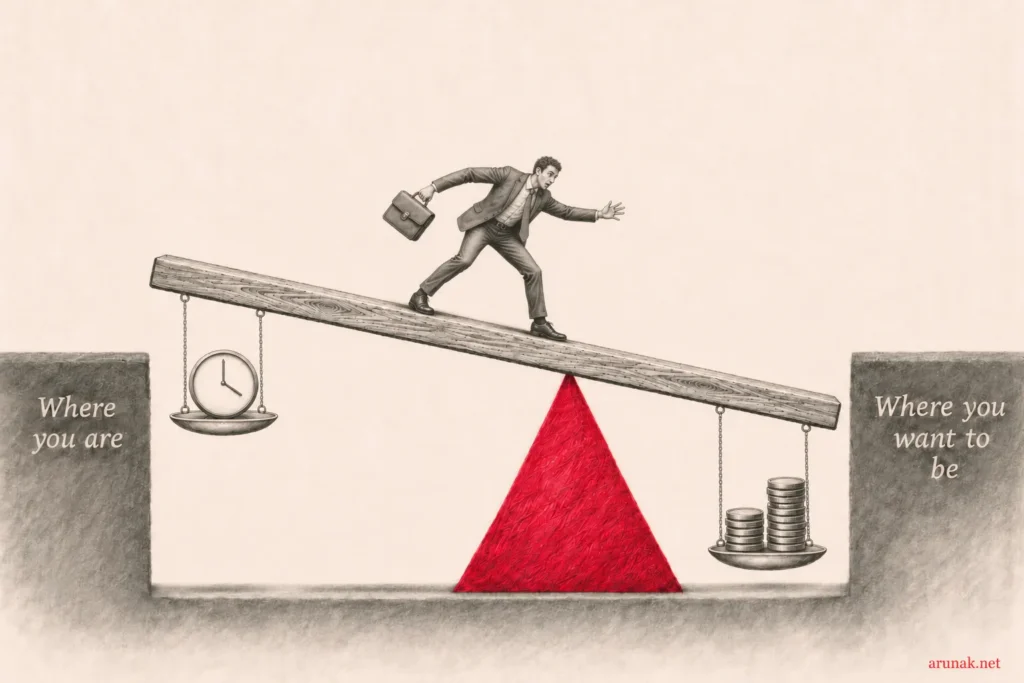
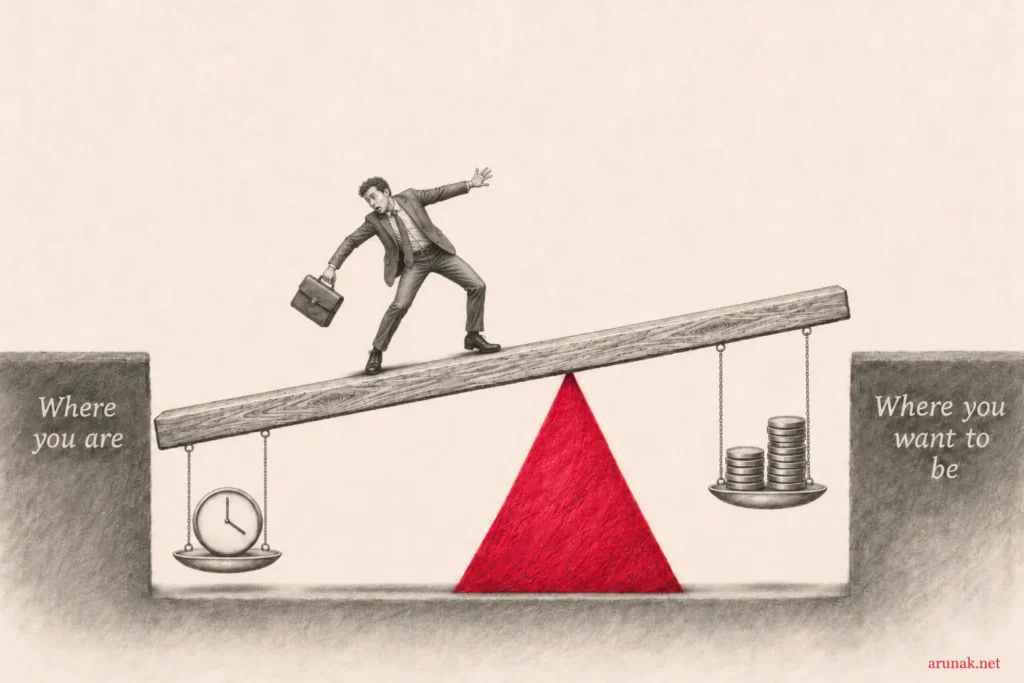
Getting too comfortable with the extra free time that money buys
The point of no return
And there comes a point when it becomes nearly impossible for you to break free from this trap.
This is the point of no return.
By then, the dream job that you once aimed for slowly becomes just that: a dream.
And the career fulfillment you were longing for slips further out of reach. And now, you’re stuck in a job you only intended to pass through.
There are many reasons why this could happen. Some of them are:
Your professional experience takes a different direction
Suppose you want to become a photographer. But right now, you’re working in a completely different field—say, as a teacher. So you might want some exposure to the business side of photography. You take a bridge job as an assistant studio manager. A year goes by. Now, with a steady paycheck and a healthy social life, you’ve grown too comfortable in this bridge job. You have no intention of leaving, even though you know you’d enjoy being a photographer more. So you let another year slip by like this. Now you’re extremely comfortable with this bridge job; you even begin to reason that “being in the photography world is enough.”
But at the end of the second year, you finally realize the mistake you’ve made. You never wanted to manage photographers; you wanted to become one. And you don’t really enjoy this job anymore. So you finally decide to make the switch.
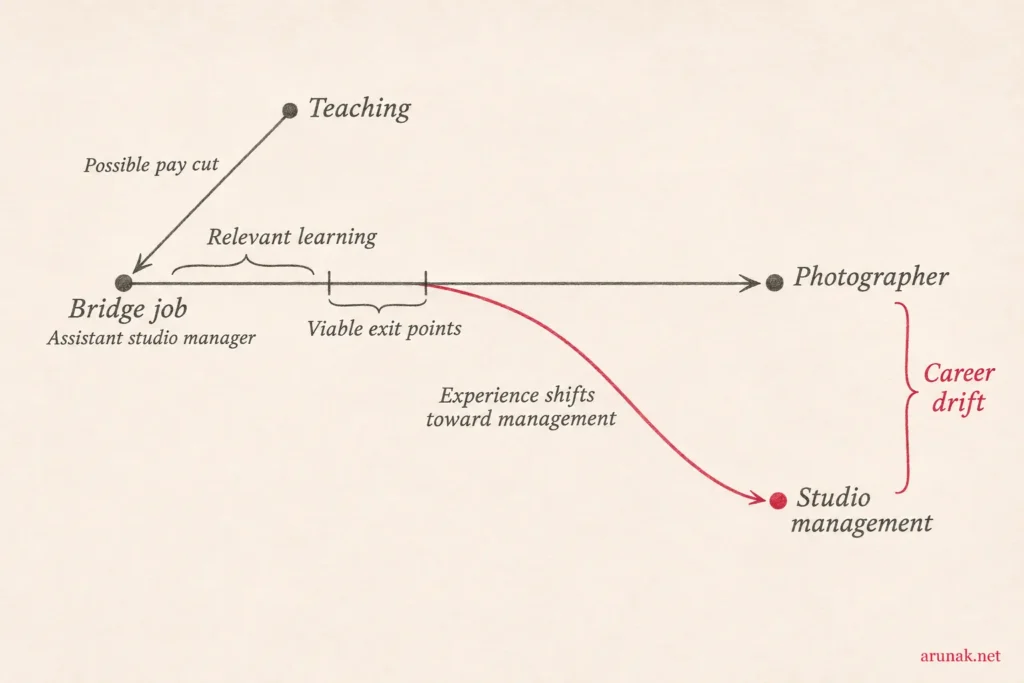
But now there’s a problem you didn’t anticipate when you first took the bridge job. Even though you’re now in the photography industry and understand how the business works, your professional experience is heavily weighted toward business management. You have no portfolio. Just a wealth of experience in business management. So instead of using the bridge job to get a foot in the door as a photographer, you’ve drifted further down the management path. It is as if you had no progress towards your goal at all.
Your life grows around the bridge job
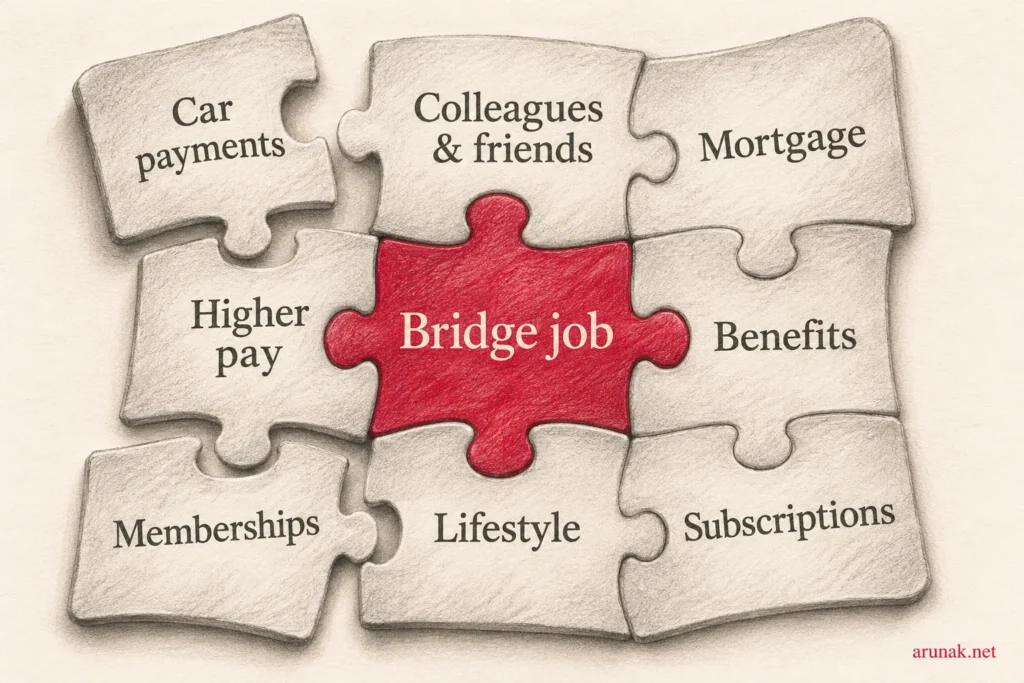
Another reason you might find yourself stuck in a bridge job is that you’ve started building your personal and professional life around it. This is called job embeddedness.1 And it’s exactly the situation I found myself in when I was taking a bridge job.
Job embeddedness takes place when:
- Your colleagues become part of your inner circle.
- You get attached to the benefits the bridge job provides.
- Your lifestyle grows around the job’s higher pay (car payments, a larger mortgage, and costly memberships or subscriptions, for example).
In the face of these attachments, you risk reshaping your idea of a “dream job” altogether.
But that raises the question: “If I’ve found people I enjoy working with, and this bridge job gives me the benefits and lifestyle I want, why throw it all away and look for another? Haven’t I accidentally found my dream job?” That’s a valid question. And a logical one, indeed. There might even be instances where the answer is “yes.” But that answer should hinge on one very important question: Will this job provide you with long-term fulfilment?
There’s a reason you chose to leave your previous job and take on a bridge job. You’re in pursuit of fulfilment. And fulfilment doesn’t necessarily boil down to having plenty of money to spend, the benefits the bridge job offers, or even the good friends you make at work. True, career fulfilment would probably benefit from all these things. But the question that carries the most weight is: “Do you enjoy what you do? And would you still enjoy the work itself if the money and benefits were stripped away?” Whether you earn $100,000 or $60,000 a year, have great colleagues to spend your days with, or have amazing health coverage, how satisfied you are at work plays a huge role in both your physical and mental well-being.2
You may feel like you’re enjoying it at the moment. But a career isn’t a sprint over 100 metres; it’s a marathon over many kilometres. A career spanning 40 years, at 40 hours a week for 50 weeks a year, adds up to roughly 80,000 working hours. That’s like working around the clock for more than nine years non-stop. You can gloss over your dissatisfaction for the first few metres, but you’ll have to face reality when you’re deep into this long-lasting marathon. So why not take some time to backtrack and set a course toward your dream career now?
Your bridge job could eat into the resources meant to take you toward your dream career
The point of a bridge job is to give you the extra time and/or money you need to prepare for your dream job. But if you don’t allocate that time and money toward it, you’re letting your bridge job consume the resources you meant to invest in your future.
For example, instead of building a portfolio on the side or establishing connections for your next job, you pour all your energy back into the bridge job (taking more responsibilities, spending money on unnecessary purchases). This creates a vicious cycle. It works like this:
- A lack of preparation for your next job pushes you to stay a little longer in your bridge job.
- But you again channel that extra time and money into other things—taking on more responsibilities in the bridge job or spending money on lifestyle upgrades instead of developing the skills you need for your next job.
- So now, you have to stay a little longer in the bridge job to save more money and buy yourself more time.
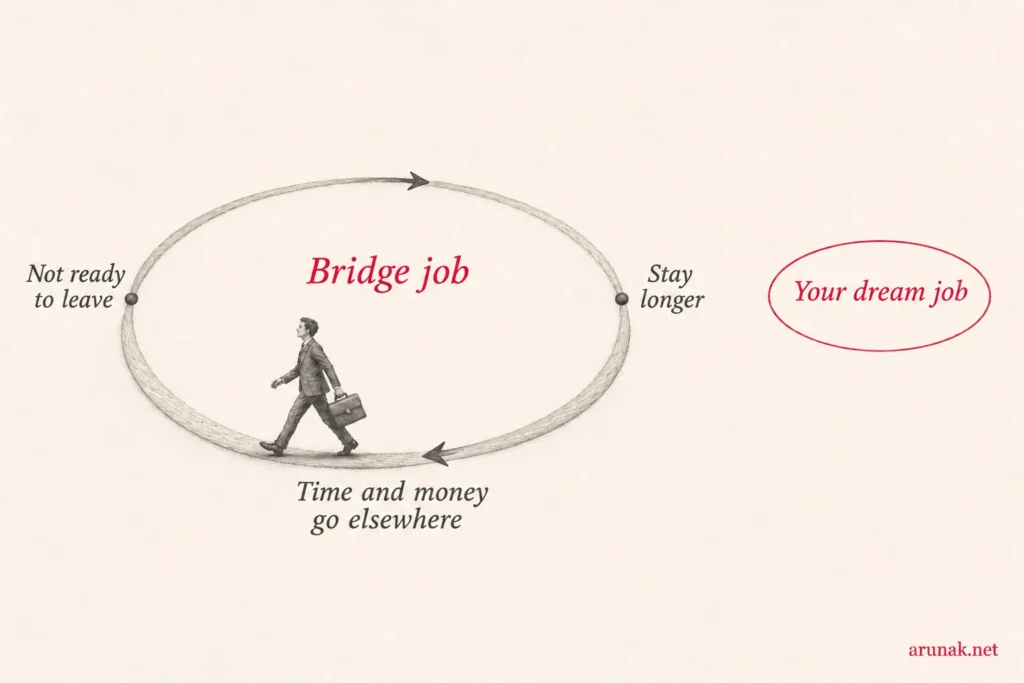
As your lack of preparation keeps pushing the transition further back, you eventually start convincing yourself that it isn’t possible at all. In other words, you are now trapped in your bridge job.
How to avoid getting stuck in a bridge job
So what can you do to avoid these traps and use a bridge job to move smoothly from your current job to your dream job?
Make your exit plan clear from the start
Even though I, too, got comfortable enough to risk falling into one of these traps, I was still able to pull myself back at the eleventh hour, thanks to that nervous—and even risky—remark I made at my job interview. I made it clear, both to myself and to the company, that I was just passing through. I’d announced my departure before I even accepted the job offer. Would I have had more peace of mind if I’d kept quiet in the interview, taken the job and promised myself I’d leave when the time came?
Of course.
I vividly remember a handful of times when a colleague or one of my managers asked, “So, how’s the job search going?” Even though I know that they meant well, I felt extremely uncomfortable with this question because I’d grown so comfortable in my bridge job that I kept putting off preparing my PhD applications.
Job embeddedness was slowly taking shape.
But that discomfort is what actually helped me to finally get my act together: preparing for my exams in time, looking for prospective graduate supervisors, learning about the field I wanted to enter, and finally leaving my bridge job to start a PhD overseas.
If possible, start your next career on the side
As mentioned, one of the biggest reasons why you’d get trapped in a bridge job is losing sight of the bigger picture. A practical way to prevent this from happening is to stay actively involved in the work you eventually want to do.
For example:
- If you plan to write full time but are currently in a bridge job, write 1,000 words a day and make a habit of publishing online—on Substack, Medium or your own website, for example. No matter how modest such a habit seems, it keeps you connected to your long-term goals. Even though you’re not writing full time yet, you already feel like a writer, which motivates you to leave your bridge job behind and move into writing full time.
- If your goal is to become an artist but you’re currently in a bridge job, making your own work, connecting with local artists each week, and attending meetings or workshops could potentially help you feel like an artist already.
- If your goal is to become a photographer but you’re currently in a bridge job, joining a community where you can get feedback on your work from other photographers helps you feel that you’re already part of that world.
Connect with people already doing the work you want to do
Building on the last point, connecting with people in your intended field not only helps you feel part of it, but also encourages you to stay the course when the transition gets difficult. Any healthy connection is valuable, whether you make it in your bridge job or outside work altogether. But they are bound to become more meaningful and strong over time when you create them with the people who love doing the same things that you love to do. These types of connections will ease the stress that comes with a career transition. They become shock absorbers, cushioning the bumps on the road toward your dream career.
Final thoughts
Getting up every day excited to go to work is slowly becoming a luxury only a few can afford in this fast-moving world. With so many layoffs and the prospect of AI making some careers obsolete, we’re continually being pushed to ask: “What do I really want to do in my professional life?”
Once you’ve figured out the answer and need to change careers, a bridge job can help close the skills gap standing between you and your dream job. However, you’ll only get the most out of it if you’re careful not to let it overshadow your long-term career goals.
Have you ever taken a bridge job, or are you in one right now? Feel free to share your experience in the comments below.
- Mitchell, T. R., Holtom, B. C., Lee, T. W., Sablynski, C. J., & Erez, M. (2001). Why people stay: Using job embeddedness to predict voluntary turnover. Academy of Management Journal, 44(6), 1102–1121. https://doi.org/10.5465/3069391. ↩︎
- Faragher, E. B., Cass, M., & Cooper, C. L. (2005). The relationship between job satisfaction and health: A meta-analysis. Occupational and Environmental Medicine, 62(2), 105–112. https://doi.org/10.1136/oem.2002.006734. ↩︎