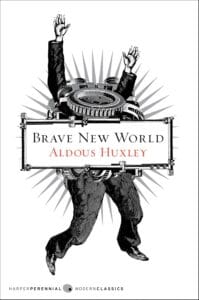
Snapshot
In Brave New World by Aldous Huxley, society is controlled through technology, genetic engineering, and psychological conditioning; all designed to preserve stability and happiness.
In this so-called “brave new world,” there are no mothers, no families, and no such thing as love. People are born in laboratories and divided into castes: some are engineered to be intellectually superior, like the ‘Alphas’, while others, like the ‘Epsilons’, are given just enough intelligence for routine labor.
When John, a man raised outside this system, is brought into this “civilized” world, his struggle to understand and ultimately reject its emptiness ends in tragedy.
Table of Contents
Summary
A world without flaws
A group of students enters the Central London Hatchery and Conditioning Centre. The world we know is gone; erased and replaced by something entirely new. Familiar words like marriage, sadness, love, family, home, and even mother have no meaning here. Is this a better world? The Director of the Conditioning Centre is certain that it is.
“My good boy!” The Director wheeled sharply round on him. “Can’t you see? Can’t you see?” He raised a hand; his expression was solemn. “Bokanovsky’s Process is one of the major instruments of social stability!”
Major instruments of social stability. Standard men and women; in uniform batches. The whole of a small factory staffed with the products of a single bokanovskified egg. (page 7)
Technology and science have taken full control over reproduction, human behavior, and even emotion. The new world’s entire order rests on three cornerstones: Community, Identity, and Stability.
“We condition the masses to hate the country,” concluded the Director. “But simultaneously we condition them to love all country sports. At the same time, we see to it that all country sports shall entail the use of elaborate apparatus. So that they consume manufactured articles as well as transport. Hence those electric shocks.” (page 23)
Everyone Belongs to Everyone Else
In a world with no mothers, everyone is born in a lab, designed to have a set level of intelligence. And from that, a caste system is born; Alphas at the top as the thinkers and leaders, then Betas, Gammas, and finally Epsilons, who do the heavy work.
“Frightfully clever. I’m really awfully glad I’m a Beta, because I don’t work so hard. And then we are much better than the Gammas and Deltas. Gammas are stupid. They all wear green, and Delta children wear khaki. Oh no, I don’t want to play with Delta children. And Epsilons are still worse. They’re too stupid to be able …” (page 27)
Everyone has their role in society, and they don’t question it, because they’re genetically engineered not to. Stability stays intact. This new world prizes stability above all and rejects chaos so completely that even the idea of a family is wiped out entirely. For this new world, there is a new motto: everyone belongs to everyone else.
“Mother, monogamy, romance. High spurts the fountain; fierce and foamy the wild jet. The urge has but a single outlet. My love, my baby. No wonder these poor pre-moderns were mad and wicked and miserable. Their world didn’t allow them to take things easily, didn’t allow them to be sane, virtuous, happy. What with mothers and lovers, what with the prohibitions they were not conditioned to obey, what with the temptations and the lonely remorses, what with all the diseases and the endless isolating pain, what with the uncertainties and the poverty—they were forced to feel strongly. And feeling strongly (and strongly, what was more, in solitude, in hopelessly individual isolation), how could they be stable?” (page 41)
“Family, monogamy, romance. Everywhere, exclusiveness, a narrow channelling of impulse and energy.
“But every one belongs to every one else,” he concluded, citing the hypnopædic proverb.” (page 40)
Even with all the constraints designed to keep people from feeling negative emotions, anger, rage, or sadness can still bubble up. The World State sees this as a defect, and it has a solution: soma, a “pleasant drug” used to control emotions and maintain social order. Soma takes away discomfort, unhappiness, and stress, all without any noticeable side effects.
“Now—such is progress—the old men work, the old men copulate, the old men have no time, no leisure from pleasure, not a moment to sit down and think—or if ever by some unlucky chance such a crevice of time should yawn in the solid substance of their distractions, there is always soma, delicious soma, half a gramme for a half-holiday, a gramme for a week-end, two grammes for a trip to the gorgeous East, three for a dark eternity on the moon; returning whence they find themselves on the other side of the crevice, safe on the solid ground of daily labour and distraction, scampering from feely to feely, from girl to pneumatic girl, from Electromagnetic Golf course to …”(page 55)
“Don’t you even understand what manhood and freedom are?” Rage was making him fluent; the words came easily, in a rush. “Don’t you?” he repeated, but got no answer to his question. “Very well then,” he went on grimly. “I’ll teach you; I’ll make you be free whether you want to or not.” And pushing open a window that looked onto the inner court of the Hospital, he began to throw the little pill-boxes of soma tablets in handfuls out into the area. (page 213)
Bernard Marx: The Misfit
Bernard Marx, an Alpha, looks at all of this with a sideways glance. He feels isolated in his own thoughts, yet brave enough to hold onto them and speak up. He doesn’t care for the shallow pleasures or the emptiness of this artificial world. He wants change. He wants to show others that one day, these ideas will collapse under their own weight, that this “imposed” stability isn’t permanent.
A Trip to the Savage Reservation
Bernard comes up with an idea. He’s going to visit a Savage Reservation. When this new world was built, it split into two parts. One part is where Bernard lives, a world built entirely around artificial stability. But some people didn’t want any part of it; they chose to live separately. This place is called the Savage Reservation.
“… about sixty thousand Indians and half-breeds … absolute savages … our inspectors occasionally visit … otherwise, no communication whatever with the civilized world … still preserve their repulsive habits and customs … marriage, if you know what that is, my dear young lady; families … no conditioning … monstrous superstitions … Christianity and totemism and ancestor worship … extinct languages, such as Zuñi and Spanish and Athapascan … pumas, porcupines and other ferocious animals … infectious diseases … priests … venomous lizards …” (page 103)
Here, Bernard and Lenina Crowne, an Alpha-Plus who accompanies him on the trip, meet Linda. Linda is a Beta who got stranded in the Savage Reservation when she was young, and the story of how she ended up there immediately catches Bernard’s interest. She had an affair with the Director of Hatcheries and Conditioning, also called Thomas “Tomakin”. Later, on the Reservation, Linda gives birth to her son, John, who will become a central figure in the story as John the Savage.
Bernard sees an opportunity to bring his message to the New World through John. In Bernard’s society, biological birth is frowned upon, yet even the Director broke that rule.
Huxley shows the reader that natural impulses can sometimes outweigh artificial stability.
John was “born a crime,” and Bernard wants both to bring him justice and to prove his point to the New World. So he asks John to come back with him.
But the young man had evidently not heard the question. “O wonder!” he was saying; and his eyes shone, his face was brightly flushed. “How many goodly creatures are there here! How beauteous mankind is!” The flush suddenly deepened; he was thinking of Lenina, of an angel in bottle-green viscose, lustrous with youth and skin food, plump, benevolently smiling. His voice faltered. “O brave new world,” he began, then—suddenly interrupted himself; the blood had left his cheeks; he was as pale as paper. (page 139)
The Arrival of the Savage
John the Savage arrives in the New World.
In every sense of the word, he is different in the eyes of everyone around him. Unlike the people of this world, he has been exposed to books from the Old World, especially Shakespeare. He talks differently, he thinks differently, and he sees this world—one he was excited to enter—as a mess, even though everyone else sees it as orderly and perfect.
He refuses to join in the artificial pleasures of this society, seeing them as empty and degrading.
Yet despite all this, the public is fascinated by him.
Riding that social momentum, Bernard, who brought John to the New World, gains fame and approval because of John’s popularity.
A World Without Pain and Sorrow
John, on the other hand, begins to question what it truly means to be human.
In the 17th chapter of the book, these two worldviews collide.
On one side is Mustapha Mond, one of the leaders of the New World, and on the other is John, the Savage. Mond admits that truth, beauty, and freedom have been sacrificed in the name of stability.
Knowledge was the highest good, truth the supreme value; all the rest was secondary and subordinate. True, ideas were beginning to change even then. Our Ford himself did a great deal to shift the emphasis from truth and beauty to comfort and happiness. Mass production demanded the shift. Universal happiness keeps the wheels steadily turning; truth and beauty can’t. And, of course, whenever the masses seized political power, then it was happiness rather than truth and beauty that mattered.
Still, in spite of everything, unrestricted scientific research was permitted. People still went on talking about truth and beauty as though they were the sovereign goods. Right up to the time of the Nine Years’ War. That made them change their tune all right. What’s the point of truth or beauty or knowledge when the anthrax bombs are popping all around you? That was when science first began to be controlled—after the Nine Years’ War. People were ready to have even their appetites controlled then. Anything for a quiet life. We’ve gone on controlling ever since. It hasn’t been very good for truth, of course. But it’s been very good for happiness. One can’t have something for nothing. Happiness has got to be paid for. You’re paying for it, Mr. Watson—paying because you happen to be too much interested in beauty. I was too much interested in truth; I paid too. (page 228)
“My dear young friend,” said Mustapha Mond, “civilization has absolutely no need of nobility or heroism. These things are symptoms of political inefficiency. In a properly organized society like ours, nobody has any opportunities for being noble or heroic. Conditions have got to be thoroughly unstable before the occasion can arise. Where there are wars, where there are divided allegiances, where there are temptations to be resisted, objects of love to be fought for or defended–there, obviously, nobility and heroism have some sense. But there aren’t any wars nowadays. The greatest care is taken to prevent you from loving any one too much. There’s no such thing as a divided allegiance; you’re so conditioned that you can’t help doing what you ought to do. And what you ought to do is on the whole so pleasant, so many of the natural impulses are allowed free play, that there really aren’t any temptations to resist. And if ever, by some unlucky chance, anything unpleasant should somehow happen, why, there’s always soma to give you a holiday from the facts. And there’s always soma to calm your anger, to reconcile you to your enemies, to make you patient and long-suffering. In the past you could only accomplish these things by making a great effort and after years of hard moral training. Now, you swallow two or three half-gramme tablets, and there you are. Anybody can be virtuous now. You can carry at least half your mortality about in a bottle. Christianity without tears–that’s what soma is.” (page 237)
But John isn’t willing to accept this “new truth.” He sees the cracks in the artificial reality around him and recognizes that the world is only peaceful because people’s right to think and feel has been suppressed.
“But I like the inconveniences.”
“We don’t,” said the Controller. “We prefer to do things comfortably.”
“But I don’t want comfort. I want God, I want poetry, I want real danger, I want freedom, I want goodness. I want sin.”
“In fact,” said Mustapha Mond, “you’re claiming the right to be unhappy.”
“All right then,” said the Savage defiantly, “I’m claiming the right to be unhappy.”
“Not to mention the right to grow old and ugly and impotent; the right to have syphilis and cancer; the right to have too little to eat; the right to be lousy; the right to live in constant apprehension of what may happen tomorrow; the right to catch typhoid; the right to be tortured by unspeakable pains of every kind.” There was a long silence.
“I claim them all,” said the Savage at last.
Mustapha Mond shrugged his shoulders. “You’re welcome,” he said. (page 240)
The Savage’s Revolt
After this conversation, John makes up his mind. He wants to stay away from this “Brave New World.” He isolates himself, moving away from civilization to live a simple, pure life.
He constantly struggles with guilt, desire, and his own faith. To the people of the New World, John becomes a laughingstock, turned into a source of entertainment. News crews are sent to track him down and record him, mocking his misery.
Overcome by despair and hopelessness, John ultimately takes his own life.
Ideas that resonate with me
Huxley’s Warning for the Future
In the world Huxley created, truth, freedom, and depth of feeling are sacrificed for the sake of societal happiness, order, and stability.
This begs the question: can they not coexist in some kind of equilibrium while still maintaining a sustainable society? Huxley’s world is built on the premise that we cannot.
“My dear young friend,” said Mustapha Mond, “civilization has absolutely no need of nobility or heroism. These things are symptoms of political inefficiency. In a properly organized society like ours, nobody has any opportunities for being noble or heroic. Conditions have got to be thoroughly unstable before the occasion can arise. Where there are wars, where there are divided allegiances, where there are temptations to be resisted, objects of love to be fought for or defended–there, obviously, nobility and heroism have some sense. But there aren’t any wars nowadays. (page 237)
But in later chapters, after John the Savage enters the story, Huxley also reveals the pitfalls of such a tightly controlled society. Through John’s character, the reader sees that a world prioritizing comfort and stability above all else may appear happy on the surface, but it does so at the cost of what makes life fully human.
Huxley’s warning, in the simplest sense, is that utopian ideals would not work in the real world.
This leads us to ask: what is the solution, then?
We can only turn to history for answers; and the answer can be boiled down to a single word: compromise.
As the economist Thomas Sowell puts it, “There are no solutions, only trade-offs.”
What does John’s death symbolize
At the end of the book, John the Savage dies alone and isolated, frustrated by the very ideals he had held so dearly, if only for a short time. In the New World, truth and freedom are suppressed to maintain stability; but as an individual living in this world, John cannot see that as a solution.
“But I like the inconveniences.”
“We don’t,” said the Controller. “We prefer to do things comfortably.”
“But I don’t want comfort. I want God, I want poetry, I want real danger, I want
Freedom, I want goodness. I want sin.”
“In fact,” said Mustapha Mond, “you’re claiming the right to be unhappy.”
“All right then,” said the Savage defiantly, “I’m claiming the right to be unhappy.” (page 240)
John’s death symbolizes the destruction of individuality in a world built on control. The book makes us ask: can an individual ever be truly satisfied if the world is designed solely to maintain social stability?
Why did Huxley invent Lenina?
Until I stepped back from the story, I didn’t fully see the importance of the character Lenina Crowne to the story; an Alpha-Plus at the top of the hierarchy in Huxley’s caste system.
One of the main reasons Huxley created her is to highlight the contrast between the New World and the Savage World; from Lenina to John.
Another reason is to show that even at the very top of the hierarchy, in the most stable society, an individual is not truly satisfied, showing that utopian ideals simply don’t work.
Generalities are intellectually necessary evils
“Just to give you a general idea,” he would explain to them. For, of course, some sort of general idea they must have, if they were to do their work intelligently, though as little of one, if they were to be good and happy members of society, as possible.
For particulars, as everyone knows, make for virtue and happiness; generalities are intellectually necessary evils. (page 4)
Even in the world Huxley created, where truth and freedom are suppressed, general knowledge is still essential for keeping society running. Without some level of knowledge, no one could perform well enough for the world to function as a whole.
But this also shows that “knowledge” can be a problem for a utopian world. People need just enough general ideas to do their work—but ideally, as few as possible—so they can be “good and happy members of society.”
This line, “Generalities are intellectually necessary evils”, is the perfect summary of the theme of the novel: a society that values stability and happiness above individual virtue, conditioning people to accept general ideas while avoiding particulars that might lead to unhappiness.
Parts that left a mark on me
One of the students held up his hand, and though he could see quite well why you couldn’t have lower-caste people wasting the Community’s time over books, and that there was always the risk of their reading something which might undesirably decondition one of their reflexes, yet… well, he couldn’t understand about the flowers. Why go to the trouble of making it psychologically impossible for Deltas to like flowers?
Patiently, the D.H.C. explained. If the children were made to scream at the sight of a rose, that was on grounds of high economic policy. Not so very long ago (a century or thereabouts), Gammas, Deltas, even Epsilons, had been conditioned to like flowers — flowers in particular and wild nature in general. The idea was to make them want to be going out into the country at every available opportunity, and so compel them to consume transport.
“And didn’t they consume transport?” asked the student.
“Quite a lot,” the D.H.C. replied. “But nothing else.” (page 22)
A love of nature keeps no factories busy. (page 23)
“We condition the masses to hate the country,” concluded the Director. “But simultaneously we condition them to love all country sports. At the same time, we see to it that all country sports shall entail the use of elaborate apparatus, so that they consume manufactured articles as well as transport. Hence those electric shocks.” (page 23)
Wheels must turn steadily, but cannot turn untended. There must be men to tend them, men as steady as the wheels upon their axles, sane men, obedient men, stable in contentment. (page 42)
“Even an Epsilon …” Lenina suddenly remembered an occasion when, as a little girl at school, she had woken up in the middle of the night and become aware, for the first time, of the whispering that had haunted all her sleeps. She saw again the beam of moonlight, the row of small white beds; heard once more the soft, soft voice that said (the words were there, unforgotten, unforgettable after so many night-long repetitions): “Every one works for every one else. We can’t do without any one. Even Epsilons are useful. We couldn’t do without Epsilons. Every one works for every one else. We can’t do without any one …” Lenina remembered her first shock of fear and surprise; her speculations through half a wakeful hour; and then, under the influence of those endless repetitions, the gradual soothing of her mind, the soothing, the smoothing, the stealthy creeping of sleep. … (page 74)
“A New Theory of Biology” was the title of the paper that Mustapha Mond had just finished reading. He sat for some time, meditatively frowning, then picked up his pen and wrote across the title-page: “The author’s mathematical treatment of the conception of purpose is novel and highly ingenious, but heretical and, so far as the present social order is concerned, dangerous and potentially subversive. Not to be published.” He underlined the words. “The author will be kept under supervision. His transference to the Marine Biological Station of St. Helena may become necessary.”
A pity, he thought, as he signed his name. It was a masterly piece of work. But once you began admitting explanations in terms of purpose—well, you didn’t know what the result might be. It was the sort of idea that might easily decondition the more unsettled minds among the higher castes—make them lose their faith in happiness as the Sovereign Good and take to believing, instead, that the goal was somewhere beyond, somewhere outside the present human sphere, that the purpose of life was not the maintenance of well-being, but some intensification and refining of consciousness, some enlargement of knowledge. Which was, the Controller reflected, quite possibly true. But not, in the present circumstance, admissible.
He picked up his pen again, and under the words “Not to be published” drew a second line, thicker and blacker than the first; then sighed, “What fun it would be,” he thought, “if one didn’t have to think about happiness!” (page 177)
How did the book change the way I think?
There are no solutions, only trade-offs.
Coffee chat
Summarize Brave New World by Aldous Huxley in one paragraph.
In Brave New World by Aldous Huxley, society is controlled through technology, genetic engineering, and psychological conditioning; all designed to maintain stability and happiness. In this so-called “brave new world,” there are no mothers, no families, and no such thing as love. People are born in laboratories and genetically predisposed into different castes: some, like the Alphas, are intellectually advanced, while others, like the Epsilons, are given just enough knowledge for labor. When John, a man raised outside this system, is brought into this “civilized” world, his struggle to understand, and ultimately reject, its emptiness leads to tragedy.
What is the deeper meaning of the ending of Brave New World?
The ending, where John the Savage takes his own life, shows that in a world built to keep society stable and happy, individual freedom gets completely crushed.
How does Brave New World compare to other dystopian novels?
Books like 1984 by George Orwell, Fahrenheit 451 by Ray Bradbury, We by Yevgeny Zamyatin, and The Giver by Lois Lowry show different dystopian visions, all connected in some way to Brave New World.
In 1984, a totalitarian government monitors everything—surveillance, thought, even the truth—creating a darker, more politically oppressive world than Brave New World. In many ways, this is the antithesis of Huxley’s vision.
Fahrenheit 451 shows a society where books are banned and “firemen” burn them to enforce conformity, to make sure that the government holds the control of knowledge.
In We, citizens are strictly regimented and identified by numbers instead of names. This is a world that is directly influenced by both Orwell and Huxley.
And The Giver, the novel most similar to Brave New World on this list, shows a seemingly perfect society where memory, emotion, and choice are tightly controlled, highlighting the cost of stability and what is lost when individuality is suppressed, just as in Huxley’s world.
Why didn’t John the Savage escape or change his fate?
He’s stuck between two worlds and hates being part of either. Back in the Savage Reservation where he grew up, nothing—truth, freedom, choice—is controlled, but love, beauty, morality, and individuality don’t really matter there. And he wants them to. So he moves to the New World, only to see that individuality is deliberately crushed to keep everything stable. Even if he went back, his inner conflict wouldn’t go away. So he does the next best thing. He isolates himself from both worlds. But soon he realizes isolation isn’t the answer either, because being alone just makes his inner struggles worse, and that’s what eventually leads to his death.
What does the title Brave New World mean?
It refers to a radical, utopian world where truth and individuality are suppressed to keep the social order intact.
Who is the narrator, and why does it matter?
There’s no single narrator in Brave New World by Aldous Huxley. Instead, the narrator is all-knowing—able to move freely between the thoughts, feelings, and actions of multiple characters like Bernard Marx, Lenina Crowne, John the Savage, and Mustapha Mond.
How does this story compare to 1984 by George Orwell?
Brave New World by Aldous Huxley is the complete opposite of 1984 by George Orwell. In Huxley’s world, people are made to love their servitude through genetic engineering, psychological conditioning, and the drug soma. There’s no need for violence; people are naturally happy and follow the rules because there’s no reason not to. In contrast, in 1984, the state led by Big Brother stays in power through surveillance, torture, and strict censorship. People follow the rules because they’re terrified.
What is the significance of soma in Brave New World?
Soma keeps people from feeling negative emotions. But even with all the constraints meant to stop anger, rage, or sadness, these feelings can still pop up. The New World sees this as a defect, and they have a solution: soma, a “pleasant drug” used by the World State to control emotions and keep society in order. It takes away discomfort, unhappiness, and stress without any noticeable side effects.
