
TL;DR
- “Follow your passion” sounds generous, hopeful, and personal, which is exactly why it became such popular advice over the years.
- But as a guide to a prosperous career, it is too vague to carry that much weight.
- That does not mean that having a passion for your work is meaningless. It is just too thin, unstable, and incomplete to function as a career strategy.
- Instead, a more reasonable question to ask is how to build a career where your strengths, motivations, tolerances, and real-world constraints begin to align in a form of work the world actually needs.
- In that sense, passion is often not the starting point, but the result of progress, skill, and a better career fit.
“Follow your passion” may be the most repeated piece of career advice in the modern world.
From Richard N. Bolles’s What Color Is Your Parachute?, first published in 1970, to Steve Jobs’s Stanford commencement speech in 2005, the idea has been repeated, recycled, and elevated into one of the most celebrated mantras of modern career thinking. And it reigned supreme for so long for a very good reason.
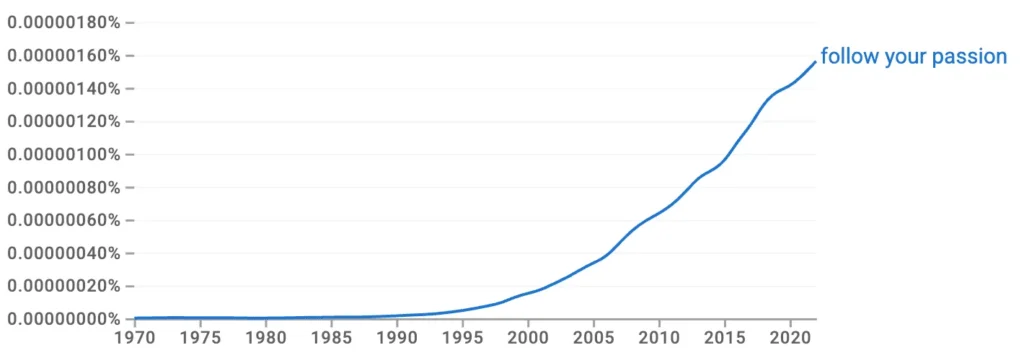
“Follow your passion” sounds generous, personal, and hopeful. It sounds like noble advice meant to rescue a person from a life of dull compromise. It tells us that somewhere inside us there is a truer calling than just duty, status, or money, and that if we’re brave enough to follow it, the rest of life will begin to make sense.
That’s a powerful promise. And so the idea stuck.
But on the practical side of things, it hasn’t delivered that promise very well.
A recent Gallup survey reported that only 31% of U.S. employees were engaged at work in 2024, down from 36% in 2020. Engagement is a more precise and direct descriptor than passion. It measures involvement, enthusiasm, and psychological investment in work. And the numbers deliver a concerning, somewhat contradictory message.
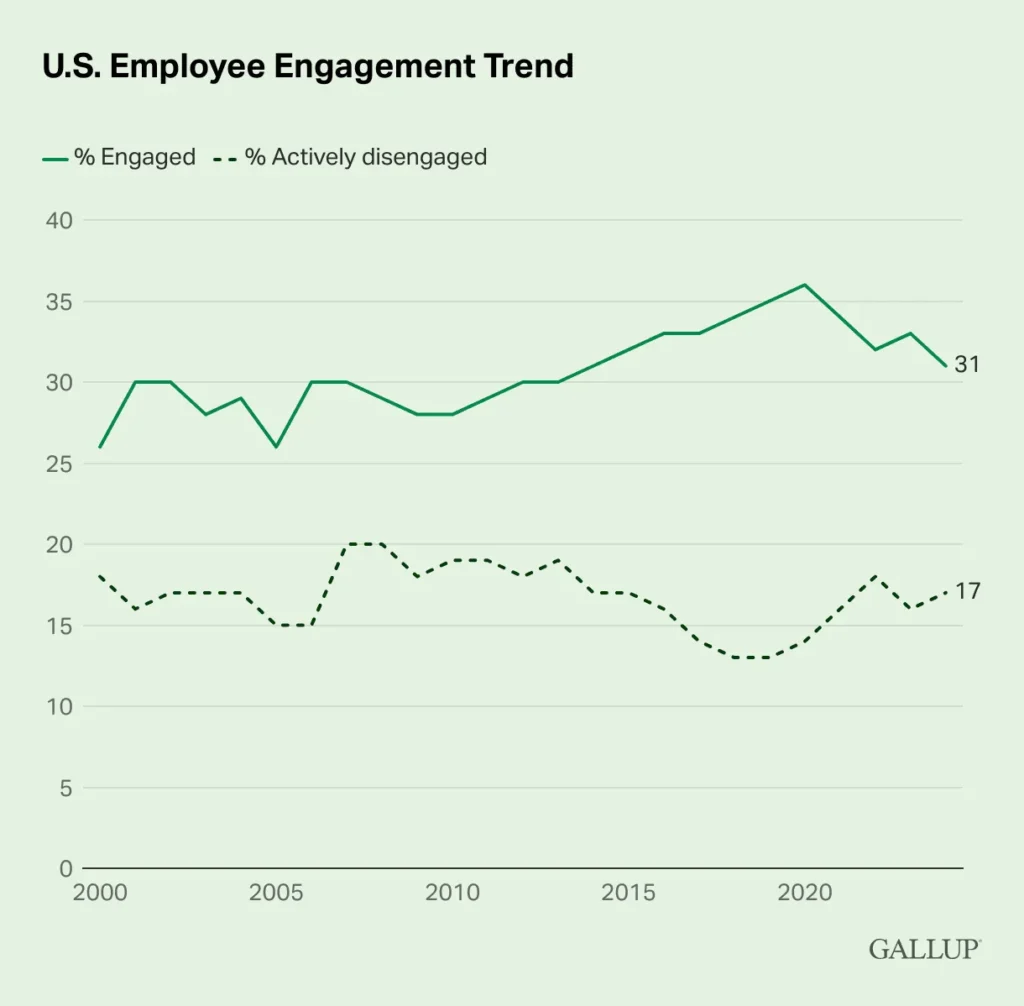
If “follow your passion” worked the way we’re told it does, we’d expect more people to be thriving once they found work they cared about. But the data points the other way. Even as the cultural pressure to find your passion has grown over the past decades, the share of people deeply engaged in their work remains stubbornly low.
And that’s only part of the problem.
The advice doesn’t just fail to guide people into satisfying careers. It also makes uncertainty feel like a defect. If passion is supposed to come first, then anyone who doesn’t feel a clear calling is left with the sense that something is inherently wrong with them. That breeds confusion. They feel as if everyone else was given clearer instructions for life, and somehow they missed the memo.
But maybe we’re just barking up the wrong tree. Maybe the real problem isn’t the person. It’s the advice itself.
The trouble with “follow your passion” is not, of course, that passion is meaningless. It’s that passion is too vague, too unstable, and too incomplete to build anything worthwhile on. A career isn’t built by chasing a feeling. It’s built by finding a form of work where a deeper set of strengths, motivations, tolerances, and constraints begin to lock into place. That’s far more sophisticated than passion.
True, it’s a harder inner dialogue. But the right questions rarely are simple.
So this post isn’t just about why “follow your passion” fails. It’s also about what to replace it with in pursuit for a better answer.
Key Takeaways:
- “Follow your passion” is popular because it touches on something true: The advice lasts because it recognizes that people are different, that work should involve more than obedience and wages, and that personal identity matters. But it becomes misleading when it turns a complicated career problem into a simple emotional one.
- Passion is usually not fully formed at the beginning of a career: One of the central mistakes in the phrase “follow your passion” is the assumption that passion already exists in a clear and reliable form. But interests often become legible only after gaining experience and building skills, not before.
- Admiration is not the same as fit: A person can love books and hate publishing, love science and hate academia, or love writing and dislike the actual role structures that come with writing careers. Career fit is revealed in practice, not in abstraction.
- Skill, progress, and mastery come before durable passion: Passion often follows competence, progress, and trust. In other words, people frequently become passionate after they get good enough to feel good.
- Constraints are not a side issue: Money, geography, credentials, time, family obligations, and risk tolerance are not enemies of authenticity. They are part of the terrain. Any career advice that ignores them becomes not just vague, but unfair.
- The real task is translation, not revelation: The question is not “What am I passionate about?” but “How do I translate my core strengths into a role the world can recognize and appreciate?”
- Better career decisions come from fit, not feeling: The replacement for “follow your passion” is to start with core strengths, understand motivation in a more mature way, take societal constraints seriously, run small experiments, and let passion emerge from stronger career fit.
Table of Contents
Why “follow your passion” became such powerful advice
But before getting there, it is worth asking a more basic question: if this advice fails so often in practice, why did it become so powerful in the first place?
Bad advice often survives the test of time because it contains something true in it. And that is part of the reason why “follow your passion” has lasted and thrived.
“Follow your passion” recognizes, at least vaguely, that people are different. It pushes against the old industrial era idea that work is only duty, wages, and obedience. So the idea gives people some breathing room, and a sense of unique identity. It suggests that there is a personal dimension entangled with career choice. That is not wrong, at least not entirely.
It also promises relief. Career choices are messy as they are, so people are naturally drawn to any principle that seems simple and clean. “Follow your passion” turns this messy problem into an emotionally appealing one. Instead of thinking about strengths, constraints, role structure, market reality, and long-term fit, you are told to look inward and identify a feeling.
That is not a bad instinct. And to some extent, it has a seductive elegance that makes the whole process feel more personal, more meaningful, and more manageable than it really is.
It also fits the modern idea of work really well. Many people no longer want work just for the sake of it. They want it to be meaningful. They want it to express something about who they are. In other words, they want not just income, but identity.
Again, that desire is understandable. But it is also part of the trap.
When work is asked to provide money, identity, meaning, belonging, and self-expression all at once, people start looking for a kind of perfect fit that rarely exists at the beginning of a career. They do not just want a decent role. They want revelation.
This is one reason books like Simone Stolzoff’s The Good Enough Job and Carolyn Chen’s Work Pray Code are so useful. They show, in different ways, how modern work has expanded beyond wages into identity, belonging, and even quasi-religious meaning.
That is how “follow your passion” becomes so powerful. It wraps a practical question in a spiritual language.
What “follow your passion” gets wrong
1. It treats passion as something you discover fully formed
One of the main weaknesses of this advice is that it assumes passion already exists in a clear and reliable form, and that all you have to do is find it.
But more often than not, that is not the case.
The reason for this is that the roles that keep us economically viable are socially constructed, whereas human beings are biologically constructed. Nature does not care whether we make money. In evolutionary terms, it cares that we survive and carry life forward. So there is no reason to expect our inborn tendencies to line up neatly with the roles a given society happens to reward.
True, we are born with different capabilities. Some people are more athletic than others. Some are more verbally sharp, more analytical, more patient, more coordinated, or perform better under pressure. But that does not mean we are born for socially constructed roles. Rather, we have to navigate our core abilities into the roles that are available to us.
The lack of this understanding becomes a huge problem. It creates the false expectation that the right path should feel obvious. If it does not, people assume something is terribly wrong. They conclude that they have not found their thing yet, and so they keep searching for it instead of looking for the evidence that could lead them toward better work, better direction, and eventually a more satisfying life.
This expectation has become so common that it now shapes how many people think about work before they have even had enough experience to judge it well.
That is part of what makes the research by Paul O’Keefe, Carol Dweck, and Gregory Walton so useful. In their 2018 paper, they argue that the common advice to “find your passion” can encourage a fixed view of interests, as if they are fully formed and simply waiting to be discovered. They found that this mindset was more likely to dampen curiosity outside a person’s current interests and make difficulty at work feel like evidence of poor fit. In other words, the advice may not only be unhelpful. It may actively distort how people approach career growth.
A better way to think about it is that interest often develops through contact, effort, and increasing understanding.
A person may begin with only a vague attraction to a field, then grow into deeper interest only after they understand its structure, language, and standards. In many serious pursuits, the work becomes interesting after this stage of comprehension, not before.
This is the core argument of Cal Newport’s So Good They Can’t Ignore You. He argues that instead of waiting for passion to appear first, you should build what he calls career capital: rare and valuable skills that can later be used as leverage to shape your working life. On this view, passion is often the result of mastery, not the starting point.
This is why waiting for total clarity is such a mistake. It asks for a fully formed feeling before the underlying conditions for that feeling have even been built.
2. It confuses excitement with fit
Just because something is interesting from a distance does not mean it should become our thing for life.
Life is not static. It is always changing, unfolding, and surprising us in ways that make it hard to see the deeper patterns, which is why what first looks disappointing can sometimes be a blessing in disguise. That creates hope, and a certain admiration for life. It makes us curious about what happens next, and leads us into modest fantasies about who we might become.
But admiration, curiosity, and fantasy have little to do with career fit, at least not directly.
You can love books and hate the publishing industry. You can love science and hate academic life. You can love photography and hate client work, or the financial side of it. You can admire law, medicine, or entrepreneurship without actually being suited to the pressures, schedules, incentives, and forms of responsibility that come with those paths.
This is where a lot of people get stuck. They choose based on the symbolic image of the role rather than the everyday reality of it.
In other words, career decisions are often distorted by abstraction. People carry a pre-formed, often unrealistic, distant image of what a job means before they learn what it actually demands in practice.
But career fit lives only in practice.
So the real question is not whether you admire a field. It is whether the actual form of the work suits your strengths, tolerances, motivations, and desired life structure as a whole.
3. It ignores skill, progress, and mastery
Coming back to Cal Newport’s argument, the point is not that passion is irrelevant. It is that passion is more often the result of progress than the starting signal.
Because in the very beginning, we do not even know what we do not know. In many careers, people become deeply engaged only after they build real skill, gain trust, and begin to experience progress from the inside.
It is like the relationship between a foundation and a house. If the foundation is built without a clear plan, if you just wing it, everything that comes after will eventually crack under its own weight. The foundation has to be engineered first. It has to be measured, stable, and able to carry load. Only then can you build the house that matches your imagination. You can build a beautiful house out of vision, but you cannot build a sound foundation out of vision alone.
That order holds up especially well in the long run.
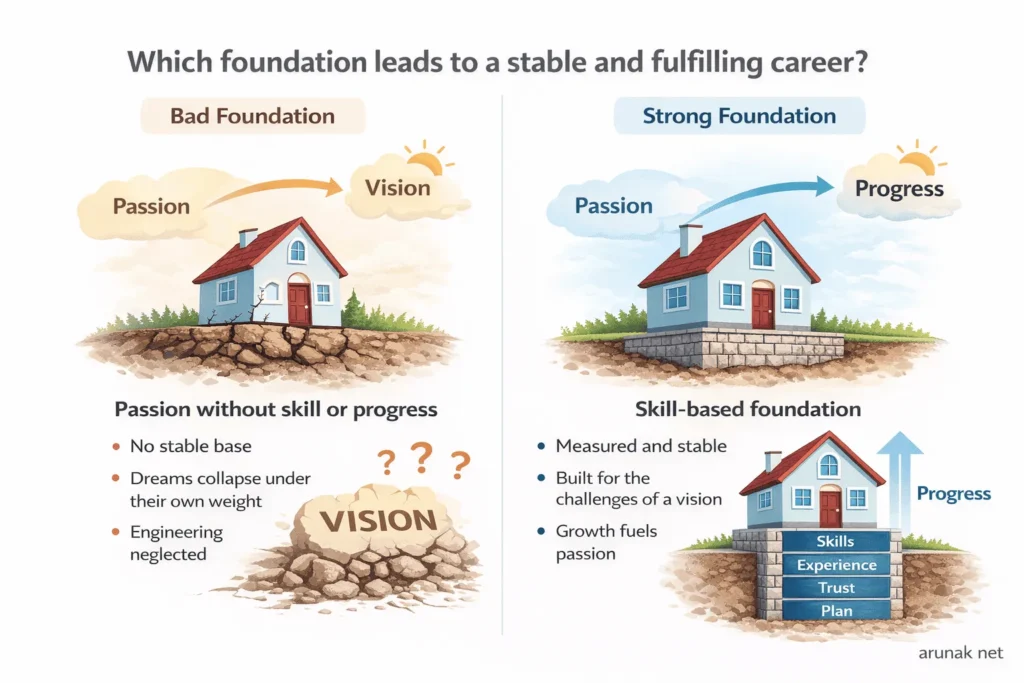
What usually happens in career advice is that this sequence gets inverted. People are told to begin with a feeling and build a life around it. It is like designing the dream house first and hoping the ground will somehow learn to hold it.
Newport argues, more plausibly, through many real-world examples, that people who become deeply satisfied with their work often build valuable skills first, then gain the leverage to shape better work, and only then come to love what they do.
This idea also fits what motivation research has been saying for years. Self-Determination Theory, associated most closely with Richard Ryan and Edward Deci, argues that autonomy, competence, and relatedness are core conditions that support high-quality motivation and engagement.
This is a far more serious and systematic model than waiting for a mystical inner signal.
In other words, we often become passionate about things after we get good enough to experience progress in them.
This means you do not need to start with a grand passion. You may need to start with the capacity to improve, to sharpen your skills, and to build something real enough that passion has somewhere to attach itself.
4. It ignores privilege and constraints
This is where the advice stops being merely vague and becomes unfair.
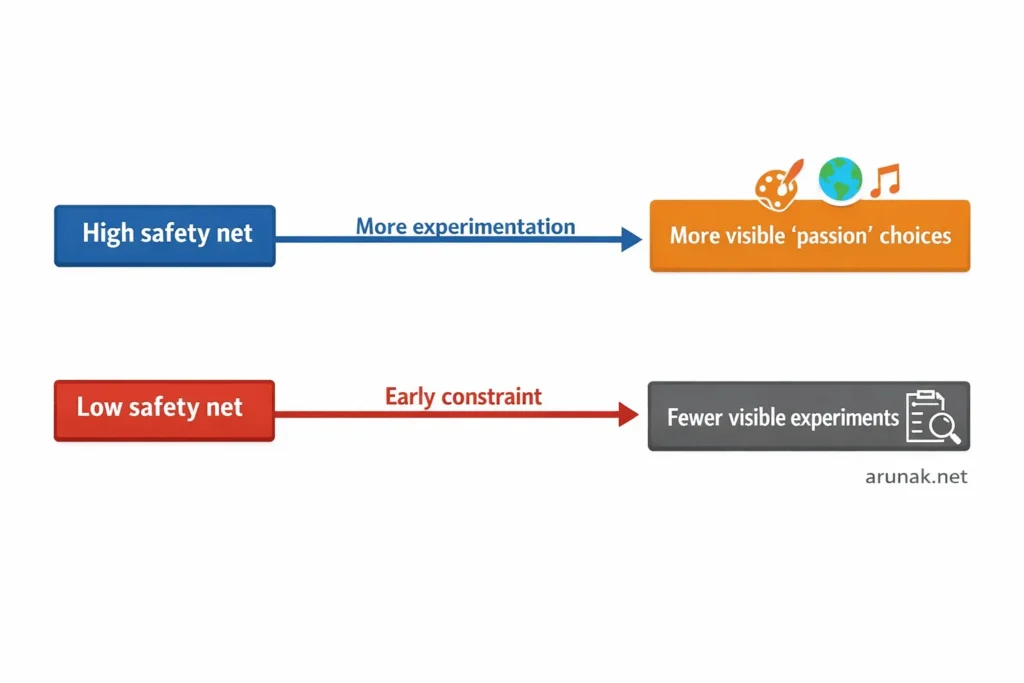
Some people can afford low-paid apprenticeships, uncertain detours, expensive training, or long periods of trial and error. Others simply cannot. Some people have financial support, strong networks, geographic flexibility, or family backup. Not everybody is given the same starting point.
Advice that pretends otherwise flatters the fortunate and confuses everyone else.
This is one of the strongest points in Erin Cech’s The Trouble with Passion. Her argument is that passion is not just an innocent personal value. It has become a social ideal, what she calls the passion principle, and that ideal can reproduce inequality because it asks people to organize work around self-expression and devotion in a world where the ability to do so is unevenly distributed.
Although the idea of passion-seeking is extremely popular among college-educated and non-college educated workers alike, the opportunities for, and the consequences of, “following your passion” can vary dramatically. Increased automation and outsourcing have meant that workers without a college degree are much less likely to have access to jobs with tasks that people might conceivably be passionate about. But even with a college degree, working-class and first-generation college graduates are more likely to end up in low-paying unskilled jobs when they pursue their passion than their wealthier peers. In other words, passion-seeking is a goal for most workers, regardless of class background or education, but there are wide discrepancies in who is ultimately able to parlay their passion into stable, well-paid jobs.
So what happens when we pretend that everyone starts from the same place?
People with stronger safety nets can take low-paid but meaningful work, tolerate uncertainty, and eventually convert that into prestige. People without those buffers are often told that their realism is evidence of cowardice.
I should also note that the argument I am making here is not that competitive advantage is purely self-made or untouched by social conditions, though as a society we should do our best to make sure people have something closer to equality of opportunity.
At the same time, I also believe this is part of how society moves forward. People see that life is not fair, and still push beyond their circumstances to make progress anyway. Over time, this creates a generational growth that moves the entire society forward.
But as individuals, living through only a small fraction of that larger movement, we also have to understand that change happens gradually. And if we want to be part of that progress, we have to look inward and figure out our most realistic source of competitive advantage.
Then we have to map that out, as honestly as we can, to where we want to go in life.
The notion that we can do anything is often naive. It does not help us, and it does not help the people we are trying to serve by doing our work well in the career we choose.
The real problem: passion is not a career strategy
By this point, we can see the problem with the whole “follow your passion” framework.
“Follow your passion” fails not because passion is unimportant, but because it is often too thin a category to guide a major life decision. A person, and the contribution that person can make, is much deeper than a feeling.
A person has recurring strengths, characteristic weaknesses, attention patterns, tolerances, motivational structures, and ways of responding to pressure. They also live inside a world of constraints, institutions, incentives, and available forms. Careers are not pure expressions of the self. They are social roles.
This means the real problem is not how to find a passion. It is how to translate yourself more truthfully into a form of service that others can recognize and use.
A good career is not simply one you feel excited about. It is one that translates your deeper profile, your core strengths, into a role that the world can recognize and appreciate.
This translation is the real work. And obviously, it is not that easy accomplish.
Once you see this, the weakness of passion-first advice becomes obvious. It skips almost the entire middle.
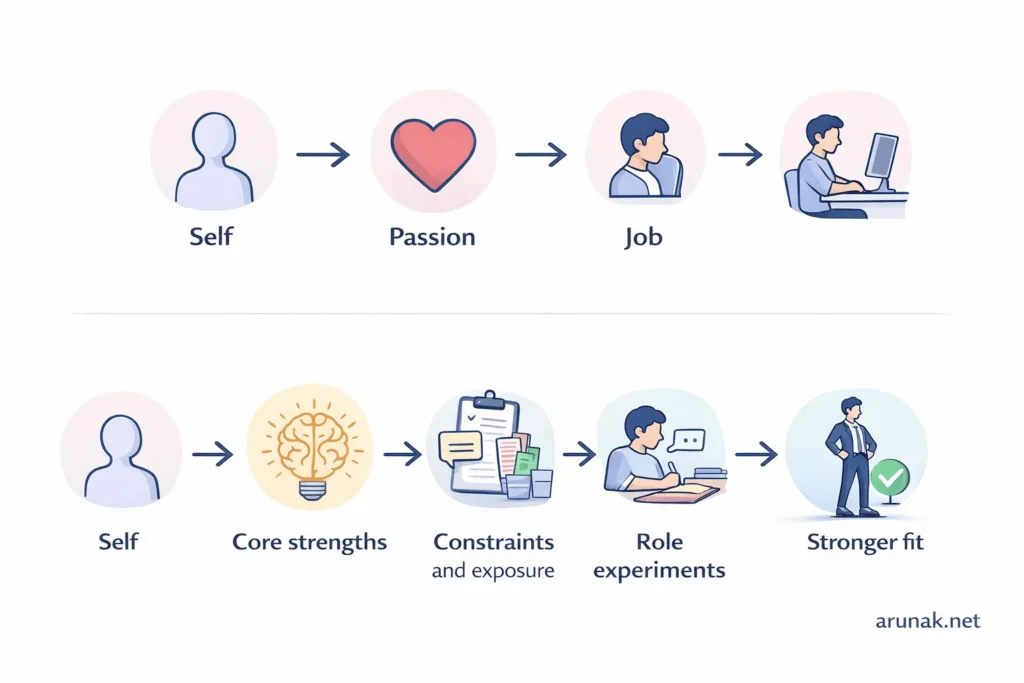
It imagines the path as:
Self → Passion → Job
But the real process looks more like this:
Self → Core strengths → Constraints and exposure → Role experiments → Feedback → Stronger fit
That is a much slower progress. It’s also less romantic. But much more practical and useful.
And it explains something very important: passion may still matter, but it is often better treated as feedback than as the entire instruction manual.
What to do instead of following your passion
So the question that immediately follows is: if passion is not enough, what should people do?
The answer is that they should build toward career fit. In other words, work towards contribution, not passion.
This means starting with a more logical basis than emotion alone and moving through real constraints rather than around them.
1. Start with your core strengths
Do not begin by asking what excites you in the abstract. Begin with patterns.
- What do you learn unusually fast compared to others?
- What kinds of problems hold your attention?
- What kinds of difficulty do you tolerate better than most people?
- What do others consistently trust you for?
- Under what kinds of pressure do you become more focused rather than less?
This is closer to what people are often trying to get at when they talk about flow.
These questions are not glamorous, but they are far more useful than waiting for a revelation to happen on its own. Your life already contains clues. All you have to do is look for recurring evidence, not feelings.
2. Look at motivation in a more mature way
Motivation is not singular.
There is a big misconception that people either have passion or they do not. But real motivation is more structured than that. Some people are energized by building things. Some by solving complex problems. Some by explaining things clearly. Some by organizing complexity. Some by helping other people. Some by long periods of solitary concentration. Some by performance under pressure.
All of this points to something important: engagement is the real currency of a good career. Passion often follows when engagement remains intact.
A person who says, “I want meaningful work,” has not said enough. Meaningful in what form? Under what conditions? With what tradeoffs? Through which daily tasks?
The more precisely this inner motivation is understood, the less likely a person is to mistake a vague longing for a workable and economically viable career path.
3. Take constraints seriously
This is where serious career advice parts ways with fantasy.
You do not choose careers from infinite possibilities. You choose them under actual conditions.
Some of those conditions are:
- money
- geography
- family obligations
- credentials
- opportunity structures
- risk tolerance
- time
These are not enemies of authenticity. They are part of the terrain.
A career path that makes sense psychologically but collapses materially is not a good fit. A path that pays well but drains a person at the level of temperament and motivation is not a good fit either.
Real fit has to survive in the real world.
4. Run small experiments
This may be the most practical advice in this whole post.
Most people try to solve career questions through introspection alone. The idea is that if we think long enough, compare options carefully enough, and say no to enough wrong paths, clarity will eventually arrive on its own.
But this is rarely the case.
Clarity comes from action, not introspection.
That action can take many forms: a short stint in a real environment, a side project, a part-time role, an internship, informational interviews, freelance work, public writing, or volunteering.
These small experiments convert abstraction into information. They let you see whether a career fits not just as an idea, but as an actual structure of tasks, expectations, and rewards.
Many people are not confused because they lack passion. They are confused because they do not yet have enough practical contact with the right forms of work.
A little trial and error can save years of elegant confusion.
5. Let passion emerge from fit
Do not ask, too early, “What am I passionate about?”
Ask instead: Where do my strengths, motivations, tolerances, and real opportunities begin to lock together? Where is that intersection?
This is a much better question. And it gives a much more accurate answer than simply asking what excites you.
Because once those constraints are built into the question, something important often happens. Work begins to feel less externally imposed, and progress becomes more visible. As a result, skills become more polished. Whatever you choose to do begins to feel more like an extension of who you are and less like a costume you have to wear every day.
That is often what passion feels like from the inside.
Not a mystical beginning, but a successful alignment.
What this looks like in real life
Here are some real-world scenarios that bring these ideas down to earth.
Case 1: “I’m passionate about helping people”
This sounds admirable, but it still leaves a great deal unclear.
Helping people can mean teaching, nursing, therapy, social work, management, public policy, recruiting, community organizing, coaching, or law. These roles are not just different in subject matter. They are also vastly different in working pace, emotional burden, social structure, feedback loops, institutional setting, and the kind of pressure they place on the person.
So a much better question to ask is: In what form, under what conditions, and through what kind of daily work do you like to help other people?
Case 2: “I love writing”
This is very similar to the first example.
Writing can translate into journalism, technical writing, grant writing, speechwriting, content strategy, copywriting, research writing, editing, legal writing, or authorship. These are not small variations on the same discipline. In practice, they are entirely different role structures.
A person may love to write but hate deadline-driven news work. Another may dislike self-expressive writing but thrive in analytical or technical explanation. Someone else may eventually realize that their real interest is not writing in itself but presenting interesting ideas for a specific audience. In that case, writing is simply the medium through which they want share their work.
Again, the issue is translation.
Loving writing is a very real, useful, and transferable strength. But it is not yet enough to carve out a career path that someone can grow into and love over the long run.
Case 3: “I don’t have a passion”
This may be the most important case of all.
A large number of people do not begin with a single obvious passion, and there is nothing abnormal about that. In fact, much of the distress caused by career advice comes from making this ordinary condition feel like a personal defect.
It is not.
Many people begin with fragments of what is too quickly called passion: an interest here, a curiosity there, a certain kind of attention, a certain tolerance for pressure, a certain pleasure in solving particular problems. Those fragments only become legible through time, exposure, and most importantly, action.
You do not need a calling in order to live a good life with a satisfying career.
You just need to observe yourself carefully, turn vague impressions into practical tests, falsify your own assumptions, and move toward a career you can genuinely come to love.
The passion will follow.
A better way to think about career direction
So how do you observe yourself in order to move toward a better career fit?
It all starts with a simple recognition: a person holds much more weight than a job title.
The world does not offer perfect expressions of the self. It offers roles. Those roles are shaped by institutions, markets, incentives, and the limits of social legibility.
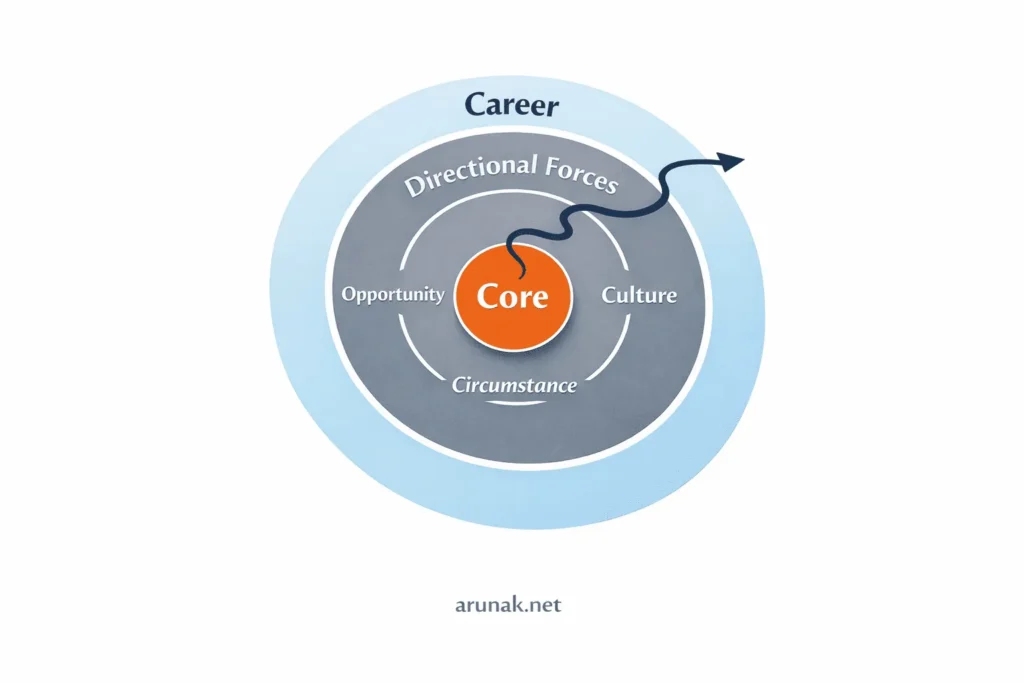
So the problem of career fit is not solved by chasing the strongest feeling. It is solved by making a better translation between a person’s core strengths and the socially legible career vessels available in the world, or even entirely new roles, provided they offer something valuable to other people.
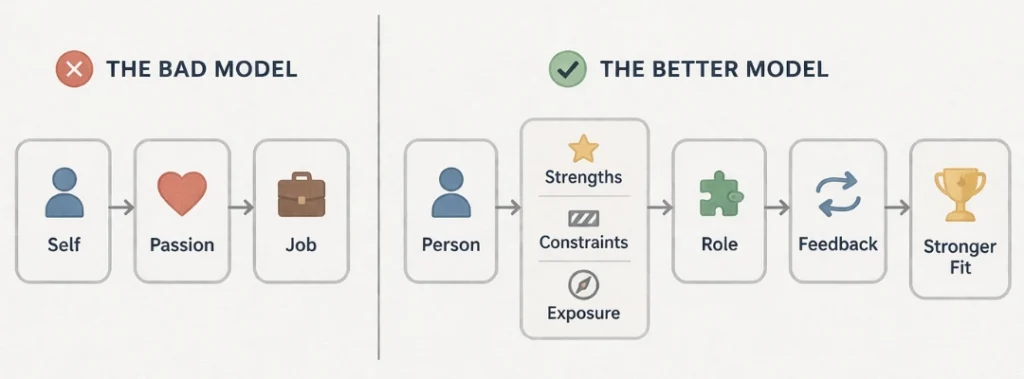
This is why “follow your passion” is weak advice. It relies on a single data point in the much larger process of finding a good career fit.
A better model begins earlier and goes much deeper. It starts with the core strengths of a person. It pays attention to strengths, motivations, tolerances, and constraints. It tests those against the demands of real work. It gets refined through active feedback and then adjusts the path along the line of least resistance.
And when that translation begins to work, passion may appear, not as something innate that was engraved into your being, but as evidence that something true in you has found a form that the world can use.
The complete version of this framework can be found in the full post on career fit.
Frequently asked questions
Is following your passion bad advice?
On its own, yes.
But it is too vague to guide a serious career decision. Passion matters, and it can be an important part of thriving in a career, but it is rarely enough by itself.
What should I do instead of following my passion?
Start with your core strengths, motivations, tolerances, and real-life constraints.
Then test possible careers through real-world experiments and build toward fit.
What if I have no passion for any career?
This is normal, and it does not mean that you are good at nothing.
Many people who eventually find successful careers they love do not begin with a clear passion. Passion for a line of work often develops only after they build some competence in it.
Does passion come before skill or after it?
Sometimes interest comes first, but it is not guaranteed.
In many real careers, deeper passion follows competence, progress, and autonomy.
Should I choose passion or stability?
This is often the wrong question because it frames the choice as if there are only two options.
This is not true.
The better question is which path creates the strongest long-term fit, one that aligns meaning, sustainability, and real-world constraints.
What is the difference between passion, purpose, and career fit?
Passion is a feeling of deep interest or engagement.
Purpose is a broader sense of meaning or contribution.
Career fit is the degree to which a role matches your strengths, motivations, tolerances, and constraints in a sustainable way.
Conclusion: Do not follow passion. Build toward fit.
Passion, for whatever we choose to do, is obviously very important to have.
But it is usually not the starting point.
More often, it is a byproduct of success in whatever we choose to do with our lives. That success may come from a career that matches your strengths, gives you room to improve, aligns with your real-life constraints, and allows you to see progress over time.
This is why “follow your passion” fails. It has more to do with scattered feelings than with a well-constructed question that can lead us in the right direction.
A better career path begins with a set of core strengths, aligns with reality, and treats career direction as a problem of slow translation rather than sudden revelation.
So do not ask, too early, what you are passionate about.
Ask what kind of person you really are, under what conditions, and which forms of work allow your deeper strengths to become visible, valuable, and fully alive in the long run.
And the passion will follow…
