One-line takeaway
A long, satisfying life is built on small habits, done daily, with people you love. That, in its most traditional sense, is what ikigai means.
At a glance
Ikigai by Garcia and Miralles defines the concept ikigai as a reason to get up every day.
But the book doesn’t stop there. It moves through several interconnected territories, from the psychology of purpose (logotherapy) to the state of deep focus known as flow, and then into the concrete routines that support a long life: food, exercise, community, and the acceptance of imperfection that the Japanese call wabi-sabi.
Table of Contents
Chapter by chapter summary
I. What is the meaning of “Ikigai”: A mysterious word gets a working definition
In its most literal sense, ikigai is a person’s most fitting reason to live. It’s the reason they get up in the morning.
But this word gets thrown around enough that it’s worth slowing down and pinning it to the page. Every word in the definition matters.
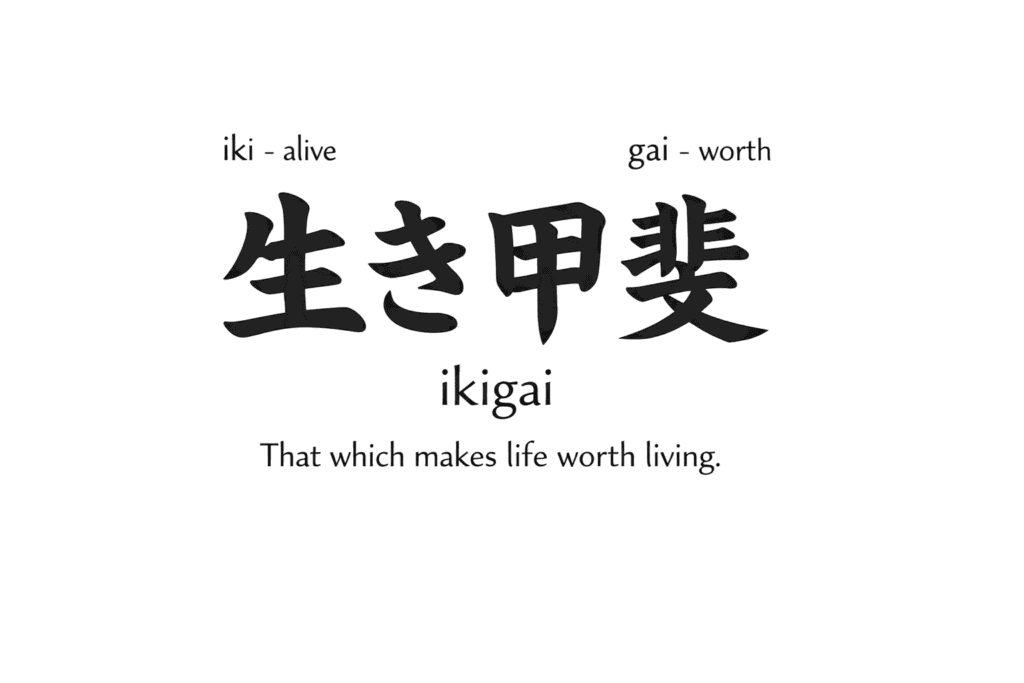
The word ikigai (生き甲斐) is made up of two Japanese parts: iki, meaning “life” or “alive,” and gai, meaning “worth” or “value.” Put together, it translates cleanly to: that which makes life worth living.
Below is a brief summary of the book’s core material, before I go deeper into the concepts in the next section, “Key ideas & takeaways.”
II. Anti-aging Secrets: The longevity story of the Blue Zones
Next, the book shifts to the “Blue Zones.” These are a handful of places around the world that researchers and journalists have pointed to because they seem to produce an unusual number of people who live to very old ages, and who stay healthy and active for longer. Out of the five original Blue Zones, Okinawa is one of them, alongside Sardinia (Italy), Ikaria (Greece), Nicoya (Costa Rica), and Loma Linda (California).
The book treats longevity and ikigai as deeply connected. People with a clear reason to get up tend to stay socially connected, keep moving in small ways every day, and carry less of the aimless stress that comes from feeling unneeded.
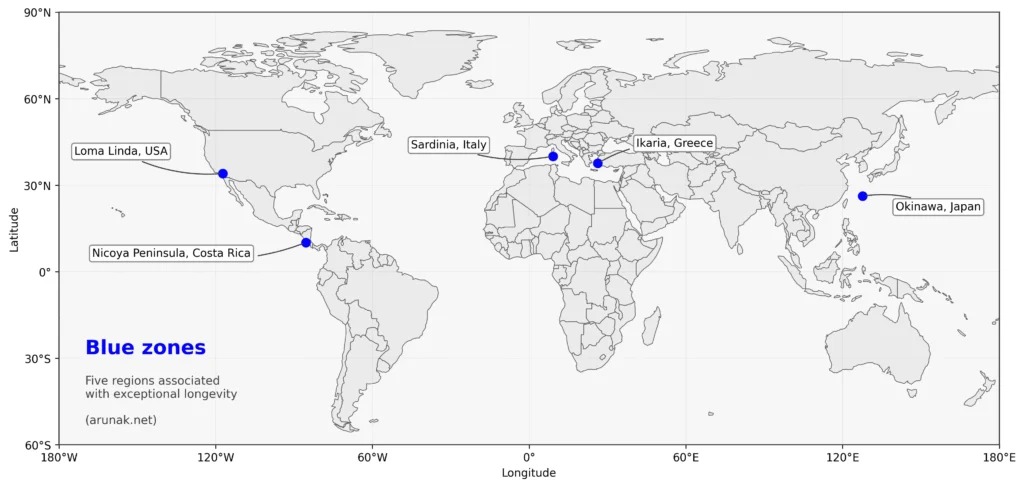
According to scientists who have studied the five Blue Zones, the keys to longevity are diet, exercise, finding a purpose in life (an ikigai), and forming strong social ties, that is, having a broad circle of friends and good family relations. (p. 14)
III. From Logotherapy to Ikigai: Purpose and its psychological aspects
Purpose, at some point, stops being a motivational slogan and becomes a clinical matter in our lives. And there comes the question: what happens to a person when they can’t find a reason to keep going?
This is the domain Viktor Frankl worked in. Frankl was an Austrian psychiatrist and Holocaust survivor who spent nearly three years in Nazi concentration camps. What he observed there, and what he had already begun to theorize before the war, became the foundation of logotherapy, a form of psychotherapy built around the idea that the search for meaning is the primary human drive. The word comes from the Greek logos, meaning “meaning,” and his most famous book, Man’s Search for Meaning, published in 1946, is part memoir and part argument. He built logotherapy out of what he witnessed in the camps, that the prisoners most likely to survive were the ones who still had something to live for, a task unfinished, a person waiting, a reason to hold on.
Ikigai makes the connection to Frankl explicit. Early on, the authors describe ikigai as “like logotherapy,” then immediately pull it back down to earth. Instead of a grand, heroic purpose, it shows up as the steady happiness of staying engaged, staying useful, and staying connected.
This is where the ikigai versus purpose confusion usually starts. People hear ikigai and assume it means a single defining mission. But in this book’s framing, purpose has more of a daily meaning: small things you like doing every day, like gardening, going for walks, cooking a familiar meal, tending to a plant. It also shows up in taking responsibility for other people, and in making commitments to keep learning, whether a new skill, a new language, or simply staying curious about something.
As a working answer to “Is ikigai the same as purpose?”: ikigai is a reason to live that’s close enough to reach. Purpose can be that too, but it’s often discussed as something bigger and further away.
There are two ways people talk about ikigai: as a reason to live, and as a purpose to live.
The reason behind these two interpretations is a conflation between the traditional meaning of ikigai and the ikigai model, the four-circle Venn diagram most people have seen. That diagram is a different thing entirely. It was created in 2014 by a British blogger who swapped one word on an existing purpose diagram. It went viral. And somewhere along the way, the two got treated as the same concept.
A more detailed explanation of this can be found here.
So it’s worth noticing that ikigai as a reason to live and ikigai as purpose are two different things.
| Ikigai as a reason to live | Ikigai as purpose |
|---|---|
| Simple reasons to get up every day: walking routines, relationships, a craft, a community role. | A longer, more structured plan: a direction you are trying to grow into over the years. |
| Mostly lived, rarely announced. | Often articulated and thoroughly planned. |
| Stabilized by identity, goals, and chosen commitments. | Stabilized by obligations and social ties. |
| If it disappears, the day feels empty. | If it disappears, the future feels unmoored. |
IV. Find Flow in Everything You Do: Attention becomes the currency of a good life
The book eventually lands on a concept that’s being talked about extensively these days: flow.
Flow is the state of being so absorbed in what you’re doing that you lose track of time. You’re not checking the clock. You’re fully immersed in whatever you’re doing, attention completely spent on the thing in front of you.
I always come back to a quote from Jack London’s Call of the Wild that explains this perfectly:
“There is an ecstasy that marks the summit of life, and beyond which life cannot rise. And such is the paradox of living, this ecstasy comes when one is most alive, and it comes as a complete forgetfulness that one is alive.”
This ecstasy can be recognized as our ikigai.
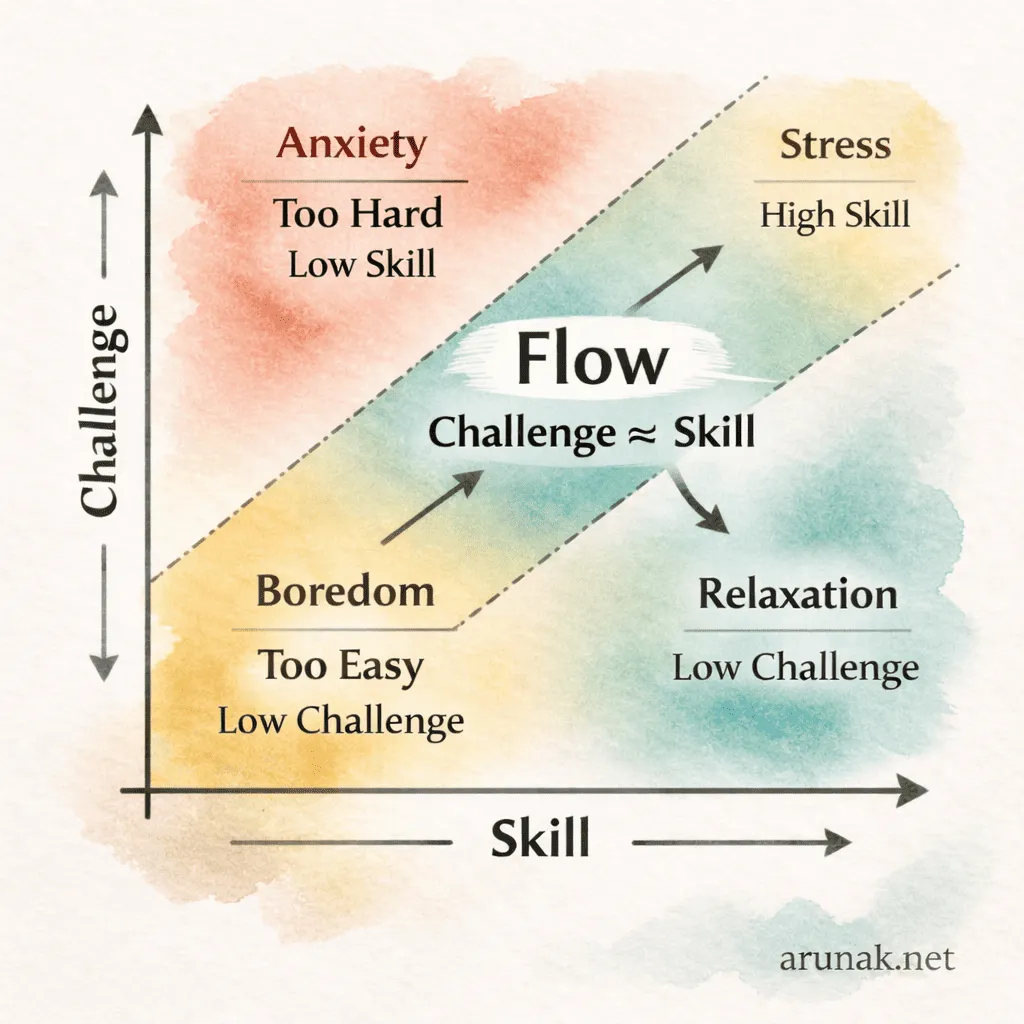
In the research space around flow, a common way to explain it is the balance between challenge and skill. Too little challenge and you slide into boredom. Too many challenges and you slide into anxiety. Flow is the narrow channel where the task asks something of you, but not so much that you break your momentum.
In the book’s practical framing, this is why small activities can matter more than they look like they should. Return to an absorbing activity often enough, and it becomes a stabilizer, something that gives every day a shape, a grounded meaning.
Examples of everyday flow activities
- Walking with a simple goal in mind: a specific route, a pace, or a set amount of time,
- gardening as a simple feedback loop, where you do something small, and the plant tells you how well you’re doing,
- a craft that’s just hard enough to keep you engaged: cooking, woodworking, learning to play guitar, drawing, knitting, or learning a new language,
- and work outside of work, when it has clear goals and immediate feedback, even if the work itself is quite ordinary.
The link between flow and ikigai is that, flow isn’t purpose by itself, but it’s one of the ways purpose becomes livable. It turns a reason to live into something you can actually practice every day, which is exactly what ikigai asks of you.
V–VI. Masters of Longevity: Advice from centenarians
After the big ideas, the book becomes more concrete, shifting its focus to how people actually use ikigai in practice. García and Miralles traveled to Ogimi, a small village in Okinawa with the highest percentage of centenarians in the world, and conducted a hundred interviews with its residents. This is a great transition because it takes the theory already laid out in the first part of the book and shows it in practice.
Here’s what they noticed:
- How they eat: simple, light meals, often plant-forward, built around habits more than strict rules.
- How they move: somewhat surprisingly, they don’t exercise as a hobby. But they move all the time: walking, gardening, visiting friends, and many other daily rituals that involve some kind of movement.
- How they work: Ogimi is a close-knit village, where everybody relies on everybody else. Staying useful isn’t about chasing productivity. Being needed is what keeps the day meaningful.
- How they build community: they see their friends often, most of them every single day. They’re close with their families. And that social fabric makes aging less isolating.

The most consistent lessons the authors heard from the eldest members were these:
- Don’t worry much,
- Cultivate good habits,
- Nurture your friendships every day,
- Live an unhurried life, and
- Stay optimistic.
VII. The Ikigai Diet: Food for a long, healthy life
The book then turns to how these centenarians stay sharp by choosing what they eat carefully. One of the more interesting ideas introduced here is hara hachi bu, a practice of stopping when you’re just starting to feel full. More precisely, eat until you’re about 80% full. But the number isn’t really the point; the posture is, such that you eat with enough restraint that you can still move through the rest of the day without feeling weighed down.
- Okinawans consume, in general, one-third as much sugar as the rest of Japan’s population, which means that sweets and chocolate are much less a part of their diet.
- They also eat practically half as much salt as the rest of Japan: 7 grams per day, compared to an average of 12.
- They consume fewer calories: an average of 1,785 per day, compared to 2,068 in the rest of Japan. In fact, low caloric intake is common among the five Blue Zones.
—p.124
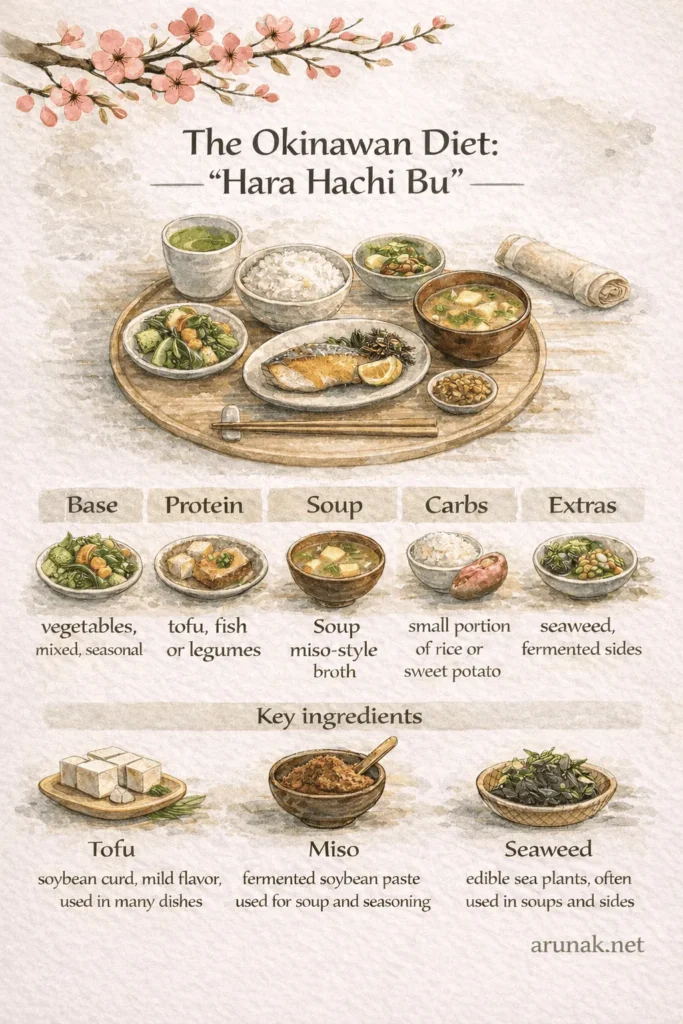
Their average meal is filled with:
- Base: vegetables (seasonal, mixed)
- Protein: tofu, fish, or legumes
- Soup: miso-style broth
- Carbs: small portion of rice or sweet potato
- Extras: seaweed, fermented sides
Key ingredients
- Tofu: soybean curd, mild flavor, used in many dishes
- Miso: fermented soybean paste used for soup and seasoning
- Seaweed: edible sea plants, often used in soups and sides
VIII. Movement is life: Movement versus exercise
The authors make the point that the people who age well aren’t necessarily the ones who exercise the most. They’re the ones who move the most. They walk, garden, and do chores all the time. They stay physically involved with their days. Movement isn’t a separate identity. It’s built into the shape of life.
Some examples:
- Morning: light walking, house chores, garden work
- Afternoon: errands on foot, cooking prep, social visits
- Evening: short walk, tidying around the house, gentle stretching
IX. Resilience and Wabi-sabi: How to face change without letting it harden you
Up to this point, the book has mostly stayed in the visible world, talking about diet, movement, companionship, and daily routine. Wabi-sabi is where it adds a psychological layer.
Wabi-sabi is a Japanese aesthetic and way of seeing that accepts impermanence and imperfection. The point isn’t to fix life into something flawless, but to stay open to change without treating the setbacks as a personal failure.
Some examples of how it shows up:
- As a stress curator: you can age fast if you fight reality all day.
- As a permission structure: not everything needs to be optimized to be worth living.
- As a softening practice: small routines and supportive relationships become a way of absorbing the hardships of life and making it more bearable.
Three stages of resilience
- Acceptance frame: figuring out what’s out of our control, without spiraling into self-blame.
- Social support: having a close set of people who help when life gets difficult, before it becomes too heavy to carry alone.
- Routine: small repeated actions that keep life steady when motivation fades.
Key ideas & takeaways
A deep dive into ‘blue zones.’
Okinawa is one of five regions in the world known as Blue Zones, a term coined by National Geographic journalist and researcher Dan Buettner to describe places with an unusually high concentration of people who live into their 90s and beyond. Buettner identified nine common behaviors across these populations, and one of them, which he specifically links to Okinawa, is ikigai: a clear sense of why you get up in the morning. His research suggests this quality alone may be worth up to seven additional years of life expectancy.
So this is where the whole fascination with ikigai has taken the world.
That said, the Blue Zones concept has faced serious scrutiny in recent years. A researcher at University College London named Saul Justin Newman has argued that many of the longevity statistics underpinning the Blue Zones may be distorted by unreliable birth records, and that some of what looked like exceptional longevity was actually a consequence of poor record-keeping. His work is worth knowing about because it sharpens the point rather than undermining it.
Even researchers who question the raw longevity numbers haven’t dismissed what the Okinawan elders themselves say about how they live. Makoto Suzuki, a longevity researcher based in Okinawa who has spent decades studying why people there live as long as they do, points to two factors that he believes hold up regardless of the data debate: moai and ikigai.
Moai is the Okinawan tradition of a lifelong social support group, a tight circle of friends, often formed early in childhood, that people maintain well into old age, meeting regularly, supporting each other financially and emotionally. And ikigai, discussed throughout this post, is the sense that your days have a reason.
The ikigai diagram and its overlap with the traditional meaning of ikigai
Ikigai‘s meaning is best understood in its most traditional sense: that which makes life worth living. It’s not a framework or a career plan, but rather the ordinary, everyday things that make someone feel alive. It’s plural, personal, and already present in our lives right now. It describes a reason to live.
The ikigai model, on the other hand, is a different thing entirely. It’s the four-circle Venn diagram most people have seen. It was created in 2014 by a British blogger who swapped one word on an existing purpose diagram. It went viral. And somewhere along the way, the two got treated as the same concept. The ikigai model describes a purpose to live.
More information about both concepts is available in this post.
In this post, I talk about what ikigai actually means, why the ikigai model is still useful if you know what it’s for, and how to use both without confusing one for the other.
Flow: how to achieve it
The more popular term, flow, is, in my opinion, very close to the concept of ikigai. Not as a life plan, but as a felt sense of being absorbed in something worth doing every day.
Flow is usually described as a state of deep involvement where attention narrows, self-consciousness calms down, and the sense of time disappears. It shows up when a task is demanding enough to require full attention, but not so demanding that it overwhelms you in the process. It’s a balance between challenge and skill: too easy becomes boredom, too hard becomes anxiety.
The connection I see is that, like ikigai, flow isn’t a personality trait. It’s a relationship between you and what you’re doing in the moment. Both involve clear goals and immediate feedback. And because flow is built out of attention, it scales down to any ordinary task. You can find it in work, but also in a morning walk, a craft, a kitchen routine, or a garden.
Here are the 7 conditions for achieving flow, mentioned in the book:
According to researcher Owen Schaffer of DePaul University, the requirements for achieving flow are:
- Knowing what to do
- Knowing how to do it
- Knowing how well you are doing
- Knowing where to go (where navigation is involved)
- Perceiving significant challenges
- Perceiving significant skills
- Being free from distractions
—p.58
The ten rules of Ikigai
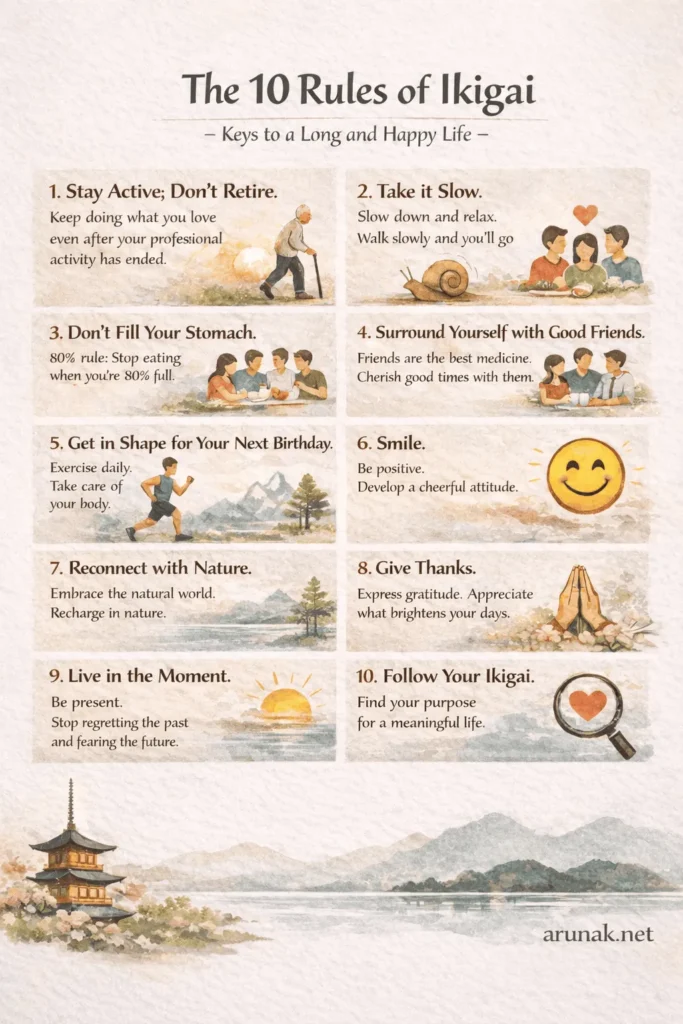
At the very end of the book, the authors summarize their findings into ten rules that help people live not only long, but also healthy and happy lives. These rules are based on the hundreds of interviews they carried out with the elderly residents of Ogimi, a small village in the northern part of Okinawa known for having one of the highest concentrations of centenarians in the world.
The ten rules are:
- Stay active; don’t retire.
- Take it slow.
- Don’t fill your stomach.
- Surround yourself with good friends.
- Get in shape for your next birthday.
- Smile.
- Reconnect with nature.
- Give thanks.
- Live in the moment.
- Follow your ikigai.
Why I picked up this book?
To learn more about the Blue Zones, the ikigai diagram, and the traditional definition of ikigai.
Highlights
There is, in fact, no word in Japanese that means retire in the sense of “leaving the workforce for good,” as in English. According to Dan Buettner, a National Geographic reporter who knows the country well, having a purpose in life is so important in Japanese culture that our idea of retirement simply doesn’t exist there. (p. 10)
Existential crisis, on the other hand, is typical of modern societies in which people do what they are told to do, or what others do, rather than what they want to do. They often try to fill the gap between what is expected of them and what they want for themselves with economic power or physical pleasure, or by numbing their senses. (p. 41)
What do Japanese artisans, engineers, Zen philosophy, and cuisine have in common? Simplicity and attention to detail. It is not a lazy simplicity but a sophisticated one that searches out new frontiers, always taking the object, the body and mind, or the cuisine to the next level, according to one’s ikigai. (p. 75)
Rituals give us clear rules and objectives, which help us enter a state of flow. When we have only a big goal in front of us, we might feel lost or overwhelmed by it. Rituals help us by giving us the process, the substeps, on the path to achieving a goal. When confronted with a big goal, try to break it down into parts and then attack each part one by one. (p. 85)
“Food won’t help you live longer,” she says, bringing to her lips a bite of the diminutive confection that followed our meal. “The secret is smiling and having a good time.” (p. 106)
“Working. If you don’t work, your body breaks down.” (p. 114)
“To live a long time you need to do three things: exercise, eat well, and stay with people.” (p. 114)
How it changed the way I think?
Out of everything I learned from this book, some things are quite predictable, like having a good circle of friends. But one wasn’t that obvious to me: constant movement, not particularly exercise. That pushed me to go for a walk every day, and it’s helped me enormously, not just physically, but mentally in ways I hadn’t even anticipated.
Studies from the Blue Zones suggest that the people who live longest are not the ones who do the most exercise but rather the ones who move the most. (p. 135)
Read this if you:
- want a simple, narrative introduction to how ikigai is commonly framed outside Japan and what the authors mean by it,
- are trying to turn “live longer” advice into a handful of repeatable daily habits around food, exercise, and social ties,
- want to understand why Okinawa shows up so often in longevity discussions and how the book uses the Blue Zones story strengthen this argument,
- are looking for a simple, non-technical approach to thinking about purpose that is grounded in routine, relationships, and staying useful to other people,
- want a book you can skim for actionable prompts and lifestyle patterns rather than research depth or strict scientific arguments (you can probably finish reading this book within 2 hours).
Coffee chat
What is ikigai, and what does ikigai actually mean in plain English?
Ikigai is commonly explained as something that gives life value, meaning, or a reason to get up in the morning. It can be tied to people, hobbies, community roles, or work. It’s not inherently a single “one true calling”. It can be as simple as going for a daily walk. Many modern explanations of ikigai are now westernized, so definitions can vary quite a bit by source.
As a reference point, the Japanese government’s own definition describes it as a broad concept that refers to that which brings value and joy to life, from people like one’s children or friends, to activities including work and hobbies.
Is the Ikigai book actually worth reading, and what is the Ikigai book about?
Yes, it’s worth reading.
The book presents ikigai as a practical way of thinking about a long, satisfying life, using Okinawa and its longevity stories as the basis for that premise. It mixes lifestyle habits, social structure, and psychological concepts like meaning and flow, rather than staying purely philosophical. The experience is closer to a guided overview with real-world examples than a tightly argued, research-based book. For anyone who wants a quick, readable introduction to the ikigai approach, it’s a great fit. And you can finish it in two to three hours.
What is the ikigai diagram, and is the ikigai diagram really Japanese?
No, it’s not.
The ikigai model, the four-circle Venn diagram most people have seen, is a different thing entirely from the traditional Japanese concept of ikigai. It was created in 2014 by a British blogger who swapped one word on an existing purpose diagram. It went viral. And somewhere along the way, the two got treated as the same concept. Traditional ikigai describes a reason to live. The ikigai model is more aligned with purpose.
What are the 10 rules of ikigai, and do the 10 rules of ikigai come from the book?
Yes, the book explicitly talks about ten rules of ikigai, shaped by the hundred interviews the authors carried out with residents of Ogimi, a village in northern Okinawa that holds the Guinness World Record for the highest average life expectancy, and they are:
Stay active; don’t retire.
Take it slow.
Don’t fill your stomach.
Surround yourself with good friends.
Get in shape for your next birthday.
Smile.
Reconnect with nature.
Give thanks.
Live in the moment.
Follow your ikigai.
What does ikigai mean, and how do Japanese sources define ikigai?
Ikigai meaning is best understood in its most traditional sense: that which makes life worth living. It’s not a framework or a career plan, but rather the ordinary, everyday things that make someone feel alive. It’s plural, personal, and already present in our lives right now. It describes a reason to live.
I keep seeing the ikigai diagram online. Is that what the book really teaches, or is it a simplified add-on?
No, they’re not the same thing.
Ikigai means, in its most traditional sense: that which makes life worth living. It’s not a framework or a career plan, but rather the ordinary, everyday things that make someone feel alive. It’s plural, personal, and already present in our lives right now. It describes a reason to live.
The ikigai model, on the other hand, is a different thing entirely. It’s the four-circle Venn diagram most people have seen. It was created in 2014 by a British blogger who swapped one word on an existing purpose diagram. It went viral. And somewhere along the way, the two got treated as the same concept. The ikigai model describes a purpose to live.
Is ikigai meaning basically “purpose,” or is it broader than work and career, and how do Japanese explanations describe it?
No, not necessarily. Ikigai doesn’t point directly toward purpose, although it can lead someone there.
The concept is more flexible, broad, and plural than purpose. It’s not attached to a specific destination the way purpose tends to be. Someone’s ikigai can simply be a daily walk, gardening, or a community role they return to week after week. This is also why “find your dream job” readings of ikigai can feel incomplete. They narrow something that’s meant to stay open.
A more comprehensive guide on the difference between these two concepts, and how to use both, can be found here.