
TL;DR:
Ikigai meaning is best understood in its most traditional sense: that which makes life worth living. It’s not a framework or a career plan, but rather the ordinary, everyday things that make someone feel alive. It’s plural, personal, and already present in our lives right now. It describes a reason to live.
The ikigai model, on the other hand, the four-circle Venn diagram most people have seen, is a different thing entirely. It was created in 2014 by a British blogger who swapped one word on an existing purpose diagram. It went viral. And somewhere along the way, the two got treated as the same concept. The ikigai model describes a purpose to live.
This post is about what the meaning of ikigai actually is, why the ikigai model is still useful if you know what it’s for, and how to use both without confusing one for the other.
Like most people, I came to know the word ikigai while scrolling through social media.
And like most things we encounter that way, it arrived as a diagram, with four overlapping circles, and four different labels: what you love, what the world needs, what you can be paid for, and what you’re good at. The word ikigai sits right in the middle, at the point where all four supposedly meet.
I immediately wanted to learn more, not just about the concept, but about what it actually looked like in practice. What does it feel like to have that kind of clarity? Is it something you arrive at once, or something you keep working toward, a way of being?
Right around that time, my wife handed me the book: Ikigai: The Japanese Secret to a Long and Happy Life by Héctor García and Francesc Miralles. So I started reading it.
And there it was, on the first page, that same diagram with four circles.
But as I kept reading, something started to feel off. The further García and Miralles moved away from the framework and toward the people who actually lived it, specifically the residents of a small island called Okinawa, the wider the gap became between what the diagram says and what these people were actually doing.
The ikigai described in that four-circle model, clean and career-focused and optimizable, looked almost nothing like the ikigai these people based their lives on.
They weren’t mapping overlapping circles. They were gardening, gathering with lifelong friends, practicing a craft, and cooking for their families. They knew, without hesitation, what made their days feel worth living. And that was it.
This isn’t a fault of the book. García and Miralles are doing something closer to reportage—collecting interviews, observations, and everyday examples—and most of what I write here draws from that same material. But it’s worth understanding the difference.
The Venn diagram model looks clean and promising. For someone who feels like they’re moving through work without really going anywhere, it feels like exactly the kind of framework they’ve been waiting for.
That diagram, however, didn’t come from Japan. And more importantly, it isn’t what ikigai actually means.
Key Takeaways:
- Ikigai meaning comes from two Japanese words: iki (life) and gai (worth). It translates to “that which makes life worth living,” and in Japan, it’s found in small, ordinary things, not career milestones.
- The ikigai model (the four-circle Venn diagram), on the other hand, was never Japanese in origin. It was adapted in 2014 from a Spanish purpose framework. Its creator has since clarified that it doesn’t represent the original concept.
- Ikigai is plural. A national survey found the average Japanese respondent listed 8 to 9 separate sources of ikigai. It’s not one thing, it’s many small things that make someone’s life worth living.
- The ikigai model is still useful, but only as a diagnostic tool for career alignment, not as a definition of ikigai, and not as something you have to “complete” before you’re allowed to have meaning in your life.
- You don’t need all four circles to overlap. That framing is the Western addition. In Japan, ikigai has never required income, mission, or a marketable skill. Even a morning walk, gardening, or sitting with someone who needs company can count as someone’s ikigai.
- Ikigai comes before purpose. It’s the fuel. The ikigai model, at its best, is just the engine that helps you shape that fuel into something sustainable and useful to others.
Table of Contents
Ikigai meaning: what it actually means in Japan
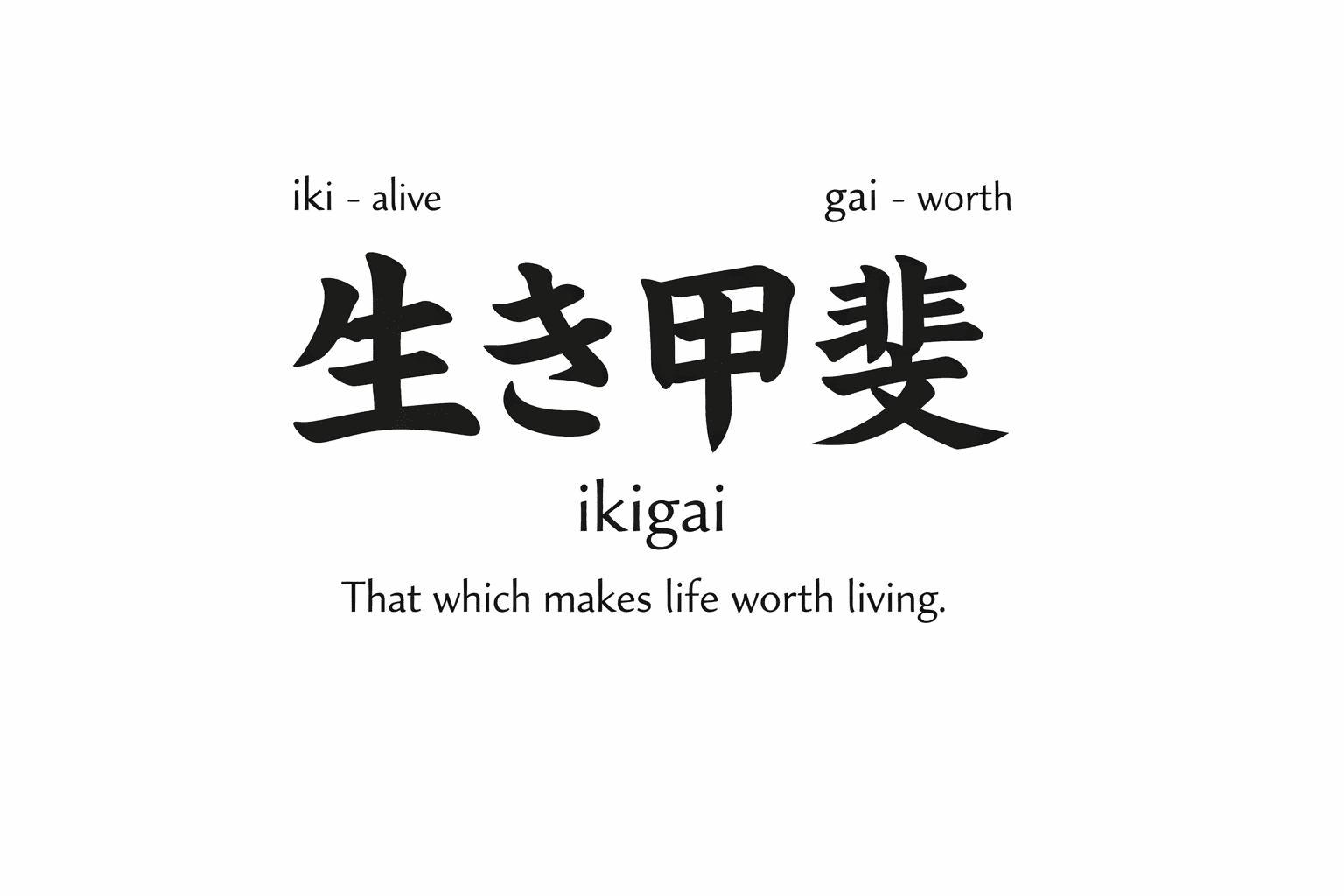
The word ikigai (生き甲斐) is made up of two Japanese words: iki, meaning “life” or “alive,” and gai, meaning “worth” or “value.”
That which makes life worth living.
It’s as important to notice what’s in this definition as it is to notice what isn’t.
A lot of the most vivid examples of ikigai come from Okinawa, where García and Miralles spoke with older residents in places like Ogimi about what makes their days feel worth living. There’s no requirement about career, mission, or anything of commercial value.
When García and Miralles interviewed more than a hundred elderly residents of Ogimi Village, a place often called the “village of longevity,” they asked each of them what their ikigai was. The answers were unhesitating and almost entirely ordinary: meeting with friends, gardening, art, or even just going for daily walks. Not a single person described a career framework or a life mission. They just knew what made their days feel worth living, and they were busy doing it.
This reminds me of a line from The Call of the Wild by Jack London:
“There is an ecstasy that marks the summit of life, and beyond which life cannot rise. And such is the paradox of living, this ecstasy comes when one is most alive, and it comes as a complete forgetfulness that one is alive.”
Ikigai, in its traditional sense, is this ecstasy.
The ikigai model: the popular diagram (and why it’s controversial)
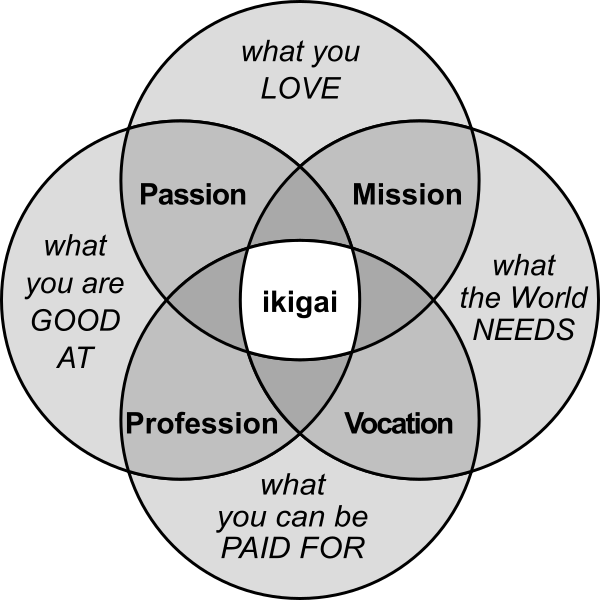
In 2014, a blogger named Marc Winn watched Dan Buettner’s TED Talk about longevity in Okinawa, a talk that briefly mentioned ikigai as a “reason to wake up in the morning.” Around the same time, he came across a purpose framework created by Spanish astrologer Andrés Zuzunaga: four overlapping circles mapping what you love, what you’re good at, what the world needs, and what you can be paid for. In a moment of what Winn himself called “mischief,” he replaced the word “purpose” at the center of Zuzunaga’s diagram with “ikigai.” He wrote the accompanying blog post in about 45 minutes. It went viral.
Winn was candid about it afterward. In his own words: “The sum total of my effort was that I changed one word on a diagram and shared a ‘new’ meme with the world.” He later wrote a follow-up post clarifying that his diagram doesn’t reflect the original Japanese concept, that real ikigai can be as simple as having a daily morning tea or gardening, not a career intersection point.
The diagram itself isn’t the problem. As a tool for noticing where our work and our energy are out of alignment, it’s genuinely useful. The problem is what happens when it’s treated as a definition. When we start believing that we can only have ikigai once all four circles overlap, that we need to be paid for something that also happens to be what you love, what you’re good at, and what the world needs, all at once.
Ikigai vs purpose: the key difference
So it’s worth being clear that, ikigai, at least in its traditional sense, and the viral ikigai diagram are very different concepts. That difference is best understood through the lens of purpose.
There’s a specific kind of pressure that comes with the word “purpose” because it implies something singular, a calling, a direction that a whole life should be organized around. This is the ikigai model, the one built on four pillars. And if you haven’t found it yet, the implication is that you should keep looking, that something is missing, that you’re somehow behind your own life.
That pressure isn’t without value. It pushes toward something worth finding, a way of being genuinely useful to other people, which is no small thing. But it isn’t ikigai. It comes before ambition and career narratives. It’s much simpler, and in many ways more available.
A national survey conducted in Japan in 2018 found that 47.5% of people aged 70 and older are active in ways that express their ikigai, through work, hobbies, and community engagement. When researchers dug deeper, almost no one described a single overarching source. People pointed to multiple things at once: a craft practiced for years, a role in a local group, a relationship, a morning ritual. Plural, ordinary things, not a mission statement.
García and Miralles capture this well in their book. One of the Okinawan residents they interviewed described ikigai as something you don’t search for. It’s just already there. You notice it when you’re not looking.
The Japanese psychiatrist Mieko Kamiya, who first wrote seriously about ikigai in 1966, described it not as something you find once and then have forever, but as something that needs to be tended over the course of a lifetime, the way a garden does.
So ikigai isn’t a destination. It’s a practice.
Purpose tends to feel singular and organizing. Ikigai is plural and ordinary, the everyday reasons life feels worth living, coming from many small sources at once. The viral Venn diagram is closer to purpose: singular, organizing, and career-shaped. Ikigai is closer to reasons to live: plural, ordinary, sustaining.
A more natural place to start, then, isn’t with the diagram. It’s with the smaller, more honest question: what already makes my days feel worth living?
A practical way to find your ikigai (in 30 minutes)
Here’s a simple exercise that gets at that, to find something worth living for.
Step 1 – Inventory (10 minutes)
Write your answers to these three questions without thinking too hard:
- What consistently gives me energy, during or after doing it? Or what subject do I get so excited about that I’d talk about it to anyone who’ll listen?
- What would I keep doing, or like to do, even if it gets hard or no one’s watching?
- What activity makes time disappear when I’m doing it? I start for about 10 minutes, and somehow an hour goes by.
While answering, it’s important to keep your wishful thinking at bay! These answers shouldn’t be guided or forced toward something meaningful, or even something helpful to others, at least not yet. All of that comes later. And they don’t even have to point to a single thing.
Step 2 – Find the patterns (10 minutes)
Look at what you wrote and circle anything that appears more than once, or in more than one form. Most people find their answers cluster around something: teaching, making things, solving problems, being around people, learning, caring for others, writing, reading, building something from nothing, and many more.
Whatever shows up repeatedly is the thread worth pulling.
Step 3 – One-week experiment (10 minutes)
Now that the answers are on the page, the next step is to pick the smallest, most accessible version of what you found and commit to doing it, in any shape or form, at least once this week. Not as a life overhaul, just as a test.
The thing about this is: if you’ve taken enough time in the previous step answering those questions faithfully, doing that particular thing once this week will naturally lead to doing it twice the next, because it’s something you’d genuinely want to return to. If you still feel uncertain about what you found in Step 1, that’s a signal to go back and answer more carefully.
The point isn’t to locate your ikigai in a single sitting. It’s to start paying attention to what already makes your days feel alive, and then act on it, even in a small way. That won’t always be easy, especially when life is full, and many things are competing for attention. The key is to stay curious and keep the range of answers wide.
Ikigai examples
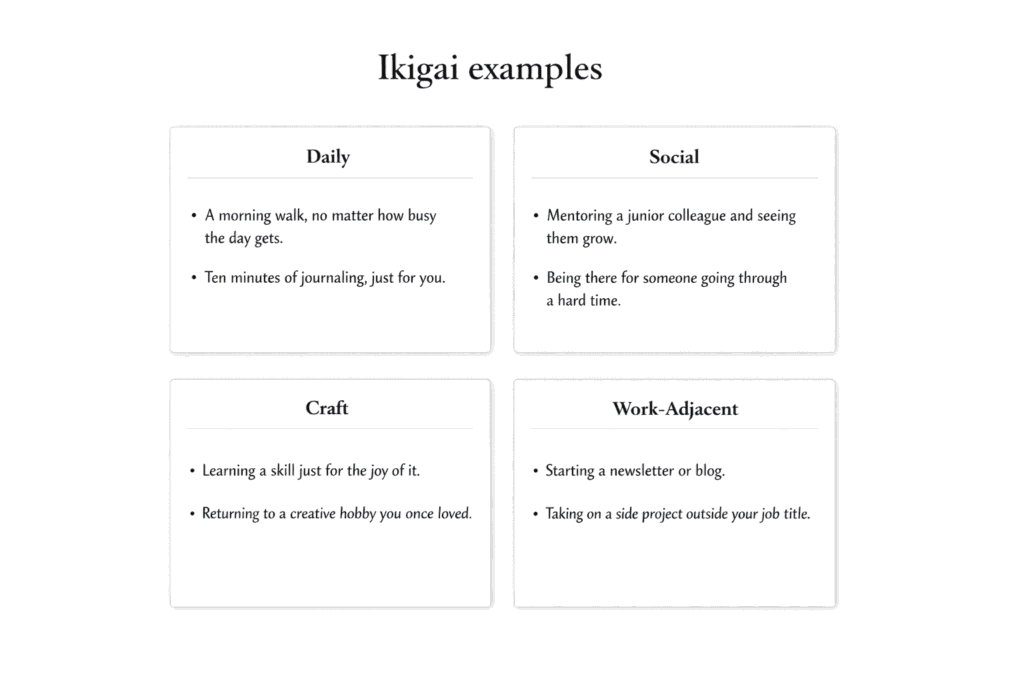
Here are some examples of what ikigai can actually look like.
Daily:
- A morning walk you promise yourself no matter how busy the day gets.
- Cooking a real meal at the end of the week.
- Ten minutes of journaling, not because you think it will lead somewhere, but because the act of writing makes you feel better.
Social:
- Mentoring a junior colleague and noticing that you made a real difference in their life.
- Showing up somewhere as a volunteer and realizing the contribution feels more real and meaningful than a lot of what you do at your actual job.
- Sitting with someone going through something hard and finding that just being there was enough for them.
Craft:
- Learning a skill with no professional application attached to it, a language, an instrument, a woodworking project, and finding that the learning itself was what you were after all along.
- Returning to a creative practice you abandoned years ago and wondering why you ever stopped.
- Finishing something with your hands and feeling a quiet satisfaction that no performance review has ever quite matched.
Work-adjacent:
- Starting a newsletter.
- Building a portfolio.
- Taking on a side project that has nothing to do with your job title.
The thing all these examples have in common is that when you’re doing them, you’re not asking whether they count, whether they matter, or whether they’re leading anywhere. You just simply feel alive.
Where to go from here
So it’s clear: ikigai doesn’t mean “find the career where passion meets profit.” It’s just a way of being.
But ikigai and purpose don’t have to stay separate. What the ikigai model offers, at its best, is a way to take what’s already alive in you and ask whether any of it can be shaped into something larger. Below is a way to do that, by mapping your ikigai onto the four pillars of the ikigai model.
What you love
Someone’s ikigai, even though it can look similar, isn’t the same as what they love. The difference lies in scope: ikigai is the role an activity plays in making life feel worth living, often tied to identity, rhythm, and belonging, while “what you love” is the felt enjoyment of the activity itself.
For example, an ikigai can be a noun, a broader life-area or practice, like photography. The next step is finding the verb for that noun: noticing, composing, documenting, interviewing, teaching. That verb travels across careers.
What you love is more specific and immediate. With that same example, once you have the verb, you can shape your love for this particular thing into something testable by trying three versions of the same practice:
- solo, just for you,
- social, shared with others,
- public, shown, taught, or performed.
And once you can name what you love at the level of verbs, not just nouns, the next question becomes clearer: what parts of this can you actually get better at, on purpose?
What you are good at
How does a love for something turn into skill, and more importantly, without killing its spirit?
For a particular ikigai, take writing. It starts by turning “I like writing” into a clear, repeatable output you can actually measure and improve. “I like writing” is too vague to build on because it’s only qualitative. But “I can explain one idea clearly in about 800 words” is quantitative, and that’s a good place to start. The work stops being an identity (“I’m a writer”) and becomes an output: a clean explanation, a tightened argument, a readable page.
Over time, improvement doesn’t come all at once. It shows up as one of three changes you can notice: the same piece becomes better, cleaner in structure and sharper in sentence; or it becomes faster, the draft arriving without hours of friction; or it becomes more consistent, happening regularly, not only on good days.
And skill rarely grows in isolation. It usually shows up when one thing collides with something else already in your arsenal of skills: writing and teaching becomes clarity, writing and analysis becomes rigor, writing and taste becomes editing. What looks like talent is often just a pairing that grows into something other people can recognize and rely on.
Once you can name the output and watch it improve, the next question stops being philosophical and becomes more practical: how do you keep doing this, over and over, in a life that still has to pay bills?
What you can be paid for
This is the sustainability aspect of ikigai. How can someone keep doing what makes life feel worth living, without it becoming a financial burden?
It’s worth noting that the research behind this comes from Okinawa, a small, remote island with its own ecosystem: tight neighborhood life, local crafts, small-scale industries, and community structures that go back generations. In places like Ōgimi, ordinary ikigai like gardening or crafting can sit inside a supportive economic web without having to justify itself as a standalone career. Income is often diversified across pensions, family support, low cost of living, small agriculture, traditional crafts, and mutual-aid groups that historically pooled money.
Most people don’t live inside that kind of low-cost, high-support community. So “just do what you love” can turn into a financial trap unless it’s connected to something people will actually pay for.
But the “paid for” part of the ikigai model isn’t really about profit. It’s about permission. Not permission from society, but permission from your own life—rent, food, time, energy—to make your ikigai sustainable. The goal isn’t to squeeze money out of it. It’s to build a small financial base around it so you can keep returning to it, again and again, without resentment.
Practically, that often means finding the simplest, most valuable output of the thing you love. If you love writing, maybe it’s an article, an edit that tightens someone else’s argument, or an essay series that saves readers time. If you love photography, maybe it’s documentation, portraits, visual storytelling, or teaching.
When something starts from that original ikigai concept—this makes my life worth living—it tends to become valuable to other people almost by accident. Maybe not right away. But over the long run, through repetition, as the quality improves and trust builds, eventually someone wants more of it and is willing to pay for it.
But again, money isn’t the point. Sustainability is. And sustainability, sooner or later, pulls toward value, and value makes the whole thing viable. But if money isn’t the point, the next question becomes: value for whom? And that’s where the last circle matters, not as a mission, but as the way your ikigai naturally reaches other people.
What the world needs
People from Okinawa, who live in a way that keeps ikigai active day to day, don’t necessarily think about purpose or mission. And yet, doing something you love, for a long enough time, tends to end up being helpful to other people in one way or another.
Purpose, for most people, feels like something “out there,” something you’re supposed to discover and commit to, rather than something that grows from the inside out. But because every person is unique, their set of skills is unique too. When someone starts doing something they genuinely love, it naturally becomes, or at least becomes very easy to shape into, something useful to others. And helping other people is, in the end, the only way life seems to make any sense.
So, how does ikigai become useful to the world? Turns out, the people of Okinawa have been doing this quietly for centuries.
In Okinawa, it’s not just that people have an ikigai. It’s that they have a good environment to practice it, a social fabric where the small things are rarely done alone. There’s even a word for the ethos: yuimaru, meaning mutual aid. And another idea, ichariba chōdē, the feeling that once you meet someone, they become family. And then there are the moai: tight, long-running groups that meet regularly, keep each other company.
So yes, someone’s ikigai might be gardening. But the “world needs” part shows up almost automatically, because gardening becomes vegetables shared, time shared, labor shared, a reason to check on someone, a reason to be seen. The usefulness isn’t always inside the activity. It’s in the relationships the activity creates.
In a Western context, the problem isn’t that people don’t have passions. It’s that there aren’t enough repeatable, built-in structures that turn private loves into shared life. We’re mobile, scheduled, and often isolated. Community becomes an option rather than the default.
So the translation isn’t “find a grand mission.” It’s smaller and more practical: take the thing you’d do anyway, and let it become a recurring point of contact, a place where people can rely on you, and where you can rely on them. That’s what “what the world needs” looks like when the abstract language is stripped away. It does not have to be as grand as saving the world.
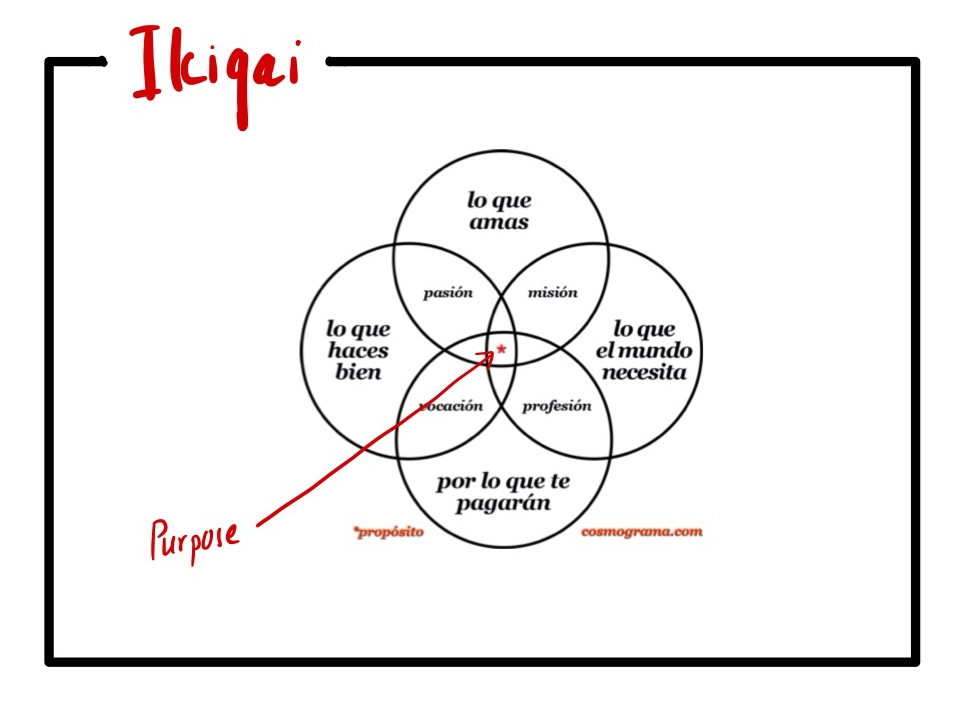
Put together, you start with what makes life worth living, translate it into something you can practice and improve, make it sustainable enough to keep returning to, and then let it become useful to other people, which happens almost inevitably.
This way, ikigai becomes both a reason for being and the foundation of a purpose. Ikigai stays the fuel, love, and life-worth-living, while the diagram(the ikigai model) becomes the engine, skills, value, and constraints.
Purpose, in this sense, is something that’s unique to each of us, and already exists in the world in some shape or form. The diagram is just an attempt to explain that truth, the same way a mathematical equation exists to explain a law of physics that was already there.
But this true purpose isn’t always easy to find. The power of ikigai is that it offers a way to get there systematically.
So if the ikigai model were revised, I’d keep its original intent but make one change: replace the word ikigai at the center of the four circles with purpose (this was its original form). Then move ikigai outside the diagram entirely, because ikigai is somewhere you can start tomorrow, or even this afternoon, without the pressure of having to find the intersection of all four circles first.
When we practice ikigai, our purpose and all four pillars start to present themselves. And with it comes everything the diagram was trying to point at in the first place.
How to use the ikigai model without getting trapped by it
It’s best to treat the four circles as a diagnostic, not a destination. A destination is something you aim at once, a final answer. A diagnostic is something you return to, over and over, to see what’s drifting out of alignment.
The problem usually isn’t that you don’t have an ikigai. The problem is that the pieces around it aren’t cooperating. You might be good at something that pays well, but it doesn’t energize you, and after a while, it starts to feel like you’re spending your best hours on someone else’s priorities. Or you might love something deeply, but it’s trapped in the “in my free time” category: beautiful, real, meaningful, but structurally fragile, because it has no time allocation, no dedicated space, and not enough support to keep returning to it.
The circles make those failures visible. They let you point at the exact gap instead of just saying “I feel off.”
- I love it, but I’m not good at it yet. That’s a skill problem.
- I’m good at it, but it drains me. That’s an energy problem.
- I love it, and I’m good at it, but it can’t support itself. That’s a sustainability problem.
- I can do it, and I can get paid, but it doesn’t really help anyone. That’s a usefulness problem.
In other words, the diagram isn’t asking you to “find your purpose.” It’s asking: what’s missing right now, if you want this to be a life you can keep living?
Ikigai misconceptions
“Ikigai must be your job.”
A Sony Life Insurance survey of 1,400 people across Japan found that the average respondent listed 8 to 9 separate sources of ikigai. These are, by nature, an accumulation of small, meaningful things, not a single career-defining mission. The idea that your job has to be the source of your meaning is something the Western Venn diagram added. It was never part of the original concept.
“You need all four circles to overlap to have ikigai.”
This follows directly from treating the Marc Winn diagram as a definition. The implication is that if you love what you do but aren’t financially where you want to be yet, you haven’t arrived, that you haven’t made it. That framing keeps the goal perpetually just out of reach, which is the exact opposite of what ikigai is supposed to do.
To his credit, Winn himself clarified this later. Even García and Miralles, who included the diagram in their book, describe ikigai first and foremost as a felt sense of meaning, not a checklist.
“You find it once, and you’re done.”
Ikigai isn’t something you lock in at a certain age and keep as is forever. It moves, evolves, and expands over time. The psychiatrist Mieko Kamiya, writing in 1966, described ikigai as something that shifts across a lifetime, not a fixed answer, but a living question.
FAQ
Is ikigai the same as purpose?
Not quite. “Purpose,” in the way most people use it, implies one overarching, singular direction that everything in life should point toward. Ikigai is broader and more plural. It can come from many sources at once, including small daily rituals like a morning walk, a weekly meal cooked from scratch, or a craft practiced slowly over the years. The difference is best understood this way: purpose is a destination, and ikigai is the feeling of actually living, and living better, every day.
What is the ikigai model?
The “ikigai model” most people know is the four-circle Venn diagram: what you love, what you’re good at, what the world needs, and what you can be paid for. It was created in 2014 by a British blogger who adapted an existing purpose framework. It’s useful for career reflection, but it doesn’t accurately represent what ikigai means in Japanese culture.
Is the ikigai Venn diagram accurate?
Not as a cultural definition. It can be a useful tool for thinking through career alignment, but it shouldn’t be mistaken for the original concept. The difference is best understood when the two are treated as journey and destination: ikigai as the journey, something worth living for, and the ikigai model as the destination, a calibration to shape that thing worth living for into a sustainable way of living.
Can you have ikigai without being paid for it?
Yes. The “paid for” element belongs to the Western diagram, not to the original concept. In Japan, ikigai is found most commonly in hobbies, family roles, creative practice, and community. Income has never been a prerequisite.
References
Book
García, Héctor, and Francesc Miralles. Ikigai: The Japanese Secret to a Long and Happy Life. Penguin Books, 2017. (The primary source for the Ogimi Village interviews, resident accounts, and the four-circle diagram. goodreads.com)
Academic / Research
Sone, Toshimasa, et al. “Sense of Life Worth Living (Ikigai) and Mortality in Japan: Ohsaki Study.” Psychosomatic Medicine, vol. 70, no. 6, 2008. (A 7-year study of 43,391 Japanese adults; those without a sense of ikigai had a 1.5x higher risk of all-cause mortality. pubmed.ncbi.nlm.nih.gov)
Amon, Kelsang Lhamo, and Kiyoko Miura. “Ikigai and Subsequent Health and Well-being Among Japanese Older Adults.” The Lancet Regional Health – Western Pacific, February 2022. (Nationwide longitudinal study; having ikigai was associated with 31% lower risk of functional disability and 36% lower risk of dementia. pmc.ncbi.nlm.nih.gov)
Kamiya, Mieko. Ikigai-ni-tsuite (What Makes Life Worth Living). Misuzu Shobo, 1966. (The foundational Japanese academic text on ikigai as a psychological concept; the basis for the “ikigai shifts across a lifetime” framing.)
Government / Institutional
“Ikigai: The Japanese Secret to a Joyful Life.” The Government of Japan (JapanGov), March 2022. (Confirms ikigai as “that which brings value and joy to life” and includes the 2018 national survey data on ikigai sources among older Japanese adults. japan.go.jp)
Diagram origin
Winn, Marc. “What’s Your Ikigai?” The View Inside Me, May 14, 2014. (The original blog post where Winn replaced “purpose” with “ikigai” on Zuzunaga’s diagram. theviewinside.me)
Winn, Marc. “Meme Seeding.” The View Inside Me. (Winn’s own account of the diagram’s creation, including his admission that it doesn’t capture the original Japanese concept. theviewinside.me)
Winn, Marc. “The Story Behind the Ikigai Venn Diagram.” The View Inside Me, February 2025. (A later reflection on the diagram’s spread and its distance from traditional ikigai meaning. theviewinside.me
Zuzunaga, Andrés. Propósito. 2011. (The original Spanish purpose framework that Winn adapted; the actual source of the four-circle model. cosmograma.com)
Kemp, Nicholas. “Ikigai Misunderstood and the Origin of the Ikigai Venn Diagram.” Ikigai Tribe. (One of the most thorough English-language breakdowns of the diagram’s origin and how it diverged from the Japanese concept, including the Sony Life Insurance survey data. ikigaitribe.com)
Kemp, Nicholas. “Ikigai FAQ.” Ikigai Tribe. (Covers the most common questions about ikigai meaning, the diagram’s cultural accuracy, and the “paid for” misconception. ikigaitribe.com)
Other
DeBevoise, Nell. “How You’re Getting Ikigai Wrong, And What It’s Costing You.” Forbes, March 28, 2024. (Covers the most common ikigai misconceptions, including the “must be your job” myth and the diagram’s limitations as a definition. forbes.com)