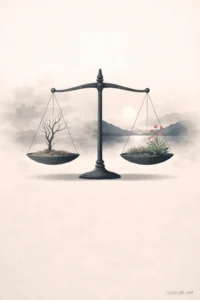
The Story phase
“I know it’s full of evils, full of human injustice, greed, folly, waste. But it is also full of good, of beauty, vitality, achievement. It is what a world should be! It is alive, tremendously alive—alive, despite all its evils, with hope. Is that not true?” (Page 389)
When I first read this quote in The Dispossessed by Ursula Le Guin, I interpreted it as “The world is okay as it is.” But when I revisited it while writing the book review, I realized it’s much sharper than simple acceptance.
The quotes brings about the idea that a world worth living in can’t be sterilized. If there’s vitality, there’s chaos. If there’s beauty, there’s waste. In fact, good exists only because bad exists. We see the beauty and achievement through the vantage point of waste, greed, and injustice.
We can’t have it both ways. Aliveness has a price.
So here’s the tension: when we feel frustration, disappointment, and pain, can we justify it as inevitable—the price we pay for achieving our goals? Or are these struggles just avoidable costs we’re accepting by default?
The Structure phase
Economists have a blunt name for this: opportunity cost.
It’s not “what something costs.” It’s what you give up when choosing a certain path, the best alternative that becomes impossible because you went the other way.
A more concrete way to see it: every “yes” pays in a different currency. In everyday life, we pay not just in time, attention, and money, but in reputation, energy, and relationships. When we say yes to something, we automatically say no to something else, too.
The bill is often invisible. We see the path we chose but rarely look back to notice the unchosen one.
So all the inevitable struggles we face right now have been free choices until the point where we decided to price the alternative. Greed can be what we get when status is priced higher than belonging, for example. Injustice can be what we get when convenience is priced higher than fairness.
As Thomas Sowell mentions in his book, Basic Economics, there are no solutions, only trade-offs.
The interface
The story phase: “the good exists with the bad.”
The structure phase: “everything comes with an opportunity cost.”
The interface: The life we choose to live isn’t judged by whether it contains ugliness or not, but by whether we recognize which ugliness is a tradeoff we’re consciously buying, and which ugliness is just an unpriced habit.
Question: In your real life right now, what “bad” are you tolerating as if it’s unavoidable, that might actually be the hidden opportunity cost of a choice you’ve made without much thought, a choice you still have the opportunity to revisit?