One line takeaway
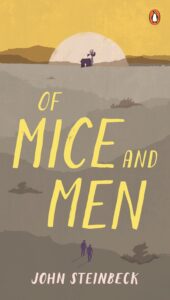
Of Mice and Men by John Steinbeck tells the story of two men’s struggle to hold onto their hopes and dreams in the teeth of the Great Depression.
Snapshot
In 1930s California, two men walk side by side along a dusty road, searching for work in an economy crushed by the Great Depression. The tall one, George, does most of the talking. The other, Lennie, is massive and childlike, with a mind that can’t keep up with his strength.
“One day”, they tell each other, “they’ll own their own ranch”; their own piece of land, a place where they can live off the fat of the land and tend rabbits. Finally, they arrive at a new ranch near Soledad, California, and they start working. Their dream slowly starts to feel possible.
But then, one simple incident triggers a chain reaction of chaos that ends in tragedy.
Table of Contents
Summary
Setting
The story unfolds in Great Depression-era California, in the world of ranch work, temporary jobs, and bunkhouses, where everyone is trying to scrape by. George and Lennie are no exceptions.
They’re constantly on the move because Lennie can’t control his strength, so he continuously gets into trouble.
But unlike the others, George tells Lennie, “We have each other.”
But not us.” Lennie broke in. “But not us! An’ why? Because . . . . because I got you to look after me, and you got me to look after you, and that’s why.” He laughed delightedly. “Go on now, George!” (p. 9).
The story starts as they approach Soledad to work at a ranch, hoping to save enough money to buy their own piece of land.
Main Characters
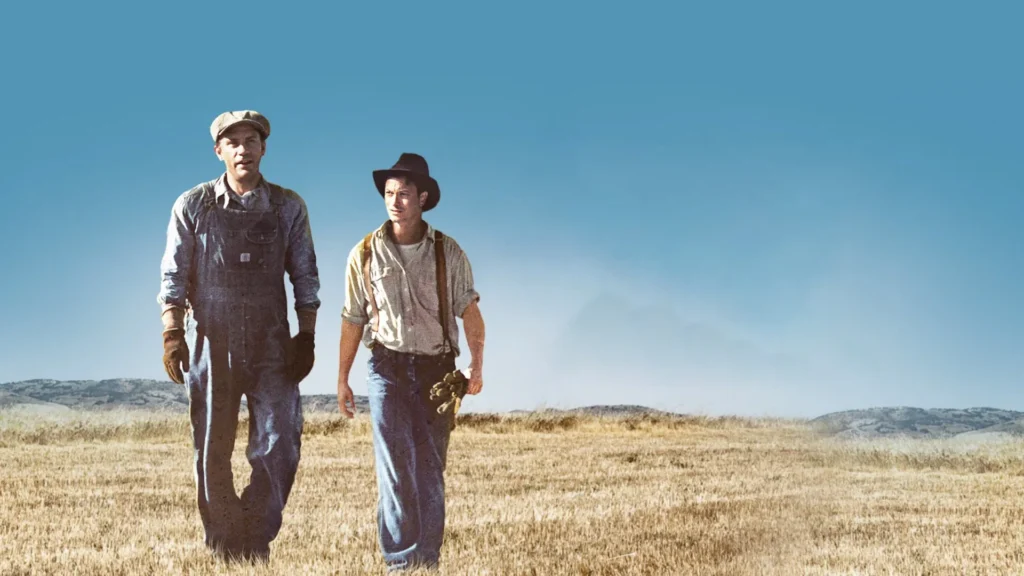
Main two characters
- George is practical and sharp, constantly thinking ahead. He’s the caretaker who keeps the plan and Lennie’s safety together.
- Lennie is physically powerful but emotionally childlike, deeply attached to George and their dream of owning a ranch one day. He can be dangerous without meaning to be.
Other characters from the ranch
- Candy is an aging ranch hand, terrified of being discarded, desperate for security.
- Curley is the boss’s son, insecure and aggressive, always looking for a target to prove himself.
- Curley’s wife is lonely and restless, treated like a problem more than a person, searching for attention and an escape.
- Slim is the respected ranch authority, calm and observant, the most stable character on the ranch.
- Crooks is the African-American stable hand, isolated by racism, protective of his space, fully aware of the power dynamics around him.
Plot Summary
Act 1: Arrival at the ranch
From the first scene of the book, it’s clear that George is always managing Lennie.
This is, to some extent, necessary because they both lost their previous job in Weed after Lennie touched a girl’s dress because it looked soft, and she accused him of assault.
But I also notice that George managing Lennie isn’t manipulation. It’s protection.
As the story goes, when they start talking about their dream of owning their own land one day, a small farm, this becomes more and more clear.
“We gonna have a little place,” Lennie explained patiently. “We gonna have a house an’ a garden and a place for alfalfa, an’ that alfalfa is for the rabbits, an’ I take a sack and get it all fulla alfalfa and then I take it to the rabbits.” (p. 62).
When they finally arrive at the ranch, the reality of the Great Depression is visible through the worn bunkhouse, the desperate faces, and the continuous competition for work.
In the ranch, all the men work together, so close to each other, yet their minds are miles away from one another.
The social hierarchy is also quite visible. Some have power, others are being watched, and only a few are safe to speak freely.
Curley, the ranch owner’s son, loves to boss people around and signals an immediate threat to both George and Lennie. This is the kind of person who escalates situations out of insecurity, and George, who knows how Lennie can react without understanding, stays watchful of every interaction between them.
Act 2: Tensions
But Lennie stands out without even trying. He’s a huge fella who’s obviously strong, and his personality always draws attention, especially in a place where men are looking for someone to blame.
In time, Curley begins to turn his eyes on George and Lennie constantly, and eventually picks a fight with Lennie, which turns violent.
This fight gives the first clues into Lennie’s inability to calibrate his strength and how he can be dangerous and create sudden chaos.
In the middle of all this tension is Curley’s wife, who indirectly shares her loneliness and her need for connection with others when Curley’s not around.
Act 3: The turning point
One day, Lennie ends up alone with Curley’s wife, and she starts to open herself up to him, sharing her dream of becoming a Hollywood actress and how she believes her mother stole the letter that would have made it happen.
At some point, Lennie, without any ill intentions, starts to stroke her hair.
This innocent moment quickly escalates as Curley’s wife panics and tells him to stop. When she starts to scream, Lennie tries to quiet her by covering her mouth, terrified that George will be angry.
Panicked by this, Lennie uses all his force to silence her.
This is exactly what George was trying so hard to prevent. But it happened anyway. This time, there’s no easy way out like the last time. Even Lennie realizes this as he looks over the dead body of Curley’s wife in the barn.
So he runs to hide in the brush by the river, just like George told him to do if he ever got into trouble.
After realizing what happened, the entire ranch turns into a hunt.
And with all this, George realizes that all of their precious dreams just went down the drain.
The ending
With Curley’s thirst for revenge, the entire ranch turns into a manhunt.
George realizes there’s no version of this where Lennie gets a fair outcome, and that he won’t survive what’s coming.
So George decides to find Lennie first, and he knows exactly where he is.
Before joining the ranch, George told Lennie, “If you jus’ happen to get in trouble like you always done before, I want you to come right here an’ hide in the brush.”
George meets Lennie at the river, and as painful as this is, he realizes it’s better be him than anybody else.
With that thought, yet with trembling hands, George aims his pistol at Lennie’s head, and pulls the trigger…
Ideas that resonate with me (The review)
What the book is really about
This 100-page book is a true testament to what a book can do, especially what a novel can do.
Many of my friends, who recommended this to me, said that this is the book that got them into reading again in their twenties, and I can see why.
The story shows what happens when genuine friendship and fragile hope collide with an environment that offers people almost no margin for error.
What makes the book extraordinary is how all these three components—genuine friendship in a time where it’s so scarce, hopes and dreams, and a world with no room for mistakes—are masterfully intertwined and compressed into just 100 pages.
Key Conflicts
One of the strengths of the story is the conflicts between different personality types and between man and economic forces.
What makes the story resonate is the tension that runs through every interaction.
Some of them are:
| Conflict | Core idea |
|---|---|
| George vs. the world’s instability | He wants control and safety in a world built to deny both. |
| Lennie vs. his own instability | He wants comfort and softness, but can’t balance gentle intentions with overwhelming strength. |
| The men vs. society | A hierarchy where weakness is punished, and power wins all. |
| Curley vs. the rest | Insecurity turning into violence. |
| The dream vs. reality | Their hopes exist in a world designed to grind them down. |
Key Themes
| Theme | How do they show up |
|---|---|
| Loneliness | Crooks being alone in his room, Candy’s fear of being useless, and Curley’s wife always looking for someone to talk to. |
| Friendship / responsibility | George constantly managing Lennie, the repeated retelling of their dream to own a ranch, and the final decision to end Lennie’s life. |
| The American Dream | The ranch fantasy, Candy’s money making the dream feel real, Crooks briefly wanting in on George and Lennie’s dream. |
| Power and vulnerability | Curley picking fights, Curley’s wife’s loneliness and constant struggle to talk to somebody, Crooks being socially vulnerable despite his intelligence. |
| Marginalization (race, disability, gender) | Crooks’s isolation, Lennie being treated as a problem, Curley’s wife being reduced to a threat. |
Symbols & motifs
| Symbol / motif | Meaning |
|---|---|
| Mice and George and Lennie’s dream to own their own ranch | Softness and innocence, fragility of human dreams |
| The farm | The structural control of society, societal stability, and belonging. |
| Hands (Lennie likes mice, but he accidentally kills them because he can’t control his strength) | The instability of power, the friction between intent versus outcome. |
| Solitude | The repeated pattern of people admitting they have nobody, especially while surrounded by many. |
| Violence (not just personal, but structural) | Presented as the inevitable, default solution when fear and power come together. |
Character analysis
George
George, like Lennie, values a stable life more than anything else. And as the sharper of the two, he’s fully aware that he’s the one who should be on top of things at all times.
He’s always running damage control, everywhere he goes, never getting to be more than a protector and a planner.
What he fears most, however, isn’t his and Lennie’s dream getting too far to reach, but Lennie getting hurt, especially in a way that George couldn’t undo.
What he chooses, again and again, is responsibility, even at the cost of his own freedom, and finally the dream itself.
“Listen to me, you crazy bastard,” he said fiercely. “Don’t you even take a look at that bitch. I don’t care what she says and what she does. I seen ‘em poison before, but I never seen no piece of jail bait worse than her. You leave her be.” Lennie tried to disengage his ear. “I never done nothing, George.” (p. 22).
Lennie
Lennie is the gentle giant who has limited impulse control and childlike desires.
He values things that make him feel soft, safe, and comforted.
The contrast in Lennie’s personality traits creates the core tragedy of his character.
On one hand, he’s built with exceptional strength and power, and on the other, he’s this innocent soul who just wants to pet mice and tend rabbits.
Finally, this inner tension explodes outward and destroys everything, turning it into chaos.
George said, “You get right up an’ take this pup back to the nest. He’s gotta sleep with his mother. You want to kill him? Just born last night an’ you take him out of the nest. You take him back or I’ll tell Slim not to let you have him.” Lennie held out his hands pleadingly. “Give ‘um to me, George. I’ll take ‘um back. I didn’t mean no harm, George. Honest I didn’t. I jus’ wanted to pet ‘um a little.” (p. 30).
Curley and Curley’s wife
These two characters are the primary symbols for the conflicts in the story.
Curley, being deeply insecure, creates conflicts with everyone on the ranch.
Curley’s wife, on the other hand, creates conflicts by projecting her loneliness. She also overlooks the danger she’s in, in the grip of needing connection with other people. Her presence triggers violence through these personality traits.
Together, these two characters show how fragile life is when power is petty and consequences are permanent.
“Well, Curley’s pretty handy,” the swamper said skeptically. “Never did seem right to me. S’pose Curley jumps a big guy an’ licks him. Ever’body says what a game guy Curley is. And s’pose he does the same thing and gets licked. Then ever’body says the big guy oughtta pick somebody his own size, and maybe they gang up on the big guy. Never did seem right to me. Seems like Curley ain’t givin’ nobody a chance.” (p. 18).
He hates big guys. He’s alla time picking scraps with big guys. Kind of like he’s mad at ‘em because he ain’t a big guy (p. 18).
Candy, Crooks, and Slim
Candy mirrors the average American life. Through his character we get to see what the system does to aging workers, and the fear of being replaced.
Crooks shows what systematic isolation does to a person, not just loneliness, but forced separation with constant threat underneath it.
Slim’s character shows what respect looks like when it’s earned, not forced. He’s everything Curley isn’t.
The ending
The ending is obviously a devastating one.
Even though right after the incident between Lennie and Curley’s wife, we can guess that what’s about to happen is inevitable, yet when it happens, it still feels devastating.
Looking at the ending from a thematic vantage point, however, brought me the realization that this is the whole heart of the story, that dreams can’t survive in a world where they were destined to be crushed in the first place.
But on a more personal level, the ending also shows how deeply George cares about Lennie, even though the events seem to contradict that fact when looked at from the surface.
The gun, strangely enough, becomes the mercy.
“Yeah,” said George. “I’ll come. But listen, Curley. The poor bastard’s nuts. Don’t shoot ‘im. He di’n’t know what he was doin’.” (p. 68).
Why the name of mice and men?
The title of the book comes from a line in a 1785 poem called “To a Mouse” by Robert Burns.
But Mousie, thou art no thy-lane,
In proving foresight may be vain:
The best laid schemes o’ Mice an’ Men
Gang aft agley,
An’ lea’e us nought but grief an’ pain,
For promis’d joy!
The poem is about a farmer who accidentally destroyed a mouse’s nest with his plow, which the mouse needed to survive the winter.
Steinbeck chose this title because it perfectly fits the central theme of the story, the fragility of human dreams and the reality that even the most carefully planned futures can be destroyed by forces beyond our control.
Final thoughts
I read this book in the first week of January 2026, and it was the perfect way to start the year.
Even though the book is only around 107 pages, the story covers many layers that took me through an emotional rollercoaster of a journey.
Parts that left a mark on me (Best quotes from the book)
“Don’t let him pull you in—but—if the son-of-a-bitch socks you—let ‘im have it.” (p. 21).
“Ain’t many guys travel around together,” he mused. “I don’t know why. Maybe ever’body in the whole damn world is scared of each other.” (p. 24).
“Guy don’t need no sense to be a nice fella. Seems to me sometimes it jus’ works the other way around. Take a real smart guy and he ain’t hardly ever a nice fella.” (p. 28).
As happens sometimes, a moment settled and hovered and remained for much more than a moment. And sound stopped and movement stopped for much, much more than a moment (p. 65).
George shook himself. He said woodenly, “If I was alone I could live so easy.” His voice was monotonous, had no emphasis. “I could get a job an’ not have no mess.” He stopped. “Go on,” said Lennie. “An’ when the enda the month come—” “An’ when the end of the month came I could take my fifty bucks an’ go to a . . . . cat house—” He stopped again. Lennie looked eagerly at him. “Go on, George. Ain’t you gonna give me no more hell?” “No,” said George (p. 72).
How did the book change the way I think?
The ability to bring our dreams alive has more to do with circumstances than we often realize.
Read this if you:
- Want a short novel you can finish in a day or two, but will resonate with you for a long time
- Are trying to understand how friendship, responsibility, and power work when people have very little control over their lives
- Want a story that shows how hope can be both motivating and fragile when your future depends on other people and luck
- Interested in reading a book with interesting themes and characters
- Like to read books about great friendships
