
There are two types of readers when it comes to quitting a book before it ends.
There’s the completionist reader who says, “We must finish what we started.” And on the other end, there’s the selective reader who says, “life is too short to finish a bad book.”
I’ve been both of these types in the past.
When I’m reading a book, if the first part was interesting but the second half gives me nothing, I still used to push myself to the end.
I was stuck in the sunk cost fallacy.
But I’ve been on the opposite end, too. When I couldn’t connect with a book, I’d quit instantly, without even questioning why, just because I “didn’t feel like it.”
It took me a while to realize neither of these approaches actually solves the real problem, that is, how to read more books?
Because quitting a book doesn’t guarantee the next one will magically be better.
It just wastes time you could’ve spent reading a better book.
This actually led me to read less. The number of books I read per year kept getting low.
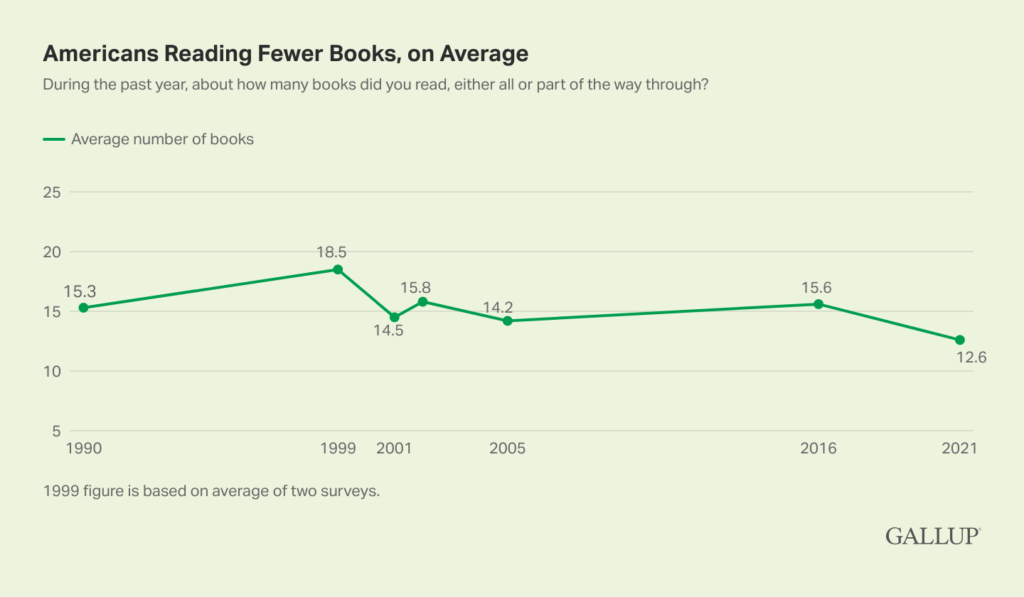
And this isn’t just me. Gallup’s 2021 report shows that Americans are reading fewer books than ever before. So the struggle to stay engaged with a book is a widespread reading pattern.
After some time, I realized what the missing piece of this puzzle was: I never asked why I didn’t like the book in the first place.
Once I started doing this, everything made sense.
Picking up a book you won’t like is inevitable. It happens more often than we’d like it to happen. So quitting isn’t a failure; it’s just a part of the process.
But understanding why I had to quit a certain book reduces the odds that I’ll quit the next one.
Eventually, I can choose books with a high chance that I’ll actually finish them.
This is how you read more books by quitting more, by quitting deliberately.
So what should this thought process look like?
Key Takeaways:
1
The fastest way to read more, and to read better, is to become extremely selective about what you pick up and be extremely thoughtful about what you put down.
2
Strategic quitting means asking why you didn’t like a book so you can avoid similar ones in the future, turning every abandoned book into data that improves your next choice.
3
When you quit books deliberately instead of randomly, you build momentum, protect your time, and eventually read more because you’re spending less time on books you won’t finish anyway.
Selective reading & strategic quitting
The best way to get out of this unproductive loop and start reading more is to control both sides of reading: what you choose to pick up and what you choose to put down.
Then connect the two.
Once you understand what kinds of books you’re quitting, you can avoid picking up similar ones in the future. That reduces the chance of abandoning a book midway, and helps you finish more books overall.
In other words, the fastest way to read more, and to read better, is to become extremely selective about what you pick up and be extremely thoughtful about what you put down.
This is what I call the Selective Reading + Strategic Quitting approach.
Controlling the input: Selective reading
The first half of this process is about controlling the input.
Most of the time, we pick up a book just because we want to read a book, not because we want to read that particular book. We do this because someone recommended it, because we saw a quote on Instagram, or because the cover looked interesting.
But this leads to reading books we don’t actually care about.
The problem is that we often get frustrated midway, especially with nonfiction, even if the book is well written and delivers good content, because we weren’t interested in that content to begin with.
If we chose the book because we wanted to read it, on the other hand, there’s a bigger chance we’ll enjoy it, and finish it.
So how do we choose books intentionally? On what basis should we do this?
What you’re curious about right now
By far, curiosity has been the core litmus test I use for picking up a new book, and for good reason.
Reading becomes ten times easier, almost unintentional, when the book’s main thesis is also pointed to where our curiosity is pointed at.
Now that the content of the book supports our curiosity, our mind and the book work hand in hand to make sure we reach the finish line.
What problem are you trying to solve
This section narrows down the curiosity discussed in the previous section into something specific, a particular question you’re actively trying to answer.
Sometimes these are questions we’ve been thinking about. Something we heard during a conversation with a coworker. Something we saw on social media that we now want to verify for ourselves. Or they might be specific questions related to a career shift, personal growth, productivity, relationships, or creativity.
For example, I remember glancing at a book, The Rise and Fall of the Great Powers, that had been collecting dust on my bookshelf for at least a couple of years. I kept looking at it every time I passed by, so long that it felt guilty to not read it at this point.
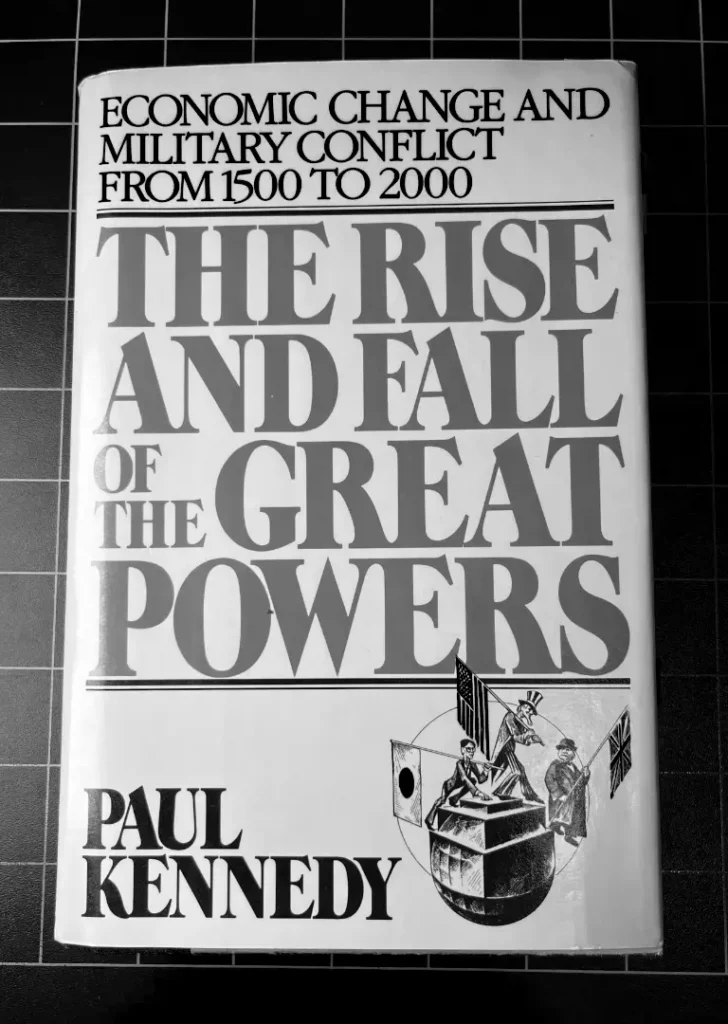
So I picked it up and started reading.
The book was well written. But I really couldn’t connect with it. The more pages I turned, the more resistance I felt. About forty pages in, I decided to give up. It went back to where it was.
Another year went by.
Then I found myself thinking about a question that had been bugging me for more than a decade: How did Asia lose its power to Europe in a matter of decades, even though it had held that power for centuries?
I’d read a couple of books trying to find an answer. I got around to an answer, but none of those books really addressed the specific question I had in mind.
Then, out of nowhere, I remembered that book I’d abandoned a year ago might have some answers.
So I picked it up again.
Unlike last time, I was hooked within a few pages. It was leaving breadcrumbs toward the question I was trying to answer. So I read with curiosity.
And there it was. It even had a dedicated section for this specific question.
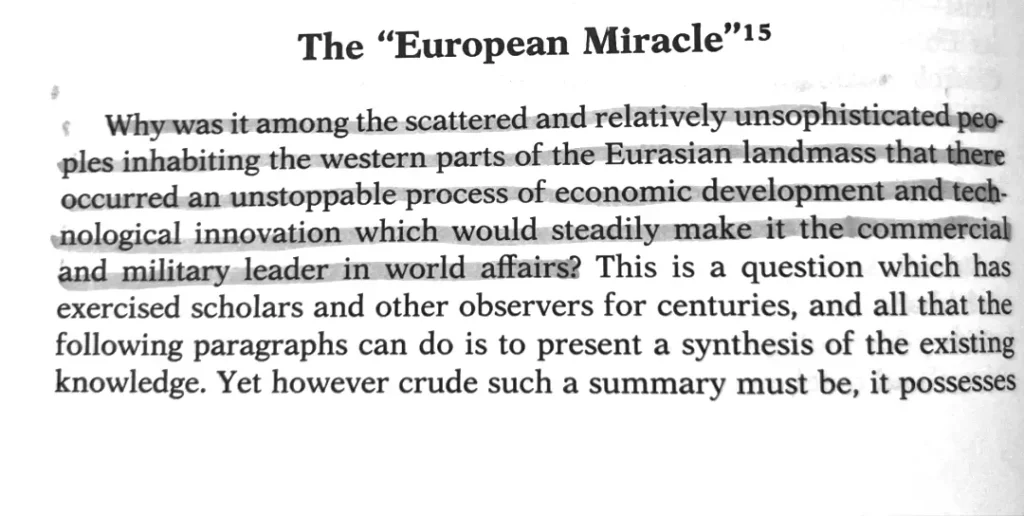
On page 17, it delivered precisely the answer I was looking for.
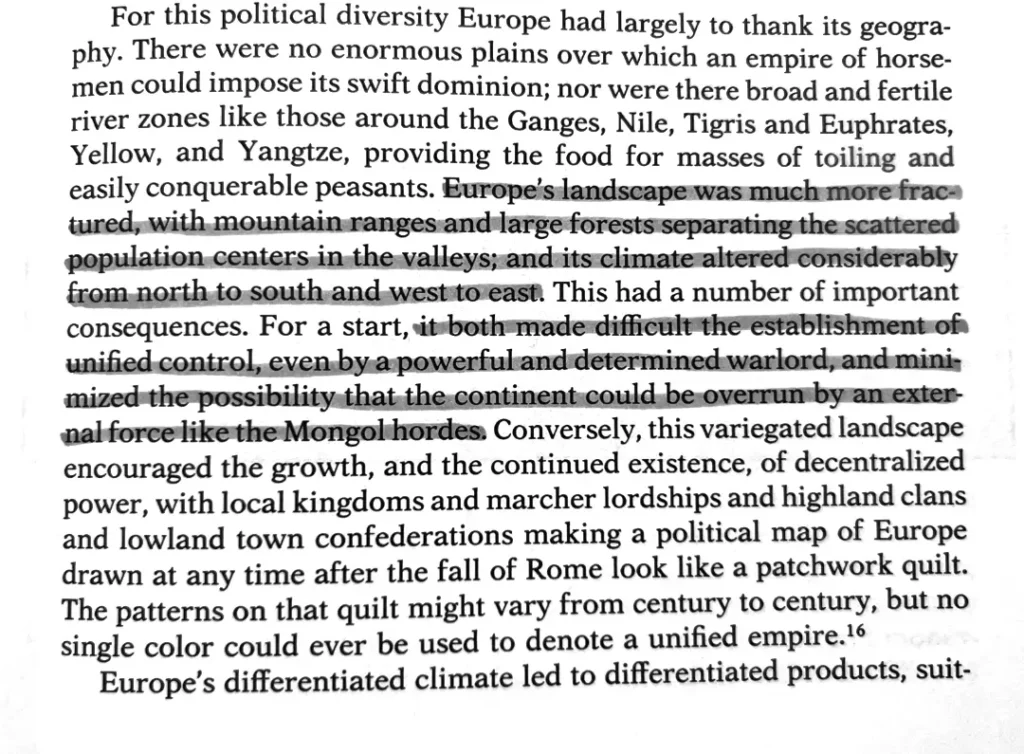
Had I just read it cover to cover the first time because I’d started it, I wouldn’t have picked it up again to find this answer. Reading with intent turned a DNF(did not finish) into one of my favorite books of all time.
What aligns with your long-term projects
When the book you pick up feeds the work you’re already doing, there’s a bigger chance you’ll enjoy it, and finish it.
A simple way to figure this out is by asking: Does this book align with my long-term projects?
For instance, say you’re running an online business that involves a lot of social media marketing. Picking up a book that helps you understand how to become better at social media marketing is a great choice. The content naturally interests you because it connects to your work.
This means there’s a better chance you’ll finish it.
The best part about picking up a book that aligns with your long-term goals is that it not only helps you finish the book, but also leads you into other related books, creating a chain reaction of purposeful reading in the long run.
What energizes you, not what you “should” read
There’s no prize for suffering through a classic you secretly hate.
We’re social animals, whether we like it or not, so it’s natural to push through a book you’re not enjoying just because most others say they loved it.
You unlock the superpower to read more books when you decide to be the black sheep, to put that book down anyway.
Selective reading prioritizes joy and usefulness, not obligation.
This alone filters out the majority of the noise.
Controlling the output: Strategic quitting
Selective reading protects your inputs. Quitting protects your time.
Just because the input is now properly controlled doesn’t guarantee we won’t end up disliking the book anyway.
In the beginning, when trying this process out, it’s normal to find ourselves picking up books we end up disliking more often than not. The goal of the second part of this process is to quit books with the same intent we used to pick them up.
By this, I mean we should have a clear idea why we want to quit the book, even though we sorted it out carefully in the previous step.
Once this is done, over and over, book by book, the feedback we get shapes our decision-making. It feeds back into the input, helping us pick up books we’ll actually enjoy.
Our ability to correctly decide whether we’re going to like a book gets better and better, which means we’re reading more than we’re putting down over time.
This is how quitting more books helps you read more books.
The circle is complete. We optimize both ends: input and output.
But there’s something else to think about before quitting a book, that is, when to quit.
If I quit early in the book, more often than not, I’m making a blind decision. The book might actually be worth it. On the other hand, if I stay with a book two-thirds of the way through even though I really don’t like it, I’m wasting my time.
So where’s the optimum place to quit a book, if you need to quit it?
This, of course, depends on the book, the context, and your own reading patterns. But to make it simpler and straightforward, there’s a rule introduced by Nancy Pearl that’s become quite popular among readers.
The rule is: if you’re under fifty years old, read the first fifty pages before deciding to quit the book. If you’re above fifty, the rule becomes more flexible.
If you’re 50 years old or younger, give every book about 50 pages before you decide to commit yourself to reading it, or give it up.
If you’re over 50, which is when time gets shorter, subtract your age from 100 – the result is the number of pages you should read before deciding whether or not to quit. If you’re 100 or over you get to judge the book by its cover, despite the dangers in doing so.”
-Nancy Pearl
So I decided fifty pages is my baseline.
When I reach the fifty-page mark, I ask one or more of these questions to help me understand whether I should quit the book or not.
The “Promise Check”: Is this book delivering the value it promised?
Now that in the first part of this process we asked ourselves, “What do I want to get out of this book?”, one of the best ways to decide whether to quit is to continuously ask: “Is this book delivering the value it promised me when I picked it up?”
If not, dropping it is the best decision. It gives you more time to read a book that’s actually valuable to you.
The “Season Test”: Is this the best fit right now?
Quitting a book doesn’t necessarily mean quitting it forever.
The question for the season test is: Is this the right book to read now?
Sometimes we need more important and necessary solutions than the book we’re currently reading provides. Or if it’s fiction, we might not be interested in a particular type right now, even if the book is really good.
For example, I was reading a very specific type of fiction: dystopian novels that aligned with the ideas of a nonfiction book I’d read a while ago, A Conflict of Visions by Thomas Sowell. After reading five or six novels in this very specific sub-genre, I picked up a different type of fiction for my weekly fiction slot: All the Pretty Horses by Cormac McCarthy, a western, completely different from the dystopian novels I’d been reading nonstop for two months.
Even though this book is extremely well written, which goes without saying, I couldn’t enjoy it. I was still hooked on those dystopian novels and already eyeing something similar: The Dispossessed by Ursula K. Le Guin.
So after fifty pages of All the Pretty Horses, I put it down to pick up The Dispossessed.
I’ll definitely pick it up some other time. But right now, I have no seasonal interest in western fiction. The book isn’t bad. It’s just not the right seasonal choice.
Your mood matters more than you think.
For these kinds of situations, having a “paused” list liberates us from feeling guilty about putting down a good book. A more convenient way to do this is to have a Goodreads account with a dedicated shelf for it.
The “Effort-to-Reward Ratio”: Can I justify the value I’m getting out of the book for the effort I’m putting in?
There are books whose content is highly researched but doesn’t produce much of an output. We’re just reading scattered facts. The book doesn’t converge into an original idea, let alone sometimes any idea.
The problem with such a book is twofold.
First, it takes a lot of effort to read. This inevitably takes a lot of time. The only way to justify that time and effort is if the book is delivering value.
Second, especially in today’s world, if we just want facts, nonfiction shouldn’t be our first choice. We can get facts, potentially fresher, more updated facts from other places.
The reason to read a nonfiction book is for its thesis. Facts should just be there to support that thesis.
At the fifty-page mark, if you feel like the book doesn’t converge into an idea or a series of ideas, that there’s no thesis, just scattered facts, it’s a good idea to abandon it.
Benefits of selective reading + strategic quitting system
You read more because you stop wasting time on the wrong books
The more I put this strategy to work, the clearer it gets that we don’t have “reading problems”, we just have a problem putting books down.
As someone who grew up reading a lot of books, putting down a book midway feels almost like a criminal offense. And there’s too much shame attached to it; way more than there should be.
“There’s a certain romance to reading, hence the inevitable heartache when you break up with a book,” says professor Maria Tatar. “I need both substance and sorcery, captivating content and magic on the page.”
“When that magic is absent“, she continues, “readers should act accordingly, whether they’re 50 or 100 pages in“.
The reader’s clock is what matters.
Your attention stays sharp
By following this process, selective reading and strategic quitting, you’ve already figured out what works, so your attention stays sharp.
This builds momentum.
Momentum is more important for reading more books than anything else.
If you set a goal to read a certain number of books and you see that you’ve even surpassed your goal in the middle of the year, you’ve built strong momentum. Nothing’s going to stop you from reading at that point.
As a result, the number of books you put down goes down gradually. You’re taking in more books and putting down fewer books.
The system is working. You’re reading more books.
Your reading becomes aligned with your goals
We read books because we like reading them.
We get something out of finishing them. It can be joy, influence, insights, or practical knowledge.
These books don’t necessarily have to align with our goals, either professional or personal. But the more I read books, the more I try to implement this strategy, the more it’s clear to me that I’m unconsciously bridging that gap. I pick up books that align with my personal and professional goals.
In hindsight, this makes sense.
But this isn’t something we can do deliberately. We don’t know what we don’t know. So it has to be organic.
This is the advantage of having a system like this.
For just one book, it’s a simple two-step process. But in the long run, with the help of several hundred books, it becomes a framework that helps us go from “I don’t know what I don’t know” to “I know what I don’t know”, which is the ultimate foundation we need for achieving anything.
This system will help you build that.
You become a better thinker
As a result, we begin to think more clearly.
This is not only because we’re constantly thinking about what works, but also because our thinking becomes more focused as we read books that align with our goals.
You protect the joy of reading
All of the above benefits don’t make much sense if we’re not enjoying what we’re reading, whether it’s a novel or a nonfiction book.
By controlling our input and output of reading, we get to eliminate the books we don’t genuinely enjoy. This is a very important point because the biggest reason people’s reading gets worse every year is that they force themselves to read something they don’t like.
According to research, 28.76% of people never finish a book they start reading, but those who finish one book are 29.02 times more likely to read at least one more.
Quitting isn’t failure, it’s curation
All in all, it’s the mentality that most of us book lovers have that needs some adjustment.
You’re not giving up on a book when you quit it. You’re curating your mind.
The whole idea of reading is like a museum. Not every piece deserves to go on display. Likewise, not every book you pick up has to be finished. Some belong in storage. Some you need to send back. And a few, very few, belong in the center of the gallery, under the spotlight.
But this is okay.
Because the Louvre is famous for the Mona Lisa, even though thousands of other works hang on its walls. The masterpiece defines the collection, not the volume.
This is what selective reading and strategic quitting help you find: the best books that genuinely help you achieve your goals while giving you the freedom to enjoy many others around them.
What’s one book you’ve been forcing yourself to finish that you might need to let go?
Frequently Asked Questions
1. Is it okay to quit a book if I’m not enjoying it?
Yes. In fact, it’s necessary if your goal is to read more books in the long run.
If reading the book isn’t enjoyable, you’re just dragging yourself to the finish line because you feel like you must finish what you started. The only thing that happens by finishing this book is that you waste time you could have used to read something you really like, and learn something interesting from it in return.
But it’s really important to make a mental note about why you’re quitting the book so that you have a better chance of avoiding the same kind of book in the future.
2. How many pages should I read before deciding to quit a book?
A good rule of thumb for this comes from author Nancy Pearl.
The rule is: if you’re under fifty years old, read the first fifty pages before deciding to quit the book. If you’re above fifty, the rule becomes more flexible.
If you’re 50 years old or younger, give every book about 50 pages before you decide to commit yourself to reading it, or give it up.
If you’re over 50, which is when time gets shorter, subtract your age from 100 – the result is the number of pages you should read before deciding whether or not to quit. If you’re 100 or over you get to judge the book by its cover, despite the dangers in doing so.”
-Nancy Pearl
3. Should I feel guilty about not finishing books?
No, because quitting a book isn’t failure. It’s curation.
If you’re not enjoying a book, even though you know it’s well written and something you should read, it’s better to come back to it when you’re ready for it.
The best way to cope with this guilt is to have a “paused” shelf so that you don’t feel like you’ve completely abandoned the book.
4. Does quitting books help me read more?
Yes, although these two ideas, quitting books versus reading more books, seem to contradict each other, if you quit books with intent, that is, asking the question “Why did I not like this book?” and then feeding that insight into the choice of picking up the next book. Eventually you’ll pick up many books you won’t quit.
So yes, quitting books does help you read more, but under the condition that you quit them deliberately.
5. What is Nancy Pearl’s “Rule of 50” for quitting books?
Introduced by Nancy Pearl, this rule has become quite popular among readers.
The rule is: if you’re under fifty years old, read the first fifty pages before deciding to quit the book. If you’re above fifty, the rule becomes more flexible.
If you’re 50 years old or younger, give every book about 50 pages before you decide to commit yourself to reading it, or give it up.
If you’re over 50, which is when time gets shorter, subtract your age from 100 – the result is the number of pages you should read before deciding whether or not to quit. If you’re 100 or over you get to judge the book by its cover, despite the dangers in doing so.”
-Nancy Pearl
6. How do I know when it’s time to give up on a book?
If you’re not enjoying a book after a baseline number of pages, it’s best to give up and come back to it when you’re ready for it.
This baseline can vary depending on the book’s genre, page count, and so on. But fifty pages is generally a good rule of thumb.
7. Will the book get better in the second half if it starts slowly?
This is not a guarantee.
Some novels, especially older ones, have a slow build. It’s the second part where the story comes alive on the slow foundation it was built on.
That said, most books that start amazingly continue to be amazing. If you’re at fifty to a hundred pages and nothing’s grabbed you, it probably won’t.
8. Should I come back to a book later if I’m not in the right mood?
Yes, this is the best way to handle the situation rather than sticking with a book you don’t like.
Moods change.
Books are tied to mood, season, and life circumstances. What doesn’t work for you now might be perfect when your mood, interests, or life phase changes. Aligning the books we read with these factors helps us read more books in the long run.
More often than not, I tend to enjoy a book and get a lot more out of it when I read it for the second time, even though I quit it the first time because I didn’t like it.
9. What are the signs that I should quit a book?
Major signs include:
- You wouldn’t care to think about the book while you’re not reading it.
- You wouldn’t naturally reach for the book when you have free time.
- It starts to feel like an obligation, and there’s no enjoyment in turning the pages.
Quitting the book at this point is the best thing to do. It saves you time to read something you really like.
10. Is it wasteful to quit a book I paid money for?
If the book is bad and you’re not going to enjoy it, the truth is that the money is already gone, whether you finish it or not.
The best way to handle this is to move on to something you genuinely enjoy.
If you still feel guilty about the money you spent, it’s a good idea to give the book to a friend who you know will enjoy it and find it helpful. This way, you not only save your time by not reading a book you know you won’t enjoy, but also help someone else in the process.
