
TL;DR
Most career advice starts from the wrong place: the job.
It asks what role fits you best, instead of asking what kind of person you are at a deeper level. Because of this, many people end up in careers that look right on paper but feel wrong over time.
A better way to think about career fit is through three layers:
- your core (how you think, what energizes you, what you’re naturally good at)
- the directional forces acting on you (environment, opportunity, culture, constraints)
- the career that emerges from how those two interact
A career is not something you simply choose. It is a translation of your core strengths through the forces that shape your path.
If the translation is poor, the answer is not always to try harder. It is to understand your core strengths more clearly, reshape the forces around you, and move toward a role that expresses more of who you really are.
Most career advice starts with the same kind of question.
What job fits you best? What kind of career would make you happy? What job suits your strengths?
These questions aren’t entirely useless, but they’re often hit and miss. More often than not, they lead to surface-level matching. You can have the right strengths for a job and still feel badly misplaced in it.
This is because these questions approach you from the vantage point of a job, not the other way around. And that is a problem, because many jobs can appear to fit your strengths while still being poor long-term translations of who you really are.
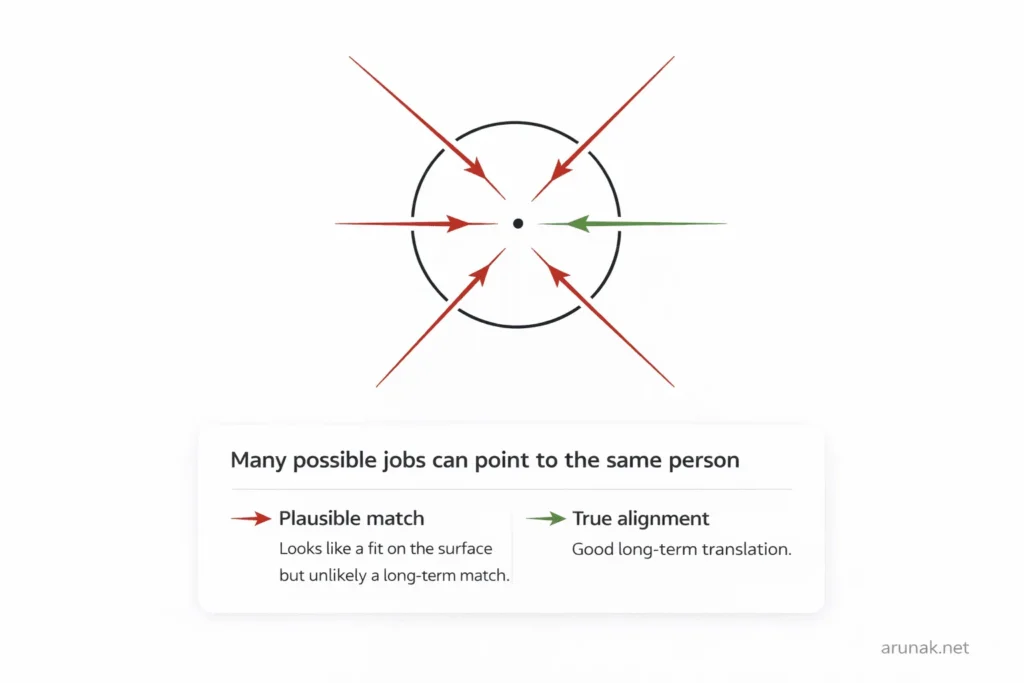
Over time, staying in a role that is not compatible with your core personality traits creates stress, friction, boredom, and a sense that your working life is moving in an entirely wrong direction, even when you are competent enough to do the job really well.
So, what are the right questions to ask, especially when you feel stuck in your current role, are considering a career shift, or are trying to choose a path in the first place? How do you choose a career that is not just a plausible match on paper, but a better expression of the kind of person you really are?
That is what this post is about.
Key Takeaways:
- Career fit is often misunderstood: Most people define career fit from the job’s perspective. This leads to surface-level matching that doesn’t hold up over time.
- The same core strengths can map to multiple careers: Your strengths are rarely specific to one role. Many careers can look like a good fit, but only some will align deeply in the long run.
- Career outcomes are shaped, not just chosen: Your path is influenced by directional forces (environment, exposure, culture, and opportunity), not just your abilities.
- Misalignment is often a translation problem: Feeling stuck or underused is not always a lack of ability. It is often a sign that your current role is a poor translation of your core strengths.
- You can influence directional forces: You cannot control everything, but you can change environments, seek better exposure, move toward better problems, and surround yourself with the right people. These shifts change where your career is heading.
- Career fit is not a one-time decision: A good career is not found instantly. It is approached gradually by improving the alignment between your core strengths and your intended career.
Table of Contents
The problem with most career advice
Most career advice is built around a familiar set of categories: interests, strengths, values, goals, and market demand.
None of those things are irrelevant. In fact, they’re often the most obvious things to focus on from the side of the labor market, because jobs are defined in terms of visible outputs, measurable skills, and practical constraints. Recruiters, employers, and institutions need these kinds of legible signals for the hiring process.
The problem with this, however, is that fit can still be badly defined when it is approached from the job’s side first. From the standpoint of the person seeking a career, these categories aren’t just enough to establish a good fit.
That is because a person’s core strengths are more often than not aligned with more than one career path. A mind that is analytical, disciplined, and verbally strong might plausibly fit law, consulting, research, policy, finance, or management. On the surface, all of those can look reasonable.
But surface plausibility doesn’t guarantee long-term alignment.
That is where the real problem begins.
The issue isn’t that people fail to reflect, or fail to research, or fail to think carefully enough. The issue is that the top-down framework—that is, from the job to the person—assumes that if you understand yourself well enough, compare the options carefully enough, and reason clearly enough, you can simply choose the right career from the outside in.
That assumption often backfires.
Many people start thinking about career fit in terms of external demand before they think about their internal center, their core strengths. They try to understand themselves through the jobs available to them, with the categories that are often too broad to capture who they really are. This process can be useful for finding a job, of course, but it is not always fine-grained enough to identify a career that will hold up over the long term.
A person may have a real pattern of ability, motivation, perception, and temperament. But the world doesn’t offer roles perfectly matched to those qualities. It offers titles, credentials, prestige hierarchies, and simplified stories about what counts as a good life.
So the real challenge is not just self-knowledge or job knowledge.
It is translation.
The same underlying strengths can be translated into very different careers, and a career that looks plausible from the outside can still be the wrong long-term expression of who you really are.
Here are some real-world examples to make this argument concrete.
Jeff Bezos once planned to become a theoretical physicist. He eventually recognized that it wasn’t the right fit for the kind of mind he had. He says:
So, I loved physics, and I studied physics and computer science, and I was proceeding along the physics path. I was planning to major in physics, and I wanted to be a theoretical physicist. And computer science was sort of something I was doing for fun. I really loved it, and I was very good at the programming and doing those things, and I enjoyed all my computer science classes immensely. But I really was determined to be a theoretical physicist. That’s why I went to Princeton in the first place. It was definitely… And then, I realized I was going to be a mediocre theoretical physicist. And there were a few people in my classes, like in quantum mechanics and so on, who could effortlessly do things that were so difficult for me. And I realized there are 1,000 ways to be smart.
What changed wasn’t his ability. He recognized that the career he’d committed to was a poor fit for the kind of mind he had. With the same core strengths, he found an entirely different expression of them in building Amazon Inc.

Brian May, the lead guitarist of Queen, once said that scientists are often artistic because they “see patterns in things.” And he is his own example. The same mind that made him a world-class musician also earned him a PhD in astrophysics, but he found his most successful self in music.

John Urschel played in the NFL and later became a mathematician at MIT. On the surface, those look like unrelated careers. But in his own telling, the common through-line was quantitative thinking, a strength that could be expressed in two radically different worlds.

All three examples point to the same conclusion: a career can match your skills extremely well and still be the wrong translation of your core strengths.
That is why a job-first approach can be misleading. It notices overlap at the level of skills, but misses the deeper pattern that determines whether a career will actually fit your life over time.
This problem shows up most clearly in people who feel lost, underused, or hard to classify, people who know they’re capable of something, can almost see it, definitely feel it, but can’t clearly explain what that something is. They keep trying to choose a career, yet still feel that the available options don’t fully represent them.
All this being said, some degree of trial and error is inevitable in this kind of search.
But there is a way that helps narrow it down, and that is to move away from a purely top-down approach, where you try to position yourself within available careers, and instead start from the inside out.
That is what this framework is trying to do.
It separates the process of finding the right fit into three distinct layers: your core, the directional forces acting on it, and the career that emerges through the process.
Layer 1: The Core
People often say things like: Michael Jordan was born to play basketball, or Steve Jobs was born to build companies, or Amy Winehouse was born to write and perform music.
But this confuses me.
How can anyone be born to do something that is defined socially? Basketball, entrepreneurship, and songwriting are not biological categories. They are human-made careers.
There is no real harm in saying this casually. But it creates a misleading idea of what we should actually focus on when choosing a career.

Michael Jordan was not born to play basketball. He was born with a particular set of traits: athletic ability, coordination, competitive drive, and an unusual tolerance for pressure. Those traits happened to map extremely well onto becoming one of the greatest, if not the greatest, basketball players of all time.
In the same way, Steve Jobs was not born to be a CEO, and Taylor Swift was not born to be a pop star. They each had underlying patterns of mind, unique taste, intuition, narrative sense, discipline, that found expression in those careers.
This distinction matters because it changes the conventional approach to choosing a career.
The first step, therefore, is not to ask what job fits you. It is to understand what is within you that makes you who you are, independent of any job title.
This is what I call the core: the underlying structure that makes someone the kind of mind they are.
That includes things like:
- their natural modes of attention
- the kinds of problems that energize them
- the forms of difficulty they tolerate well
- their temperamental style
- the environments in which they become sharper-minded without even trying
This idea becomes clearer when you look at how the same underlying ability can show up in very different domains.
Take timing as an example.
Bob Hope was known for his precise comedic timing, especially his rapid-fire delivery of one-liners that landed cleanly with audiences. What is less widely known is that he briefly pursued boxing under the name “Packy East” before committing fully to comedy.

On the surface, those are two very different arenas. But both reward the same underlying capability: timing under pressure.(Yang et al, 2025; Fac et al, 2014)
He stepped onto two entirely different stages, yet relied on the same core ability. What changed was not the existence of the skill, but the form in which it was expressed. Over time, he recognized that stand-up comedy was the better long-term expression of his core strength.
The reverse pattern also shows up. Some fighters move into comedy later in their careers.
Joey Medina, a former professional boxer from the Bronx who won the New York State championship, later became a stand-up comic. One article notes that he “knows how to land a punchline just as well as he once landed a jab.”
Across these cases, the outward careers look completely different. But the underlying capabilities, timing, composure under pressure, and responsiveness to an audience remain the same.
This is the key point: the same core strengths can support very different careers, and not all of them will be equally good fits over the long run. That is why getting this first layer right matters so much. If you misunderstand your core, you may spend years choosing among roles that all seem reasonable, but none of which are a true long-term fit.
This is what makes the core both the most important layer and the hardest one to see clearly. It is deeply personal, and it can not be outsourced. No one else has direct access to how you think, how your thinking patterns evolve, or what actually sustains your attention over time.
So this step requires careful, honest attention, not in terms of job titles, but in terms of how your mind actually works.
Some people struggle in conventional education but have a mind built for synthesis, pattern recognition, or abstraction. Others may not perform well in structured, test-based settings, but think clearly in motion, through action, interaction, and real-time problem solving.
Some people are not physically expressive or fast-moving, but are exceptionally strong in structured thinking. They work through ideas on paper, build arguments, and shape language with unusual precision.
The standard career categories, interests, strengths, values, goals, and market demand don’t capture these deeper patterns, or are not necessarily designed to capture them.
A lot of career confusion begins when people can’t see this first layer clearly, or when they’ve been trained to look at themselves from the outside, from the perspective of a job, and try to align their abilities to fit a description that was never designed to describe them in the first place.
And even when this layer is fully understood, something is still missing. The same core strengths can be pushed in very different directions depending on the forces acting on them.
I call these the directional forces.
Layer 2: The Directional Forces
This is the layer that is most often overlooked.
The previous section discussed how to understand who you are, which is a bottom-down approach.
But this approach, on its own, is not sufficient to ensure a good career fit.
Even if you start from a ‘bottom-down’ question (“What are my core strengths?“), You still run into a problem, that is, they don’t map cleanly or immediately to a well-defined career. The translation is not straightforward.
In other words, there is an intermediate layer that most people miss.
These are the directional forces.
A person is not a direct reflection of a job, and a job is not a direct expression of a person. Something in between shapes how one becomes the other.
Directional forces are the pressures, constraints, and influences that push the same core strengths in one direction rather than another.
They include things like:
- family expectations
- class and economic constraints
- geography
- educational access
- exposure to certain professions but not others
- prestige signals
- cultural ideas about success
- confidence, fear, timing, and luck
People’s inner capabilities do not directly convert into job roles.
They get directed.
Two people with similar underlying abilities can end up in very different places because the forces acting on them were different. One person encounters the right mentor early, develops the right language for their strengths, and enters a career where those strengths accumulate over time. Another person may never get that alignment. Their core strengths remain intact, but they become misdirected, invisible, or underused.
This is why career outcomes can’t be read as pure evidence of merit or essence. A career may reflect something unique about a person, but it also reflects the forces that shaped their path over time to end up in that career.
So, understanding the directional forces you’ve been exposed to matters as much as understanding your raw potential.
But more importantly, once you can understand these forces, you are no longer completely subject to them. You are better positioned to bend them to your will.
You may not be able to control all of them, of course. Some are structurally fixed: where you were born, the resources available to you, the opportunities you encountered earlier in life.
But many of them can be, at least, influenced.
- You can change your environment, your workplace, or even where you live.
- You can seek out people who help you move toward what you actually want.
- You can get closer to the kinds of problems that match and refine your core strengths.
In that sense, career direction is not just about choosing the right role. It is about gradually shaping the forces that act on you, so that over time, they push you toward better expressions of who you really are.
This is the practical use of this layer.
If you already have a clear sense of your core strengths, the next step is not to search endlessly for the perfect career. It is to ask a different question:
What forces are currently shaping my path, and which of them can I bend to my will?
Layer 3: The Career
But that question immediately raises the next one: bend them toward what? What should those forces be pushing you toward?
That is where the third layer comes in.
The third layer is the outermost one: the career.
This is the socially legible part. It is the point where a person becomes visible to the world through something the world can recognize as a role: engineer, teacher, designer, analyst, manager, writer, operator, or founder.
Careers matter because society runs on them. They create trust, expectation, coordination, and economic exchange. And most importantly, they are how your work becomes usable to other people, and so makes you financially viable.
But a career is not the same thing as a person. It is a compressed representation of a person.
A career captures some part of your core strengths and ignores the rest. Sometimes that compression is not a bad thing. Sometimes it even helps by aligning your core strengths toward something useful for others. But sometimes it can get in your way.
This is what many people experience as misalignment.
They are not merely in a career they dislike. They are in a role that translates their core strengths poorly, and most of who they are is lost in translation.
The role may reward some aspects of a person while suppressing others, or force them to operate in a way that feels unnatural and constrained. Over time, this creates friction, not always visible from the outside, but very real from the inside.
A career, then, is not chosen in isolation. It is the result of how your core strengths interact with the directional forces acting on them.
That is why two people with similar core strengths can end up in very different careers, and why the same person can end up in very different careers at different points in life.
So the goal is not simply to pick a career.
The goal is to arrive at a career that is a good translation of your core strengths, given the forces acting on you.
Once you see it this way, the question changes.
Instead of asking:
“What career should I choose?”
You start asking:
“What kind of role would be a better expression of my core strengths, given the direction I am currently being pushed in?”
And more practically:
“What small shifts in my current situation would move me toward a career where I can express myself fully?”
This is where this career fit model becomes usable.
You don’t need to make a perfect decision today. You need to move in the right direction starting today.
That means moving toward work that consistently uses your strongest patterns of thinking, reducing exposure to environments that suppress or distort those patterns, and choosing roles that allow more of your core strengths to be expressed, not less. It also means using directional forces deliberately, the people around you, the culture you work in, and the environments you place yourself in, to nudge yourself toward better-fitting roles over time.
Bringing back the same example, Michael Jordan was not born to play basketball. He had a rare athletic core that happened to find one of its strongest expressions in that sport. But basketball was also one of the most visible, celebrated, and institutionally developed sports in the United States. That is a strong directional force. Had he been born somewhere else, where another sport occupied that cultural space, his abilities may have been routed differently. The core may have remained the same, but the directional forces around it could have pushed it toward another career entirely.
This does not mean we should simply settle for whatever path happens to be available.
Once you understand your core and the directional forces acting on it, you can begin to shape those forces deliberately. You can change your environment, seek out different people, move toward different problems, and slowly reposition yourself toward the kind of career that fits you better and that you wholeheartedly come to love.
Without this understanding, a person can work very hard over a very long time and still end up far from where they belong, then mistake that drift for destiny.
A good career is not found in a single step. It is approached gradually.
A Way to Visualize the Career Fit Model
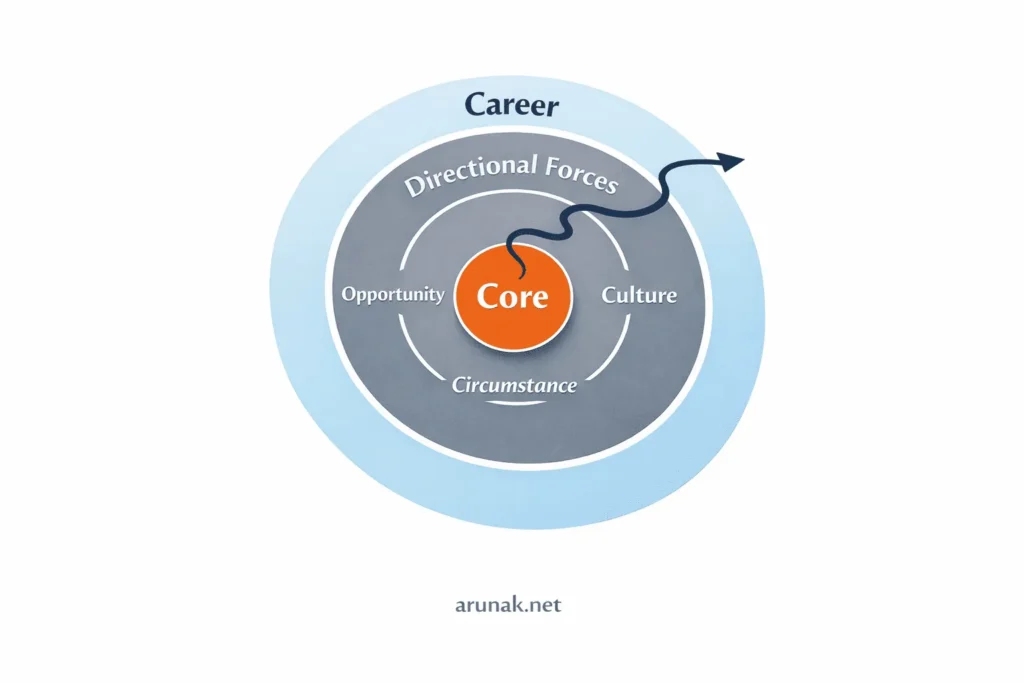
At the center is the person: the unique patterns of mind, motivations, and core capabilities.
From that center, a route is drawn outward. That route is shaped by the directional forces: opportunity, pressure, culture, and circumstance.
Where this route lands on the outer layer is the career, the point where the world sees what you do and what you stand for.
That means a career is not just a match between a person and a role. It is a path-dependent translation.
And when the translation is poor, the answer is not always to try harder within the same career. It is to understand the core underneath, identify which directional forces are pulling you off course, and reposition yourself toward a career where more of who you are actually comes through.
Common career related questions through the lens of the career fit model
Once you see these three layers, a lot of familiar career problems become easier to explain.
But what if you want to be the only person in a certain kind of role? Does this line of thinking allow for that?
It does.
The framework above offers a clear path toward better career alignment. But this does not mean that someone has to align themselves with a predefined career.
Sometimes, when you figure out your core strengths, there is no existing career that puts them fully into practice. No role that harnesses their full capacity. The predefined options feel too narrow, too partial, or simply misaligned for you.
In a situation like this, the goal is not to find the right box to fit into. It is to figure out how to bend the directional forces so that a new kind of role becomes possible, one that did not exist before you came up with it, but that other people genuinely need. That is the condition that matters: whatever you build around your core strengths should create real value for others. When it does, the role sustains itself. When it does not, it just remains a personal project.
The core strengths are still intact, and the model still holds. What changes is that instead of navigating toward an existing career, you are using the directional forces to carve out a new one, one that matters to other people.
Why high performers can still feel lost
A person can have a strong set of abilities at Layer 1 but poor routing at Layer 2, which leads to a weak or distorted role at Layer 3.
From the outside, this can look like indecision or underachievement.
But the real problem is not always a lack of discipline. Sometimes, the person has simply never been translated into a career that fits them correctly.
When this happens, there is a persistent feeling that is hard to shake: I know I’m capable, but I can’t fully express myself through the career I’m in, even though I’m genuinely good at what I do.
Why can success still feel like a failure?
Tony Robbins once said in an interview (timestamp: 46:00) that “Success without fulfillment is the ultimate failure“:
This is the ultimate failure. ‘Cause if you go at something and you fail and you’re an achiever, you don’t fail. You go, ‘I learned something. I’ll just try something else. I’m going to still get there.’ But when you succeed, and you’re not happy, you’re technically screwed.
The outer role may look impressive while translating your core self really poorly. The world only sees the success. But what you feel inside is pure friction.
This is one reason conventional career advice often feels too shallow. It treats career attainment as proof of fit.
It is clearly not.
You can figure out your core strengths and direct them toward a career you actually want, or even toward a completely novel one. You might fail along the way. But as Robbins puts it, that kind of failure is not really failure. It is information. And each time, you get closer to where you actually want to belong.
Why other people often see you completely differently from how you see yourself
Other people mostly see Layer 3. They see the career, the output, the credentials, and the visible track record.
They usually don’t see the deeper person or the directional forces that produced your career in the first place.
That is why people often receive advice that sounds plausible but still misses the mark. Others are responding to the visible counterpart, not the real person underneath it.
What is the outcome of a model like this?
The idea for this post starts from a simple belief: many people are more capable than their current career might suggest.
Not because everyone is secretly exceptionally talented, and not because self-discovery magically erases structural constraints. But because human potential is often filtered through poorly designed systems, weak language, and directional forces that most people are never taught to see.
So the goal here is to build a better vocabulary for career alignment.
Not just a vocabulary of careers, but a vocabulary of core strengths and capabilities, directional forces, career translation, misalignment, and alignment.
That is the purpose of the career fit model.
It gives us a way to talk about career fit without reducing a person to a personality label or taking someones job role as the final verdict of who they are, helping more people find their way to careers that are not just plausible on paper, but genuinely theirs.