

In 2005, Steve Jobs stood in front of Stanford’s graduating class and delivered one of the most beloved commencement speeches ever. Somewhere in the speech, he said, “You’ve got to find what you love,” and just like that, it became one of the most admired pieces of career advice in the modern world.
But if you look closely at Jobs’s own career path, it is hard to argue that a simple act of following passion was the primary engine of his success. His career looks less like the straight expression of a pre-existing passion and more like the gradual buildup of something the world found useful, unique, and hard to ignore.
That does not make Jobs a liar, of course. It means the popular interpretation of his speech doesn’t capture the essence of what he was actually trying to explain.

In So Good They Can’t Ignore You, Cal Newport makes this point well, arguing that “follow your passion” is bad advice not because passion is worthless, but because it is too simplistic to explain how meaningful work is actually built. The better lesson, Newport suggests, is to pay attention to what Steve Jobs did, not just the most quotable version of what he said.
The question that follows immediately is: then what?
If passion is not enough, what should replace it?
The answer begins to appear when you stop looking at this question only through yourself, through the lens of passion, and start looking at it through others, through the lens of contribution. In other words, the best and most practical way to channel whatever you are good at is not by shaping it only around what you happen to like, but around what it can become useful for in the world.
So what exactly is contribution? How do you recognize it for yourself? How do you figure out where your strengths are most useful to others? And what questions should you ask to find that out?
That is what this post is about.
Key Takeaways:
- “Follow your passion” is weak advice because passion is hard to define, hard to prioritize, and easy to lose when work becomes difficult.
- Follow your contribution is stronger advice because it asks what your strengths can do for other people under real conditions.
- Contribution creates a better psychological and economic loop: meaning, persistence, visible value, recognition, and opportunity.
- Passion is still important driver, but it is more often a result of good work than the cause of it.
- The most realistic path to a stable and satisfying career is not self-expression alone, but the conversion of your abilities into something useful in the real world.
Table of Contents
Why is passion too weak to guide a career?
The first problem with passion is that it’s impossible to fully define. A lot of people don’t have one clear, fully formed passion waiting to be discovered within themselves. So the advice arrives with the force of a command but without the clarity needed to act on it. It tells people to trust a feeling they may not even have, or to organize their future around an intuition that isn’t really intuitive.
The second problem is that passion is hard to prioritize. Most people are interested in more than one thing. They may like writing, business, history, design, science, sport, teaching, or music, all at once. So even if they try to be honest with themselves, the question still stays murky: which passion is supposed to lead their life? In practice, the question of where a person’s strengths actually lie is almost always easier to answer than the question of what they feel most passionate about, because the first is something you can observe and measure, and the second isn’t.
The third problem is that passion changes with time. What feels important at twenty-one may not feel important at thirty-five. People change. Their responsibilities change. Their capacities change. Their understanding of work changes. A career built entirely around a temporary feeling can become unstable very quickly when life moves on without asking permission.
The fourth problem is that passion becomes fragile under pressure. When people treat interests as something they are supposed to “find,” they become more likely to lose confidence when things get hard. Difficulty starts to look like a sign they’ve hit a dead end, a feeling that this isn’t really for me, that they haven’t found the right thing after all. But that interpretation is rarely true. Interests aren’t something that miraculously arrive one day. They are usually earned through sustained effort, through repetition, through gradually getting better at something over a long period of time. You can’t figure out what you care about over a single coffee. And even if you think you did, the first serious obstacle tends to dissolve that conviction altogether, which brings the fragility problem back around to where it started.
The fifth problem is subtler than the others. We tend to assume that people love something first and succeed at it later. But in many cases, that order is at least partly reversed. Sometimes, it takes real hard work to uncover your interests. It takes building competence and confidence before you can see clearly who you are and what you actually care about. In other words, it may not be that passion leads to good work. It may be that good work is what passion grows out of.
Why is contribution the better question
So why is contribution a better answer?
Because it asks a harder and more serious question than “What excites me right now?” When you aim at contribution instead of passion, you’re forced to ask: “What can I become capable of doing that is genuinely useful to other people?”
And that changes everything.
Because now there are some real guardrails in place.
- What are your actual strengths, not just what you like?
- How much difficulty and uncertainty can you absorb before you walk away?
- What can you do really well, almost effortlessly, that other people find genuinely hard?
- And, unlike what the passion narrative tends to sugarcoat, it asks: given your real constraints, how do you turn what you like into something people can actually benefit from?
This set of questions pulls you out of the fantasy that there’s one perfect role waiting somewhere to match your inner self. It keeps you grounded in reality. And in return, it gives you the most realistic path to success.
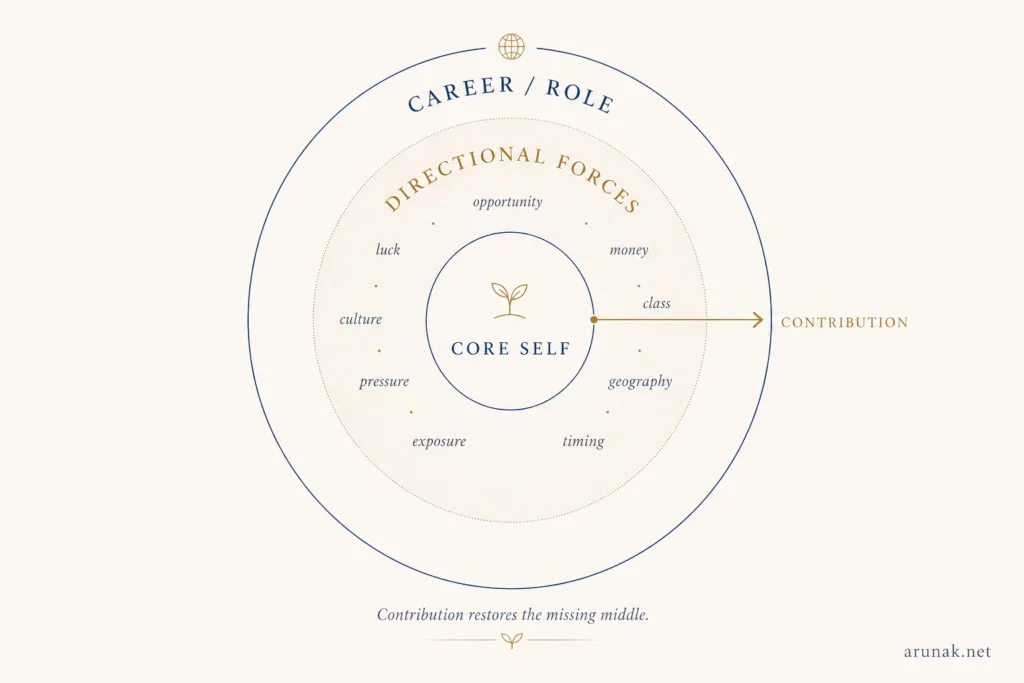
A clearer way to visualize this is in terms of three stages of our lives.
At some point, you realize that you like doing some things more than others. Some things come really easily to you: the way you naturally structure an argument, or find patterns where others hardly see any, or being able to command a room just by being in it. These are the things that feel obvious and easy to you, but that others find genuinely difficult. You realize that you are, in many ways, unique. This is what I call the core self.
Now, this is where you have to be really careful. Because you naturally become passionate about what makes you unique, and tend to project that core self into a career of your liking. But there’s an elusive middle ground between who you are and the work you end up doing.
How do you get there? What would get in the way, and what can actually carry you across? These are what I call the directional forces: opportunity, money, class, geography, timing, exposure, pressure, culture, and luck. This is where the passion narrative really underdelivers, because it skips this uncomfortable middle. It just says, “just go for it.” But when real life hits you with a thousand frictions and hard constraints, just going for it does not work.
On the other hand, contribution maps out that middle and makes it real. It connects your core self to the world as it actually is. A stable career that makes you want to keep showing up is not found by jumping straight from the first layer to the third. That is exactly what “follow your passion” encourages: to skip the hard translation. It sugarcoats your ambitions.
Contribution restores that missing step. That’s why it’s more serious than passion. It’s not merely about self-expression. It’s about conversion; the conversion of what you’re capable of into something the world can actually use.
Why does contribution hold up better in real life?
The immediate question that follows is: why does conversion matter, and why does it beat passion?
Contribution—or rather, the conversion it demands—has one major advantage over passion: it leaves evidence. It acts on the real world and changes something, and usually for the better: A problem becomes clearer, a system works better, a patient gets properly treated, a student understands something they didn’t understand before, a piece of writing makes a difficult subject usable, a software gets built, a process improves.
At the end of the day, someone benefits. That is not necessarily the case with passion.
This orientation—being fuelled by contribution rather than feeling—matters for anyone’s success, both psychologically and economically.
The Psychology of Contribution
Let’s start with the psychological aspects first.
Adam Grant, an organizational psychologist at Wharton and the author of Give and Take, has shown through his research on prosocial motivation that people often become more persistent when they can see who benefits from what they do. Work becomes easier—and more enjoyable—when it stops being a private desire or mere self-expression and becomes part of a chain of effect.
Passion, taken too literally, encourages a self-centred way of thinking about work. It keeps asking what the world is giving back to me. Contribution asks almost the opposite: what am I putting into the world that is actually useful? That doesn’t mean all work must be noble, with no room for self-expression. Of course not. It means that meaning—and with it, happiness and a sense of success—often grows when effort connects to consequence.
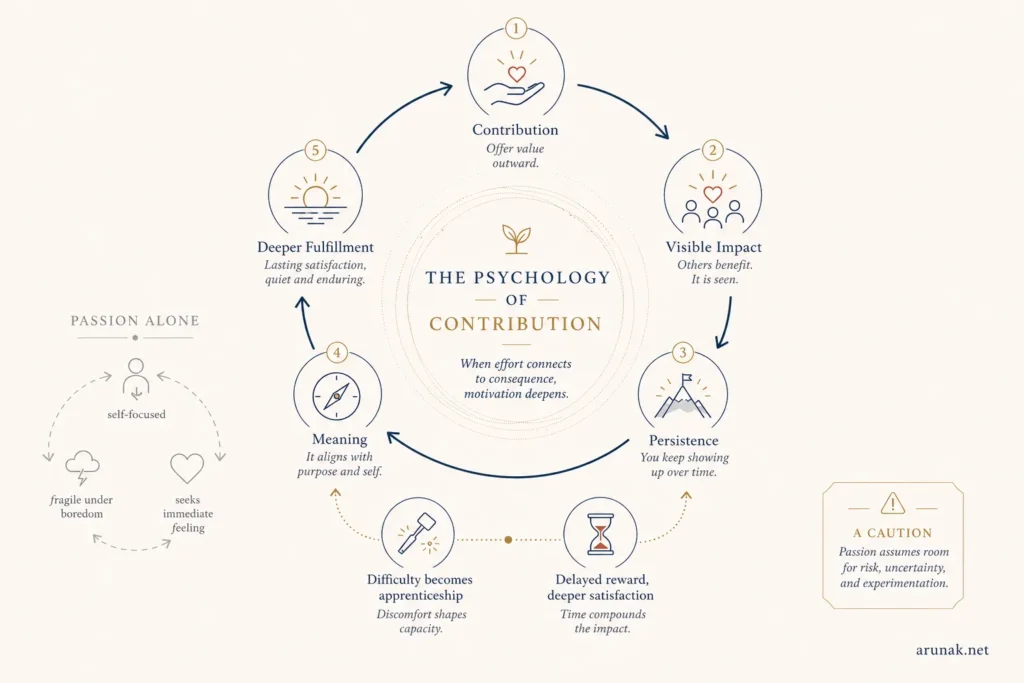
This is also why contribution holds up better under difficulty. If your only question is whether you feel passionate today, then boredom, repetition, or frustration can shake your confidence over time. But if your question is whether this work is helping you build the capacity to contribute something important, then difficulty starts to mean something. It becomes part of the apprenticeship.
It also changes how you think about satisfaction. A lot of worthwhile work doesn’t offer constant pleasure. It’s not always fun. It offers a delayed kind of reward. There may be monotony in the middle. But finishing something hard, building a skill over years, or seeing the effects of serious effort produces a deeper and more stable sense of fulfilment than momentary excitement ever can.
Contribution is also less naive about inequality. “Follow your passion” assumes people can afford uncertainty, room for trial and error, low pay, prestige gambles, and long stretches of confusion. Erin Cech, a sociologist at the University of Michigan who studies inequality in career pathways, has shown that passion talk can reproduce inequality even when it sounds so liberating. It asks for expressive freedom in a world where access to experimentation is distributed very unevenly.
The Economics of Contribution
The second advantage is economic, and it completes the economic flywheel that passion alone cannot really create on its own.
When you ask the right questions—not just what do I enjoy, but what can I do well that others genuinely need—you start to find the overlap between your strengths and your interests. Then you point that overlap outward. You make it useful to someone else.
The more value you create, the more people notice. That recognition turns into money, opportunity, and a reputation that compounds over time. And here is the part that passion advice never quite gets to: once that foundation is in place, you actually have something to stand on. You can start shaping your work more toward what you genuinely love. Passion can become the destination. It just cannot be the starting point.
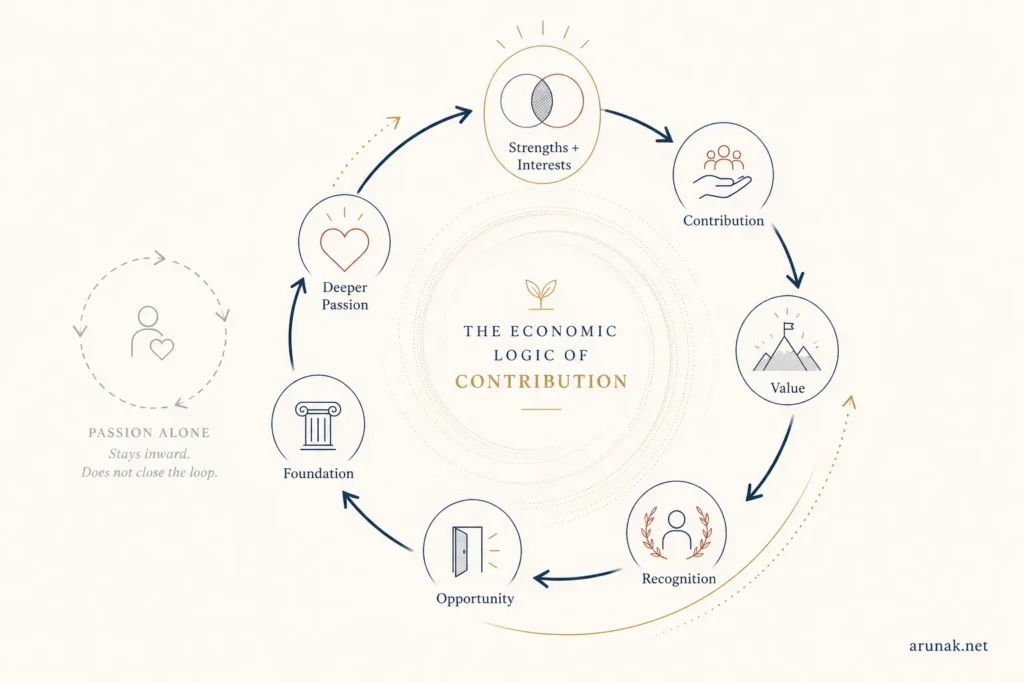
If you follow passion first and skip contribution, that loop never really closes. You stay stuck in the first layer, expressing yourself, waiting to be discovered, hoping that feeling is enough. But more often than not, it isn’t.
If you love video games, the passion version says: just play. The contribution version asks: what can you build around that? You could stream and build an audience by being genuinely entertaining or instructive. If you love writing, the passion version says: just write for yourself. The contribution version says: publish. Put it in front of people. Let it do something for someone. If you love fitness, the passion version says: train. The contribution version says: coach, or build something that helps other people train better. In each case, the interest is the same. What changes is the direction. You stop pointing inward and start pointing outward.
This is the economic logic of contribution. It does not ask you to abandon what you love. It asks you to make it count for someone other than yourself. And when you do that consistently, over time, you begin to find passion in what you do.
The better question to ask
So look at it this way: “follow your contribution” is better advice than “follow your passion.”
Not because passion is worthless, but because passion is too unstable to carry you to success on its own.
A better career question is this: what do I seem capable of becoming genuinely useful at to other people?

It makes room for effort, time, and also for uncertainty. It makes room for the fact that many good careers are not discovered in a flash of self-knowledge, but built gradually through work, rerouting, exposure, and many, many feedback loops. So it aligns really well with reality.
Whether we like it or not, the world does not reward feelings, at least not directly. It rewards value in some recognizable form.
So perhaps the point is not to ignore passion, but to put it in its right place. Passion is often not the starting point. It is what sometimes grows after your core skills begin to meet the world in a way that matters to other people.
And that is a far better path toward a career that actually fits.
Further reading
- Cal Newport, “On Passion and Its Discontents”
- Cal Newport, “Follow Your Passion Is Bad Advice”
- Stanford Report, “Why ‘Find your passion!’ may be bad advice”
- O’Keefe, Dweck, and Walton, “Implicit Theories of Interest”
- Erin A. Cech, The Trouble with Passion
- Adam Grant et al., “Impact and the Art of Motivation Maintenance”
- Harvard Business Review, “What Job Crafting Looks Like”
- Wrzesniewski and Dutton, “Crafting a Job”