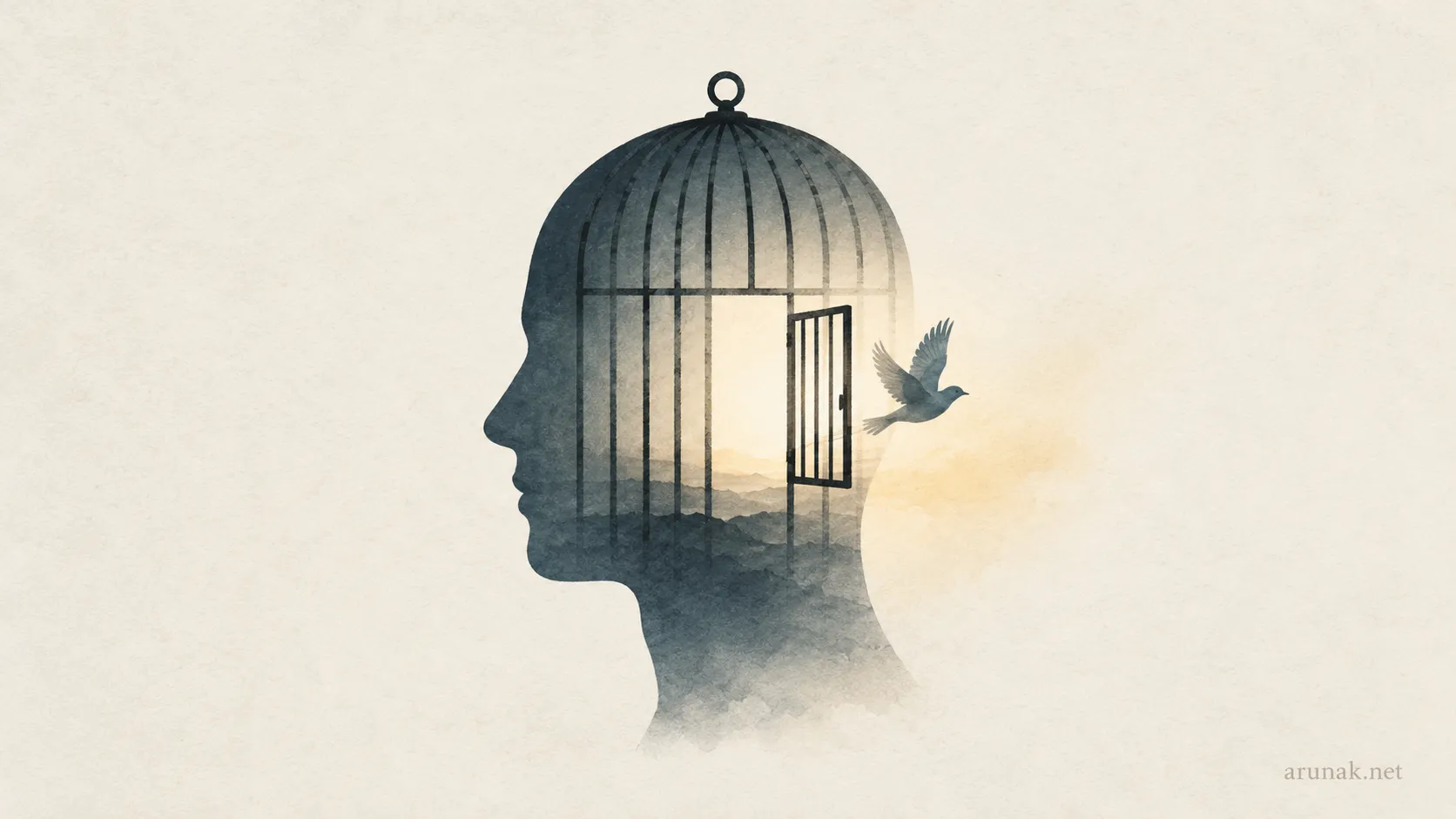
“Once you learn to read, you will be forever free,” said Frederick Douglass, the abolitionist, writer, and orator who taught himself to read while being enslaved.
And I never truly understood how accurate this quote really is until I started reading dystopian fiction. Because a dystopian book, when done right, is almost always held together by a common thread, the very thing Frederick Douglass fought so hard for: freedom.
Now, there are many, many ways a writer can explore the dimensions of freedom, as evident in the books I’m going to discuss in this article. But what was strikingly common across all these books, the underlying question that all of these stories try to raise, was always the same: how do we find the balance between individual freedom and the collective stability of society?
Sounds too complicated? I agree.
But I think this is why dystopian fiction, or utopian fiction for that matter, is such a brilliant vessel, a friendly messenger of sorts, that helps us digest such complex, yet incredibly important ideas with ease.
Here are 5 of my favorite dystopian books that expose those hidden dynamics from very different angles.
Table of Contents
What are some of the best dystopian books to read?
If you want a short list, these are the five dystopian books mentioned in this article, categorized by how freedom is controlled in each story and by what kind of reader might get the most out of each book:
| Book | Author | Main form of control | Best for readers interested in |
|---|---|---|---|
| 1984 | George Orwell | Fear | surveillance, propaganda, truth, authoritarian power |
| Brave New World | Aldous Huxley | Pleasure | comfort, distraction, technology, engineered happiness |
| The Handmaid’s Tale | Margaret Atwood | Bodily autonomy | reproductive control, gender, religion, law |
| The Giver | Lois Lowry | Safety | memory, childhood, emotion, sameness |
| The Dispossessed | Ursula K. Le Guin | The promise of freedom | utopia, anarchism, capitalism, social pressure |
What to read first?
| Reasons to read | Book to read | Why this one | Reading weight | Approx. page count |
|---|---|---|---|---|
| If you want to read the political nightmare version of dystopia | 1984 | The most direct political dystopia on this list, and probably the most popular one too. | Heavy read | 320 pages |
| If you want a more modern story, that seems close to the ideals of today’s society | Brave New World | A world controlled less by fear and more by pleasure, comfort, distraction, and engineered happiness. | Medium-heavy read | 288 pages |
| If you want a dystopia built around gender, religion, and reproductive control | The Handmaid’s Tale | Best if you want to think about feminism, bodily autonomy, religious power, and law. | Medium-heavy read | 357 pages |
| If you want a short but powerful introduction to dystopian fiction | The Giver | Probably the easiest one to finish in a couple of days, but still powerful enough to resonate with you. | Light read | 208 pages |
| If you want the most intellectually challenging book on this list | The Dispossessed | The book that absorbs many of the lessons from the other four and turns them into a discussion about the meaning of ‘freedom’ itself. | Slow, thoughtful read | 465 pages |
1. 1984 by George Orwell: Freedom is controlled through fear
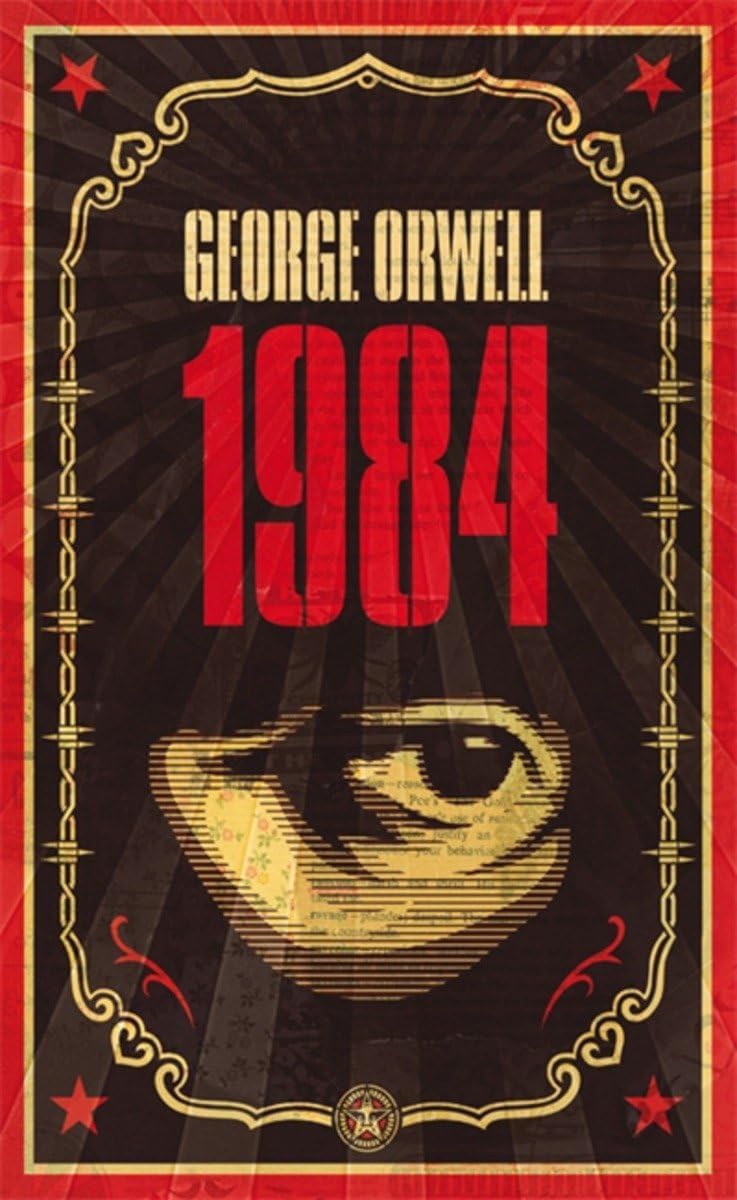
Winston Smith, a 39-year-old clerk, walks onto the street on another dark, cloudy day. Everywhere he looks, there’s a poster with an enormous face gazing down from the wall. Under the figure, the caption reads: “Big Brother is watching you.”
It was one of those pictures that are so contrived that the eyes follow you about when you move. Big Brother is watching you, the caption beneath it ran. (Page 1)
This dystopian world is set in Orwell’s imagined 1984, where the government controls every aspect of life by rewriting history, manipulating truth, and crushing any form of individual thought or rebellion. Telescreens, which function as both televisions and surveillance cameras, dominate everyday life. They are installed in homes, workplaces, and public spaces, making sure everyone is monitored at all times.
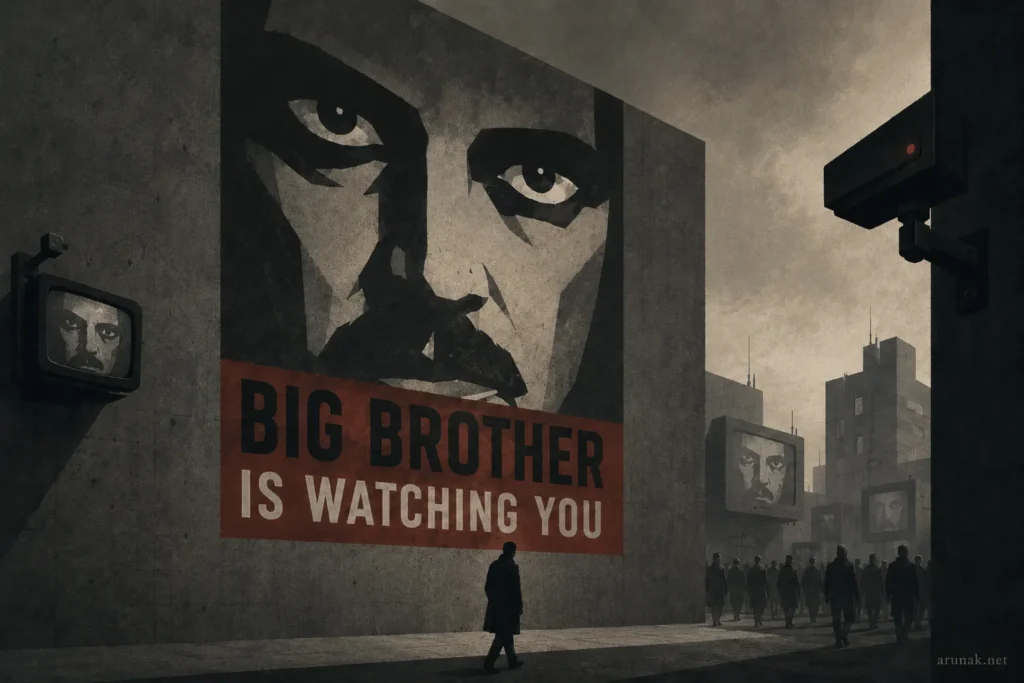
1984 is the most famous dystopian novel on this list, and one reason it has remained so enduring, unsettling, and politically dangerous is that it gives us a comprehensive language for understanding modern political oppression. Some of its terms have moved far beyond the novel itself: Big Brother, thoughtcrime, doublethink, newspeak, and the memory hole.
There are two types of oppression in 1984. One is obvious; the other is more subtle, and in some ways more terrifying.
First, Orwell’s world is controlled through surveillance and punishment. People know they are being watched. They know that a careless word, a facial expression, or even a private thought can destroy not only their career, but their entire existence. The phrase “Big Brother is watching you” captures the central mechanism of oppression in the story: no part of life is fully private.
But there is a second form of oppression in the novel. The Party does not just want obedience; it wants to bend reality itself.
The Party wants to control truth, and worse, to rewrite it. The meanings of words are manipulated; the past is continuously rewritten; the minds of people are trained so thoroughly that even thinking against the Party becomes a punishable crime. If people do not have the words to think clearly, they eventually lose the sense of clarity itself.
All of this can seem absurd and overly extreme. But there is a reason this book has resonated with readers for so long, and why it has been banned or restricted in some countries, even today. It shows the horror of what can happen when individual freedom is taken over by collective stability. And although Orwell pushes that balance to its most terrifying extreme, the tension itself is not entirely foreign to us.
Best for: readers interested in surveillance, propaganda, censorship, and authoritarian power.
The central warning: truth and individual freedom are not guaranteed. They have to be protected.
2. Brave New World by Aldous Huxley: freedom is controlled through pleasure
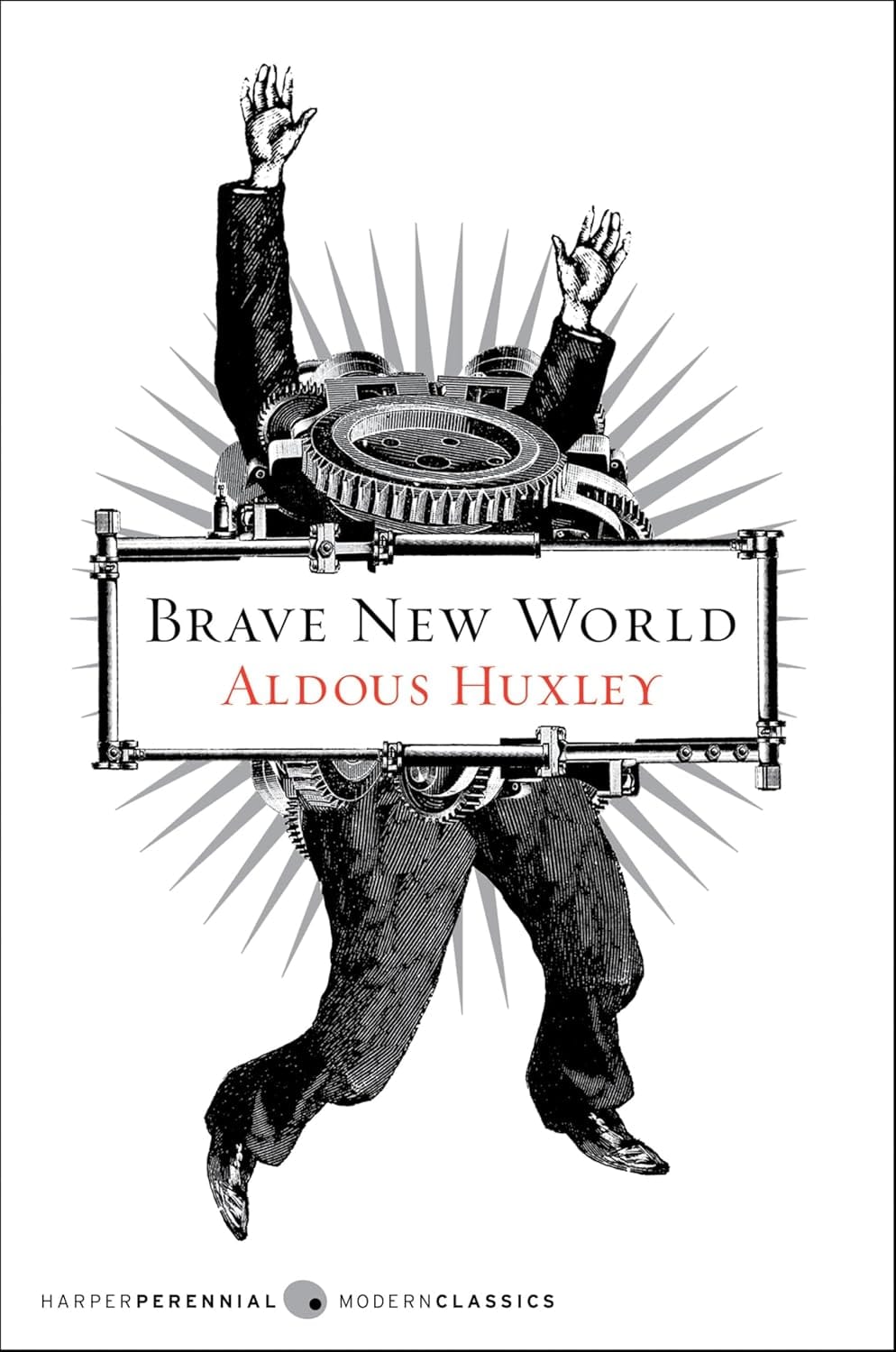
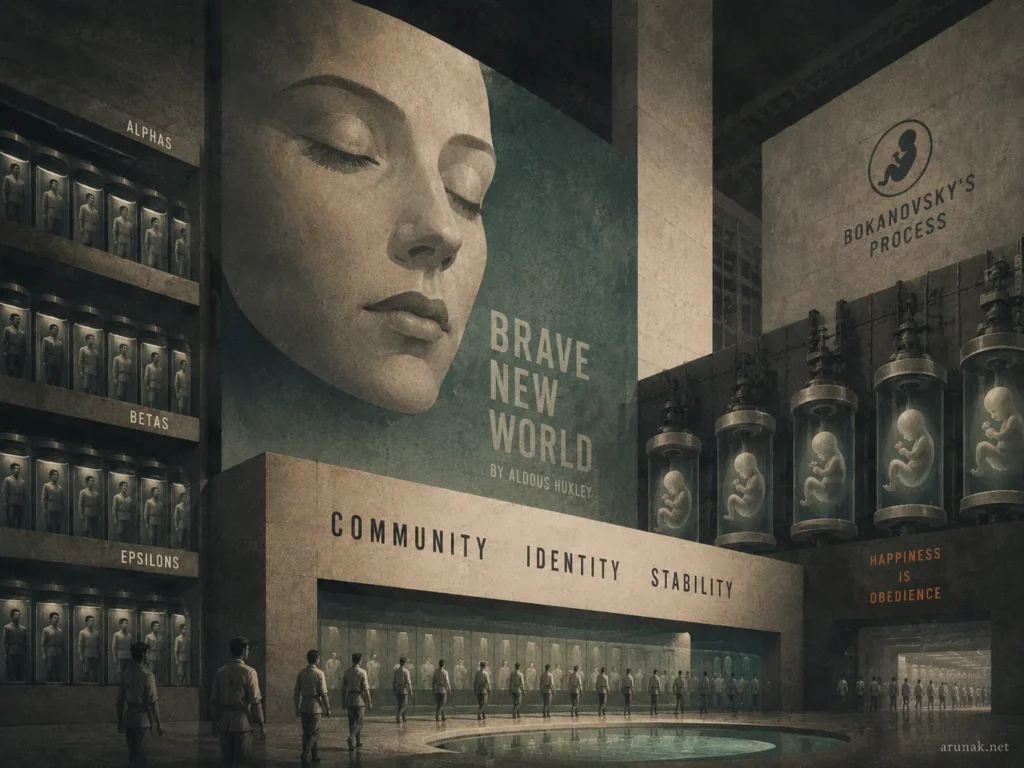
In Brave New World by Aldous Huxley, society is controlled through technology, genetic engineering, and psychological conditioning; all designed to preserve stability and happiness.
In this so-called “brave new world,” there are no mothers, no families, and no such thing as ‘love’. People are born in laboratories and divided into castes: some are engineered to be intellectually superior, like the ‘Alphas’, while others, like the ‘Epsilons’, are given just enough intelligence for routine labor.
“My good boy!” The Director wheeled sharply round on him. “Can’t you see? Can’t you see?” He raised a hand; his expression was solemn. “Bokanovsky’s Process is one of the major instruments of social stability!”
Major instruments of social stability. Standard men and women; in uniform batches. The whole of a small factory staffed with the products of a single bokanovskified egg. (page 7)
In terms of the extremes of social control, Brave New World is almost the complete opposite of 1984.
People are still being oppressed in Huxley’s world, but in some ways, it is even worse because they do not really understand that they are being oppressed until the damage has already become almost impossible to undo. Instead of being ruled through fear, as they are in 1984, the people in Brave New World are given every kind of pleasure, both physical and mental.
This is why I think these two books are so useful to read together. Orwell imagines a society where people obey because they are terrified. Huxley imagines something more slippery: a society where people obey because they are too comfortable.
Together, the two stories show that both extremes of stability, whether enforced through fear or manufactured through pleasure, can eventually become oppressive.
At first, however, this seems contradictory. How can people be oppressed when they are given every pleasure in the world?
The answer reveals itself by the end of the story: from 1984 to Brave New World, the mechanisms of oppression have shifted from controlling the output to controlling the input.
In 1984, the output is controlled: people know they are oppressed, but they are too afraid to resist. In Brave New World, the input is controlled: people are genetically engineered so thoroughly that they do not even recognize that they are being oppressed.
There is no need to actively oppress people who have no desire to rebel in the first place.
Comfort, when engineered and distributed by power, can become a dangerous political tool. There is no reason to think deeply about anything if we are conditioned to feel that deep thinking is unnecessary; There is no reason to destroy art, literature, philosophy, or serious conversation when people are constantly bombarded with shallow distractions that make those things feel irrelevant; There is no reason to demote individual freedom when people are engineered to feel that solitude itself is abnormal.
This is such an unsettling truth, and in many ways, Brave New World feels closer to reality than the open terror of 1984.
Best for: readers interested in technology, pleasure, consumer culture, and engineered happiness.
The central warning: a society can lose freedom without feeling oppressed, as long as it is kept comfortable enough.
3. The Handmaid’s Tale by Margaret Atwood: Freedom is controlled through bodily autonomy
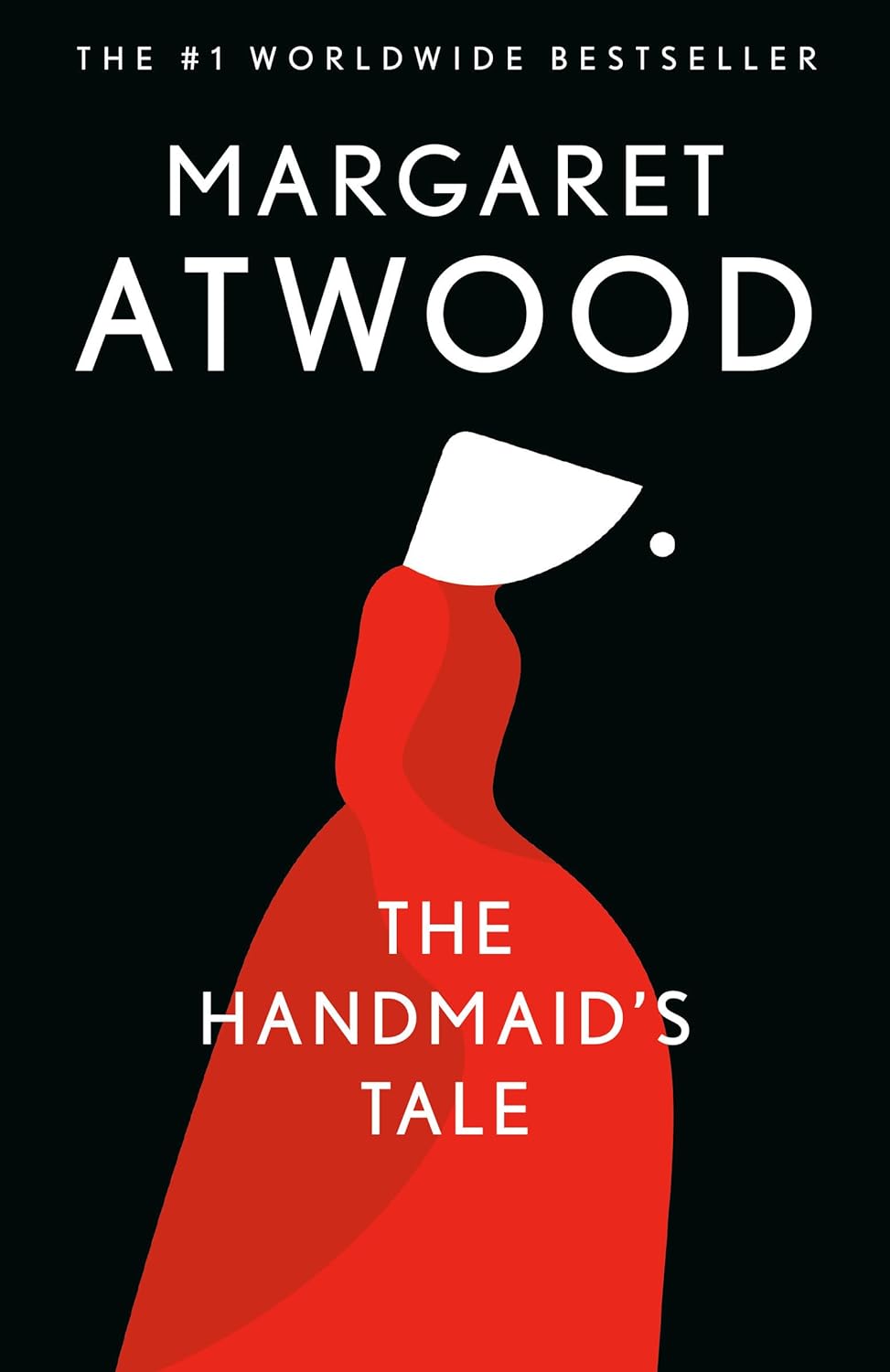
In 1984 and Brave New World, oppression is largely psychological first and physical second. The Handmaid’s Tale flips this upside down.
Here, the primary site of oppression is bodily autonomy.
In the dystopian world of Gilead, women’s rights are stripped down to the bare minimum after the world faces a severe fertility crisis. As a solution, or at least as the regime’s excuse for a solution, the remaining fertile women are forcibly assigned to reproduction.
Once reproduction becomes the state’s highest priority, women’s bodies become state property. Bodily autonomy becomes the center of politics because the crisis in the novel is a fertility crisis. From there, the oppression spreads outward. It extends into names, careers, literature, money, and religion.
We were the people who were not in the papers. We lived in the blank white spaces at the edges of print. It gave us more freedom. We lived in the gaps between the stories. (Page 78)
What struck me most is how systematic and methodical the fall into Gilead is.
Personal rights, especially women’s rights, are taken away slowly, bit by bit, until they have none left. Each step of the way, the regime offers an argument to justify what it is doing. By the end, women have lost almost every form of freedom, but the decline has been so gradual that the loss itself has become completely justified, so that it no longer even enters their consciousness to question how much of their individual freedom disappeared along the way.
This is why I would put The Handmaid’s Tale among the best dystopian books. It shows how political oppression enters private life before people fully realize what is even happening.
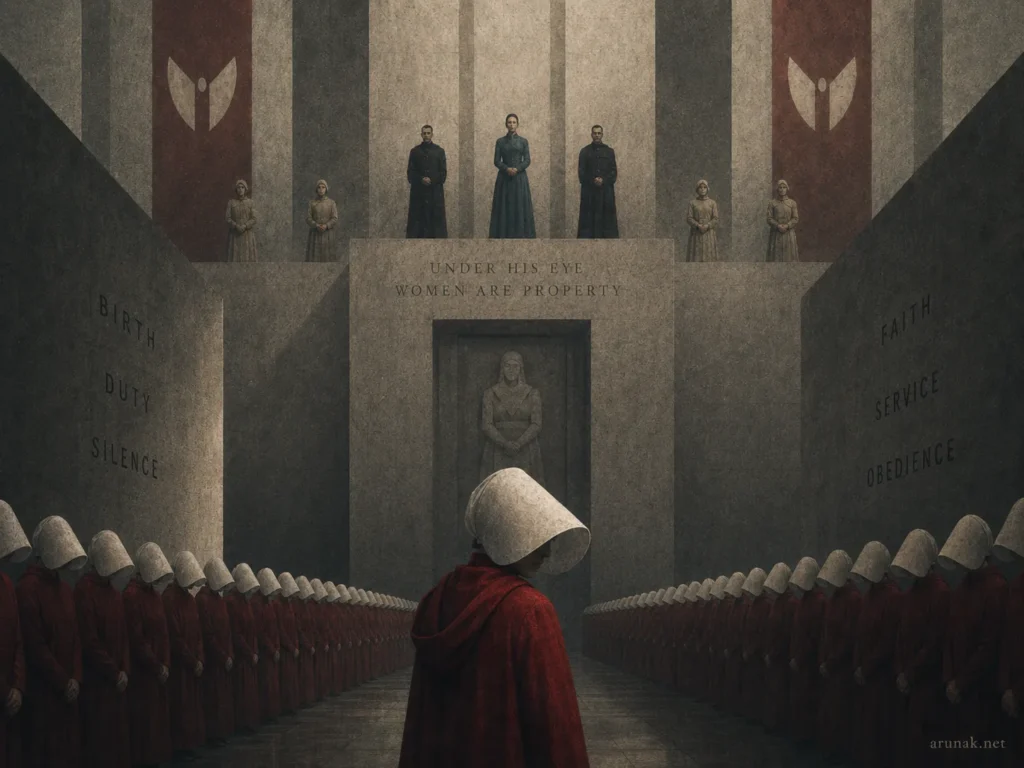
What’s most concerning is that Gilead does not even need to control everyone in the same way. When the roles, ranks, uniforms, rituals, and dependencies are created, the system runs on its own. People become pawns in their own oppression.
At some point, the oppressor can almost take their hands off the system, because the pressure no longer comes only from above; it begins to come from the society itself.
Best for: readers interested in gender, religion, reproductive control, law, and social hierarchy.
The primary warning: when a society turns bodily autonomy into a political resource, individual freedom inevitably goes down the drain.
4. The Giver by Lois Lowry: Freedom is controlled through safety
The Giver is quite different from the other three books mentioned before.
There is no obvious dictator or dramatic public terror at the center of the story. The world of The Giver looks calm, organized, and even reasonable. People are polite. Families are carefully arranged. Conflicts are avoided as much as possible. Even people’s minds are saved from a violent history, so they do not have to carry the burden of the past.
This is a society built around safety.
There is no inequality, no divorce, no unemployment, and no forms of injustice in this world. But there is one more thing that’s missing: personal choice. There are no real memories, no real emotions, no color, no uncertainty, and not even the concept of love.
Would we be comfortable living in a world like this?
Jonas, a twelve-year-old boy in this world, finds himself asking the flip side of that question, as he has just discovered it for himself:
Jonas hesitated. “I certainly liked the memory, though. I can see why it’s your favorite. I couldn’t quite get the word for the whole feeling of it, the feeling that was so strong in the room.” “Love,” The Giver told him. Jonas repeated it. “Love.” It was a word and concept new to him. (page 157)
At the beginning of the novel, safety seems like the least threatening form of control. It does not even feel like people are being controlled in the first place.
Fear is obviously dangerous. Pleasure becomes suspicious once you see how it works. Control over bodily autonomy is immediately disturbing.
But safety? Who wants more pain, war, grief, inequality, divorce, unemployment, or injustice?
This is why, I think, The Giver brings another fresh perspective into the debate between personal freedom and collective stability.
Jonas grows up in a community where the sources of suffering have been removed by removing many of the things that make us human. There is no love because love creates attachment; there is no memory because memory brings pain; there is no color because difference itself is treated as a kind of instability (No one in this world can even see color; they see only in black and white).
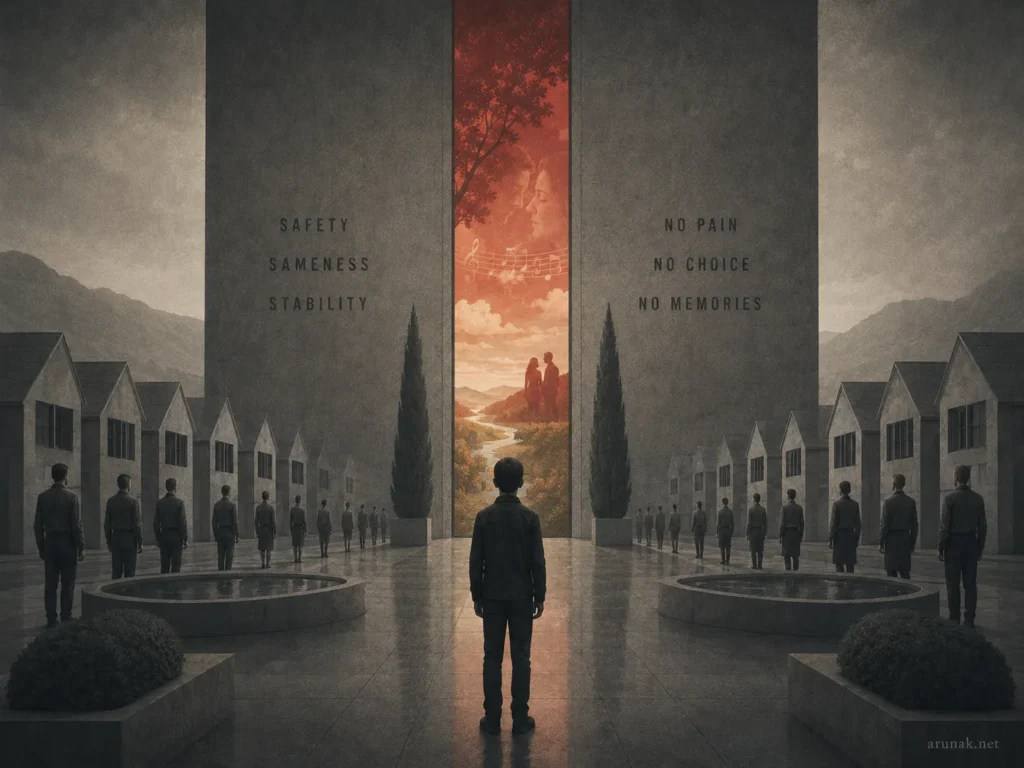
Once again, the common thread appears: it is not at the extreme ends that a sustainable society emerges, but by a carefully held balance between freedom and order, pain and safety, individuality and belonging.
A person who has never known color cannot mourn color; a person who has never known love cannot fully miss love; a person who has never inherited memory cannot understand what it means to live without history.
But Jonas is given the role of the Receiver, the one person chosen to hold the community’s memories of the past: its pain, beauty, violence, music, love, and grief. Because he now sees everything that everyone else cannot see, his rational mind begins to wake up.
So he starts to question things:
“Do you love me?” There was an awkward silence for a moment.
Then Father gave a little chuckle. “Jonas. You, of all people. Precision of language, please!”
“What do you mean?” Jonas asked.
Amusement was not at all what he had anticipated. “Your father means that you used a very generalized word, so meaningless that it’s become almost obsolete,” his mother explained carefully.
This is one of the most important emotional centers of the book, and it connects The Giver to 1984, but in a subtler way. Orwell shows language being destroyed by force. Lowry shows language being made harmless through politeness and social engineering.
But the result is very similar to that of 1984: the quality of life slowly disappears.
Best for: readers who want a short, accessible, emotionally powerful dystopian novel.
The primary warning: when safety becomes the highest priority, life can become peaceful and empty at the same time.
5. The Dispossessed by Ursula K. Le Guin: freedom is tested by the promise of freedom itself
The Dispossessed is the most interesting ending point for this list because it complicates the whole idea of dystopian fiction in the first place.
This story is not a simple dystopia. It is more layered than that, and throughout the book, it keeps touching the edges of utopia. Le Guin called it an ambiguous utopia, and the word ambiguous carries a lot of weight here.
The book follows Shevek, a physicist from Anarres, a harsh moon settled by anarchists who left the wealthy planet Urras generations earlier. Urras is beautiful, abundant, capitalist, hierarchical, and unequal. Anarres is poor, dry, cooperative, egalitarian, and built around the rejection of private property.
So the two worlds are built on completely different political systems. Urras is organized around ownership, hierarchy, markets, and state power. Anarres is organized around shared responsibility, mutual aid, and the belief that no one should own another person’s labor or life.
Le Guin sets up this political contrast for a very good reason: to show that both systems can produce their own kind of oppression.
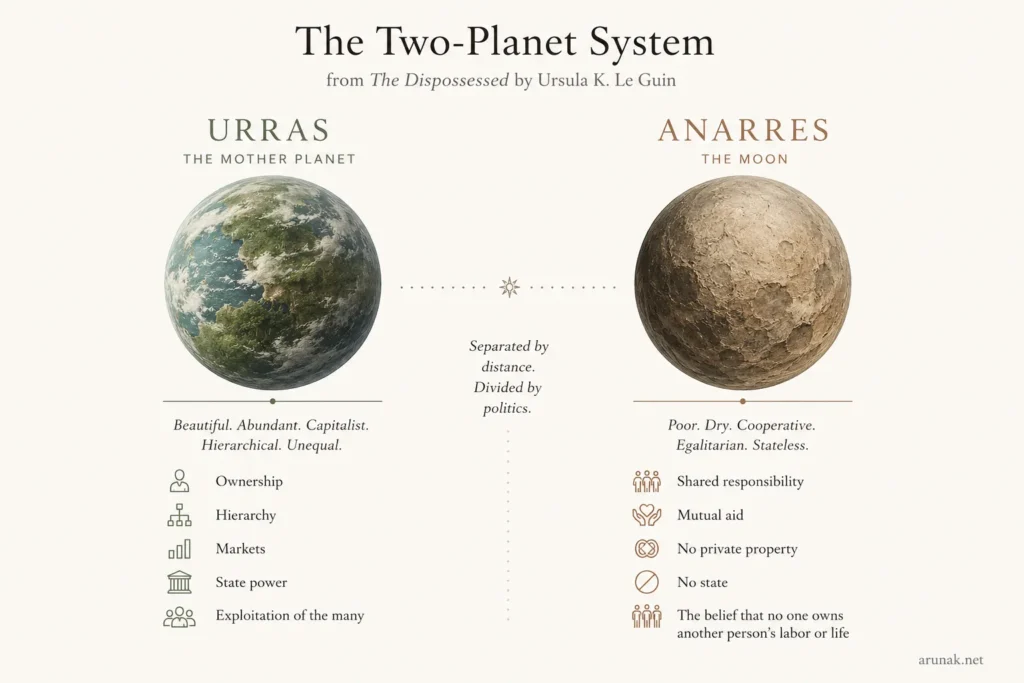
Urras, the planet, which is much more similar to ours, both physically and politically, has obvious tools of oppression: class, property, state power, gender hierarchy, poverty, and political manipulation. This is the kind of oppression that most of the other dystopian books in this article revolve around.
Freedom exists in those worlds, but it is unevenly distributed.
After reading the other novels, it is easy to think: wouldn’t it be better to have a world built around individual freedom? Living on a planet much like Urras, which we naturally crave, a place where no state, class system, or private ownership can crush individual freedom, and to live absolutely free.
Le Guin gives us a taste of that society through Anarres.
And she shows that it might not function as we might expect.
On Anarres, there seem to be no obvious forms of oppression, at least on the surface. There is no formal state, no private property, and no ruling class sitting above everyone else. But as the story unfolds, we begin to see that social pressure can become its own kind of authority. Bureaucracy grows without admitting that it is bureaucracy. Public opinion becomes its own pseudo-form of government.
So this story becomes the perfect illustration of the phrase: “Those who build walls are their own prisoners.”
Seen this way, The Dispossessed becomes the conclusion to the other four books.
- 1984 shows that fear can destroy freedom.
- Brave New World shows that pleasure can soften freedom until people stop wanting it.
- The Handmaid’s Tale shows that social stability can turn bodily autonomy into a tool of oppression.
- The Giver shows that safety can remove the pain of life, but only by removing part of life’s meaning.
So what is the solution to all this?
The most obvious answer would be to maximize individual freedom. But The Dispossessed shows that ‘going all in’ on freedom does not automatically solve the problem either. Even a society built with good intentions can create its own walls.
There are no perfect systems.
That, to me, is the message that runs through all five books, and The Dispossessed brings it to its most mature conclusion. So, the question changes by the end.
Now, it is no longer only, “How is freedom destroyed under oppression?”
It becomes something more difficult, yet very important to collectively figure out:
“How can freedom survive under good intentions? Where should we draw the line between collective stability and individual freedom?”
“I know it’s full of evils, full of human injustice, greed, folly, waste. But it is also full of good, of beauty, vitality, and achievement. It is what a world should be! It is alive, tremendously alive—alive, despite all its evils, with hope. Is that not true?” (Page 389)
Best for: readers interested in political philosophy, science fiction, anarchism, capitalism, and the limits of utopian thinking.
The primary warning: even the promise of freedom can create its own kind of oppression.
References and further reading
1984 by George Orwell
- Marshall University Library: 1984 and banned books
- Index on Censorship / IMI: Belarus bans the sale of 1984
Brave New World by Aldous Huxley
The Handmaid’s Tale by Margaret Atwood
- The Booker Prizes: Reading guide to The Handmaid’s Tale
- The Booker Prizes: Monthly spotlight on The Handmaid’s Tale
- PBS NewsHour: Margaret Atwood and the visual symbolism of Gilead
The Giver by Lois Lowry
- American Library Association: The Giver, 1994 Newbery Medal winner
- Lois Lowry: Awards
- The New Yorker: What Lois Lowry Remembers