

When I first read The 48 Laws of Power, I had the same reaction many people do: this book is really interesting, but it is also somewhat confusing.
One law tells you to stay quiet. Another tells you to get attention. One says to be bold. Another says not to outshine the master. One says to become more visible. Another says to become mysterious.
If you read the book straight through and try to hold all forty-eight laws in your head at once, chances are you will end up more confused than empowered.
That was the problem I ran into with this book.
The laws are not useless, of course.
The problem is that most people read them as if they are one unified rulebook. They are clearly not. They are a mixed collection of strategies for different situations, different personalities, and different kinds of power.
This is why I think the book becomes much more useful once you categorize the 48 laws.
How do you do that? By asking a series of questions first. For example:
- Why did that coworker get punished even though they were brilliant?
- Why did someone weaker but more strategic get ahead?
- Why did one person become respected through their silence while another did it through showing off?
Greene’s book is full of answers to questions like this. But the answers are buried under contradiction unless you categorize the laws first.
That is why I no longer think the best way to read The 48 Laws of Power is from Law 1 to Law 48 as if it were a fixed sequence.
A better way is this:
- First, identify where you are in your personal and/or professional life.
- Second, decide what kind of power you want around you.
- Third, understand how other people use power around you.
One note before I begin: these categories are interpretive, not absolute. A few laws could reasonably sit in more than one place. But forcing a primary placement is exactly what makes the book more useful.
Table of Contents
1. Categorize the laws by where you are in your career
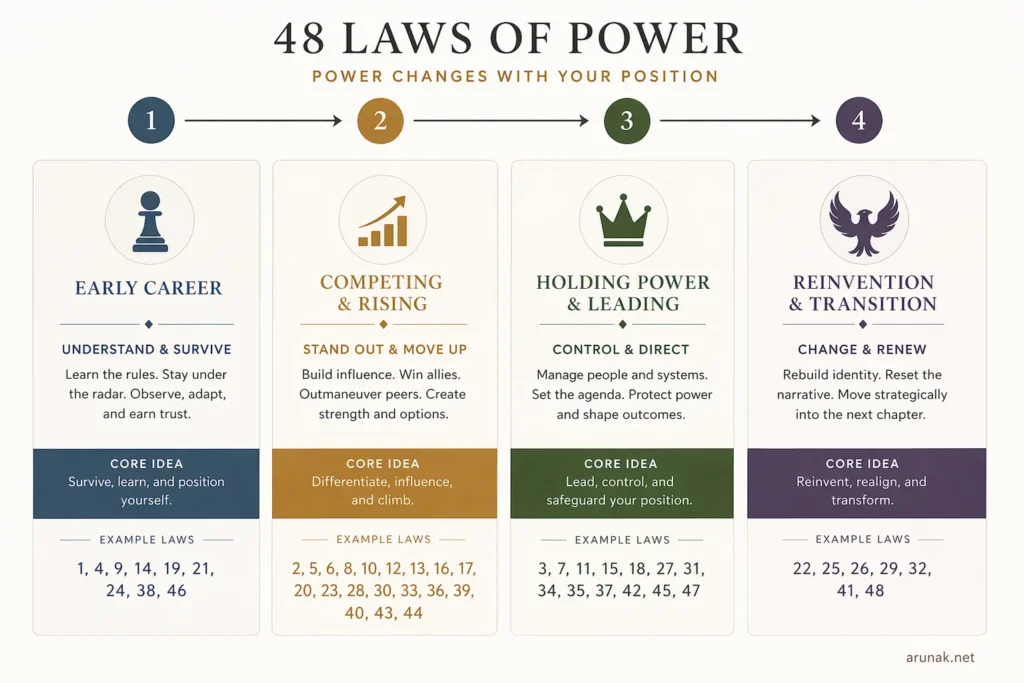
I noticed that Robert Greene makes this distinction all the time, especially in the “Reversal” section at the end of each law. But it is somewhat hidden when you look at the book as a whole.
Some laws are clearly written for people who are still under someone else’s authority. Others are for people competing with peers. Others are for people who already have power and are trying to maintain it.
And some become most useful when you are rebuilding your authority, changing direction, or stepping into a whole new identity. The same law can be a game-changer in one stage and a huge mistake in another.
A. Early career
These are the laws that become more useful when you are early in your career, under someone else’s command, and still working your way through the laws of power in the real world.
- Law 1 — Never Outshine the Master
- Law 4 — Always Say Less Than Necessary
- Law 9 — Win Through Your Actions, Never Through Argument
- Law 14 — Pose as a Friend, Work as a Spy
- Law 19 — Know Who You’re Dealing With
- Law 21 — Play a Sucker to Catch a Sucker
- Law 24 — Play the Perfect Courtier
- Law 38 — Think as You Like but Behave Like Others
- Law 46 — Never Appear Too Perfect
B. Competing and rising
These laws become useful when you are no longer just surviving in the field but trying to differentiate yourself, stand your ground, and move upward among peers.
- Law 2 — Never Put Too Much Trust in Friends, Learn How to Use Enemies
- Law 5 — So Much Depends on Reputation
- Law 6 — Court Attention at All Costs
- Law 8 — Make Other People Come to You
- Law 10 — Infection: Avoid the Unhappy and Unlucky
- Law 12 — Use Selective Honesty and Generosity to Disarm Your Victim
- Law 13 — Appeal to People’s Self-Interest
- Law 16 — Use Absence to Increase Respect and Honor
- Law 17 — Cultivate an Air of Unpredictability
- Law 20 — Do Not Commit to Anyone
- Law 23 — Concentrate Your Forces
- Law 28 — Enter Action with Boldness
- Law 30 — Make Your Accomplishments Seem Effortless
- Law 33 — Discover Each Man’s Thumbscrew
- Law 36 — Disdain Things You Cannot Have
- Law 39 — Stir Up Waters to Catch Fish
- Law 40 — Despise the Free Lunch
- Law 43 — Work on the Hearts and Minds of Others
- Law 44 — Disarm and Infuriate with the Mirror Effect
C. Holding power and leading others
Once you are responsible for other people, systems, and outcomes, the laws change. The problem is no longer just reading the power moves, but rather managing them.
- Law 3 — Conceal Your Intentions
- Law 7 — Get Others to Do the Work for You, but Always Take the Credit
- Law 11 — Learn to Keep People Dependent on You
- Law 15 — Crush Your Enemy Totally
- Law 18 — Do Not Build Fortresses to Protect Yourself
- Law 27 — Play on People’s Need to Believe to Create a Cultlike Following
- Law 31 — Control the Options
- Law 34 — Be Royal in Your Own Fashion
- Law 35 — Master the Art of Timing
- Law 37 — Create Compelling Spectacles
- Law 42 — Strike the Shepherd and the Sheep Will Scatter
- Law 45 — Preach the Need for Change, but Never Reform Too Much at Once
- Law 47 — Do Not Go Past the Mark You Aimed For
D. Reinvention and transition
These laws become useful when you are changing roles, recovering from failure, stepping into a legacy, or rebuilding your public image.
- Law 22 — Use the Surrender Tactic
- Law 25 — Re-Create Yourself
- Law 26 — Keep Your Hands Clean
- Law 29 — Plan All the Way to the End
- Law 32 — Play to People’s Fantasies
- Law 41 — Avoid Stepping into a Great Man’s Shoes
- Law 48 — Assume Formlessness
Read the full law-by-law breakdown: 48 Laws of Power Summary and Review.
2. Categorize the laws by power type
This is the categorization that finally made the whole book make sense for me.
When I first picked up the book and read through the first ten laws or so, it confused me.
One law tells you to gain power through visibility, another through invisibility. One says to be bold, another says to be cautious. The contradictions piled up until I couldn’t make sense of any of it.
So I threw the book back on the shelf.
It stayed there for two years. Then I picked it up again, but this time with the intention of writing a review. I read all forty-eight laws carefully, trying to understand the contradictions that had frustrated me before.
That’s when I understood something I’d missed the first time: the book doesn’t talk about a singular type of power. It talks about different flavors of power.
Take Law 30: Make your accomplishments seem effortless. Roger Federer embodied this. His power came from grace and ease. He made the impossible look simple. That calm mastery made him untouchable.

By Mike McCune from Portland – Roger Federer @ BNP Paribas 2012 Open vs FedererUploaded by flickrworker, CC BY 2.0, Link
Now compare that to Kobe Bryant. Kobe built his power on visibility, making sure everyone knew how hard he worked, how obsessed he was. The “Mamba Mentality” wasn’t about looking effortless. It was about showing the grind. And it worked. That relentless dedication became its own kind of intimidation. This is Law 34: Be Royal in Your Own Fashion.

Both laws work in real life, even though they contradict each other.
My confusion came from asking the wrong question. The question isn’t which law is right. The question is: what kind of power do you want?
Do you want to live like a king? By being present, visible, and impossible to ignore? Or like a god? By keeping your distance, being mysterious, and untouchable?
The laws aren’t a checklist. They’re a menu. The power you gain depends entirely on which ones you choose and how you combine them.
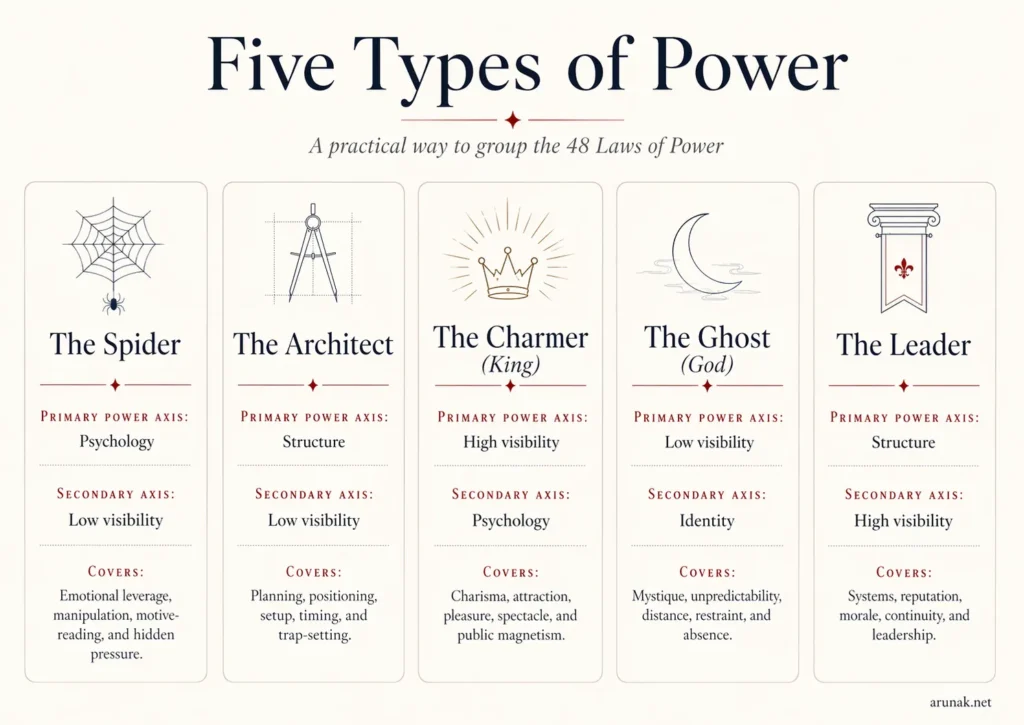
Here are five archetypes Greene builds across the book:
| Archetype | Primary Power Axis | Secondary Axis | Covers |
|---|---|---|---|
| The Spider | Psychology | Low visibility | All emotional and manipulation laws |
| The Strategist | Structure | Low visibility | All planning, positioning, and trap-setting laws |
| The Charmer | High visibility | Psychology | All charisma, attraction, and spectacle laws |
| The Ghost | Low visibility | Identity | All mystique, unpredictability, and distance laws |
| The Leader | Structure | High visibility | All system, reputation, and leadership laws |
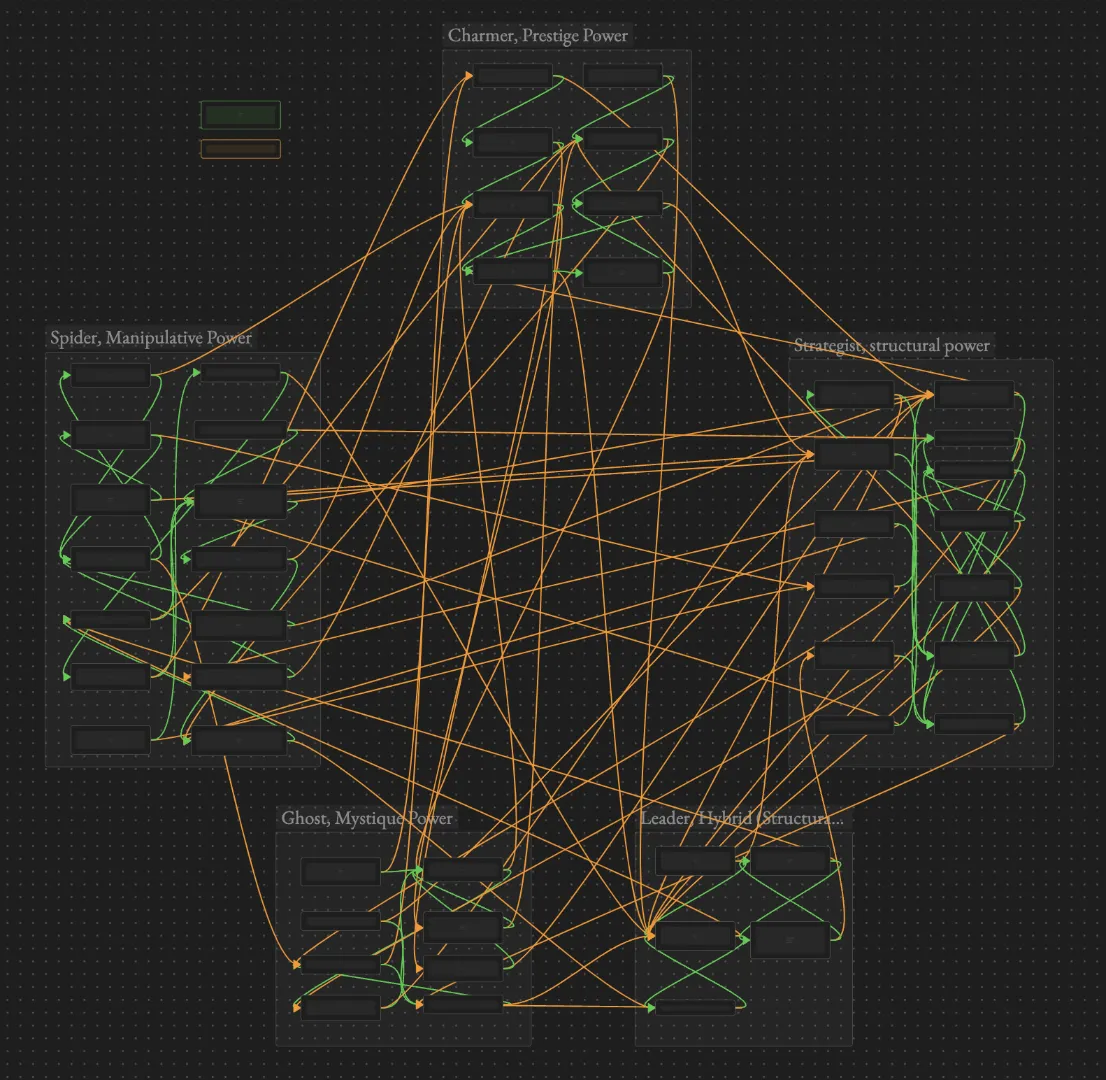
To test this, I mapped all 48 laws onto these archetypes, then connected similar laws with green arrows and contradictory ones with orange.
The result was striking: green arrows never left the box they started in. Orange arrows always did.
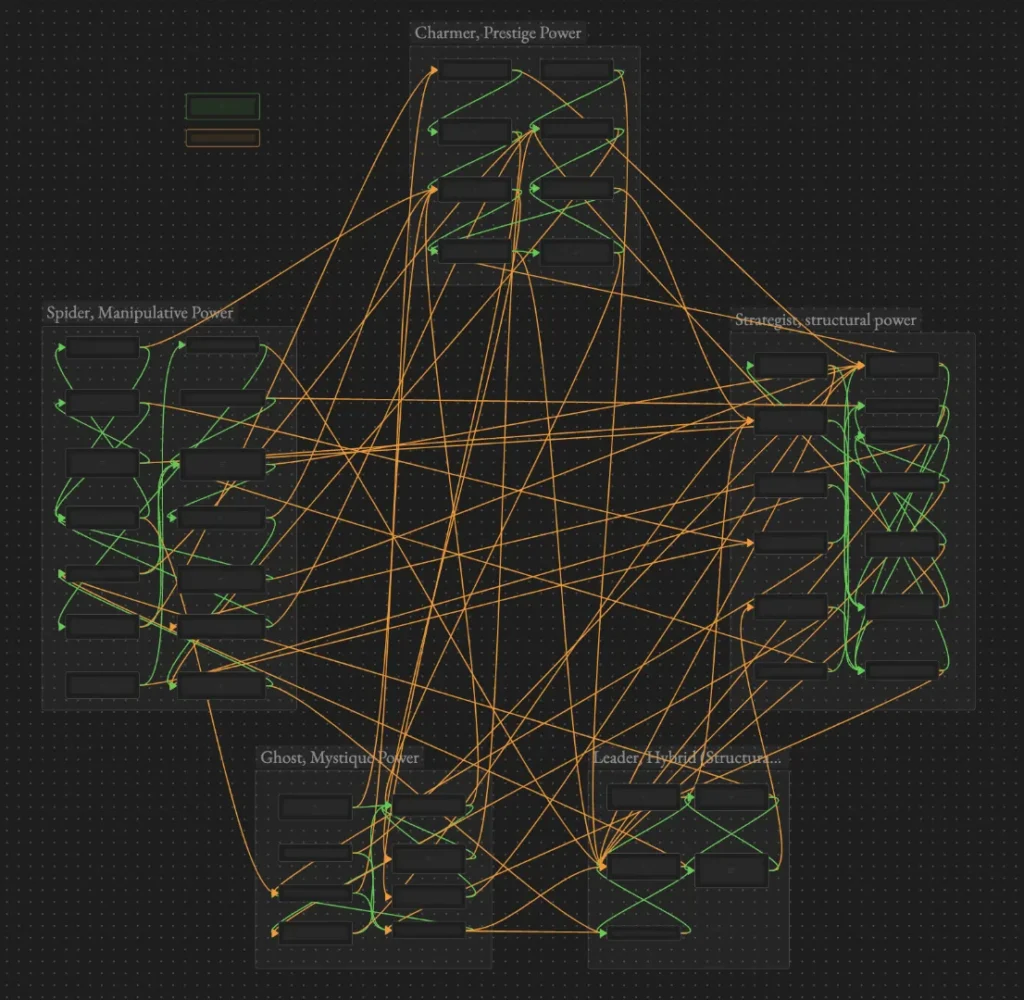
The laws within each archetype form their own ecosystem. They work together and against the laws in every other archetype.
So the takeaway is this: trying to practice all 48 laws won’t give you power. It’ll cost you power. You have to decide what kind of power you want first. Then focus on the laws that support it.
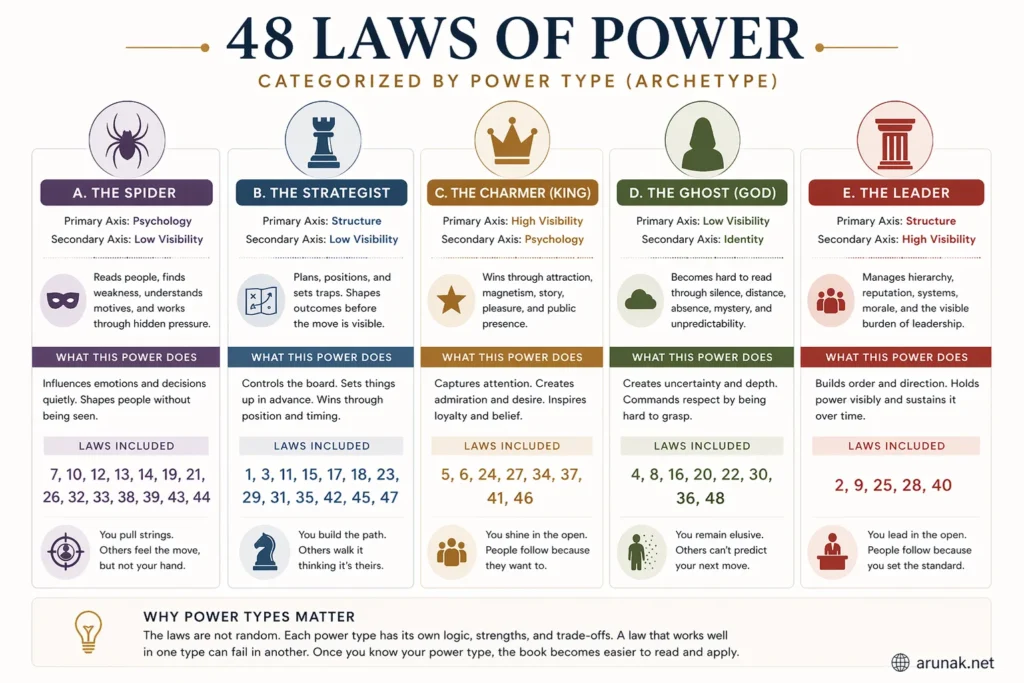
A. The Spider
This is psychological power with low visibility. The Spider reads people well, notices weakness, understands motives, and works through hidden pressure.
- 7 — Get Others to Do the Work for You, but Always Take the Credit
- 10 — Infection: Avoid the Unhappy and Unlucky
- 12 — Use Selective Honesty and Generosity to Disarm Your Victim
- 13 — When Asking for Help, Appeal to People’s Self-Interest, Never to Their Mercy or Gratitude
- 14 — Pose as a Friend, Work as a Spy
- 19 — Know Who You’re Dealing With — Do Not Offend the Wrong Person
- 21 — Play a Sucker to Catch a Sucker — Seem Dumber Than Your Mark
- 26 — Keep Your Hands Clean
- 32 — Play to People’s Fantasies
- 33 — Discover Each Man’s Thumbscrew
- 38 — Think as You Like but Behave Like Others
- 39 — Stir Up Waters to Catch Fish
- 43 — Work on the Hearts and Minds of Others
- 44 — Disarm and Infuriate with the Mirror Effect
B. The Strategist
This is structural power with low visibility. The Strategist wins through planning, positioning, setup, timing, traps, and the shaping of outcomes before the visible move happens.
- 1 — Never Outshine the Master
- 3 — Conceal Your Intentions
- 11 — Learn to Keep People Dependent on You
- 15 — Crush Your Enemy Totally
- 17 — Keep Others in Suspended Terror: Cultivate an Air of Unpredictability
- 18 — Do Not Build Fortresses to Protect Yourself — Isolation Is Dangerous
- 23 — Concentrate Your Forces
- 29 — Plan All the Way to the End
- 31 — Control the Options: Get Others to Play with the Cards You Deal
- 35 — Master the Art of Timing
- 42 — Strike the Shepherd and the Sheep Will Scatter
- 45 — Preach the Need for Change, but Never Reform Too Much at Once
- 47 — Do Not Go Past the Mark You Aimed For; In Victory, Learn When to Stop
C. The Charmer
This is high-visibility psychological power. The Charmer wins through attraction, magnetism, pleasure, story, emotional pull, and public presence.
- 5 — So Much Depends on Reputation — Guard It With Your Life
- 6 — Court Attention at All Costs
- 24 — Play the Perfect Courtier
- 27 — Play on People’s Need to Believe to Create a Cultlike Following
- 34 — Be Royal in Your Own Fashion: Act Like a King to Be Treated Like One
- 37 — Create Compelling Spectacles
- 41 — Avoid Stepping into a Great Man’s Shoes
- 46 — Never Appear Too Perfect
D. The Ghost
This is low-visibility identity power. The Ghost becomes hard to read through silence, distance, absence, mystery, restraint, and unpredictability.
- 4 — Always Say Less Than Necessary
- 8 — Make Other People Come to You — Use Bait if Necessary
- 16 — Use Absence to Increase Respect and Honor
- 20 — Do Not Commit to Anyone
- 22 — Use the Surrender Tactic: Transform Weakness into Power
- 30 — Make Your Accomplishments Seem Effortless
- 36 — Disdain Things You Cannot Have: Ignoring Them Is the Best Revenge
- 48 — Assume Formlessness
E. The Leader
This is high-visibility structural power. The Leader manages hierarchy, reputation, continuity, morale, and the visible burden of responsibility.
- 2 — Never Put Too Much Trust in Friends, Learn How to Use Enemies
- 9 — Win Through Your Actions, Never Through Argument
- 25 — Re-Create Yourself
- 28 — Enter Action with Boldness
- 40 — Despise the Free Lunch
Once I started reading the book this way, the contradictions stopped bothering me.
On this basis, the laws are not a checklist. They are a menu.
So the real question becomes: what kind of power do you want to associate yourself with?
Read the full law-by-law breakdown: 48 Laws of Power Summary and Review.
3. Categorize the laws by everyday mode of use
This third category may be the most useful of all, especially for people who are reading the book not to dominate others but just to navigate through life carefully.
Most of us do not really want to become Machiavellian operators. What we want is to understand the game without getting trapped in other people’s power moves.
So I think the laws should also be divided by how they are used by people in everyday life.
This category is different from the first one. The first asks where you are. This one asks how you want to use the law.
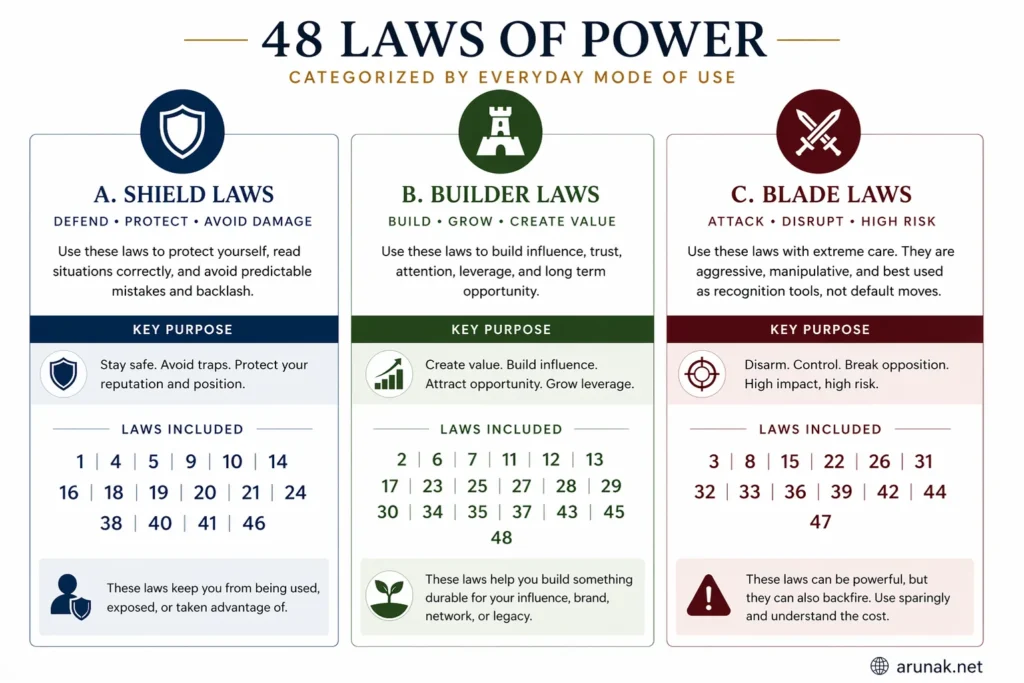
A. Shield laws
These are laws you mainly use defensively. They become useful to avoid unnecessary damage, read situations correctly, and protect yourself from predictable backlash.
- Law 1 — Never Outshine the Master
- Law 4 — Always Say Less Than Necessary
- Law 5 — So Much Depends on Reputation
- Law 9 — Win Through Your Actions, Never Through Argument
- Law 10 — Infection: Avoid the Unhappy and Unlucky
- Law 14 — Pose as a Friend, Work as a Spy
- Law 16 — Use Absence to Increase Respect and Honor
- Law 18 — Do Not Build Fortresses to Protect Yourself
- Law 19 — Know Who You’re Dealing With
- Law 20 — Do Not Commit to Anyone
- Law 21 — Play a Sucker to Catch a Sucker
- Law 24 — Play the Perfect Courtier
- Law 38 — Think as You Like but Behave Like Others
- Law 40 — Despise the Free Lunch
- Law 41 — Avoid Stepping into a Great Man’s Shoes
- Law 46 — Never Appear Too Perfect
B. Builder laws
These are the laws that can be used to build something durable: influence, trust, attention, leverage, and opportunity.
- Law 2 — Never Put Too Much Trust in Friends, Learn How to Use Enemies
- Law 6 — Court Attention at All Costs
- Law 7 — Get Others to Do the Work for You, but Always Take the Credit
- Law 11 — Learn to Keep People Dependent on You
- Law 12 — Use Selective Honesty and Generosity to Disarm Your Victim
- Law 13 — Appeal to People’s Self-Interest
- Law 17 — Cultivate an Air of Unpredictability
- Law 23 — Concentrate Your Forces
- Law 25 — Re-Create Yourself
- Law 27 — Play on People’s Need to Believe to Create a Cult-like Following
- Law 28 — Enter Action with Boldness
- Law 29 — Plan All the Way to the End
- Law 30 — Make Your Accomplishments Seem Effortless
- Law 34 — Be Royal in Your Own Fashion
- Law 35 — Master the Art of Timing
- Law 37 — Create Compelling Spectacles
- Law 43 — Work on the Hearts and Minds of Others
- Law 45 — Preach the Need for Change, but Never Reform Too Much at Once
- Law 48 — Assume Formlessness
C. Blade laws
These are the aggressive or high-risk laws. Some are frankly manipulative. That does not make them useless. It just means they are more useful as recognition tools than as advice.
- Law 3 — Conceal Your Intentions
- Law 8 — Make Other People Come to You
- Law 15 — Crush Your Enemy Totally
- Law 22 — Use the Surrender Tactic
- Law 26 — Keep Your Hands Clean
- Law 31 — Control the Options
- Law 32 — Play to People’s Fantasies
- Law 33 — Discover Each Man’s Thumbscrew
- Law 36 — Disdain Things You Cannot Have
- Law 39 — Stir Up Waters to Catch Fish
- Law 42 — Strike the Shepherd and the Sheep Will Scatter
- Law 44 — Disarm and Infuriate with the Mirror Effect
- Law 47 — Do Not Go Past the Mark You Aimed For
This is one of the most practical uses of the book.
You do not need to become the kind of person who uses every law. But you should know when one is being used on you.
Final words
Together, sorting the 48 laws through these three lenses makes the book much easier to use in real life.
The first asks: Where am I right now, and what laws should I use to get ahead?
The second asks: What kind of power am I trying to build around myself?
The third asks: How should I actually handle this law in daily life?
Seen this way, the book starts to take on a much clearer structure.
You stop treating them as commandments and start treating them as patterns.
Only then does the book start to make sense.
You do not need all 48 laws at once. You need the right lens for the right moment. That is what makes the book readable, and more importantly, usable.