
What is Nobody Wants to Read Your Sh*t about?
This is one of the best books on writing I’ve ever read.
What’s interesting is that Steven Pressfield didn’t really write his first novel until 51, but had been working and honing his craft for almost 27 years.
What’s even more interesting is that the knowledge he accumulated about writing did not come from a single domain. He’s been a copywriter, screenwriter, schoolteacher, tractor-trailer driver, offshore oil-rig worker, migrant fruit picker, and even an adult-content writer. Through these roles, he learned real, valuable lessons about storytelling before he became a novelist, and now a nonfiction writer.
So, this is an all-in-one book that gives so much depth, but also the breadth of writing. He presented these ideas in the most effective way possible, in that, most of the chapters in the book are only one page long, which I found quite accessible.
Ideas and takeaways worth keeping
Every piece of writing should be about something
Pressfield makes a very simple, but very easy-to-miss, point about any piece of writing: it should be about something. He says that even though this seems very easy to understand, most of what we see, in any creative work, is about nothing.
The principles of storytelling are sometimes so obvious that we can’t see them. Of course, you say, a story has to be about something. But I challenge you. Read a thousand screenplays penned by aspiring writers. Nine hundred and ninety-nine will be about nothing (and I don’t mean in a good way like Seinfeld, which by the way was never about nothing.)
I think about this with what Robert Caro, a two-time Pulitzer Prize-winning author, said about his process of writing. In the section where the interviewer asks about his outlining process, Caro says:
“I can’t start writing a book until I’ve thought it through and can see it whole in my mind.”
Then he says he boils the book down to three paragraphs, two, or one, and adds:
“That process might take weeks.”
Even though some of his books are about 1,200 pages long, he says the concept is always the same. First, figure out what the book is about, and then write it as the final line of the book. Then, work backwards by writing the whole 1,200 pages toward that single sentence.
The three acts
There are three acts to any successful story. Pressfield says that this is commonly used, not only in creative writing, but also in movies and other creative storytelling ventures.
ACT ONE
I met her in a Kingstown bar.
We fell in love. I knew it had to end.
ACT TWO
We took what we had
and we ripped it apart.
ACT THREE
Now here I am, down in Kingstown again.
The hero’s journey and the collective unconscious
Out of all the amazing insights that I came to devour from this book, this is undoubtedly the most interesting, and I think, most effective one in writing.
The effectiveness of this concept comes from the fact that this is something we collectively agree on as human beings, something that “makes sense.” We unconsciously recognize that this is how “things should happen.” Pressfield shows that this pattern has long dominated our unconscious mind, and he leads the reader toward psychologists and researchers who have done work in this area.
The famous Swiss psychiatrist Carl Jung called this the collective unconscious.
- The hero begins in the Ordinary World.
- The hero receives the Call to Adventure.
- The hero refuses the Call.
- The hero meets the Mentor.
- The Mentor gives the hero the courage to accept the Call.
- The hero crosses the Threshold and enters the Special World.
- The hero encounters enemies and allies, and goes through an ordeal that becomes his Initiation.
- The hero confronts the Villain and acquires the Treasure.
- The Road Back: the hero escapes the Special World and tries to “get home.”
- The Villains pursue the hero, and the hero must fight or escape again.
- The hero returns home with the Treasure and brings it back into the Ordinary World, but now as a changed person because of the ordeal and experiences of the journey.
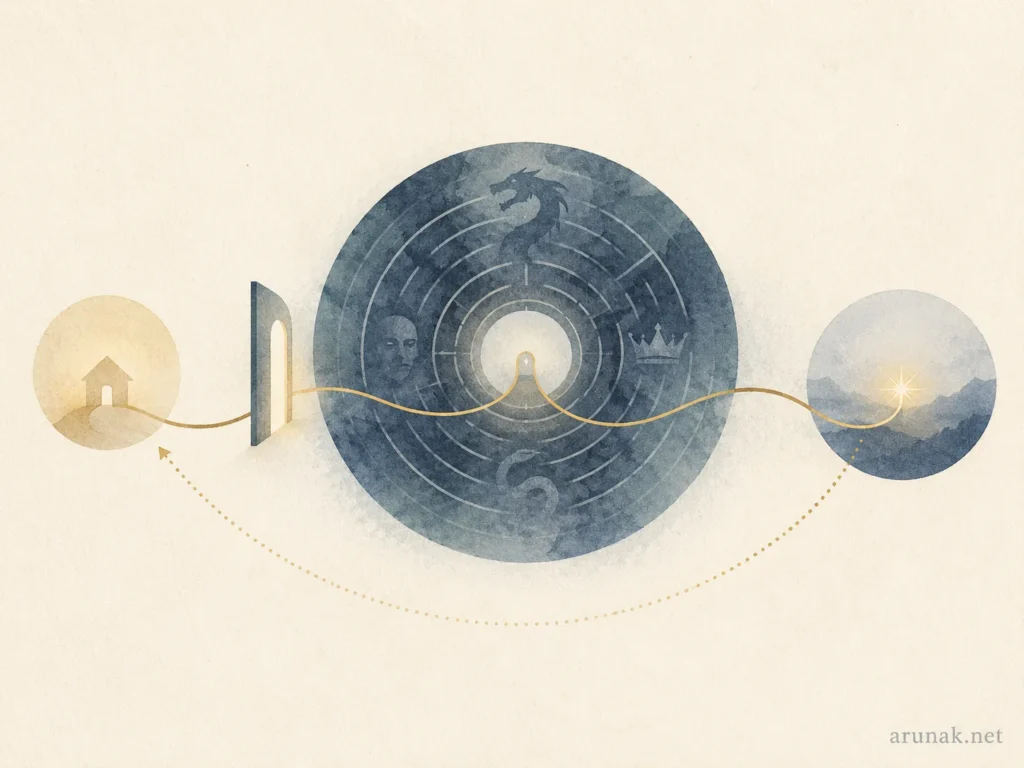
From The Epic of Gilgamesh and The Odyssey to Journey to the West, The Hobbit, Star Wars, and Harry Potter, this pattern keeps returning in different forms, that, the hero leaves the familiar world, enters a world of danger that tests his/her limits and values, and comes back changed.
| Story / myth | Approx. date | How it fits the pattern |
|---|---|---|
| The Epic of Gilgamesh | c. 2nd millennium BCE | Gilgamesh leaves ordinary kingship and goes through loss, trial, and a search for wisdom. |
| The Odyssey | c. 8th century BCE | Odysseus tries to return home, but the journey changes the meaning of home itself. |
| Ramayana | before 300 BCE | Rama is exiled, tested, confronts Ravana, and returns to Ayodhya. |
| Beowulf | composed c. 700–750 CE | Beowulf leaves home to face monsters, wins treasure and honour, and later faces the cost of heroism. |
| King Arthur legends | popular before 11th c.; Geoffrey’s version c. 1135–1139 | Arthur rises into a special world of kingship, order, trial, betrayal, and loss. |
| Journey to the West / Monkey King | 16th century | The Monkey King moves from rebellion to discipline and spiritual service through the pilgrimage. |
| The Hobbit | 1937 | Bilbo leaves the Shire, faces danger, gains treasure, and returns changed. |
| Star Wars | 1977 | Luke leaves the farm, meets mentors and enemies, enters a larger world, and returns with new identity. |
| Harry Potter and the Philosopher’s Stone | 1997 | Harry leaves the ordinary world, enters the magical world, faces danger, and discovers who he is. |
The hero’s journey + three acts
And then, Pressfield gives the “working backbone” of a successful story, which is nothing but the combination of the hero’s journey integrated into the three acts.
Are you beginning to see the contours of what makes a story a story? Can you see the universal architecture that underlies virtually every tale from the Norse sagas to South Park and Keeping Up with the Kardashians?
Three-Act Structure + Hero’s Journey = Story.
One more thing that came to mind while reading this was the concept of the “five-second moment” in storytelling, which I came across while reading Matthew Dicks’s book Storyworthy. He says:
All great stories, regardless of length or depth or tone, tell the story of a five-second moment in a person’s life. (page 79)
As common and successful as the hero’s journey and the three-act model are in storytelling, the five-second moment is also effective, and evidently just as common.
I’ve seen this over and over again in movies, where the main characters’ fundamental values change, specifically just before the third act begins. And then the third act is the payoff: the outcome of the main character becoming a good person, which gives the audience the feeling that they have witnessed a complete story.
The recent popular book, and the movie, Project Hail Mary, is a textbook example of this concept in play.
So, the structure becomes:
Act 1
- Hero begins in the ordinary world.
- A disturbance breaks that world open.
- The villain enters, or the central problem becomes visible.
Act 2
- Hero enters the special world.
- The hero encounters enemies and allies.
- The hero goes through the ordeal.
- The hero gains something, but the effort required to gain it changes the hero’s values.
- This is the “five-second moment.”
Act 3
- The hero returns, changed.
- The end.
So the story is not really about whether the hero gets the treasure at the end. It is about what the hero has to become in order to get it.
The five-second moment gives the story meaning, because this is where the external journey becomes an internal change. And, at the end of the day, what moves us is someones internal change, not the external journey.
This is why the dinosaurs in Jurassic Park, the shark in Jaws, or the cool science in Project Hail Mary are not really the point of the story. They are narrative devices that create the ‘special world’, where the hero is taken out of ordinary life, placed under pressure, and forced to become someone different, someone better.
Every non-story is a story
This is one of the most important lessons I came across in the book: all the ideas described above, the hero’s journey, the three acts, and concept-driven storytelling, are not limited to creative writing or fiction. They are applicable, and should be taken into account, if your writing is to be successful in nonfiction too.
This could be a leaflet, a PhD thesis, or even a joke. He says:
What exactly is a story? How, one may reasonably ask, can I take my Masters’ thesis on the metaphysics of motley in the works of Joseph Conrad or my Gardening Class speech on winter soil preparation for geraniums and make it into a narrative? Trust me, you can.
Best quotes and passages from Nobody Wants to Read Your Sh*t
You don’t really learn an art or a craft in school. In the real world, the process is more like an apprenticeship, multiple apprenticeships under multiple masters. It happens on the street and it happens in the studio. It happens in bed. It happens sober and it happens stoned. It happens getting up early and it happens staying up late.
What are the universal structural elements of all stories?
Hook. Build. Payoff.
This is the shape any story must take.
By hooking them (Act One), building the tension and complications (Act Two), and paying it all off (Act Three).
That’s how a joke is told. Setup, progression, punch line. It’s how any story is told.