
One-line takeaway
A playful and surprisingly profound story that turns the chaos, ego, and rebellion of a strange hero into spiritual discipline through an unforgettable adventure.
At a glance
Part myth, part adventure, and part spiritual satire, this is a book that looks simple and just funny on the surface, but carries more philosophical weight than I expected.
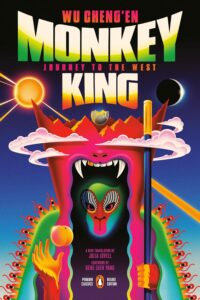
The Monkey King by Wu Cheng’en traces the arc of Sun Wukong from a brilliant, chaotic troublemaker into a student forced to confront limits, authority, and the possibility of change.
The story begins with Wukong’s refusal to submit to authority, then gradually becomes more reflective and moral, before turning his life in a completely different direction.
The review
I picked this book up from my local library when I was about nine or ten.
Some of the scenes were so vivid and tactile that I still remember the joy I felt reading them. Over time, I forgot the name of the book, but not those scenes, or its surprisingly deep ending.
So I searched around for a while to find the title, and then started reading the English translation. Even 24 years later, it lost none of its pull. I still found myself caught by the same energy, the same strangeness, and the same delight.
But this is hardly a novel point. A book that has stayed alive for more than four hundred years has already made that case for itself.
This translation by Julia Lovell, too, is phenomenal. There’s something subtle about the word choice that makes me laugh out loud:
“If you resist, I will instantly turn you into salted vegetable powder.”
And then there’s another layer of almost Kafka-level literature:
“I humbly suggest that you give him an amnesty, send him to Heaven, and assign him a government position. Once he’s inside the system, he’ll have to behave.”
Overall, this is a book that, no matter how old you are when you read it, still has enough wit and depth to keep you engaged throughout the story.
How has it changed the way I think?
A book that has lasted this long and still feels very much alive today probably has something to teach us about storytelling. One thing that stood out to me while reading The Monkey King was how naturally it falls into the shape of the hero’s journey. This idea is usually associated with Joseph Campbell, though Steven Pressfield talks about it in a very direct, practical way in Nobody Wants to Read Your Sh_t*.
The hero’s journey is a story pattern in which a character leaves an ordinary state, faces trials and transformation, and returns changed.
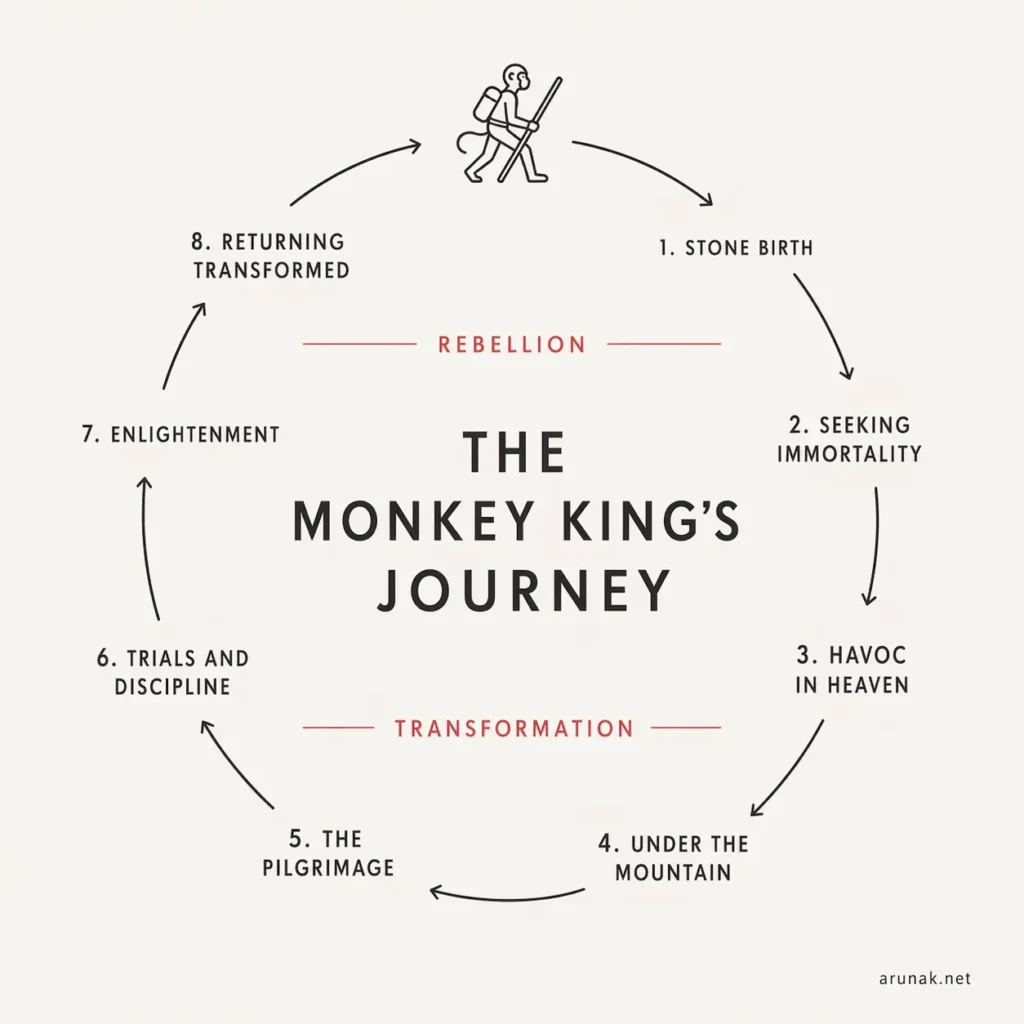
Pressfield writes that the hero’s journey is the story pattern that keeps repeating over centuries in books, movies, myths, and modern fiction because it speaks to something fundamental in human life. The famous Swiss psychiatrist and psychoanalyst C. G. Jung called this the collective unconscious.
Sun Wukong’s story moves with this same force that still drives so many successful stories today: rise, rebellion, punishment, trial, and transformation.
He begins as a force of nature. He’s clever, unruly, ambitious, and impossible to control. He wants power, immortality, and freedom from every limit placed in front of him. That is what makes the early part of the book so much fun. His defiance is thrilling. His confidence is absurd in the best way. But the story does not stop at spectacle. His rebellion against Heaven ends in defeat, and that is where the hero’s journey really begins.
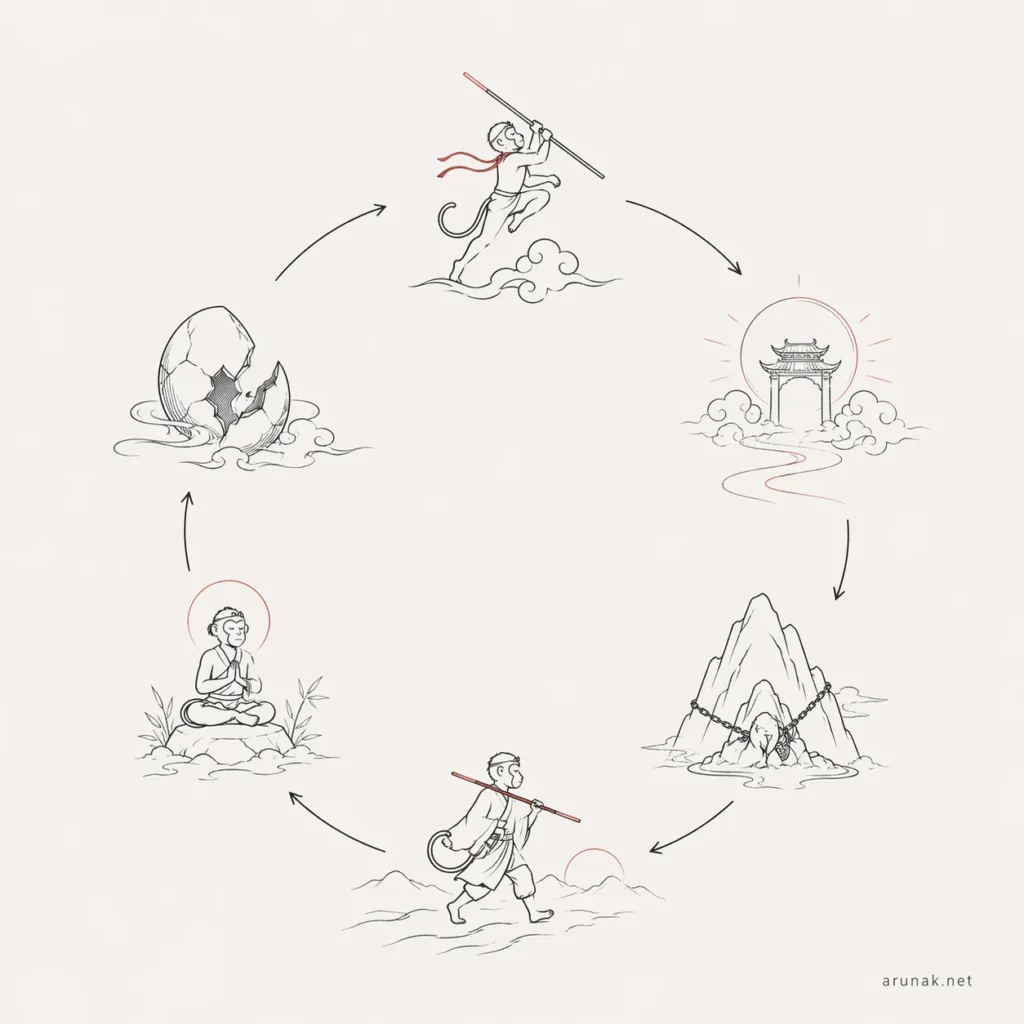
Once Sun Wukong is released to join the pilgrimage, the story starts to gather depth. The journey is still full of strangeness, danger, comedy, and invention, but now there is pressure on the character to become something more than powerful. He has to learn restraint. He has to learn what to do with the power he’s been given. He’s given a purpose: to protect the monk Xuanzang on the journey west. His power is now put in the service of something humbler and larger than himself.
That, I think, is part of why this story has held up for so long. It understands that a strong character alone is not enough. Raw energy is exciting, but hero’s transformation is what resonates with us in the long run. This book has endured for centuries because the story does more than just entertain. It triggers our collective unconscious.