
In a previous article, I covered my thoughts about a weird phase that is not really talked about when people take a leap and embark on their dream careers. And that is the long, often uncertain period where someone would go without any pay to find what they really want to do in life.
This is the phase where the “magic” happens. But it’s not all sunshine and rainbows. You have to be able to sustain yourself for such a long period of time. You have to be strategic to manage your scarce resources. But none of this would work if you don’t have a financial buffer.
Why even a little in savings goes a long way in a period like this, and how to create such a financial buffer: that’s what this article is about.
It takes money to make money
Any new venture demands a stabilisation period, much like a seed needs some time to take root. At this phase, it’s just taking in water and nutrients from the soil. It does not even begin to give anything back to us. So, from a financial standpoint, this is a period of negative cash flow.
It is when the seed finally breaks the surface and eventually starts making its own food that the record books begin to turn green.
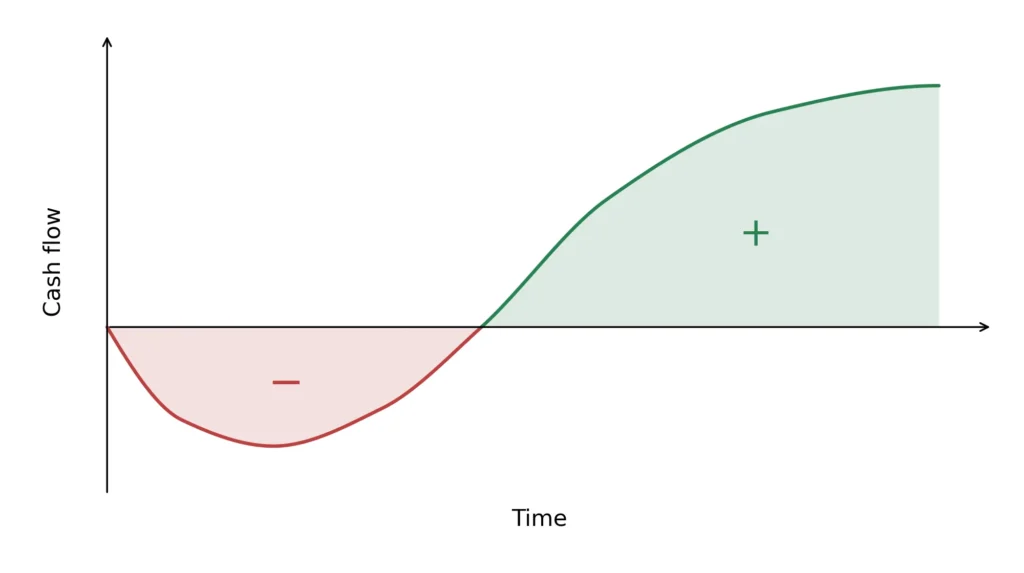
If things are done right—the soil was in good condition, and you’ve tended to it—the positives will outweigh the negatives.
That’s the outcome we are looking for.
But how well it can grow and give us the best yield possible depends on how well we’ve taken care of it in those early stages, when it could not take care of itself. If the soil was dry and the seedling was neglected, the yield would not be as great.
Like so, in a new venture, how we manage that initial stage of negative cash flow makes all the difference.1
Numbers don’t lie
But we don’t have piles of money lying around to throw into a side hustle or a new business, not to mention stay in the red for too long without any certainty about the future.
The biggest problem is that the fact that having a financial buffer creates so many opportunities in life gets lost in the messiness of everyday life. But even when we come to realise this in the process of starting a new career, business or side hustle, how can we create one?
An effective strategy is to start small. When we think about saving, we often think we have to save a lot. And we don’t often have even a rough estimate of what a “lot” is.2
Instead, things become much clearer if we reverse engineer this. For example, start from the problem itself: the new venture.
Let’s say you’re starting an eBay store. If you have the items that you’re planning to sell, you can start today. But to run it as a long-term business, you need some money for inventory, shipping, packaging and cash reserves (for payment holds, etc.).
So how much money, approximately, would you need? Here’s a rough estimate (all amounts in CAD):
| Expense | Sell your own items | Small thrift resale | Regular resale | Overall operation |
|---|---|---|---|---|
| Initial inventory | $0 | $70–$200 | $350–$700 | $1,500+ |
| Packaging supplies | $0–$15 | $10–$20 | $25–$50 | $100+ |
| Shipping funds | $0–$25 | $10–$30 | $50–$100 | $150+ |
| Cash reserve (returns, unexpected costs) | $0–$10 | $10–$50 | $75–$150 | $250+ |
| Total initial investment | $0–$50 | $100–$300 | $500–$1,000 | $2,000+ |
So for someone who’s just starting out, even 300 bucks will get them going. Once the money starts coming in, they can scale the business using the revenue. Sometimes, putting the numbers down on paper shows us that we don’t need much to get a business off the ground.
But this is not true for a business that takes a large sum of money to start, for example, a café, a vending machine business or a restaurant franchise.
Divide and rule
So if that’s the case—if your business requires a considerable financial buffer to get off the ground—where do you start? Let’s say it is nearly impossible for you to build such a buffer with your current income in the foreseeable future.
In a situation like this, the most effective strategy is to break the business plan into smaller bits.
For example, if your goal is to start a bakery supplying bread and pastries to grocery stores across town, you could begin with just sourdough loaves, made in a rented commercial kitchen and sold through weekly pre-orders.
This does two things at once. First, it reduces the financial buffer you need. Second, it lets you start the business in the near future, test the waters and generate some revenue that you can reinvest in the next stage.
This way, you create a sustainable loop that scales your business on its own.
- Cooper, A. C., Gimeno-Gascon, F. J., & Woo, C. Y. (1994). Initial human and financial capital as predictors of new venture performance. Journal of Business Venturing, 9(5), 371–395. ↩︎
- Hershfield, H. E., Shu, S., & Benartzi, S. (2020). Temporal Reframing and Participation in a Savings Program: A Field Experiment. Marketing Science, 39(6), 1039–1051. ↩︎