

At many points in our adult lives, we seriously ask ourselves the question: “What am I actually good at?”
A reasonable question. And, most of all, a really important one to ask.
Also, the answer should not be that hard. I mean, there are so many opportunities now. So many job roles, career paths, online courses, personality tests, and examples to follow.
Right?
But the more I think about this question, the less I trust the easy answers.
Because “What am I good at?” is rarely one question. It’s several questions stacked on top of each other. Trying to answer it is like trying to untangle a knot by pulling on every thread at once.
And here are the threads:
- What do I enjoy doing all the time?
- What do I learn faster than most people?
- What do other people value in me?
- What kind of work gives me more energy than drains it?
- What can I become unusually good at if I keep going?
- What can I practically build a life around?
Having more options does not make the process any easier either. As Barry Schwartz argues in The Paradox of Choice, too many options can cloud our decision-making process, not clarify it.
What a mess of a question this really is…
But still, a really important one. Why?
If you look at the trajectory of many successful people, you can see a pattern. Before they figure out what they are actually good at, more often than not, their lives look like a ‘mess’. They try different things, and move between different jobs.
And then, once they begin to see what they are really good at, the messiness disappears. They begin to laser focus on a goal, because, at the end of that messiness, comes crystal clear clarity of who they really want to be, and can be.
Not everything becomes easy, of course. But now, they are more willing to face obstacles, uncertainty, and frustration because they have the clear idea of what they are trying to become.
Seen this way, this ‘messy question’ is not something to avoid.
It’s a necessarily evil.
It’s worth putting some effort into seeing through the confusion and coming out on the other side with a clearer sense of what actually deserves your attention.
True, you might still have to adjust your trajectory, because everything changes around you. But surely, it’s better to adjust from a place of clarity than to drift from one vague possibility to another.
But where do we start?
How do we untangle this question without turning it into another personality test, another list of ‘job roles’, or another vague exercise in self-reflection?
That is what this blog post is about.
Table of Contents
The problem with looking toward yourself for strengths
First and foremost, let’s figure out why asking the question “What am I good at?” is not always that effective.
It’s because we usually ask this question only from ourselves.
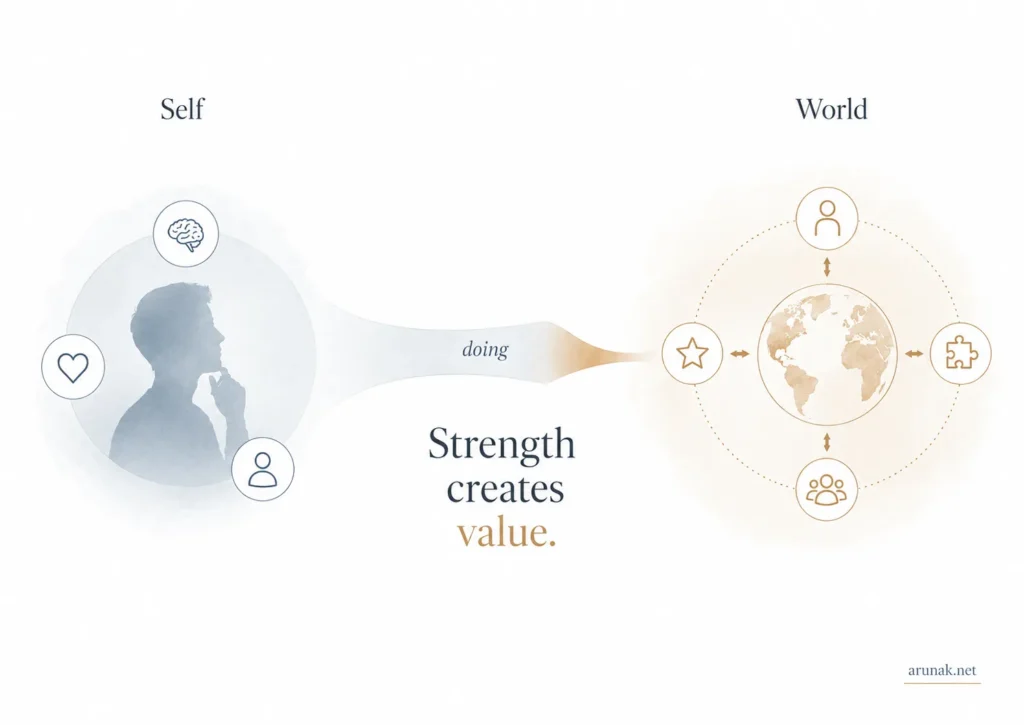
The problem is that strengths, in this context, do not fully belong to us. They are not only about what we can do. They are also about what other people need.
It’s not just the skills you have that matter; it’s how those skills help someone else.
Two very different things…
Sure, being able to wiggle your ears is impressive. But does it help people?!
This is one of the most fundamental first steps toward any long, satisfying career. A strength is only meaningful when it creates some kind of value in the world.
But it can be extremely hard to figure this out by thinking alone. It needs some doing.
It takes action to figure out how and why you are useful to other people.
So where do we start?
Here are some questions to begin with:
- Who comes to you for help? This could potentially become your audience, your customers, or the group of people you serve.
- Where do you repeatedly produce useful results?
- What kind of things do you improve at quickly?
- What do people notice about you before you tell them?
- Where does your effort create real value for other people?
The point is not to distrust yourself completely. It’s to stop treating your self-image as your most valuable career asset.
Interest is evidence, but it’s not enough evidence
To answer those questions carefully would take a couple of days, maybe even a couple of weeks.
But let’s say you have answers, and you’re confident with them.
So now what?
Looking at most career advice, these kinds of questions are not that uncommon. It’s the next step where things usually go sideways.
Because, as a society, we are always being pushed to follow our passion, discover what lights us up, and turn that into a life.
So after answering those questions, you might have a fairly good idea of what your passions are. And it’s completely natural to focus on those more than what people actually need from you.
This is a mistake.
A big one.
Does this mean passion is useless? Of course not. But it’s too fragile to build a satisfying career on by itself.
Because interests and strengths are not the same thing.
A passion is a good starting point for finding a satisfying career. It gives you energy, makes you eager to learn more. It keeps pulling you back, and keeps you in suspense. But the strengths that matter to other people are what give you a real edge in the world.
This means that a good career usually lives at the intersection of interest, ability, and usefulness. These are the common threads running through all the questions we asked before.
Here’s a more systematic way to think about it:
You start with what drives you. A passion keeps you engaged even when things get rough. And because you like doing it, you naturally notice more in the field you’re working in. You spend more time with it. You are more willing to tolerate the boring parts. So, you return to work even after frustration.
Over time, this eagerness to keep going can become a serious advantage. And you can’t have that without a passion.
Research on vocational interests confirms this. Interests are meaningfully related to performance and persistence, especially when the work fits the person well. They are important.
But they should not be the whole story.
At some point, you start to realize that to keep doing what you like for the foreseeable future, you need resources.
You need to pay bills.
And just because you are interested in something does not automatically mean people will pay for it.
So whatever you are doing should also be useful to other people.
This is why I think it can be even wiser to choose one of your secondary interests, if it allows you to deliver real value, than to chase your strongest interest in a way that produces very little value for anyone else.
The more you do it, the better you get at it. And eventually, that secondary interest may become one of your deepest interests, precisely because it has become useful to other people, the money comes, and so you are able to keep doing it.
You can be interested in music without being good at music. You can love photography without having a strong visual eye yet. You can be fascinated by entrepreneurship without being good at selling, building, hiring, or managing risk.
And that’s fine.
Time can teach you many things if you stay open to learning them. Interest gives you a reason to begin. Practice gives you a way to improve them. But usefulness is what moves the whole thing forward.
In other words, you are not just doing it for the money. That would be a thin definition of a ‘satisfying career’. But you are also not pretending that passion alone is enough.
A satisfying career needs both. It needs something that keeps you engaged, and something that lets you become useful to other people.
So interest is evidence.
But it is not enough evidence.
Practice makes ‘almost’ perfect
It is tempting to confuse all this with the idea that you can become whoever you want to be.
But this is too much of a stronger claim than the real evidence suggests.
Let’s start with the positive side of practice.
Repetition, especially when done deliberately, carefully, and corrected step by step, can absolutely sharpen a skill. There is a lot of truth here. If you do something seriously for a long time, you will almost certainly get better at it.
But practice is not magic.
A major meta-analysis on deliberate practice found that practice explained a meaningful amount of performance difference in some domains, such as games, music, and sports. But when it came to education and professions, the effect was much smaller. In professional domains, deliberate practice explained less than one percent of the variance in performance in that analysis.
Is it fair to assume that if we practiced as much as Beethoven practiced music, we would produce music that changed the world in the same way?
Probably not.
To quote from the book Innate by Dr. Kevin J. Mitchell, neuroscientist and associate professor of genetics and neuroscience at Trinity College Dublin in Ireland:
If you or I were cloned 100 times, the result would be 100 new individuals, each one of a kind.
In other words, we are not the same. And we never will be.
Which, in retrospect, is not really a tragedy. It might be one of the best traits about being human.
But it also means that practice cannot be the all-in-one solution. Practice can take you far, but it works differently depending on the person, the domain, the starting point, and the kind of skill being developed.
So it’s important to first figure out what we are already suited for, and then deliberately practice in that particular direction.
To put it another way, the capacity to get good at something differs from person to person. And this is not because some people are better at everything, but because different people have different learning advantages.
So this is the recipe to become unusually good at something: instead of just practicing something, practice something that’s aimed at the places where your natural inclinations already give you some innate traction.
So how do we find those inclinations?
By experimentation…
Herminia Ibarra talks a lot about this in her book Working Identity. We do not usually think our way into a new professional identity. We test it. We try small versions of a possible life and see what happens.
That can look very ordinary in practice:
- Take on a small project before making a big career decision.
- Volunteer for a task that uses the skill you think might be a strength.
- Write, teach, build, design, analyze, sell, or organize something in public and watch what kind of response comes back.
- Talk to people already doing the kind of work you are considering doing.
- Notice where you improve quickly, where you lose energy, and where people keep asking for more.
So the point is to run small experiments until a pattern begins to appear.
Because a strength is not just something you believe about yourself; it’s something that keeps showing up when you run experiments in the real world.
Fit and usefulness
Now, let’s say you know what your strengths are, and you have some idea of how they can be useful to other people.
Still, you have to hone those skills. You have to sharpen them enough that they become valuable, and eventually marketable.
At this point, another, more elusive factor takes the stage: the environment in which you decide to sharpen those skills.
Derek Sivers, the writer and entrepreneur who founded CD Baby, once said:
“You want to go to Silicon Valley, and with all the other programmers, you want to go to New York City with all the other finance people, or you want to go to Hollywood where you test your skills in acting. You want to learn acting in Hollywood, not in a mountain in India.”
It is just as important to find the right place to practice your strengths as it is to discover them in the first place.
Because we tend to improve faster and reach further when our strengths, values, and environment are all pulling in the same direction.
This may sound obvious, but when we look at our strengths from the vantage point of the right environment, it changes how we see our strengths in the first place.
Someone can be highly analytical in an environment that rewards fast social performance, and their real strength may look like a defect. Another person can be highly imaginative in an environment that rewards strict compliance, and their actual strength may look like a distraction. Someone else can be exceptional at deep work in a role that interrupts them every ten minutes for ad hoc meetings and messages, so they never get to see their full potential.
So when someone asks, “What am I good at?” they may be asking the question at the wrong scale. Or at least an incomplete scale.
Because the answer depends partly on the environment they are in.
- Nobody is just good at communication: They may be exceptional at careful written explanation and fairly weak at spontaneous verbal persuasion.
- Nobody is just good at leadership: They may be above average at leading through structure and below average at leading through charisma.
- Nobody is simply creative or uncreative: They may be creative when working with a strict schedule and scattered when everything is open-ended.
Strengths are deeply tied to environments.
The wrong environment can hide a strength. The right will magnify it.
A better model: strengths are loops
So, how do we deal with all this messiness around the question, “What am I good at?”
One way to tackle it is to think of strengths as a recurring loop.
A strength is not something you simply find within yourself. It’s a pattern that keeps bouncing between you and the world.
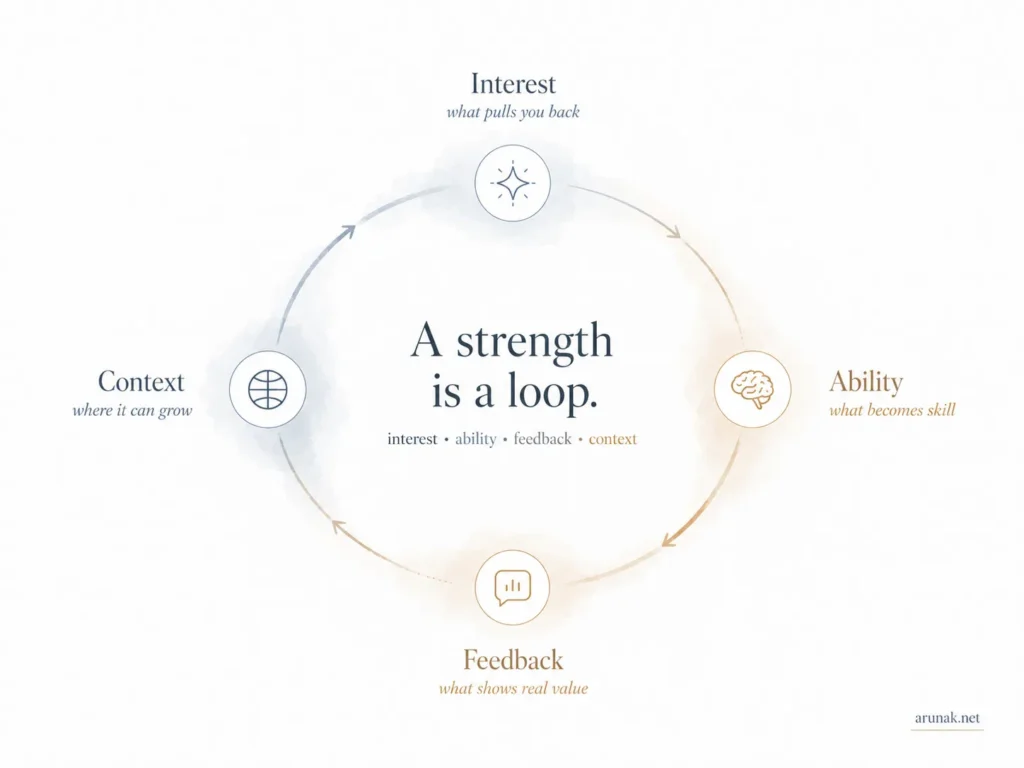
Putting together everything mentioned so far, this loop has four parts.
- First, there is interest: Something catches your attention and keeps pulling you back to it.
- Second, there is ability: By asking better questions and putting your interests into practice, you begin to see which interests can become useful skills, either immediately or through deliberate improvement.
- Third, there is feedback: Other people, the market, the discipline, or the work itself gives you clues that your effort is producing some real value.
- Fourth, there is context: This is the environment where your strengths can be magnified, sharpened, and rewarded, which helps you keep doing the work long enough to get better at it.
When all four parts reinforce one another, the strength begins to gather force.
Interest makes you want to return to the skill over time. Ability helps you improve it. Feedback keeps correcting the distance between what you can do and what people need. And context gives the whole process somewhere to live. It holds interest, ability, and feedback together long enough for them to become sustainable.
The point here is that building a fitting career starts with very specific kinds of questions and, consequently, very specific kinds of answers.
Not just:
- I like painting.
- I’m good at math.
- I like solving problems.
But something more precise:
- I am good at turning messy ideas into clear structure.
- I am good at quickly noticing weak assumptions in an argument.
- I am good at learning technical systems and explaining them clearly.
- I am good at finding hidden patterns in scattered information. I am good at spending time with difficult problems for long periods without feeling drained too quickly.
That kind of specificity is much more useful than the usual answer to the question, “What are you good at?”
Because it does not just name an interest; it points to the viability of a strength.
How to find the evidence in your own life
Let’s put all these things together so you can start looking for the pattern in your own life.
It all comes down to this: if you want to know what you are good at, start with evidence rather than trying to figure out your whole identity at once.
Look outward, not only inward.
Look at the trajectory of your life and ask these five questions.
What do people repeatedly ask me to help with?
This shows external demand, which is part of what turns an interest into a career.
The importance of this question is that other people sometimes see our usefulness before we do. Whatever we are naturally good at is just so normal to us that we do not even recognize it as a strength in the first place.
What do I learn unusually fast compared to others?
This shows a learning advantage.
Research on skill acquisition and individual differences supports the idea that people differ in how quickly they learn different kinds of skills. You may not be excellent yet at whatever this strength is, but speed of improvement is a serious clue.
What kind of work still gives me energy after the first layer of difficulty?
Any skill, when shaped into something useful enough to help other people, will eventually go through a difficult phase.
If not, it’s probably not a job.
Because if it were so easy, everybody would do it. So there would be no demand, no pay, and, in the practical sense, no job.
This is why some kinds of work suit some people better than others.
Asking this question helps separate shallow excitement from durable interest.
Many things are fun at the beginning; only a few things remain compelling when things go sideways.
In what kind of work do I consistently produce useful results?
A strength, at the very least, should change something.
It should solve a problem, improve an existing process, or make a person’s life better, even in some small but effective way.
If the skill you have zeroed in on produces no value, it might be time to go back to the notebook and look more carefully at the evidence.
What kind of environment makes my skills stronger?
The world is, in fact, not your oyster!
It’s a set of confined spaces, and some spaces give your strengths more space to breathe than others.
On the other side, maybe you feel stuck not because you lack ability, but because there is no way to see your full potential in the environment where you are trying to practice your skills.
This may be the most important question in the whole list, because none of the above matters if the environment keeps restricting what you are really good at.
Final Verdict
All this said, the answer will rarely arrive as one grand revelation, but as a repeated pattern.
Repetition is the real evidence.
But it’s also important to remember that the goal is not to reduce yourself to just one strength. People are more complicated than that.
The goal is to identify the few patterns that can carry the weight of a fulfilling career, and maybe, by extension, a more fulfilling life.
References
- Ackerman, P. L. (1987). Individual differences in skill learning: An integration of psychometric and information processing perspectives. Psychological Bulletin, 102(1), 3–27.
- Ackerman, P. L. (1992). Predicting individual differences in complex skill acquisition: Dynamics of ability determinants. Journal of Applied Psychology, 77(5), 598–614.
- Kristof-Brown, A. L., Zimmerman, R. D., and Johnson, E. C. (2005). Consequences of individuals’ fit at work: A meta-analysis of person-job, person-organization, person-group, and person-supervisor fit. Personnel Psychology, 58(2), 281–342.
- Kruger, J., and Dunning, D. (1999). Unskilled and unaware of it: How difficulties in recognizing one’s own incompetence lead to inflated self-assessments. Journal of Personality and Social Psychology, 77(6), 1121–1134.
- Macnamara, B. N., Hambrick, D. Z., and Oswald, F. L. (2014). Deliberate practice and performance in music, games, sports, education, and professions: A meta-analysis. Psychological Science, 25(8), 1608–1618.
- Nye, C. D., Su, R., Rounds, J., and Drasgow, F. (2012). Vocational interests and performance: A quantitative summary of over 60 years of research. Perspectives on Psychological Science, 7(4), 384–403.
- Nye, C. D., Su, R., Rounds, J., and Drasgow, F. (2017). Interest congruence and performance: Revisiting recent meta-analytic findings. Journal of Vocational Behavior, 98, 138–151.
- Rudolph, C. W., Friedrich, J. C., Koziel, R. J., and Zacher, H. (2025). Character strengths use at work: A meta-analysis of relations with work performance and employee wellbeing. Applied Research in Quality of Life, 20(2), 753–788.
- Ryan, R. M., and Deci, E. L. (2000). Self-determination theory and the facilitation of intrinsic motivation, social development, and well-being. American Psychologist, 55(1), 68–78.
- Vásquez-Pailaqueo, M. P., Acosta-Antognoni, H., and Leiva-Bianchi, M. (2025). Character strengths-based interventions and their efficacy related to work engagement and job performance: A meta-analysis. International Journal of Applied Positive Psychology, 10, Article 21.
- Zell, E., and Krizan, Z. (2014). Do people have insight into their abilities? A metasynthesis. Perspectives on Psychological Science, 9(2), 111–125.