
What is Children of Time about?
Children of Time is built around a fascinating concept, that, a failed human experiment, meant to guide human evolution on a distant planet, accidentally gives rise to an intelligent civilization of spiders.
Though I couldn’t get a proper grip on the story, I came to admire the evolutionary concepts that Tchaikovsky threaded through it.
The story explores how intelligence grows, how civilizations form gradually, and how survival mostly depends on whether different forms of life are willing to move beyond their fear of the unfamiliar.
Review
I was more interested in the concept of the story than the story itself…
Because the time —and so the number of pages—to map the concept of this novel into a story is a bit off to my liking.
The concept of a virus that accelerates and influences the process of evolution is obviously an interesting idea on its own. It raises intriguing questions about the mechanisms of genetic change and adaptation. But it seems that the execution of this concept was not as strong as it could have been.
The story felt a bit incomplete…
For one thing, the story has too many unanswered questions. It’s okay to warp time if the author wants to, because this is, after all, science fiction. But there must be a reason to do so. And this story lacks those reasons.
The story goes…the human race is technologically advanced and has established colonies in space and on other planets. This highly intellectual civilization believes that all humans are “spoiled” and wants to create a new human race from scratch, starting with monkeys on a distant, isolated planet. But why start there? What is the reason behind this? I couldn’t find a valid reason for any of these questions.
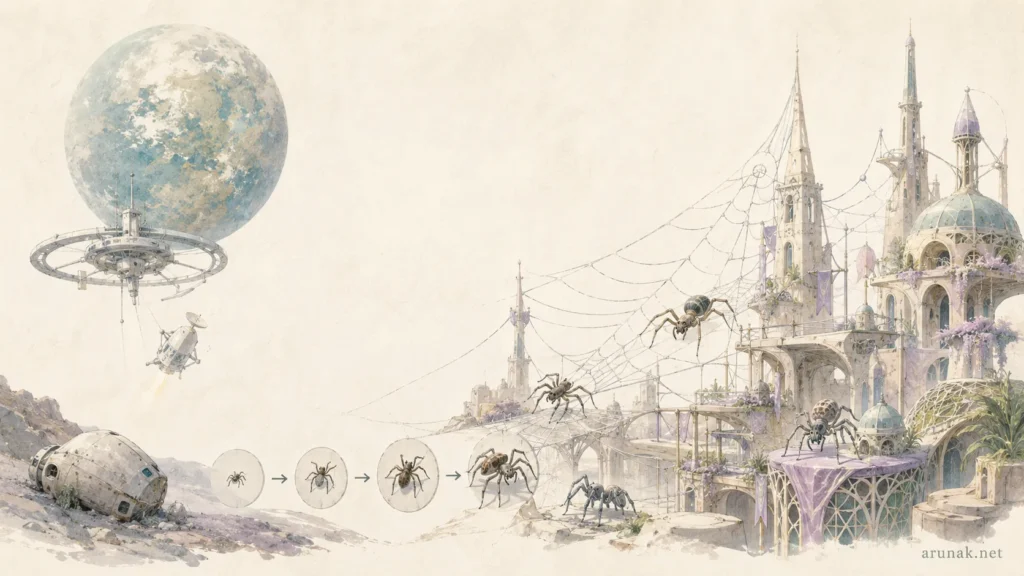
Thousands of years later, some other human civilizations stumble upon this planet and its creator. This is where the suspense of the novel should have really kicked in to get readers excited about what happens next. Instead, the story felt completely flat. Also, the differences in technology between these various groups just seemed off.
This planet, meant to develop a fresh civilization from monkeys, takes a completely wrong turn when ‘spiders’ become the prevailing life form by accident. While all this is happening, Tchaikovsky also works on another narrative of humans at war. Yet, even after 65% of the book, they exist in completely distinct timelines.
On the bright side, however, this book has reminded me just how challenging it is to write a truly good science fiction novel. I confess that I’ve never really experimented much with this genre before; I usually stick to books that I know are extraordinarily well-written. Karma treated me well with this one, as this was the first one I chose to break away from my snobbish approach to science fiction, and yet it turned on me immediately!
There is one compelling concept that Tchaikovsky truly masterfully conveyed, which pushed my rating from 2 to 3 stars—that is, for species to advance, both physically and intellectually, the presence of some kind of conflict is vitally important.
To that point, I found the character development in the world of spiders to be quite intriguing, especially how Tchaikovsky presents the idea that nature’s duality—its opposing forces—plays a crucial role in the ongoing growth and progress of all species.
The whole point of civilization is that we exceed the limits of nature, you tedious little primitives (p. 4).
Great wars ensue between spiders and their ant rivals…
The author points out that these conflicts are exactly what propel spiders to become the planet’s most dominant species. Even though we have about 600 million years of history to show that this is not a novel hypothesis after all, it is still interesting how the author carved such a novel world with this old idea. He certainly took his time carving it; but it was too long for my liking.
Best quotes and passages from Children of Time
This is the future. This is where mankind takes its next great step. This is where we become gods (p. 3).
For we are gods, and we are lonely, so we shall create . . (p. 6).
From this distance, against the vast and heedless backdrop of Everything Else, it was hard to say why any of it had ever mattered at all (p. 17).
‘Better ideas?’ ‘I’m Engineering. We don’t do ideas.’ (p. 89).
Humanity had sprung back swiftly, expanded, fought its small wars, re-industrialized, tripping constantly over reminders of what the species had previously achieved (p. 95).
She knows that individual ants cannot innovate, but that the colony can (p. 104).
Can you imagine? Generations of ice-dwellers, forgetting and forgetting who we ever were, wasting away and never seeing the sun except as just another star (p. 145).
and for a moment she feels proud and happy that her peers are doing well, before her treacherous memory goads her with the thought of the ants’ inexorable advance. Building more just means more to lose (p. 153).
Is war/conflict necessary for the progress of a species?
The adults all seemed to possess some disconcerting quality, people who had been fed a narrow range of lies that had slowly locked their faces into expressions of desperate tranquillity, as though to admit to the despair and deprivation that so clearly weighed on them would risk losing them the favour of God. The children, though–the children were still children. They fought and chased each other and shouted and behaved in all the ways he remembered children doing, even back on toxic Earth where their generation had no future but a slow death (p. 369).