
One-line takeaway
Human life is not merely random or capricious as we might think.
What is Cows, Pigs, Wars and Witches about?
Marvin Harris’s Cows, Pigs, Wars, and Witches is built around a compelling assumption: the strange things people do and believe are usually not as strange as they seem on the surface.
The primary hypothesis of the book, therefore, is that “human life is not merely random or capricious.”
Behind food taboos, rituals, wars, messiahs, and witch hunts, Harris is looking for patterns. He draws from a wide range of domains, including ecology, land, labor, inequality, and power to make his points (reminds me of the book The Rational Optimist by Matt Ridley).
This is, by far, one of the best anthropology books I’ve read in recent years.
Table of Contents
Ideas and takeaways
Culture is not built around some random events; it was formed to be in lined with material pressure
As I was just starting to read the book, I could tell that Harris had spent a good amount of time on the prologue.
There was no way I could resist reading the rest after the first few pages.
It was exceptional.
Harris is pushing back against the idea that science and reason cannot explain human lifestyles, or at least that they can’t capture anything meaningful about them. He thinks this attitude leaves us trapped in mystification.
Ours is an age that claims to be the victim of an overdose of intellect. In a vengeful spirit, scholars are busily at work trying to show that science and reason cannot explain variations in human lifestyles. And so it is fashionable to insist that the riddles examined in the chapters to come have no solution (p. 9).
He argues that “everyday consciousness cannot explain itself,” because people inside a culture are often not in the best position to see the forces that shaped it in the first place.
So the book begins with an attitude: do not just ask what people say they are doing. Follow the traces of the practical problems their customs may have been solving.
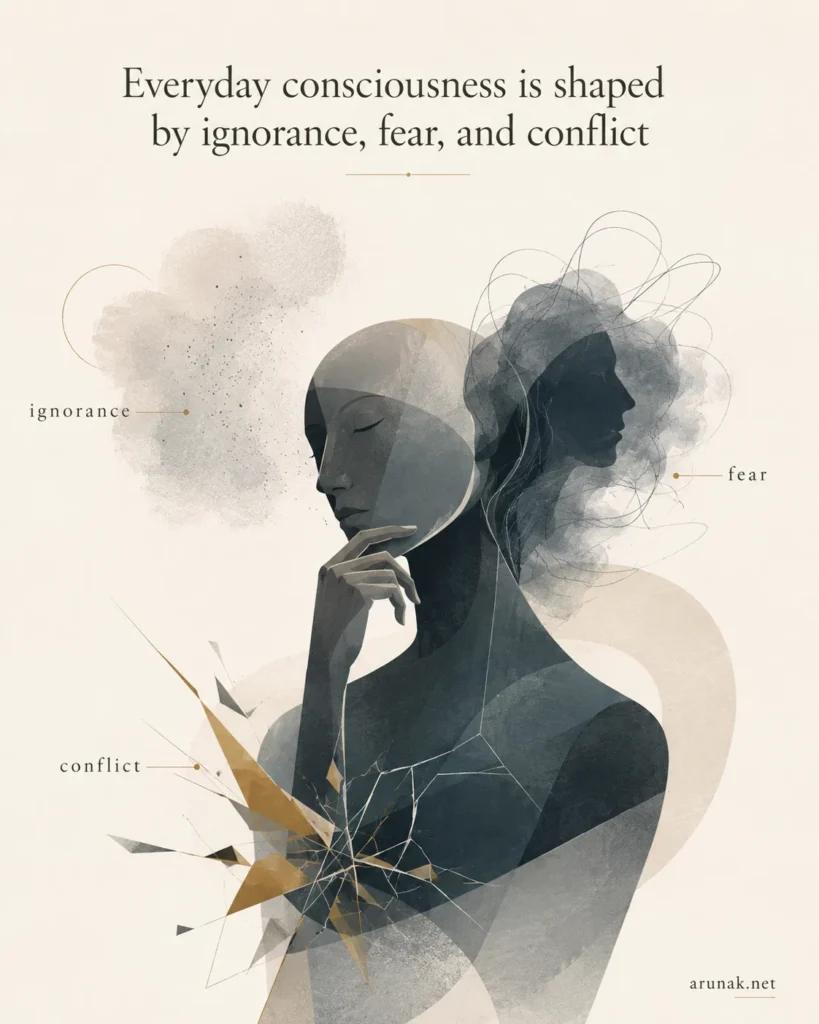
Everyday consciousness is shaped by ignorance, fear, and conflict
Harris argues that our everyday consciousness is not as clear as we think it is.
He identifies three basic elements of everyday consciousness: ignorance, fear, and conflict.
And considering what’s happening in today’s world, this rings true. We are prone to be governed, and manipulated, by these forces every day.
Harris points out that, in order to break free, we need to understand the basics of culture, stripped down to their most basic elements.
This is why most of the examples in the book come from small-scale societies, where the connection between belief, survival, food, land, inequality, and power can be easily seen.
The sacred cow is spared for the farmer’s economic survival
So, this is the first case Harris brings up to show how conceptually confused our minds can be about a well-known subject: the sacred cow, especially in Indian culture.
Killing cows is frowned upon in these cultures. That’s a fact. But this is more often attached to what Harris calls “cow love,” to imply that it is done because cows are considered sacred.
But a series of whys leads to a very different conclusion. People tend not to kill cows, even at the brink of starvation, because of a very systematic economic logic underneath the belief.
During droughts and famines, it’s quite reasonable to think of killing livestock to survive.
But if farmers do so, their fate is sealed. Even if they survive the drought, when the rain comes, they have no way to plow their fields.
Because they’ve eaten the very thing that would help them to plow fields.
So what comes next is even more catastrophic than starvation. They may not only starve; they may lose all their lives work, including the fields and their house.
Western experts it looks as if “the Indian farmer would rather starve to death than eat his cow.” The same kinds of experts like to talk about the “inscrutable Oriental mind” and think that “life is not so dear to the Asian masses.” They don’t realize that the farmer would rather eat his cow than starve, but that he will starve if he does eat it (p. 23).
To put it another way, the refusal to kill the cow is not based only on love for the animal. It is also based on the fact that the cow is part of the farmer’s survival system.
What seems like an irrational religious taboo actually turns out to have a very logical economic reasoning.
And for the scholars who argue that this is mainly a religious decision rather than a clever, practical response to real conditions, Harris has a rather hilarious answer.
He points out that more calories go up in useless heat and smoke during a single day of traffic jams in the United States than is wasted by all the cows of India during an entire year.
And he builds this comparison to the punch line:
If you want to see a real sacred cow, go out and look at the family car (p. 32).
Pig hatred is not merely a taboo; it’s an economic necessity
Another very similar misconception, Harris argues against, is the ‘pig taboo’ in the Middle East.
The common explanation is that people in the Middle East tend to believe pigs are dirty animals. And with this comes the misconception that people don’t consume pork simply because pigs are disgusting.
But, as Harris points out, that is not the real reason.
It’s because pigs were badly matched to the environment they were in.
The whole origin of the idea that pigs are dirty animals, comes from this: pigs are not biologically designed to sweat.
So in hot, dry conditions, they need external moisture to cool themselves. If there is no clean mud, shade, or water available, they become dependent on whatever moisture they can find. This is how the pig’s “dirtiness” became a common misconception.
So in the Middle East, pigs became an ecological liability.
As Harris puts it, pork “tasted good,” but it was too expensive to feed pigs and keep them cool.
So with this reasoning, the notion that pig eating is taboo because pigs are naturally disgusting animals does not hold up. Rather, pork was forbidden in cultures where raising pigs had become a bad bargain, especially in Jewish and later Islamic dietary traditions.
They were not worth the cost.
So pig hatred was not irrational. Pig raising was just not economically viable.
War is not explained by human savagery but by the absence of better solutions
War is usually explained through emotions: vengeance, bravery, honor, anger, masculinity.
Harris takes a different approach to this.
In this chapter, the goal is to shrink down the concept of war to its bare minimum, so that we get to see the real underlying dynamics of it.
His claim is that primitive warfare functions as a brutal ecological mechanism.
Primitive warfare is neither capricious nor instinctive; it is simply one of the cutoff mechanisms that help to keep human populations in a state of ecological equilibrium with respect to their habitats (p. 60).
It limits population pressure, redistributes land use, and reduces pressure on forests and gardens.
The example Harris uses to explain this is the Maring people of New Guinea. They lived by clearing forest, burning trees, and planting crops in the ashes. In Harris’s opinion, their ritual cycle connected war, pigs, gardens, and forest regeneration into one system. War pushed some groups away from overused land, giving the forest time to recover. Pig slaughter also reduced pressure on food and land, which meant that the violence of war and the ritual killing of pigs were part of the same ecological rhythm.
But Harris obviously points out that this does not make war necessary by any means. He is not praising war. He is explaining why war might be adopted as a necessary evil under certain conditions.
I think the central message from this chapter comes down to this: if war comes from an innate killer instinct, there is not much we can do. But what’s being discussed here shows otherwise. We can control it.
Because if war comes from “practical conditions and relationships,” then changing those conditions can potentially reduce the tendency for war.
Male dominance is produced by social systems, not simply by biology
In “The Savage Male,” Harris attacks the idea that male domination is a consequence of men being physically stronger than women.
His point is that human beings do not survive mainly through anatomy. We survive through culture, tools, and weapons.
So dominance is not decided by who is bigger and stronger.
It’s decided by who controls the “technology of defense and aggression.”
In other words, biology alone cannot explain social hierarchy.
We are the world’s most dangerous species not because we have the biggest teeth, sharpest claws, most venomous sting, or thickest skin, but because we know how to equip ourselves with deadly tools and weapons that perform the functions of teeth, claws, stings, and hides more effectively than any mere anatomical device.
He then connects male supremacy to warfare, polygyny, female infanticide, and competition over women.
The argument is a bit unsettling, but deliberately so. A society can create brutal men by rewarding brutality with sexual access and status.
Then, with this reasoning, Harris rejects the myth of “naturally passive women” and “naturally violent men.”
Under different incentives, he argues, women could be trained into brutality too.
What we call nature may just be a system that has been repeated long enough to the point where the social hierarchy seems to be fixed.
Male supremacy is a case of “positive feedback,” or what has been called “deviation amplification”—the kind of process that leads to the head-splitting squeaks of public-address systems that pick up and then reamplify their own signals. The fiercer the males, the greater the amount of warfare, the more such males are needed.
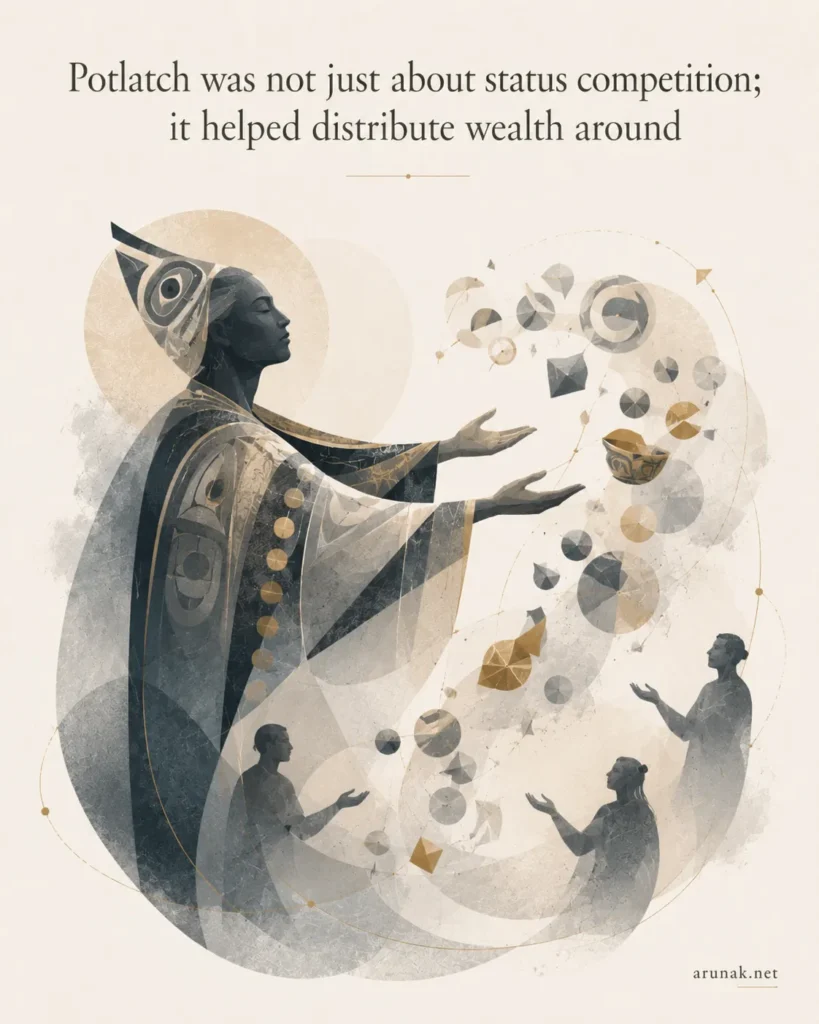
Potlatch was not just about status competition; it helped distribute wealth around
Potlatch, in simple terms, was a ceremony where chiefs or powerful people gave away, displayed, or even destroyed wealth in front of others.
On the surface, it looks like pure status competition.
Harris compares potlatch with modern “conspicuous consumption,” where people work not just to have things, but to be seen having things.
The so-called “shiny lives,” where people buy the car they cannot afford and the house they will be enslaved to pay off for a lifetime, are some modern examples of this.
However, Harris argues that potlatch was misunderstood when it was treated as “irrational prestige madness.”
It’s rather the opposite. The economic system was not serving status rivalry; “status rivalry was bent to the service of the economic system.”
In other words, prestige competition helped move goods and services around.
A modern version of this might be charity galas or public donations, where people give money partly because they care, but also because being seen giving money carries status. But, though this process, the money also moves. It funds hospitals, schools, museums, awards, scholarships, and other institutions. So the desire to be admired gets folded into the distribution of wealth.
One of the controlling mechanisms that was interesting was the way some small-scale societies suppressed boasting to keep pride at a minimum.
Among some groups, the successful hunter’s meat is mocked, no matter how good it is, as worthless to “cool his heart.”
This is how this particular tribe controls the pride of the hunter.
That said, modern society seems to be doing almost the opposite.
We reward the performance of superiority, then act surprised when everyone becomes anxious, competitive, and status-obsessed.
We seem to be more interested in working in order to get people to admire us for our wealth than in the actual wealth itself, which often enough consists of chromium baubles and burdensome or useless objects. (p. 97)
Cargo cults were not merely delusional; they were a fair response to an unfair exchange of wealth
A cargo cult, in simple terms, is a religious or social movement where people believe that wealth, goods, or “cargo” will arrive for them, usually through spiritual or ancestral forces.
These cults are usually shown as an example of irrational belief.
But according to Harris, this was also a political and economic statement.
For example, the people of New Guinea saw Europeans receiving vast amounts of goods, and they tried to explain this unequal distribution through the language of cargo. Cargo became their way of saying: why do they get all of this, and why don’t we?
So in that sense, cargo was not just fantasy.
It was a way of expressing that they were also entitled to the products of industrial society, even if they could not pay for them.
This, of course, does not mean the belief was practically successful.
It clearly was not.
But it was not as meaningless as we might think.
It emerged from colonial inequality and from the attempt to make sense of an unequal distribution of wealth.
Messiahs arise when political suffering takes on a sacred face
Harris sees messianic movements in the same way he sees cargo cults, in that they are not random outbreaks of delusion.
There is a clear reason for their arrival.
For example, the Jewish military messiahs emerged during desperate struggles against foreign rule.
These movements promised not only national restoration, but relief from economic and social inequities.
And in Jewish culture, a messiah was not a deity, at least not in the way Christianity later came to understand him.
A messiah was a human, political, and military leader.
Now, what would happen if the Jewish military lost?
History has always been written by the victors, so they would portray the idea of the messiah as delusional.
According to Harris, this is exactly what happened.
And he shows how misleading it is to portray the loser as delusional simply because they lost.
If George Washington had lost, would freedom look like a delusion?
The key point that comes through in this chapter is this: we should be careful about treating failed historical movements as irrational just because they failed.
The peaceful messiah may have been constructed by political necessity
Then, Harris moves on to one of his more controversial arguments in the whole book.
He suggests that the peaceful image of Jesus may have been shaped after the fact, as early Christian writers moved away from the military-messianic tradition mentioned in the previous section.
I do not think this section is as easy to accept as some of the other chapters in the book, but it is perfectly aligned with the common theme of the book: religious consciousness changes under political pressure.
For Harris, the image of the “Prince of Peace” was not simply a timeless spiritual truth floating above history. It was also shaped by the historical failure of Jewish revolt and the need for survival under the empire that won.
Witch hunts were manufactured when authorities needed enemies
I found the whole argument about “witches and witch hunts” to be very interesting.
At one point, the Church treated flying witches as an illusion.
But later, all that changed. It even became dangerous to deny that witches could fly.
The illusion had become the official truth.
This is an absurd reversal: first it was forbidden to believe in the flights; later it was forbidden not to believe in them.
So the point is that witch hunts were not timeless superstition.
They became a systematic narrative under particular historical conditions, especially when authorities began using torture and confession to produce enemies.
Why was the Canon Episcopi overruled? The simplest explanation is that the inquisitors were right: Witches were meeting at secret sabbats—even if they didn’t get there on their broomsticks—and they actually constituted as much of a threat to the security of Christendom as the Waldenses or the other clandestine religious movements (p. 185).
Demystifying culture is not immoral; it is, in fact, morally necessary
The epilogue brings the book back to its central purpose.
Here, Harris is carefully pointing out that he is not trying to take away the meaning of human life and culture. Rather, he is trying to remove false explanations from it.
His final claim is that we do not need more mystification.
We need a better understanding of the causes of lifestyle phenomena.
True, a better understanding would not be an all-in-one solution for all the cultural problems we are facing. But Harris says it can improve the odds for “peace and economic and political justice.”
How Cows, Pigs, Wars and Witches changed the way I think
We can’t logically explain everything, but we can explain more than we think we can.
Best quotes and passages from Cows, Pigs, Wars and Witches
We don’t expect dreamers to explain their dreams; no more should we expect lifestyle participants to explain their lifestyles (p. 11).
Some people who are disillusioned with the side effects of advanced technology think that science is “the commanding lifestyle of our society.” This may be accurate with respect to our knowledge of nature, but it is terribly wrong with respect to our knowledge of culture. As far as lifestyles are concerned, knowledge can’t be original sin because we are still in our original state of ignorance (p. 12).
“Basically, the cattle convert items of little direct human value into products of immediate utility.” (p. 26).
One reason why cow love is so often misunderstood is that it has different implications for the rich and the poor. Poor farmers use it as a license to scavenge while the wealthy farmers resist it as a rip-off. To the poor farmer, the cow is a holy beggar; to the rich farmer, it’s a thief (p. 26).
Should you read Cows, Pigs, Wars and Witches?
Read this if you:
- want to understand why strange cultural practices usually have practical and logical roots beneath the surface.
- want to question the idea that food taboos, rituals, and wars are simply irrational, and unavoidable.
- want a book that explains culture through ecology, scarcity, labor, power, and survival.
- want to see how religious beliefs can form around real economic and political pressures.