

When I first got into college, it took me a while to realize that life in college is completely different from life in high school. It’s a serious upgrade. You’ll have access to more interesting classes, more freedom, and more opportunities. But you’ll also need to make some extra effort to keep up with all of it.
In high school, teachers usually give students notes as a point of reference. But in college, it’s mostly up to you to make your own notes.
Taking notes in college is important for obvious reasons. It helps you revise things pretty quickly before finals. But in addition, better grades usually start with better notes. Also, you should make it a habit to take notes by yourself and not rely too much on another classmate’s work. This is because it’s much easier to remember what you’ve written than to remember what someone else has written.
As Peter Rogers puts it, “You learn from MAKING them.” A lot of thinking goes into deciding what to include, what to leave out, and how to organize the information in a way that makes sense to you.
This is something I learned the hard way. Your notes should not just be a transcript of what your lecturer said. They should be a newer version of what you learned, custom-written in a way that you’d understand when you read them in the future.
There are different strategies to take notes in college, and over time, these are the ones I found most useful:
Table of Contents
1. The Outline Method
Most students use the outline method even without noticing it, because it comes out naturally.
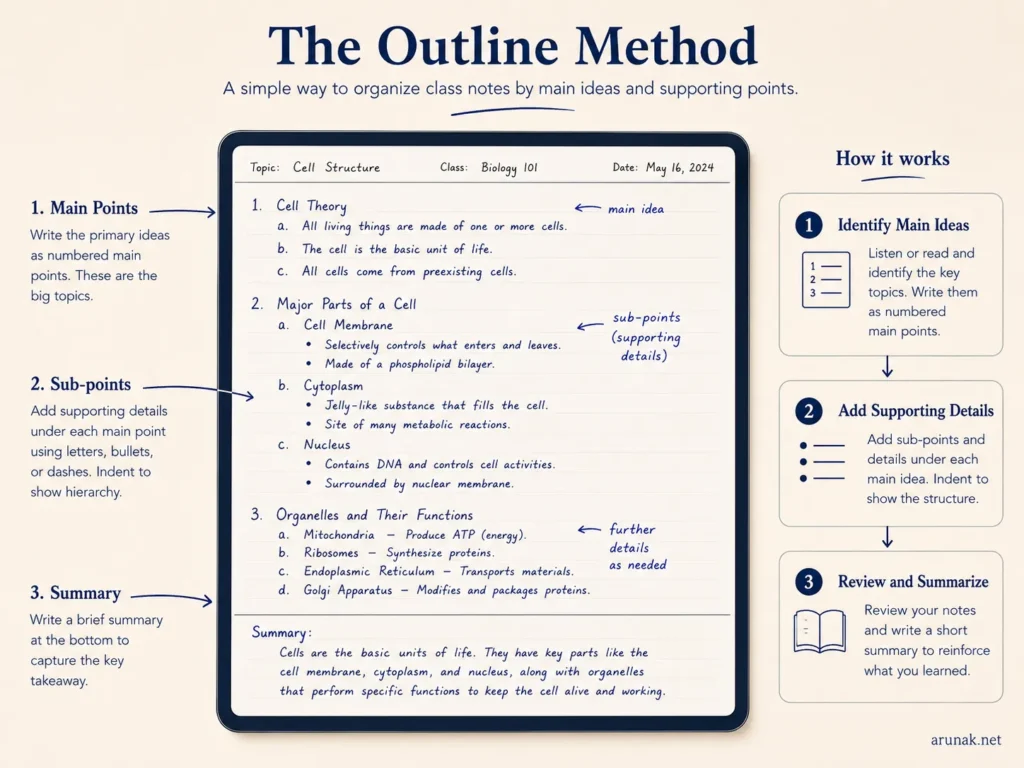
It’s also one of the easiest ways to take notes. The outline method means selecting the main points the lecturer is addressing in class, then writing sub-points beneath each main point.
This helps during revision because you know which parts belong under topic one, topic two, or topic ten. The outline method is one of the most commonly used methods of taking notes in college.
You can organize your work and ideas by using bullets or numbers to section your notes. Reading your assignments before class will also help you identify the main ideas of the coursework.
Also, if you’re using your computer to take notes, you can use apps such as Notion, Obsidian, OneNote, or Roam Research to outline your notes well.
Moreover, using the outline method is helpful because you’re able to review your notes later and summarize the work done in class that day using a short paragraph in your own words.
Summarizing your notes helps you recall what you wrote and prepares you better for the next class.
Benefits of using the outline method to take notes in college
- It’s one of the simplest methods of taking notes in college.
- It’s more structured, so it can be used as a reference point later.
- It’s easier to introduce a new point using an arrow or a bullet.
- It helps you separate the main points from your own thoughts.
- You can turn the points you write down into study questions.
- The outline method helps you prioritize the material.
2. Taking Notes Directly on Slides
Taking notes directly on slides is another really effective strategy to take notes in college, and I don’t see many people talk about it. This is especially useful if your professor already uses PowerPoint or posts lecture slides before class.
Instead of trying to copy everything from the slides, you can use them as a starting point. On the slide itself, you can add the extra details that the professor explains in class.
This helps because the main structure is already there. Your job is to add examples, explanations, warnings, and anything the professor says that is not already written on the slide.
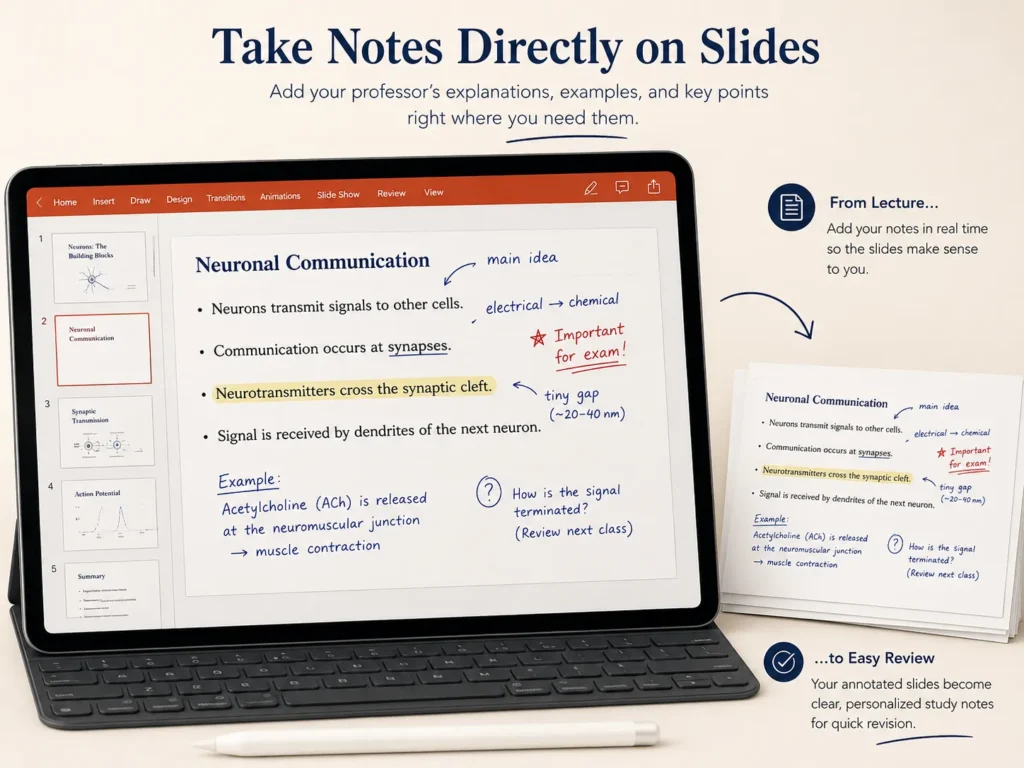
When you’re revising, getting ready for an exam, it’s easy to know what you need to cover in each topic. You can also choose to start with the tough topics when your mind is still fresh and handle the easier ones later when you feel more relaxed.
Benefits of taking notes on slides
- It’s easier to scroll through the notes you’ve taken.
- It helps you connect the professor’s explanation with the lecture material.
- It’s effective for group revision because you can easily share or project the slides.
- You can print the slides and bring them to class if you prefer writing by hand.
- It saves time because you don’t have to rewrite what is already on the slides.
3. Show Up and Sit Where You Can Focus
Sounds so obvious, but showing up to class encourages you to take notes in college. You have to come prepared if you want to get the most out of the lecture.
That said, I don’t think I’ve ever wanted to sit in the front row.
A little confession…
But I’ve found that even if you’re like me and don’t really want to sit in the front, it helps to sit at least in the middle of the class.
Sitting in front of the class, or at least somewhere you can clearly see and hear, made a big difference in the amount of notes I’d take during a lecture. And I only saw the real benefit of it at the end of the term, when I was preparing for the final exam. If you sit at the far end or at the back of the class, on the other hand, you may not see what the professor is writing down. You may also get distracted more easily.
So, sitting where you can focus has several advantages.
- It removes distractions. It’s not easy to get distracted when your attention is on what the professor is saying.
- You’re less likely to use your phone when the professor is directly in front of you.
- If a point is not clear, you can ask the professor questions more easily.
- You’re more likely to remember a question you asked yourself than a point you copied without thinking.
As I said before, you don’t have to sit in the first row every single time. The main point is to sit where you can focus, hear clearly, and stay involved in the class.
4. Writing Notes by Hand
You can’t beat the classics! This is why writing notes by hand is still one of the better strategies to take notes in college.
This is an effective method because you’re making your own notes. I find it easier to remember what I’ve written compared to using another person’s notes.
Another person may be using short forms or abbreviations you don’t understand. They may also have mixed the notes up, making it hard to follow the flow. But when the notebook is yours, you can easily make corrections, add a point, draw an arrow, or write a quick question next to your notes.
The biggest benefit of handwriting is that it slows you down. That sounds like a bad thing, but it can actually help. Because you can’t write down every single word, you will have to think really hard about what matters to go in the paper.
And this forced clarity will help you a lot when preparing for exams.
Benefits of writing notes by hand
- You’re able to process the information more actively.
- Your focus is usually better.
- Taking notes by hand improves how you organize your work.
- It helps you condense large amounts of information into something manageable.
- It can help your memory because you’re writing the ideas in your own way.
- You’re less likely to copy everything word for word.
5. The List Method
The list method is another, somewhat unique, way to take notes in college, where you jot down the most important things said in a lecture in bullet form. I don’t consider it the best strategy because it focuses too much on listing everything the professor says, instead of grasping and processing the information.
Using the list method is also challenging because you might not remember what a point stands for later, especially if you’re using shorthand.
In addition to that, the list method may not capture all the information you need to study. It can become shallow compared to other strategies.
However, the list method can still be useful in fast lectures where the professor is moving quickly, and you don’t have time to organize everything properly. In that case, you can use the list method during class and organize the notes later.
This is where note-taking apps can help. Apps such as Notion, Obsidian, OneNote, and Roam Research support nested bullet points, which makes it easier to organize ideas after class.
This feature helps you capture details from lectures without losing the structure. Doing this by hand can be troublesome for some people.
Well, I’m one of them!
Some of us have lower writing speed than typing speed. This can lead to half-completed notes and a lack of understanding of the content.
But the real value of a digital note-taking app is not the app itself. The value is whether it helps you return to your notes and use them again.
A beautiful note-taking system that you never review is not very useful, at least not in the long run. A simple note that helps you understand the lecture before an exam is far more valuable.
6. The Concept Map Method
The concept map method is another, more visually focused method to take notes in college. It’s mainly useful when you want to connect ideas from your coursework.
This method helps you determine the relationship between one concept and another.
One of the main advantages of using this strategy is that it gives you the flexibility to move from one point to another without many restrictions.
For example, a concept map is developed by starting with the main idea or topic of the coursework. Put the topic at the center of your page and maybe circle it or box it. Then, after stating the main idea, use branches to divide the other sub-ideas in order of priority.
These branches show the relationship between one idea and another. After you’re done using the branches to section your work, you can summarize the whole thing in a few words using your own words.
This is also something I still use today, especially for mapping ideas when I’m reading a book. Here’s an example map I made for The 48 Laws of Power.

The concept map method is especially useful for subjects where the ideas are connected. For example, if you’re studying biology, psychology, economics, chemistry, history, or any topic with many relationships, concept maps can help you see the bigger picture.
But it may not be the best method for a very fast lecture. It takes time to build a good concept map, so you may want to make rough notes during class and turn them into a concept map later.
7. The Cornell Method
The Cornell method is one of the most recommended strategies to take notes in college, and it’s something I still use years after graduating from college. It’s really effective because it’s structured and useful for revising notes.
This method makes it easier to define work in order of priority. It’s also helpful when studying because it gives you space not only to write notes, but also to review them.
The Cornell method follows a specific format. It usually contains a header, two columns, and a summary section.
The header is found at the top of the page and is used to write the main information, such as the name of your course, the date, or the specific topic you’re working on.
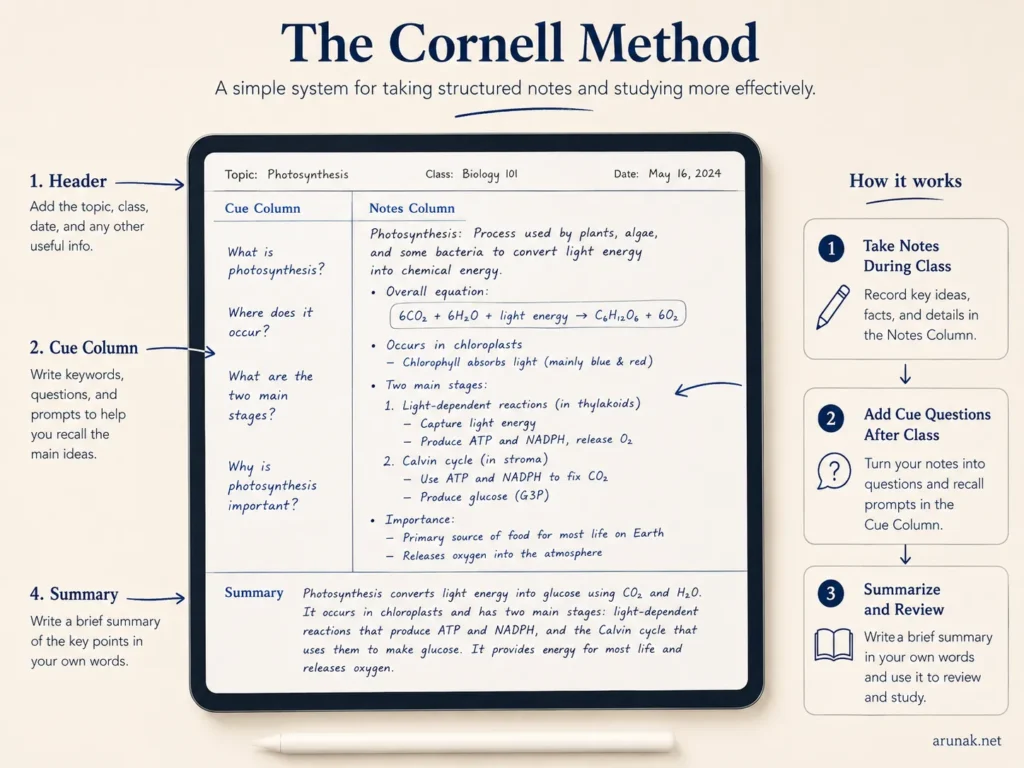
The larger column is where you write your main notes during class. The smaller column is where you write keywords, questions, or recall prompts after class.
The footer, or summary section, is where you summarize the notes and write what you recall about that topic in a few words. It’s better to recap this area using your own words so you can see how much you’ve actually understood.
The best part of the Cornell method is that it turns your notes into a study tool. When you’re revising, you can cover the main notes and use the questions or keywords to test yourself.
This, I find, is a much better way to study anything than just simply rereading your notes and hoping you remember everything.
Choosing the Best Strategy
Choosing the best strategy to take notes depends on your needs and how convenient a given strategy is for you.
- If the lecture is well-structured, the outline method may work best.
- If your professor uses slides, taking notes directly on slides may be easier.
- If you’re studying connected ideas, concept maps may be helpful.
- If you want a strong review system, the Cornell method is a good choice.
- If you’re in a fast lecture, the list method may help you capture information quickly, but you should organize it later.
The main idea is this: don’t choose a method because it looks impressive. Choose a method because it helps you understand the coursework and prepare for exams.
Conclusion
In summary, good grades usually start with taking good notes in class. Writing notes by yourself is important because it’s much easier to remember what you wrote compared to using someone else’s notes.
Using slides also comes in handy, especially if your professor uses PowerPoint in class. You can save the slides and add your own notes during the lecture.
Showing up in class also plays an important role in taking notes in college. When you’re physically in class, you’re able to take your own notes, listen to the lecturer, and ask questions when something is unclear.
This leads to another important note-taking strategy, which is sitting somewhere you can focus. You’re less distracted when you choose a seat that helps you pay attention.
Writing notes by hand is also useful because it forces you to slow down and process the information. The outline method gives you a simple structure. The concept map method helps you connect ideas. The Cornell method helps you review and test yourself later.
At the end of the day, the best way to take notes in college is to create notes you’ll actually want to come back to in the future.
That said, your notes don’t have to be perfect. They just have to help you understand the class, remember the important ideas, and walk into the exam with more confidence.