

The Story phase
In 1854, the British found themselves at war in Crimea. And with it came a terrible loss of human life.
The first thought that comes to anyone’s mind is that this was because of the battles. But someone saw through all this turmoil and realized that there was another, more elusive reason for the large number of deaths in the Crimean.
And that was sanitation: disease, and poor hospital conditions.
This person, as we have all come to admire, was Florence Nightingale.
As remarkable as her intellect was to realize this, her way of going about it was just as remarkable. Instead of just repeating that sanitation important for saving live, she turned the statistics of deaths into a diagram. A very unusual way to deal with such a thing, especially at that time.
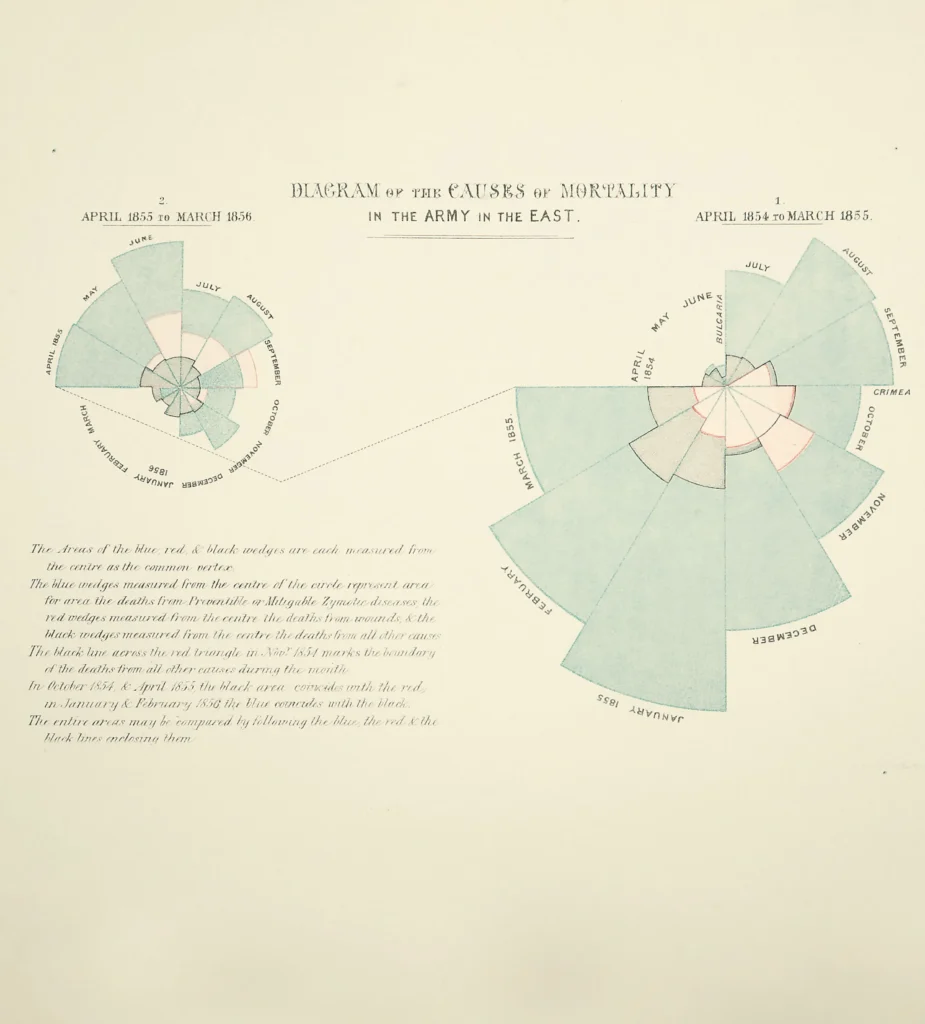
The diagram showed that many soldiers were not dying from battle wounds, but from preventable disease. She was able to convince everybody, and because of this, the case for sanitary reform became a central focus.
What she did at the time was obviously important. But the way she went about it carries its usefulness into our everyday lives, more than we might think.
We usually assume that if something rings true, and is important, we just have to say it to as many people as possible, and as many times as possible, and they will eventually be convinced.
But this is hardly the case…
Saying things louder, for a longer time, more often, and with more urgency does not always make them more convincing.
So what’s the problem here? What did Nightingale do differently?
She understood that repetition does not equal good communication.
Because people are not “all ears” all the time, for everything you throw at them.
Even if an idea is true and valuable and potentially helpful to the receiver, being able to convince the other person depends on so many factors like mood, timing, trust, examples, memory, status, and the form in which the idea is being communicated.
So how do we move through all this noise and make people convince on important matters?
The Structure phase
One useful way to think about this is that every message has its own carrier.
Let’s say someone is trying to give a warning. Depending on how it’s said, it can be seen as a command, a story, recognition, or even as a joke. It just has to be delivered in the correct way to get the type of response you are hoping for.
And there is some real science behind this.
Repetition can obviously make a statement more familiar, because we are hearing it over and over again. But familiarity is not the same as “understanding.”
But if you wrap your statement around a story, or something that gives it a meaning, it gives the other person something to relate to. And now, unlike before, they are ready to listen to you.
The doors are now open for a real conversation.

In psychology, this is called as perspective-taking: we understand an idea differently when we can imagine the situation, the pressure that comes with it, or experience behind it.
If you think about a regular day in life, the importance of having the right carrier becomes so obvious.
For example, in a meeting, someone would say, “We need to prioritize this.” Everyone nods. But, more often than not, nothing much changes over time.
We nod because it’s true. But the urgency, or the cost of not doing it, may not have been properly carried into the table.
Or during a personal conversation, someone says, “You need to take care of yourself.” Could be true. But what if the conversation goes like this:
“I’ve noticed you seem exhausted every Sunday night.”
This small observation helps the other person feel seen and opens them up.
The truth is more effectively received when it has been delivered in a form the other person can actually relate to.
In other words, a useful truth should not be just said. It should be delivered.
The Interface
It’s quite common to hear these days that “people don’t want to hear the truth”.
Maybe we are wrong about this.
Maybe, like Nightingale understood, the truth just needs a better carrier.
Where in your life are you repeating something that you are sure to be true, but it keeps falling short at other people’s ears?