
One-line takeaway
Even a little possibility of something terrible happening is still a possibility, and when lives are at risk, it should never be ignored.
At a glance
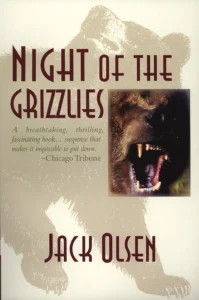
Night of the Grizzlies by Jack Olsen narrates the extraordinary events of two grizzly bear attacks in Glacier National Park on the night of August 12–13, 1967, both happening hours apart. The story then follows the emergency response and the aftermath to explain what caused such a rare and tragic incident.
Quick Facts
- Time period: overnight, August 12–13, 1967, Glacier National Park, Montana
- Key locations: Granite Park Chalet area and Trout Lake, both within Glacier National Park
- Core incident: two fatal grizzly attacks, miles apart, on the same night, triggering an immediate emergency response
- What the book is about: the events building up to the attacks, showing the breadcrumbs to why this unusual and tragic incident happened, and the aftermath
- Publication: first published in 1969 by Homestead Publishing
Table of Contents
What is the book about?
A summer season sets the trap (Glacier National Park, 1967)
The book centers on Glacier National Park in northwest Montana during the peak 1967 visitor season, when food and garbage around the lodges and campsites were left unmanaged and out in the open. This started to draw bears, especially grizzlies, into areas heavily frequented by humans.
In the first third of the book, Olsen paints a portrait of grizzly bears, noting that, in general, they’re harmless as long as they aren’t provoked or given a reason to associate humans with food.
The bear is called grizzly because his silvery white-tipped fur looked, to the early explorers who named him, like the gray in an old man’s hair. Webster still defines “grizzled” as “sprinkled or streaked with gray,” although the word seldom is used nowadays (p. 20).
But there was an outlier. A skinny, brownish grizzly with a peculiarly long, thin head had been seen frequently around Granite Park Chalet and Trout Lake, and among those visits, the sightings of this particular bear had grown increasingly frequent by August 1967.
“I don’t claim to be an authority on bears,” Teet Hammond spoke up, “but I’ll tell you one thing for sure. That bear wasn’t acting right. No, sir, that was no normal bear.” (p. 44).
Storms, terrain, and habituated bears (August 1967, Montana)
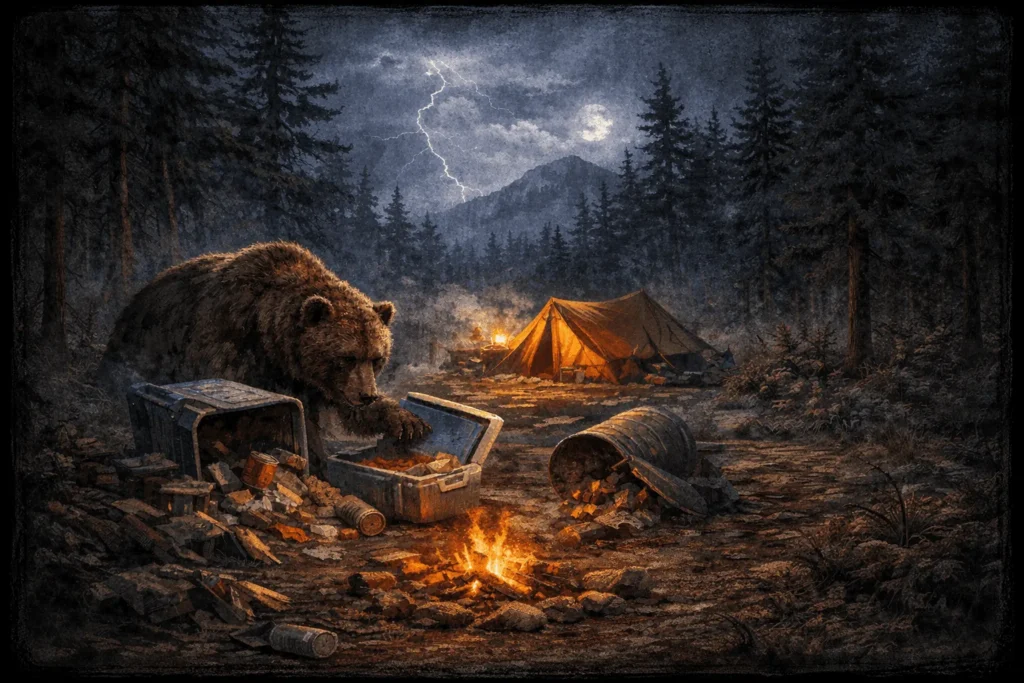
On August 12–13, there was a lightning storm and overnight rain in the national park. While all this was happening, many people noticed a bear moving through several campsites, stealing food, and sometimes walking really close to where people were sleeping. It was the same grizzly that had been stealing food for weeks on end.
By this point, it was obvious the bear was a potential threat. Some people contacted the park rangers to report it, but the response was dismissive. The rangers said they were busy with fires and would see what could be done.
The rangers at headquarters told him that they were busy with fires, but they would see what could be done. Ruder left to peddle his papers elsewhere, but he could not rid himself of the fear that any day now, there would be trouble (p. 91).
Two separate camps get attacked (night of Aug 12–13)
And there came the tipping point.
Near Granite Park Chalet, in the early hours of August 13, 1967, the same bear appeared again. This time, it was far more aggressive, aggressive enough to drag a young woman out of her sleeping bag and disappear into the forest. The attack triggered an improvised rescue operation deep in the backcountry.
Hours later, miles away at Trout Lake, there was another attack.
The same bear dragged another young woman, still in her sleeping bag, into the darkness. Two attacks, two locations, one night, is unheard of. It was an extraordinarily rare double tragedy for the national park.
The turning point: the park responds with force (Aug 13–14)
Now that the attacks had happened, park managers were scrambling to find the bear and prevent further attacks. They ordered an armed hunt to track down the bear. During the operation, multiple bears were shot, and eventually, they caught up to the one responsible for the attacks the night before.
But the damage was already done. Two lives were lost.
What had started as a nuisance bear stealing food had now turned into an institutional crisis.
Finding answers
There was no prior evidence of such a bear attack in Glacier National Park, so multiple theories were brought up about what actually happened and why it ended in such a devastating fashion.
First of all, why not one but two attacks, on the same night, and just miles apart?
What the book does best is show everything that led up to the attacks, weaving it into one coherent narrative so the reader can understand the slow collision that took place between nature and human carelessness.
The final section then covers the aftermath, tracing how the tragedy reshaped the rules and practices around food storage and waste management in national parks across the country.
Key ideas & takeaways
The grizzly man
This story strongly reminds me of the documentary Grizzly Man (2005), directed by Werner Herzog, which tracks the life and death of Timothy Treadwell, a bear enthusiast who spent 13 summers living among grizzlies in Alaska’s Katmai National Park before being killed by one in 2003. The bear responsible for Treadwell’s death was described as a scrawny, older male, strikingly similar to the bear in this story, and both stories ended with the loss of human lives and the death of the bear.
The probability is never zero.
The story raises a sobering point. Even a little possibility of something terrible happening is still a possibility, and when lives are at risk, it should never be ignored.
There were many moments in this story where park management was alerted to the unusual behavior of a food-conditioned bear, but no action was taken. A grizzly bear attack on a human was seen as something that simply didn’t happen. And statistically, that’s not entirely wrong. Grizzly attacks are genuinely rare. On average, only two to three people are killed by grizzlies in all of North America each year, and the odds of being attacked are roughly 1 in 2.1 million. The park’s assumption wasn’t irrational.
But that small probability wasn’t zero. And ignoring it cost two people their lives.
That is the point that the book is trying to make. It wasn’t just a bear attack, but rather a chain of dismissals, each one reasonable on its own, that together made into a tragedy.
If facts were rare, theories were cheap.
The most striking quote came right at the end of the book:
“If facts were rare, theories were cheap, and the news wires hummed with them” (p. 196).
Two young women, in separate parts of the park, were killed by grizzlies within hours of each other. It was unheard of.
And in the absence of prior evidence, people started throwing out wild theories, because someone had to be responsible. When something terrible happens, and the truth isn’t immediately clear, the accusations spread fast and wide.
Was it the campsite food storage? Were the bears habituated to human garbage? Was it the fault of park management? Was it just bad luck?
The book shows that it was a combination of all of these, a combination of factors that should have been taken seriously before anything happened.
Highlights
Based on estimates made by those few who have been able to clock the animal over measured distances, the big bear would beat the world’s fastest humans by 30 or 35 yards in the 100-yard dash, and by a third to a half mile in the mile run. In forest terms, this means that a grizzly on a ridge 300 yards away can be at one’s side in twenty seconds if he chooses to be. Fortunately, not one grizzly in 10,000 chooses to be (p. 21).
The bear’s agility amazed Dr. Lindan. “It moved with terrific speed and grace,” he told friends later. “So smooth! At the zoo, you have the impression that they are sluggish and slow, but the speed at which that bear as it moved up and down was absolutely amazing. After it had fed, it ran like a kitten into the trees, and I remember saying to myself, ’My God, there is no way to escape a beast like that.’ It was remarkable.” (p. 105).
Aside from their miscalculations about what the grizzly would and would not do, there was another reason why the dedicated and sincere rangers of Glacier National Park failed to take action when action was so clearly demanded. F. Scott Fitzgerald said, “Show me a hero and I will write you a tragedy.” To the men in the green uniforms of the National Park Service, the grizzly was a hero, the subconscious symbol of the vanishing frontier, the last of the big, footloose omnivores of the American West. Such heroes carry within themselves the stuff of tragedy; people break rules for them, make concessions to them, turn the other cheek to them, until sometimes the heroes wind up destroying themselves. Grizzlies had never killed in the park; therefore they never would kill in the park. It was easy for the rangers to accept such a proposition, especially since it coincided with their inner tendency to think only the grandest thoughts about the heroic grizzly. Generations of naturalists have felt and acted the same (p. 202).
Should you read it?
Read this if you:
- want to understand how a series of small, overlooked decisions can build into a tragedy
- are curious about the real relationship between grizzly bears and human encroachment in national parks
- find yourself drawn to true stories where the environment, human error, and institutional failure all collide with each other
- like narrative nonfiction stories
- are interested in how wildlife management policy in the U.S. was shaped by a single catastrophic night
You should note the source of the book published by Homestead Publishing.
https://www.homesteadpublishing.net/collections/wildlife/products/35-night-of-the-grizzlies
I appreciate you pointing this out. Homestead Publishing has now been added as the source/publisher in the post.