
One-line takeaway
The sooner you begin writing, the sooner your brain will begin processing the story.
What is Storycraft: The Complete Guide to Writing Narrative Nonfiction about?
Storycraft is one of the most complete nonfiction writing guides I’ve come across. It’s a comprehensive guide to structuring a story, setting scenes, developing themes, building action, and writing the best story that could be written.
Key ideas and takeaways
The story arc
Hart argues that good writers do not overdo exposition by dumping all the background information about the characters. Doing so delays the story. If it’s too long, at the end of it, there will be little interest left for the reader to continue through the story.
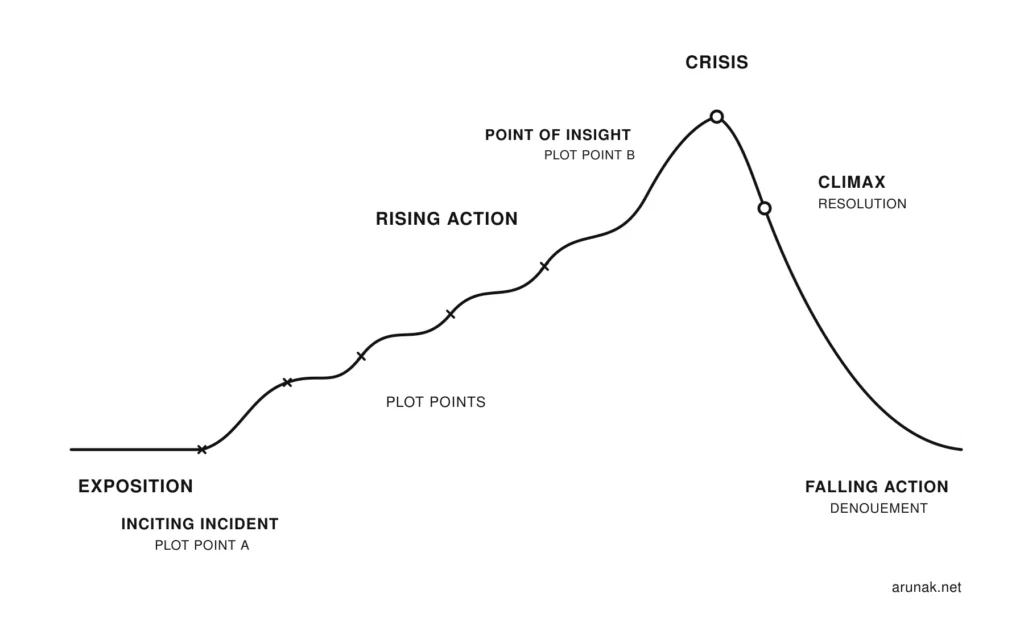
Seen this way, Hart points out that exposition is the enemy of narrative.
But the reader should know the background somehow.
That begs the question: what is the most effective way to introduce it? And where?
The most effective thing to do is to spread it over the story.
For example, to grab the reader, a writer can first start with what Hart calls an “inciting incident”, where something unexpected happens. We as readers do not know anything about the characters yet. But this incident that happens to them is so interesting that our curiosity naturally drives us to read more and more.
And then later, the writer can introduce a Plot Point B between the rising action and the crisis, where he explains who this character is and why the inciting incident happened to them.
The overall lesson I take from this section is that different stories need different sequences of these narrative elements.
A skilled writer would look at the whole story and see what should come first: crisis or exposition? Should he write it in chronological order, or should he write it out of sequence?
It all depends on the type of story the writer has in hand.
Each development in skillfully crafted rising action raises a question. Philip Gerard notes that dramatic story structure consists of “a string of mysteries organized in a deliberate order. The mysteries will be large and small, and the writer will make good use of this variation in interest, resolving the mysteries in escalating order, using smaller questions to lead into larger ones, saving the resolution of the biggest mystery for last.”
Point of view
Point of view boils down to the answers to three questions:
- Through whose eyes do we experience the story?
- From which direction?
- From what distance?
I find the way Hart answers the third question intriguing, and all the more interesting.
The “distance” is best understood by comparing it to how a photographer or cinematographer would set a scene.
For example, Hart explains the need for different kinds of narratives at different distances. If the distance is greater, where we observe the scene from a distance, the writer should adopt a “summary narrative”. But when the distance shrinks, when you are right there with the characters, the writer should adopt a “scenic narrative”.
This is very much like shooting with a camera with a long focal length (summary narrative) versus shooting with a short focal length (scenic narrative).
A good example for summary narrative, then, is wildlife photography, where we observe the subject from a distance, typically with an 80–200 mm focal length.
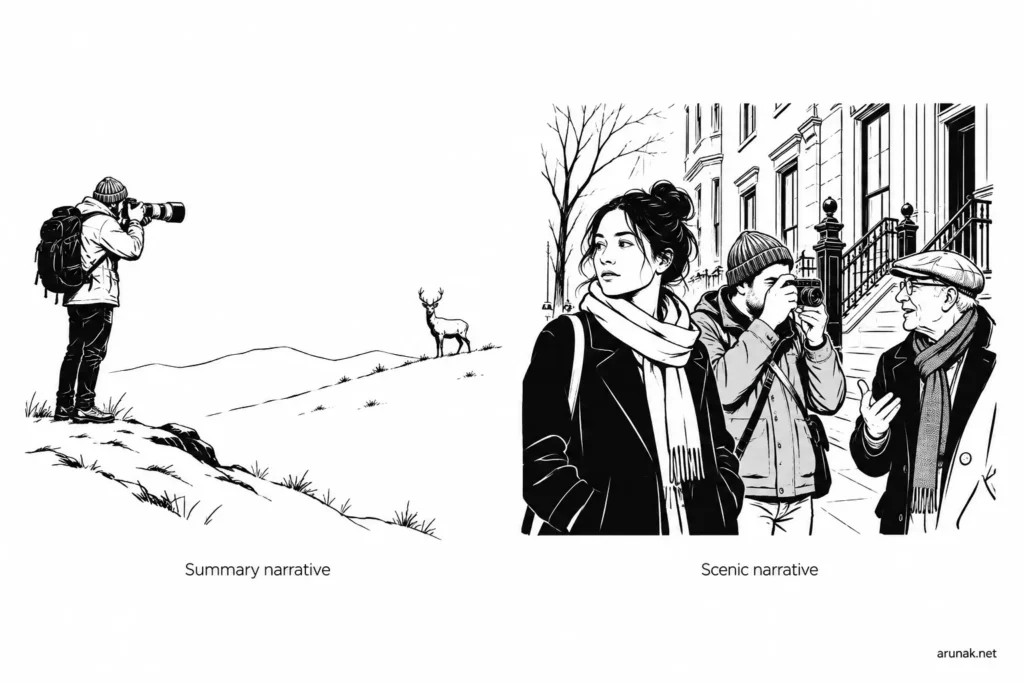
And a good example for scenic narrative would be old-fashioned New York street photography, where the focal length is almost always 35 mm.
The short focal length lets you feel like you’re in the scene with the characters.
I find this a convenient way to think about writing nonfiction narratives: it helps me imagine that I’m in the field with the right lens to capture the perfect scene.
Voice
Every writer has their own unique voice. Hart’s advice is to first embrace this fact, and then find ways to adapt it to the occasion.
But to be able to do this, first, we need to recognise it.
One way to do this is to read your writing out loud. Not only does it help you recognise your own voice, but it also helps you identify and refine the bits that don’t really work.
Many great writers do this.
For example, Mark Twain used to read his work to his family to see their reactions before publishing his books.
Hart, too, admits that he does this quite often.
When I finish the last line of this chapter draft, I’ll go back to the beginning and start reading in a firm, clear voice. I’ll hear the false notes, and I’ll make dozens of changes
Action
Writing, unlike radio, television or online graphics, is fundamentally a dry medium.
It’s just a bunch of words on paper.
What gives life to the characters that exist only on paper is action.
Throughout the narrative arc, action should ebb and flow. It pumps blood into the otherwise lifeless prose.
“Each scene will have a climax,” says narrative literary agent Peter Rubie, “and one definition of pace is how rapidly a narrative moves from climactic point to climactic point.”
“Intensity,” Jon Franklin says, “is a measure of how closely the storyteller focuses his narrative camera on the story’s participants and scenery.”
For the great majority of narrative, your aim as a storyteller is to put readers into a scene where they can experience the action as though they were there witnessing it themselves.
Theme
Theme is what a story reveals about human nature.1
So getting it right, and sticking to it, is one of the most important tasks, if not the most important, in the entire arena of nonfiction writing.
Hart argues that themes revolve around a handful of subjects, for example: struggles for power, romance and food.
Looking further, I came across one of Hart’s articles on theme: “Nut grafs: Getting to the heart of the story”.
In this article, he explains his method of setting up a theme for a nonfiction piece.
He writes:
The first word that goes on my screen is “Theme.” “Next comes the noun that serves as the subject of the theme statement. That’s followed by a verb – preferably transitive because that shows causality, which makes a statement about the nature of reality. And finally an object, which shows how something makes an impact on the world.
Favourite quote from the book
Civilization is a stream with banks. The stream is sometimes filled with blood from people killing, stealing, shouting, and doing the things historians usually record; while on the banks, unnoticed, people build homes, make love, raise children, sing songs, write poetry, and even whittle statues. The story of civilization is the story of what happens on the banks. Historians are pessimists because they ignore the banks for the river.
- Steven Pinker, The Sense of Style: The Thinking Person’s Guide to Writing in the 21st Century (New York: Viking, 2014). ↩︎