
One-line takeaway
A story about a little-known president and how a bullet, combined with poor medical treatment, cut short his time in office.
At a glance
The Destiny of the Republic by Candice Millard is a narrative history of James A. Garfield’s rise from poverty to the presidency, followed by his assassination, which tragically cut short his time in office.
The book also builds out the larger political ordeal and the painfully long medical disaster that unfolded around Garfield’s story.
It ends with Garfield’s death, assassination trial, and the settling of Garfield’s place in public memory.
Table of Contents
Summary
An unlikely president is pulled out of the crowd
James A. Garfield is an unlikely central figure, a self-made son of an impoverished Ohio farm who rises from a log cabin to the presidency.
He starts from almost nothing and moves through poverty and loss by force of relentless self-education, becoming one of the most intellectually gifted figures in American politics. He had been a teacher of languages and mathematics, a college president, a Civil War general, and a congressman, and he saw modern knowledge as a moral force.
As Garfield writes:
“The scientific spirit has cast out the Demons and presented us with Nature, clothed in her right mind and living under the reign of law.”
With that kind of mind and seriousness, he rises through the Republican Party and into the center of national politics. But luck plays its part too.
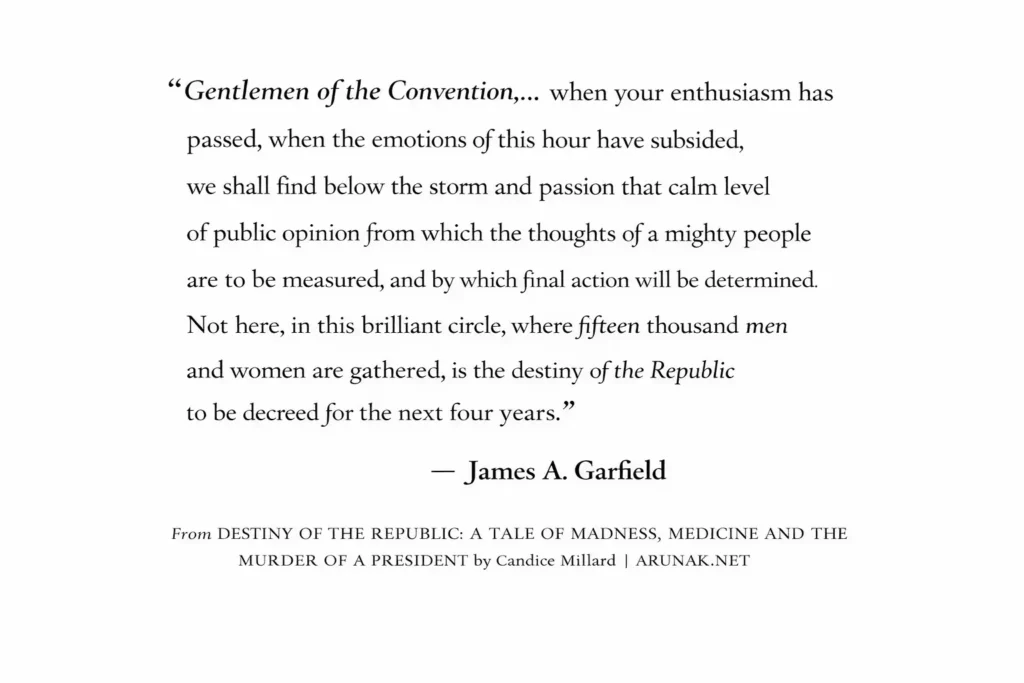
At the Republican convention in Chicago in 1880, Garfield addresses the crowd not as a presidential contender, but in support of fellow Ohioan and former congressional colleague John Sherman. But during the speech, the crowd can’t ignore Garfield’s command of the room and his extraordinary gift for public speaking, and the momentum begins to shift toward him. This is, of course, not what Garfield intended. But events move too quickly, and the surge toward Garfield becomes too strong for even him to stop.
When the telegram was received, Garfield frantically shouted, “Cast my vote for Sherman!” But it was too late. He could not stop what was happening. The last state was called, and Garfield was left with 399 votes, 20 more than were needed to win. Having never agreed to become even a candidate—on the contrary, having vigorously resisted it—he was suddenly the nominee (p. 59).
But by then it is too late. Delegates who had come to Chicago for other men are now rallying around Garfield. Frederick Douglass also throws his support behind him, in part because Garfield had long defended Black civil and voting rights. And just like that, the fate of this self-made, eloquent, reform-minded Republican is sealed.
On November 2, 1880, Garfield wins the election, and on March 4, 1881, he becomes the twentieth president of the United States.
In 1880, no commission threatened to steal the presidency, but so close was the race that there was uncertainty until the final hours. At 3: 00 a.m. on the morning of November 3, with the nation still anxiously waiting to learn who its next president would be, Garfield went to bed. When he woke up a few hours later and was told in no uncertain terms that he had won the election and was to be the twentieth president of the United States, he was, one reporter noted with astonishment, the “coolest man in the room.” Later that day, Garfield gave his election to the presidency little more mention in his diary than he had the progress of his oat crop a few weeks earlier. “The news of 3 a.m.,” he wrote, “is fully justified by the morning papers.” (p. 82).
The other side of the coin
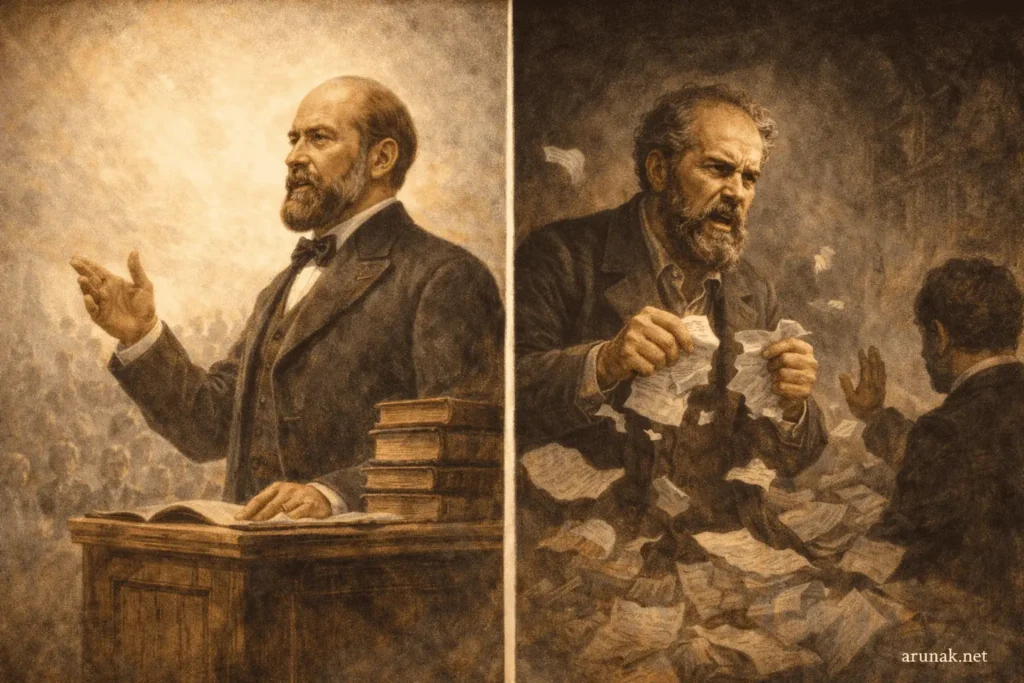
In parallel with Garfield’s rise, Millard also builds out the figure of the man who will kill him: Charles Guiteau, a failed lawyer, preacher, drifter, and office seeker.
Garfield and Guiteau are, in temperament and trajectory, complete opposites. Garfield turns discipline into achievement. Guiteau turns failure into grievance. Garfield’s classmates remember in him “a great desire and settled purpose to conquer.” Guiteau, by contrast, drifts through schemes, debts, religious delusions, and humiliations.
He fails as a lawyer, a lecturer, a preacher, and almost everything else he touches. But he refuses to accept his own failure.
Instead, he imposes on himself the idea that he has been neglected, that recognition and reward were somehow owed to him. And when Garfield refuses to grant him the consulship he believes he deserves, that grievance begins to harden into rage.
The presidency comes under pressure, but Garfield remains calm and himself
On inauguration day, March 4, 1881, Garfield is already surrounded by factional warfare, office seekers, and the machinery of patronage. Just before taking office, he lays down the final draft of his inaugural address and prepares to say “good-by to the freedom of private life.”
But Garfield is not one to give up. Even though he had landed in the most important office in the country almost by accident, he wants to prove himself equal to it.
Millard shows that even at such a volatile moment, Garfield stays unusually steady. He had already been described during the election as the “coolest man in the room”
At the same time, the White House begins to feel like a place under siege. At the start of a presidency, the pressure, demands, and threats surrounding the office only grow more relentless.
But Garfield stays stubbornly rational. He says:
Garfield, unwilling to forfeit any more of his liberty than he had already lost to political enemies and office seekers, could not have agreed more. “Assassination can no more be guarded against than death by lightning,” he wrote, “and it is best not to worry about either.” (p. 113).
Guiteau turns his resentment into a bitter mission
But unbeknownst to him, that fear, that violent possibility, was slowly becoming a reality behind the scenes.
By late spring 1881, Guiteau had irrationally convinced himself that he had helped elect Garfield and therefore deserved a consulship, especially the post in Paris. Rebuffed again and again, he begins to reinterpret this rejection as an act of personal betrayal.
Millard captures perfectly how Guiteau’s mind had begun to curdle, and how that private distortion finally hardens into action.
By the end of May, Guiteau had given himself up entirely to his new obsession. Alone in his room, with nowhere to go and no one to talk to, he pored over newspaper accounts of the battle between Conkling and the White House, fixating on any criticism of Garfield, real or implied. “I kept reading the papers and kept being impressed,” he remembered, “and the idea kept bearing and bearing and bearing down upon me.” Finally, on June 1, thoroughly convinced of “the divinity of the inspiration,” he made up his mind. He would kill the president (p. 144).
This line of thinking was not political or principled in any real sense.
It was simply his private delusion wrapped in public language.
After buying a pistol, he further fed his mind with signs, justifications, and imagined confirmations that seemed to support his delusional standpoint.
“The Lord inspired me to attempt to remove the President in preference to some one else, because I had the brains and the nerve to do the work,” he would explain. “The Lord always employs the best material to do His work.” (p. 148).
The book gives Guiteau just enough space for the reader to understand the kind of distortion that led him to this point. He is not a mastermind planning the perfect crime, but rather an unstable, theatrical man who has become completely detached from reality.
Guiteau strikes, and the doctors take over
The day had finally come for Guiteau.
On July 2, 1881, Garfield arrives at the Baltimore and Potomac Railroad Station in Washington with James G. Blaine at his side. Before entering the waiting room, Garfield pauses, smiles, tips his hat, and walks inside.
Then Guiteau takes his chance and fires two shots.
He nearly misses.
But the president is left wounded. One bullet grazes his arm, and the other enters his back and lodges behind his pancreas.
Guiteau is immediately taken away.
But these wounds were not fatal on the spot, at least not yet.
What follows is the real catastrophe.
As Garfield lies in the station, doctors begin probing the wound with unsterilized fingers and medical instruments, turning the medical response into something more dangerous than the gunshot itself. One physician in particular pushes a finger into the wound on the filthy station floor, introducing what ultimately becomes the deadlier threat: infection.
Had Garfield been shot just fifteen years later, the bullet in his back would have been quickly found by X-ray images, and the wound treated with antiseptic surgery. He might have been back on his feet within weeks. Had he been able to receive modern medical care, he likely would have spent no more than a few nights in the hospital. Even had Garfield simply been left alone, he almost certainly would have survived. Lodged as it was in the fatty tissue below and behind his pancreas, the bullet itself was no continuing danger to the president. “Nature did all she could to restore him to health,” a surgeon would write just a few years later. “She caused a capsule of thick, strong, fibrous tissue to be formed around the bullet, completely walling it off from the rest of the body, and rendering it entirely harmless.” (p. 187).
The long dying of a president becomes a national reckoning
Through the summer of 1881, Garfield endures extraordinary pain with patience, humor, and kindness. His doctors call him a “wonderfully patient sufferer,” and even late in the ordeal, he remains more curious than bitter about the lack of progress in his treatment.
Lucretia Garfield becomes one of the book’s emotional centers in these final chapters. Under intense public scrutiny, she carries herself with discipline and tenderness, and the country begins to sympathize with her almost as much as with the president.
Meanwhile, Garfield slowly comes to realize that there may be no happy ending to this ordeal. He begins to wonder whether his short presidency will leave any mark at all:
The president could not help but wonder, however, if, after such a brief presidency, he would leave behind any lasting legacy. “Do you think my name will have a place in human history?” he asked Rockwell one night. “Yes,” his friend replied, “a grand one, but a grander place in human hearts.” (p. 276).
After a harrowing period of pain, and in no small part because of failed medical treatment, Garfield finally succumbs on September 19, 1881.
And the autopsy confirms what had led to the disastrous treatment all along: the bullet had taken a different path through the body than the doctors believed, so much of what they had done was aimed in the wrong direction.
One of the examining physicians finally puts it into words and says plainly what the book has been building toward all along: “Gentlemen, this was the fatal wound. We made a mistake.”
The finger “slipped entirely through the one vertebra pierced by the bullet,” Brown would later recall. Dropping his hand, Agnew turned to the men standing around him and said, “Gentlemen, this was the fatal wound. We made a mistake.” Without another word, he left the room (p. 282).
The verdict and the legacy
After Garfield’s death, Chester A. Arthur is sworn in during the early hours of September 20, 1881, and Guiteau faces trial.
The courtroom becomes the final stage for his delusional mind, as he tries to separate the shooting from the killing, and in doing so, exposes the broken logic of his defense.
A few days later, Guiteau would himself announce his argument to the courtroom, interrupting a witness who was describing the scene at the train station when Garfield was shot. “I deny the killing, if your honor please,” he said. “We admit the shooting.” (p. 290).
The more Guiteau spoke, the more apparent his insanity became. He was highly intelligent and surprisingly articulate, but his mind did not work like that of a sane man (p. 291).
But Millard also makes clear that while Guiteau fired the shots, the doctors turned a survivable wound into a fatal ordeal.
The medical failure is not an incidental tangent in this story. Millard makes it one of the governing facts of the whole book.
The story closes with Garfield’s afterlife in public memory, not just as a murdered president, but as a man of unusual intellect, gentleness, and moral prowess.
Key ideas & takeaways
Parallel storytelling at its best
Alongside the main story of President Garfield and Charles Guiteau, there are two other storylines running through the book that quietly deepen and widen it.
They are:
Frederick Douglass, who helps Millard show that Garfield was even bigger than just a president. He matters to the story because his support makes clear that Garfield was not just another Republican politician, but a man in whom Black Americans could still place some hope in the unfinished promise of Reconstruction.
Alexander Graham Bell, who brings the book’s medical tragedy into even sharper focus. He is important to the story because his failed attempt to locate the bullet shows that the tools of a more modern future were already there, but they have not been refined well enough yet.
The writing style
I’d read Candice Millard’s debut nonfiction book, The River of Doubt, a couple of months back, and immediately came to admire her writing style.
I find that style very close to what is described in Clear and Simple as the Truth, where the author does not draw attention to the prose itself.
And now, reading this, I can see that she follows the same standard here, too, six years later.
But now I also get the sense that her writing has become more fully her own, a little more unconstrained by convention, as if she is no longer simply writing well, but carving out a style that feels more personal.
Garfield, equality, and the Black vote
Garfield was not simply sympathetic to Black Americans in the abstract, just to get a vote. He saw the country as still unfinished business, particularly on the question that mattered most after the Civil War: whether Black citizens would actually enjoy the same protection, rights, and standing before the law as white citizens. That concern runs through his politics, and Millard makes clear that this was not a decorative belief on his part. Garfield wanted the promises of Reconstruction to hold, not collapse under exhaustion, compromise, and political convenience.
He did not treat Black civil rights as a side issue to be mentioned to get votes and then abandoned right after the election. He kept returning to the same moral and political point: the war had to mean something in the lives of the people it had supposedly freed. Even during the 1880 campaign, in the one major speech he gave as a presidential candidate, he put the fate of Black Americans in the South near the center of his argument.
“This is our only revenge—that you join us in lifting into the serene firmament of the Constitution … the immortal principles of truth and justice: that all men, white or black, shall be free, and shall stand equal before the law.” (p. 54).
That helps explain why Frederick Douglass supported him so openly. Garfield had built a reputation, over the years, as someone who was right on the central questions of freedom, equality before the law, and Black citizenship. This trust did not make him president by itself, but in a close election, it gave his candidacy something very rare in the political arena, that is, real credibility with Black leaders and Black voters who had every reason to be skeptical.
“The keynote speaker that night, and the cause of all the excitement, was Frederick Douglass. After climbing to the platform, the august former slave, now a human rights leader and marshal of the District of Columbia, wasted no time in telling his audience which presidential candidate would receive his vote. “James A. Garfield must be our President,” he said to riotous cheers. “I know [Garfield], colored man; he is right on our questions, take my word for it. He is a typical American all over. He has shown us how man in the humblest circumstances can grapple with man, rise, and win. He has come from obscurity to fame, and we’ll make him more famous.” (p. 80).
The real heart of the book appears at the very end
Any Candice Millard book is worth reading, and this one was no exception.
So I kept reading to the very last page, all the way to the end of the acknowledgements, which is not something I would normally do.
I’m glad I did, because the final paragraph of that acknowledgement reveals a more personal attachment Millard had to the book’s central idea, namely her gratitude for how far medicine had come.
Finally, over the years I spent writing this book, my family and I have learned firsthand how fortunate we are to live in a time when medical science has advanced in the treatment not just of bullet wounds and infections, but of diseases as mysterious and insidious as cancer. I would like to take this opportunity to express my deepest gratitude to Dr. Gerald Woods, Cathy Burks, Dr. Brian Kushner, Dr. Margaret Smith, Lynn Hathaway, and Dr. Edward Belzer, as well as the many exceptional men and women at Children’s Mercy Hospital in Kansas City and Memorial Sloan-Kettering Cancer Center in New York. From the bottom of this mother’s heart, and on behalf of every member of my family, thank you, thank you, thank you (p. 321).
Being a longtime admirer of her work, I immediately understood what she was pointing to.
As Millard has shared elsewhere, one of her daughters was born with cancer and, fortunately, survived because of the care she received.
That final paragraph made me realize how personal the subject of this book must have been for her in this particular context, and it deepened my respect for what she was trying to do.
Highlights
It was like rowing a boat, Noyes said. If you stay near the shore, you’ll be fine. It’s only when you row too near a waterfall that you find yourself in danger (p. 65).
To a young man who has in himself the magnificent possibilities of life, it is not fitting that he should be permanently commanded. He should be a commander. JAMES A. GARFIELD (p. 85).
Light itself is a great corrective. A thousand wrongs and abuses that are grown in darkness disappear like owls and bats before the light of day. JAMES A. GARFIELD (p. 247).
It was not a defense of his actions, or even an argument for insanity, but an indictment of the men who were, he argued, the president’s true murderers—his doctors (p. 290).
“I fear coming generations of visitors who pass through this grand corridor will see nothing in the stern, sad face of Garfield to remind them that here was a man who loved to play croquet and romp with his boys upon his lawn at Mentor, who read Tennyson and Longfellow at fifty with as much enthusiastic pleasure as at twenty, who walked at evening with his arm around the neck of a friend in affectionate conversation, and whose sweet, sunny, loving nature not even twenty years of political strife could warp.” (p. 301).
How did the book change the way I think?
“Although there were many deaths in the late nineteenth century that even the most skilled physicians could not prevent, Garfield’s was not one of them. In fact, following his autopsy, it became immediately and painfully apparent that, far from preventing or even delaying the president’s death, his doctors very likely caused it.”
So the bullet was just the headline. The treatment is what made the real mess.
In stressful moments, we love clean causes: a single villain or a single event. Something you can point to and say, “That’s what did it.” But Garfield’s story is brutal in such a subtle way. The bullet was survivable, but the treatment was what led to chaos.
I made the idea into a newsletter, which can be found here.
Should you read it?
Read this if you:
- want to understand how James Garfield rose to the presidency and why—even though it was such a short time—his time in office was important for the stability of the country
- are trying to make sense of how one act of violence reshaped American politics, public life, and the civil service altogether
- care about the human side of history and want a political story that is driven by character, ambition, ego, and chance
- want a narrative history that helps you see how medicine, power, and media collided in a national crisis
- are looking for a nonfiction book that can teach you something interesting and important about the United States presidential history without reading like a dry textbook
Coffee chat
What makes Destiny of the Republic stand out from other biographies of the same president?
The writing philosophy.
Candice Millard is a classical American storyteller, a former writer and editor at National Geographic, and an exceptional writer.
Combine all three, and you get something incredibly readable: crisp prose, vivid scenes, and drama that never feels forced.
Her writing is some of the most selfless I’ve seen in narrative nonfiction. Neither the prose nor the author gets in the way of the truth, which is a real treat.
So what makes this book stand out is not just the story it tells, but the rare clarity and restraint with which Millard tells it.
Was James Garfield really killed by the bullet or by the doctors, in Destiny of the Republic?
The bullet began the crisis, but the poor medical treatment is what turned it fatal.
Doctors repeatedly probed the wound without antiseptic technique, which eventually led to infection.
And the lack of proper methods for tracing the bullet’s path was also a key part of the disaster, because the doctors kept treating the wrong internal trajectory.
How historically accurate is Destiny of the Republic as a work of narrative nonfiction?
Very accurate.
Candice Millard is not just a good writer. She is also a former editor at National Geographic, which helps explain the book’s journalistic discipline as well as its readability.
This book feels meticulously researched, drawing from library archives, letters, newspapers, medical records, and presidential papers.
At the end of the book, Millard also thanks Garfield’s descendants, which gives you a sense of how seriously she worked through both the public record and the human side of the story.
Is Destiny of the Republic worth reading if I do not usually read presidential history?
Yes, because this is not just a book about presidential history, and it certainly does not read like one.
Rather, it is a blend of biography, political intrigue, and medical disaster, all fused into one remarkably gripping narrative.
So, you do not need to be a history buff to get pulled into this story.
