
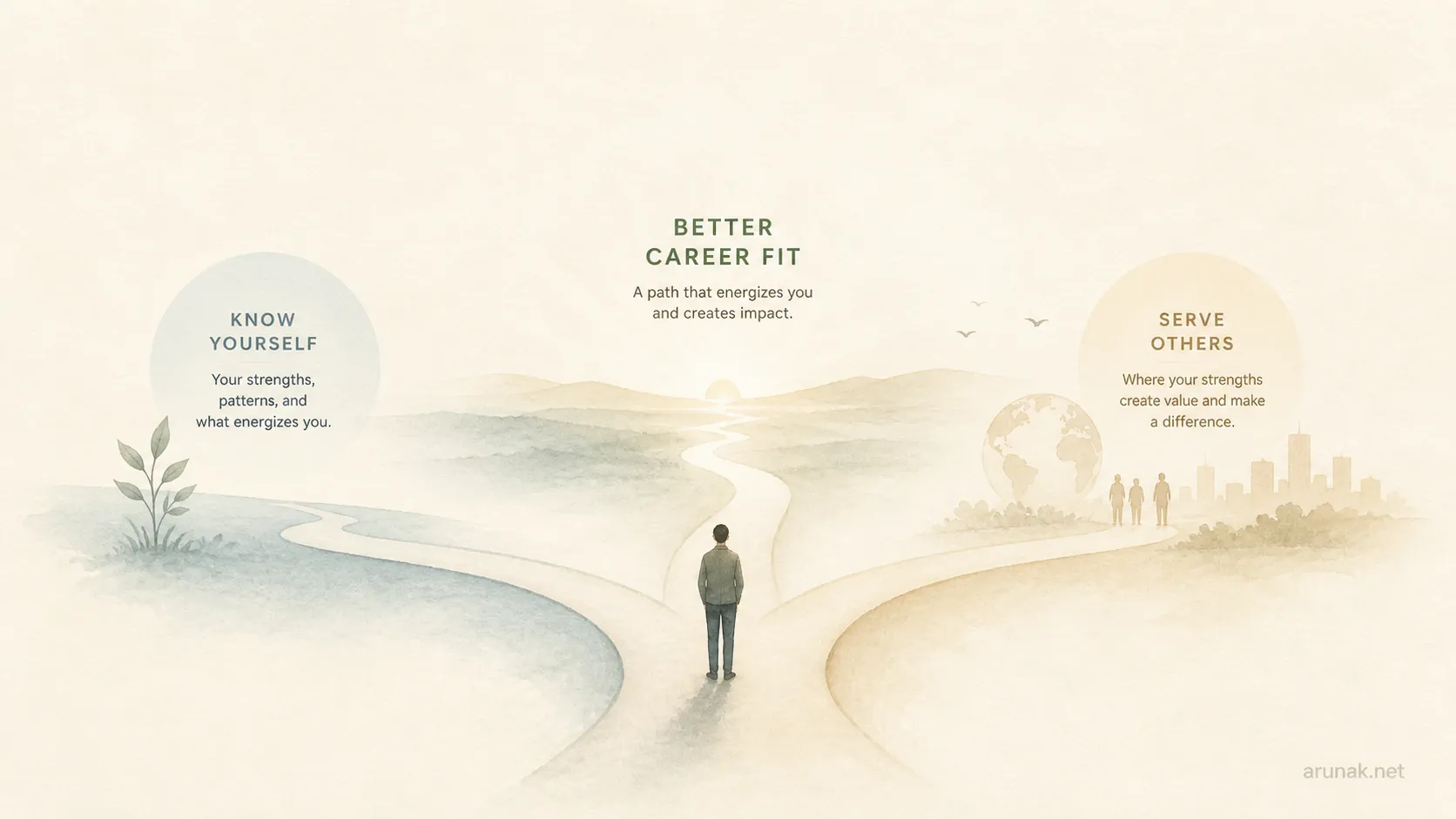
The conventional approach to finding a job has almost always been an outside-in process.
It begins with the job title, then moves to salary, prestige, current trends, qualifications, and what other people seem to be doing.
More often than not, this approach does not lead someone into a well-fit career.
So, people try to approach this by going in the other direction. They begin with passion. This feels more personal than starting with an available job title. It sounds liberating, even ambitious. This is the inside-out approach.
But this approach has limits too, because passion is difficult to quantify. It does not make much sense to walk into an interview and say, “I’m really passionate about this,” and expect that to be enough. What gets you the offer letter is usually something more concrete and quantifiable: your strengths, your skills, your judgment, your experience, and your ability to create value in a way other people can make use of it.
This is why learning how to find your core strengths for your career is a more effective starting point than merely aiming for a job title, cramming relevant keywords into your CV, or placing all your hopes on the intensity of a passion.
Having said that, core strengths do not guarantee you a job, but still, they give you a better starting point for looking for a career that fits your personality.
Understanding your core strengths helps you see your real edge in the world: the patterns in how you perform better at work, what you learn unusually quickly, what comes more naturally to you, what kind of work fills you with energy, what kind of work drains it, and where your abilities become useful to other people.
Core strengths are a more refined first step in the search for a better career fit.
So how do you actually find them?
That is what this post is about.
Table of Contents
The wrong first question
When looking for a new career or when shifting careers, we often ask ourselves: What career should I choose?
It sounds like a reasonable question. But it is better placed somewhere in the middle of a longer sequence of questions. It should come after you have gathered a clearer sense of who you are and what you’re capable of doing.
Why?
Because that first question pushes you toward a job title before you understand yourself. It makes you compare finished versions of other people’s careers with your unfinished sense of yourself. It also makes the career market look like a menu, as if the main problem is simply choosing the right option.
But often, this is not the case. Or at least, it is only one piece of the puzzle.
A career is shaped by skills, yes, but also by opportunity, timing, family background, geography, money, culture, exposure, luck, status, confidence, and the kinds of people who open doors for you.
This is why two people with similar abilities can end up in very different places. It is also why two people in the same job can experience that job completely differently. One person may feel trapped by the work, while another feels energized by it.
So what is the first question to ask instead?
What kind of work repeatedly brings out my best contribution to other people?
The most important part of this question is that it holds both directions at once: inside-out and outside-in
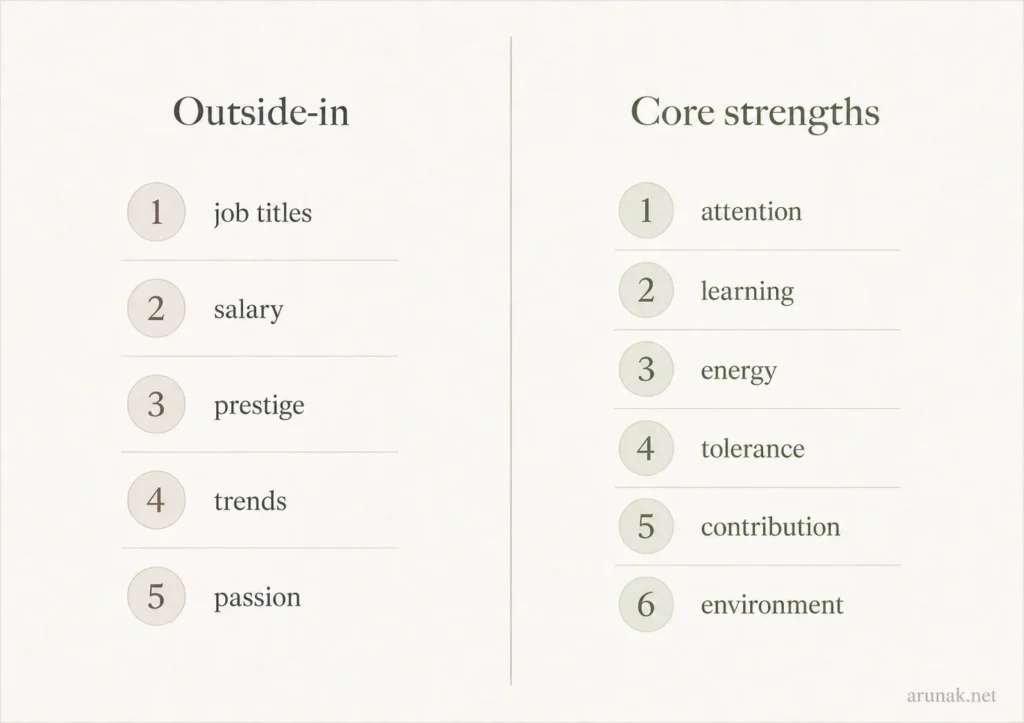
It begins inside out, because it asks what kind of work brings out your strengths. But it also moves outside in, because it asks where those strengths become useful to other people.
That makes it more precise than starting with a job title alone. It is also more grounded than starting with passion alone. A job title gives you a sense of what kind of contribution is needed. Passion gives you a sense of what kind of contribution you can provide.
So the better sequence is:
- Understand your core strengths.
- Notice the forces that govern your available options.
- Test roles, expertise where your strengths can become useful to other people.
- Use feedback to refine the direction.
What are core strengths?
A core strength is not simply something you are good at.
That is too thin a definition for it.
You can be good at something because you had early training, because your school rewarded it, because your workplace needed it, or because you were pushed into it early. You can also be good at something and still find that it drains your energy.
Competence alone does not prove fit.
A core strength has to do more than show ability. It has to reveal a recurring pattern in how you create value.
For that pattern to continue over time, it should have some durability. And this recurrence signals the fact that you like doing whatever you are doing. It cannot be only something you enjoyed once, or something you happened to be praised for in one environment. It should be something that keeps appearing across different situations, different environments, especially when the work is difficult enough to test your patience.
It may show up in the way you notice something important before other people do. It may show up in the way you organize, explain, build, question, connect, improve, or imagine ideas. It usually appears in more than one environment too: school, work, hobbies, ordinary conversations, side projects, friendships, and even the kinds of problems that bother you most.
For example, “writing” is a skill. But the core strength underneath writing may be different for different people.
- One person writes because they are good at persuasion.
- Another writes because they can make complex ideas clear.
- Another writes because they can synthesize scattered information into a usable structure.
The noticeable skill is the same, but the underlying core strength is very different.
One version of writing may make someone a prolific poet. Another may make someone a strong teacher, strategist, or essayist. The skill overlaps, but the underlying pattern of contribution does not.
So the point is that well-fit careers are not built only from skills.
They are built from patterns of contribution.
Skills can be learned, upgraded, transferred, or replaced. But these recurring patterns tell you where your skill-building is most likely to stack up over time.
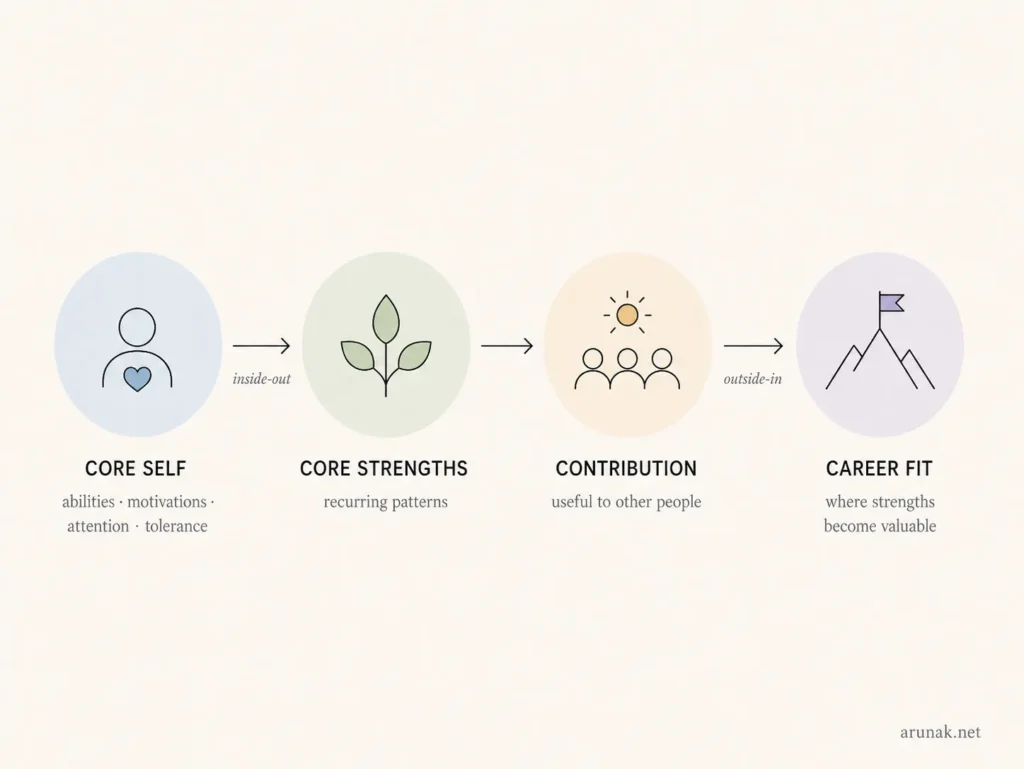
A more systematic way to understand this is to visualize career fit as the alignment between core strengths, which move from the inside out, and contribution, which is recognized from the outside in.
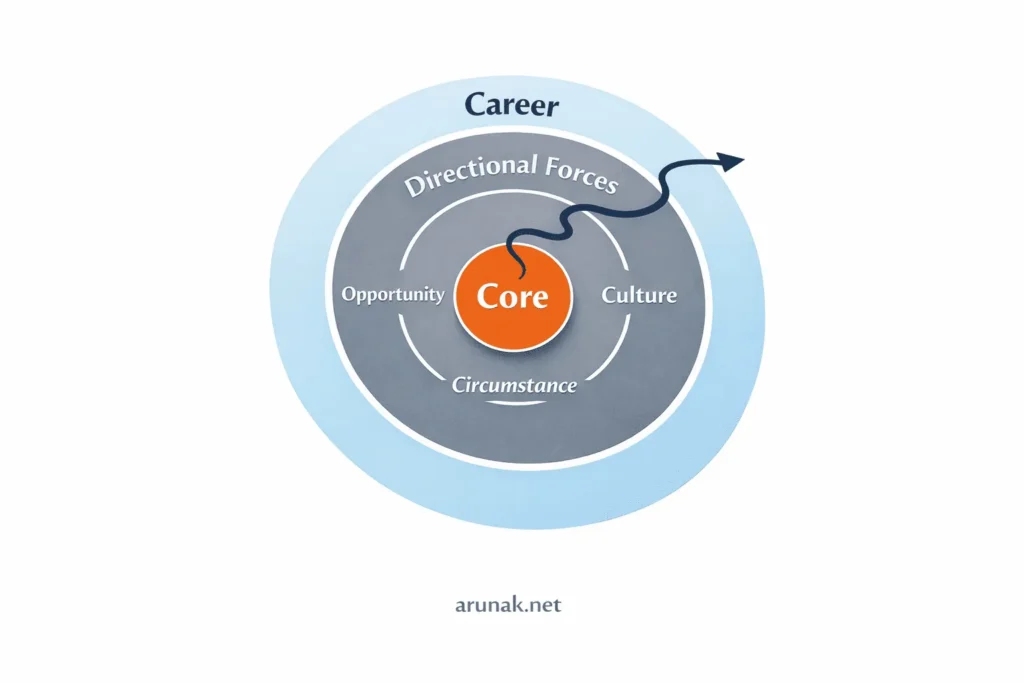
In the figure, the first layer is the core self.
This includes your natural abilities, learned skills, motivations, tolerances, patterns of attention, and the kinds of problems you seem built to notice. But the core self cannot be understood by asking only what someone likes, what they are trained to do, or what job title they like to have.
Whatever you are good at has to align with something that the world would benefit from, and so recognize as valuable.
This is where the best career fit lives: where your inner pattern of strengths becomes useful to other people.
So the question to ask is not simply, What am I good at?
A better question is:
What pattern of skills keeps appearing across different situations in my life in a way that other people find useful?
Research shows that there are often six signs to identify a possible core strength(The O*NET Content Model, Consequences of Individuals, The ‘What’ and ‘Why’ of Goal Pursuits, The Role of Deliberate Practice in the Acquisition of Expert Performance, How to identify your personal strengths).
The first five signs help identify the inner skill pattern:
- Attention: what do you notice before other people do?
- Learning: what do you improve at unusually quickly?
- Energy: what sustains your energy, even when the task itself is significantly hard?
- Tolerance: What difficulty can you bear without being diminished by it?
- Contribution: What abilities of yours other people repeatedly find useful?
The sixth sign, environment, begins to connect the core self to the second layer of the model: directional forces. A strength is never expressed in isolation. It is shaped by context, incentives, culture, opportunity, feedback, timing, and practical constraints. That is why the goal is not to find one perfect job. The goal is to understand where your core strengths are most likely to become noticeable, useful, and durable.
| Sign | Why it belongs | What it protects against |
|---|---|---|
| Attention | Strength often begins with what your mind naturally notices. Some people notice weak arguments, some notice design flaws, some notice emotional tension, some notice economical opportunity. | Confusing career fit with job titles instead of noticing patterns. |
| Learning | A strength should include future potential, not just current ability. Rate of improvement is therefore very important. | Mistaking your current skill level for your long-term skill ceiling. |
| Energy | A strength needs motivational durability. You may be good at something but still feel drained by it. | Building a career around something you can do but cannot sustain. |
| Tolerance | Every career has friction. Fit depends partly on which kind of difficulty you can bear better than others. | Romanticizing work as if the right career will feel easy. |
| Contribution | A career strength must eventually become useful to others. | Turning self-knowledge into private self-expression with no external value. |
| Environment | Strengths are context-sensitive. A strength may appear in one setting and disappear in another. | Thinking “I’m not good at this” when the real issue is the wrong environment. |
Seen this way, this table is really a diagnostic filter. It asks whether a possible strength keeps showing up in several forms:
I frequently notice this kind of problem.
I improve at it quickly.
The work that comes with it gives me energy.
I can tolerate the difficulty of doing it.
Other people find it useful.
It becomes more visible in certain environments.
A possible core strength becomes more credible when it passes several of these tests.
Core strengths are not the same as skills, interests, values, or passion
One reason why career advice gets confusing is that it mixes together several different things.
Skills, interests, values, strengths, and passion are all important. But they are not the same.
| Concept | What it means | Example |
|---|---|---|
| Skill | Something you can do | Writing, coding, teaching, data analysis |
| Interest | Something that attracts your attention | Books, science, business, cities, psychology |
| Value | Something you believe in | Freedom, truth, beauty, usefulness, security |
| Passion | A strong emotional attachment | Loving photography, startups, music, research |
| Core strength | A recurring way you create value in the world | Turning complexity into clear structure |
A skill is a tool; a core strength is the pattern behind how you use that tool well in the real world.
Understanding this distinction is especially important because it is easy to confuse consumption with fit.
You may love reading about architecture, but that does not mean you would enjoy the daily work of being an architect. You may admire entrepreneurs, but that does not mean you would enjoy sales, hiring, uncertainty, or cash-flow pressure. You may love books, but that does not automatically mean you would like the work of publishing, editing, teaching, or writing.
Interest focuses your attention, but it does not necessarily prove fit.
Passion, in many ways, can be even more misleading.
Passion feels like evidence for a better fit career because it is emotionally intense. But emotional intensity is not the same as practical career direction. A passion can fade when the work becomes repetitive, competitive, poorly paid, or socially unrewarding.
A person may love photography, for example, because they enjoy walking through a city with a camera. But professional photography may ask for something else, something more: client management, editing deadlines, marketing, pricing, social media, revisions, and the pressure to turn a private way of seeing things into a public service. The passion may still be intact. It just may not survive when it becomes the actual work.
But of course, this does not mean passion is useless.
It means passion should not carry the whole weight of career planning.
So instead of asking, “What am I passionate about?” a better question is:
Where do my strengths, motivations, tolerances, and contributions begin to overlap in practice?
This overlap is more stable than just a feeling and more practical than just a dream.
The six signs of a core strength
Now that we have defined what a core strength is, next, there comes a more practical question:
How do you actually figure out your core strengths?
First, you do not find core strengths by staring into your personality. That will probably lead you back to passion, preference, or identity.
You find them by looking for evidence.
This evidence is usually scattered across your life, and it takes many forms: a casual compliment from a friend, a task you keep being asked to do at work, a project that made you tired but strangely did not drain your energy, a problem you noticed before everyone else did, a subject or skill you learned faster than expected, or a kind of pressure that other people hated but you could easily handle.
Again, the task is not to name a strength once and be done with it.
The task is to look for a pattern.
1. Attention: what do you notice that others usually do not?
Attention is not equally distributed among us. Luckily, it is not random either.
Over time, it reveals what your mind is tuned to notice.
Some people notice inefficiency. Some notice poor design. Some notice weak arguments. Some notice a commercial opportunity. Some notice hidden assumptions. Some notice beauty. Some notice risk.
And they notice these things more easily than others.
Russell Brunson, the co-founder of ClickFunnels and one of the best-known marketers in the online business world, makes this point well when he talks about “superpowers.” In an interview, he says that every person has certain gifts, but because those gifts come naturally, we usually discount them.
When someone shows him a business, he can almost immediately see the funnel and what needs to change. “I just know it because I’ve done it for two decades,” he says. “It’s second nature to me.” But that same pattern recognition is valuable to other people. They may pay him a large amount of money for something he experiences as “just obvious.”
This is how a core strength often feels from the inside.
It does not feel impressive; rather, it feels very normal.
This is why sometimes you have to ask someone else, because they can see the strength you naturally discount as normal.
Paying attention to attention is extremely important because a strength often begins as a pattern of perception.
Before you can solve a problem, you must be the kind of person who sees it.
2. Learning: what do you improve at unusually quickly?
This sign is less about what you are good at right now and more about your rate of improvement.
Where do you get better unusually fast, compared with your other abilities or with people who have had a similar amount of training and exposure?
Most people judge themselves too early. They look at their current skill level and assume it reflects their long-term skill ceiling. But in many fields, current performance is a poor signal unless you also know how much practice, feedback, teaching, and opportunity someone has had.
A person may not be a strong writer yet, but if every essay they write is noticeably better than the last one, it’s a recurring pattern of improvement. Someone may not be an excellent speaker yet, but if they improve quickly after each presentation, it’s a recurring pattern of improvement. Someone may not be an experienced manager yet, but if they learn from each difficult conversation instead of repeating the same mistake, it’s also a recurring pattern of improvement.
This way of questioning protects you from judging yourself too early. If you are young, changing careers, or entering a more demanding work environment, your current performance may not say much by itself.
What’s important is whether you improve quickly when given feedback, practice, and better conditions and/or environments.
3. Energy: What kind of hard work gives you energy instead of draining it?
Some tasks feel good because they are just easy.
Replying to a simple message, organizing a desk, checking something off a list, or watching a short tutorial may feel satisfying. But that is not the kind of task that is meant to be discussed here. It’s a question of:
What kind of work is genuinely demanding, but still leaves you feeling empowered rather than hollowed out?
Reading is a good example. One person may read a chapter of a serious book and feel done for the day. Another person may read for hours on a Sunday, not because the book is easy, but because the act of reading itself does not feel like a drain for them. It still requires attention. It still costs effort. But the effort feels meaningful to certain people.
The same is true in other kinds of work: Some people can spend hours debugging a technical problem, some can revise an essay again and again, some can sit with a difficult emotional conversation for so long, some can analyze data until a pattern appears, some can keep going at a design problem long after others have lost patience.
A unique strength often has this strange quality: it still costs effort, but the effort does not feel like self-betrayal.
You may be tired afterward, but not emptied out.
You may need to rest, but you do not feel like you are acting against yourself the whole time.
4. Tolerance: What discomfort can you handle exceptionally well?
Any career that pays reasonably well has its own set of difficulties.
So the point is not to try to figure out how to avoid discomfort. If there is no difficulty, there is usually very little value added. And if there is very little value added, there is often no real job there.
The better question is: which discomfort can you tolerate better than most people?
This is where uniqueness becomes a career asset.
A researcher may tolerate uncertainty over a long period of time; A founder may tolerate rejection again and again; A teacher may tolerate repetition, teaching the same content many times without losing respect for the student hearing it for the first time; A writer may tolerate solitude. A manager may tolerate conflict; An engineer may tolerate debugging over a long period of time; A photographer may tolerate waiting for the right shot, and sometimes going home without a single good photo.
Seen this way, a core strength is not only what gives you energy.
It is also the kind of friction that does not destroy your mental health.
5. Contribution: where do people find you useful?
This is where self-knowledge meets the real-world constraints.
You may think you are good at many things. But some of those abilities may never turn into a service, product, career, or form of help that other people actually need.
That does not make them meaningless. It only means they may not be career strengths.
A career strength has to cross the boundary between private ability and public usefulness.
One clue is repeated requests.
What kind of help do people come to you for?: Explanation? Strategy? Taste? Calm judgment? Technical help? Emotional clarity? Writing? Fixing? Planning? Seeing what is missing?
If you think back, more often than not, there will be a pattern. Different people, in different situations, may keep asking you for the same kind of help.
That pattern gives you a more reliable clue than self-description alone.
It shows where your strength is already being recognized by the world.
6. Environment: where does the strength become most effective?
Even if you successfully identify your core strengths, they may only become visible in the right environment.
A strong case can be made that many people who feel stuck in a career do not lack ability. They are practicing their abilities in the wrong place.
An introverted person in a loud group may be excellent in one-on-one conversation. They may struggle in a role built around constant group performance, but thrive in coaching, advising, interviewing, therapy, user research, or deep client work.
A person who seems below average in a chaotic workplace may be unusually strong in deep analytical work. They may struggle in a fast, interruptive operations role, but thrive in research, strategy, writing, data analysis, engineering, or policy work that rewards sustained attention.
A person who looks unmotivated in school may become highly motivated when the work has real stakes. They may struggle with abstract assignments, but come alive in entrepreneurship, emergency response, field work, applied engineering, community organizing, or any role where the consequences are immediate and urgent.
So instead of asking only what your strength is, ask where it becomes most effective.
A practical exercise: the core strengths audit
Here is a practical exercise for figuring this out for yourself.
The most practical place to begin is with evidence from your own life, going all the way back to childhood.
Look at school, work, side projects, hobbies, conversations, volunteer work, writing, creative projects, and moments where people trusted you to do something important. Then answer these questions.
| Prompt | Your answer |
|---|---|
| What do people repeatedly ask me to help with? | |
| What problems do I notice before other people do? | |
| What kind of work makes me feel fulfilled afterward? | |
| What hard thing can I tolerate better than others? | |
| Where have I improved faster than expected? | |
| What kinds of things do I explain unusually well? | |
| What have I consistently built, improved, clarified, or organized? | |
| What kind of environment brings out my best work? | |
| What kind of environment makes me feel smaller? | |
| What contribution have I made that feels natural to me but is still useful to other people? |
After answering, look for repeated verbs.
Do you like explaining? Building? Synthesizing? Questioning? Teaching? Designing? Repairing? Organizing? Connecting? Protecting? Selling? Researching? Translating? Leading? Observing?
The answer is often in the verbs. This is one of the central points of this post:
Job titles are nouns. Strengths are verbs.
A person might say, “I want to be a writer.” But the underlying pattern may be, “I clarify complex thoughts.”
Another might say, “I want to work in science.” But the underlying pattern may be, “I investigate carefully and separate signal from noise with unusual precision.”
Another might say, “I want to start a company.” But the underlying pattern may be, “I build useful systems under uncertainty and pressure.”
Once you find the verb, ask where that verb creates leverage in real life.
Do not turn your current strengths into a prison
There is, however, one danger in strength-based career advice.
You can accidentally use it to turn your life into a kind of prison.
You can look at what you are already good at and assume that is all you are allowed to become. Or you can mistake your current environment for your true ability. You can rule out a path too early because you have not yet had the right teacher, project, mentor, peer group, or feedback loop.
This is especially dangerous early in life.
At an early age, you may not have enough data to see things clearly. You may only know what your school rewarded you for. You may only know what your family praised you for. You may only know what your first job required of you. But that is not the same as knowing the full range of your capabilities.
So the goal is not to worship your current strengths and treat them as the blueprint for the rest of your life.
The goal is to notice the strengths that may be worth developing in the future.
The world is dynamic. So are your strengths.
This is where deliberate practice becomes really useful. Deliberate practice is not just repeating something again and again; it is a focused effort, with feedback, aimed at improving a specific part of your performance.
Some abilities only become visible after serious effort. Some interests only become legible after you get past the beginner stage. Some strengths do not even appear at all until you leave the wrong environment.
So it is better to treat core strengths as evidence, not identity.
A core strength should not say, “This is all I am.”
It should say, “This is a pattern worth testing.”
Treating core strengths as evidence gives direction to better career experiments.
On the other hand, treating them as identity can become a trap, a kind of prison.
How do core strengths become career directions?
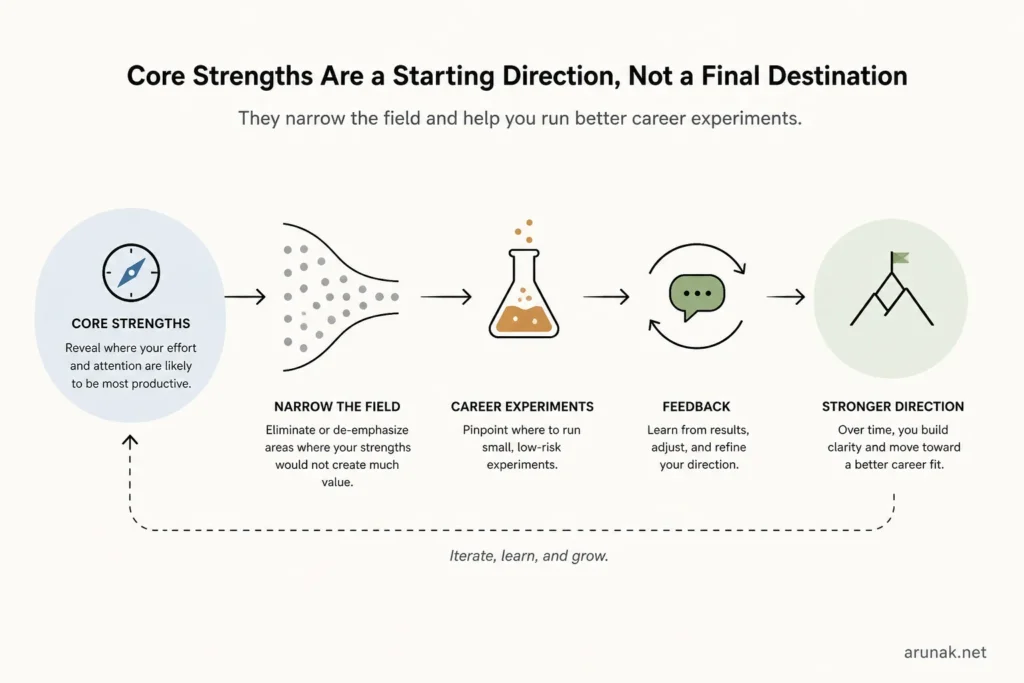
It is also important to understand that core strengths do not point to one perfect job.
That is not their function in the first place.
Their function is to narrow down the options by eliminating the wrong ones. They help you set aside areas where your effort and attention are less likely to become productive. More importantly, they help you see where to run better career experiments.
For example, if one of your core strengths is explaining complex ideas clearly, that could become teaching, writing, consulting, product marketing, technical communication, science communication, editorial strategy, curriculum design, or leadership.
At the same time, you can begin to deprioritize roles where that strength would rarely be used: highly repetitive administrative work, isolated manual work, purely transactional sales, or technical roles where communication and explanation are treated as secondary. Those roles may still be valuable. They may even suit someone else perfectly well. But they may not give your particular sets of strengths much room to breathe.
The strength does not choose the career by itself.
It gives you a direction.
Then comes the second layer, which is often overlooked.
These are the directional forces that include money, geography, family expectations, class background, available opportunities, education, credentials, cultural prestige, timing, networks, health, confidence, and luck.
These forces shape how your core strengths move through the world and turn into a career you can actually build and sustain.
That is why career fit is not a simple matching game.
It is not:
strength → job
It is closer to:
core strength → constraints and opportunities → role experiments → feedback → stronger direction
This is also why two people with the same strength may need different careers.
A person who is strong at explaining may become a professor if they like institutional depth, a writer if they like solitude and public thinking, a consultant if they like client-facing problem solving, or a product strategist if they like translating between users, business, and technology.
In all these cases, the strength is similar. The career expression is different.
Seen this way, your core strengths are not a job title.
They are a source of leverage.
Common mistakes when trying to find your core strengths
Mistake 1: Confusing what you enjoy consuming with what you enjoy doing
Liking books is not the same as liking writing. Liking photography is not the same as liking client work. Liking business podcasts is not the same as liking sales, operations, hiring, or financial risk.
Of course, you may be willing to accept some of the less enjoyable parts of a field if they allow you to use your core strengths in a meaningful way.
A person who loves photography, for example, may not enjoy invoicing clients, managing social media, negotiating rates, or editing hundreds of similar images. But they may accept those parts of the work because their core strength is still being used.
But it is important to understand that consumption is only a clue.
It is not proof.
Mistake 2: Confusing school performance with career fit
School rewards certain kinds of performance: memory, compliance, test-taking, speed, and the ability to satisfy a syllabus, for example.
Those things are worth considering, of course, but a career can be broader, messier, and more complex than a school curriculum.
Many career strengths show up only when there are real stakes, open-ended problems, difficult people, or long feedback loops.
Mistake 3: Confusing praise with fit
Other people may praise you for what is useful to them, not necessarily what is sustainable for you.
You may be rewarded for a strength that drains your energy. That does not mean that this strength does not exist, but it does mean you need to be careful about building your whole career around it.
The best career fit usually lives in the overlap between what others value and what you can sustain.
Mistake 4: Looking for one perfect answer
You are unlikely to discover one perfect career through thinking alone.
A better—and a more practical—goal is to identify a direction and then test it in the field: take on a small project, write publicly about the subject, volunteer for a relevant task, talk to people already doing the work, shadow someone, build a small portfolio piece, or try the work in a lower-risk setting before making a bigger move.
At some point, a pattern becomes harder to ignore because it keeps showing up from different angles.
You notice the same kind of problem; You improve at something faster than expected; The work gives you energy; Other people find it useful; a specific kind of environment brings something out of you.
This is often where a better career direction begins to appear.
Mistake 5: Ignoring the environment
As noted before, a strength can be invisible in the wrong environment, no matter how good you are at it.
Before you conclude that you are not good at something, ask whether the environment—work or personal—made that strength impossible to express in the first place.
Mistake 6: Treating strengths as fixed identity
Core strengths are not fixed.
They are better used as directions for developing expertise in a field or career, not as a permanent identity.
They are a map of repeated evidence. Use them to choose better experiments to run on yourself, not to decide the entire future in advance.
Conclusion: A better question than “What career should I choose?”
So the better question to ask is:
What kind of contribution do my core strengths make possible?
Of course, this is a harder question than asking, “What career should I choose?” It does not turn into an answer as easily. But it gives you a more refined direction for where to place your effort, attention, and ambition.
It moves you away from shallow passion advice. It also moves you away from purely external career advice that treats you like a bundle of marketable skills.
The point is to understand your own skill patterns clearly enough that you can place them in the world in such a way that other people find it useful.
That is a better definition of career fit.
It does not mean finding a job that perfectly expresses your personality; it’s too romantic. But it also does not mean choosing whatever the market rewards most; it’s too hollow.
The point is to find the effective middle between the two: where your inner pattern of strengths meets something other people value.
This is where career fit really begins.
FAQ
What are core strengths?
Core strengths are recurring patterns in how someone creates value in the world.
They are deeper, more durable, and more practically useful than individual skills because they show up across different types of tasks, roles, and environments.
For example, the same core strength may appear across tasks such as writing, teaching, strategy, or research. It may appear across roles such as teacher, editor, consultant, scientist, manager, or founder. It may also appear across environments such as school, work, side projects, conversations, volunteer work, or creative practice.
A skill might be writing, coding, teaching, or analysis.
A core strength is the governing pattern behind the skill: clarifying complex ideas, building useful systems, noticing weak assumptions in an argument, or helping people make better decisions.
How do I find my core strengths for my career?
Look for repeated evidence in your own life.
Ask what you usually notice before others do, what you learn faster than average, what kind of hard work gives you energy instead of draining it, what difficulty you can tolerate better than most people, what people repeatedly ask you for, and what environments seem to bring out your best work.
For example, you may feel average in a loud, fast-moving group setting, but unusually strong in one-on-one conversations. Or you may struggle in a chaotic workplace, but become much sharper in quiet, analytical work. Or you may feel unmotivated by abstract assignments, but come alive when the work has real stakes.
Then look for the pattern across those answers.
Are core strengths the same as passion?
No.
Passion is an emotional attachment.
Core strengths are patterns of contribution. They are connected to other people because they create value beyond their own private interests.
Passion is still an important signal, of course, but it is unstable as the starting point for a career. Passion often grows after competence, progress, feedback, and usefulness have developed over time.
Core strengths, on the other hand, are usually easier to observe because they leave evidence in your personal and professional life.
Are core strengths the same as skills?
No.
Skills are tools.
Core strengths are the governing patterns behind how you use those tools well in real life.
For example, two people may both have writing skills. One may be strong at persuasion. Another may be strong at explanation. Another may be strong at emotional observation.
The skill is the same: writing.
But the underlying strength is different.
The persuasive writer may be well-suited to copywriting, advocacy, sales, speeches, or opinion writing. The explanatory writer may be better suited to teaching, technical writing, essays, science communication, or nonfiction. The emotionally observant writer may be drawn toward fiction, memoir, criticism, poetry, or personal essays.
Same skill, different strengths, so they lead to Different career directions.
Can my core strengths change over time?
Yes, but also no.
You can build new skills, develop new strengths, and discover abilities that were hidden by the wrong environment. But some deeper patterns may become clearer over time, especially the way you notice problems, learn, tolerate difficulty, and contribute.
Treat core strengths as evidence, not destiny.
What if I do not know what I am good at?
The most useful first step is to look at past evidence.
Look at what people have repeatedly asked for your help with. Look at what you explain well, and what you find yourself wanting to explain even when nobody asked. Look at what you learn quickly. Look at what kind of work makes you feel sharper rather than swamped.
When you have enough evidence, run a small experiment.
For example, if people often praise you for explaining things clearly, test that strength in public: Write a short essay, give a small presentation, make a guide for a problem you understand well, or tutor someone. Record a short explanation. See whether the pattern repeats when the stakes are slightly higher.
You do not need to decide your entire future.
You only need to gather better evidence.
How do core strengths help with career fit?
Core strengths help you identify the kinds of roles, problems, and environments where your abilities are more likely to energize you, compound over time, and become useful to other people.
They do not tell you that there is one perfect job waiting for you.
They help you choose better experiments with your skills. They also help you avoid building a career only around prestige, pressure, or other people’s expectations.
Should I choose a career only based on strengths?
No.
Strengths are only the beginning of a well-fitting career.
Career choice also depends on opportunity, money, geography, credentials, timing, market demand, family responsibilities, and other practical constraints.
Those forces naturally come next, and it is important to account for them when you turn self-knowledge into an actual career path.
But without understanding your core strengths, you may choose a path that looks good and fitting on the surface, yet still feels misaligned when you commit to it.
References
- 80,000 Hours. How to identify your personal strengths.
- Barrick, M. R., & Mount, M. K. “The Big Five Personality Dimensions and Job Performance: A Meta-Analysis.” Personnel Psychology, 1991. DOI: 10.1111/j.1744-6570.1991.tb00688.x
- Cech, E. A. The Trouble with Passion: How Searching for Fulfillment at Work Fosters Inequality. University of California Press, 2021.
- Deci, E. L., & Ryan, R. M. “The ‘What’ and ‘Why’ of Goal Pursuits: Human Needs and the Self-Determination of Behavior.” Psychological Inquiry, 2000. DOI: 10.1207/S15327965PLI1104_01
- Dweck, C. S. Mindset: The New Psychology of Success. Random House, 2006.
- Epstein, D. Range: Why Generalists Triumph in a Specialized World. Riverhead Books, 2019.
- Ericsson, K. A., Krampe, R. T., & Tesch-Römer, C. “The Role of Deliberate Practice in the Acquisition of Expert Performance.” Psychological Review, 1993. DOI: 10.1037/0033-295X.100.3.363
- Ericsson, A., & Pool, R. Peak: Secrets from the New Science of Expertise. Eamon Dolan/Houghton Mifflin Harcourt, 2016.
- Eurich, T. Insight: Why We’re Not as Self-Aware as We Think, and How Seeing Ourselves Clearly Helps Us Succeed at Work and in Life. Crown Business, 2017.
- Gagné, M., & Deci, E. L. “Self-Determination Theory and Work Motivation.” Journal of Organizational Behavior, 2005. DOI: 10.1002/job.322
- Holland, J. L. Making Vocational Choices: A Theory of Vocational Personalities and Work Environments. Psychological Assessment Resources, 1997.
- Ibarra, H. Working Identity: Unconventional Strategies for Reinventing Your Career. Harvard Business School Press, 2003.
- Kristof-Brown, A. L., Zimmerman, R. D., & Johnson, E. C. “Consequences of Individuals’ Fit at Work: A Meta-Analysis of Person-Job, Person-Organization, Person-Group, and Person-Supervisor Fit.” Personnel Psychology, 2005. DOI: 10.1111/j.1744-6570.2005.00672.x
- Newport, C. So Good They Can’t Ignore You. Grand Central Publishing, 2012.
- Nye, C. D., Su, R., Rounds, J., & Drasgow, F. “Vocational Interests and Performance: A Quantitative Summary of Over 60 Years of Research.” Perspectives on Psychological Science, 2012. DOI: 10.1177/1745691612449021
- O*NET OnLine. Career exploration and job analysis.
- O*NET Resource Center. Interest Profiler.
- Peterson, C., & Seligman, M. E. P. Character Strengths and Virtues: A Handbook and Classification. American Psychological Association and Oxford University Press, 2004.
- Rounds, J., & Su, R. “The Nature and Power of Interests.” Current Directions in Psychological Science, 2014. DOI: 10.1177/0963721414522812
- Schmidt, F. L., & Hunter, J. E. “The Validity and Utility of Selection Methods in Personnel Psychology.” Psychological Bulletin, 1998. DOI: 10.1037/0033-2909.124.2.262
- VIA Institute on Character. VIA Character Strengths