
The Story Phase
We’ve coined a phrase for someone exceptionally good at something: they were born to do it. We all know what it means, but taken literally, it doesn’t make much sense. Also, I think it clouds our judgment, both about what we’re actually good at and about finding a fitting career that can lead to a fitting life.
Does this mean I don’t believe people are born with certain natural skills, or strengths? Absolutely not. It’s just that a job, a sport, a profession, or a career path are things we humans define. They come with rules, social structures, and expectations that don’t trace back to anyone’s genetic makeup. So how can we say someone was born to do one?
Then the obvious question follows. What are we born with, then? Nothing?
Of course not. We’re born with abilities, and those abilities are different from person to person. The problem is we treat abilities and job roles as the same.
The Structure Phase
I see that this is the problem with most career advice today.
It starts with the job.
And comes with a series of questions like: What job fits you? What career suits your strengths? What role would make you happy?
These aren’t bad questions. But it’s like pulling from a branch instead of the root.
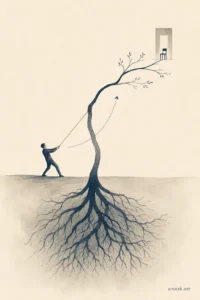
And what happens when you pull from a branch? It bends for a while. It looks like it’s moving in the direction you want. But the root hasn’t moved an inch. Eventually it resists, and then, it springs back into its old shape.
I think that’s what happens with a lot of career advice. It tries to reshape us from the outside, starting with an available career and asking us to bend toward it.
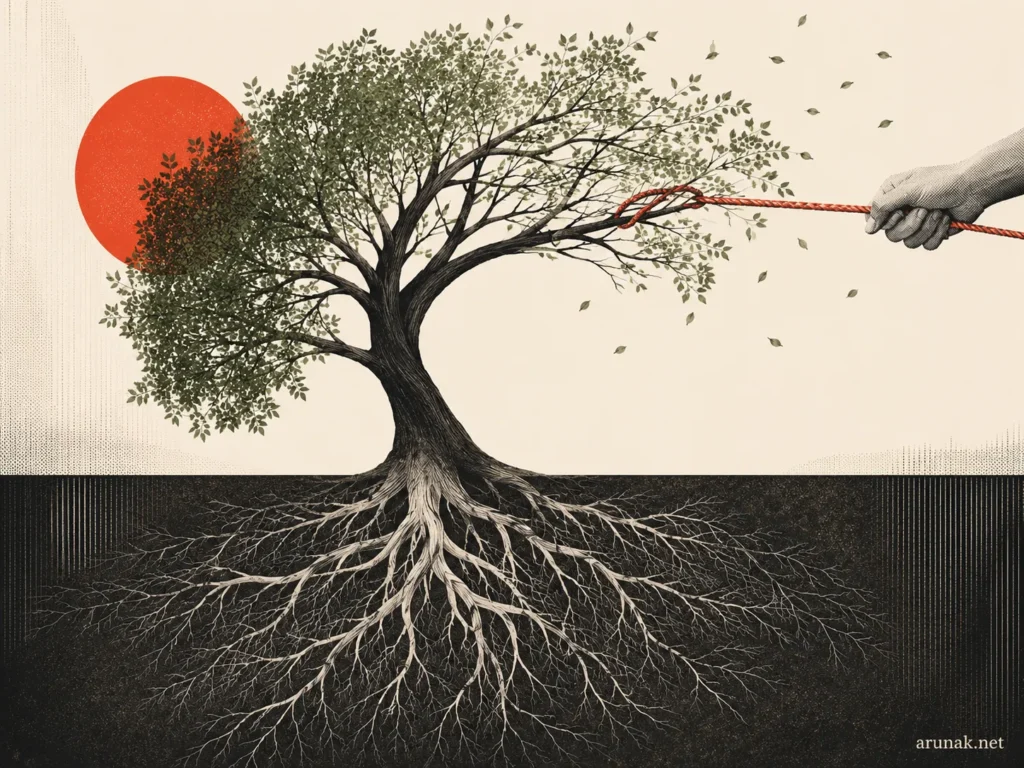
A better approach, on the other hand, starts from the root. It asks: what are this person’s core strengths? What motivates them, especially when things get hard? And how can those be translated into work that actually fits?
These questions take into account the fact that the same skill set can fit very different careers. Someone analytical, disciplined, and good with language could become a lawyer, a researcher, a writer, a consultant, an analyst, a professor, a strategist. All of these look like fitting careers on paper. But not all of them would actually fit this person.
That’s because turning someone’s skills into a well-fitting career has to pass through an intermediate layer, what I call the directional forces. This is everything that shapes where your skills end up pointing: family expectations, culture, money, geography, school, mentors, luck, timing, confidence, fear, and the opportunities you happened to see before everybody else.
This layer is rarely talked about, and it’s easy to see why: it’s more easy to sell the career fantasy instead, the “you can be whoever you want to be” version. It’s a much more comforting story to tell than “your options were shaped by forces mostly outside your control.” But these forces do exist. For example, one research on inventors found that kids from the top one percent of families are ten times more likely to become inventors than kids from below-median-income families, even when they had the same math scores as children.
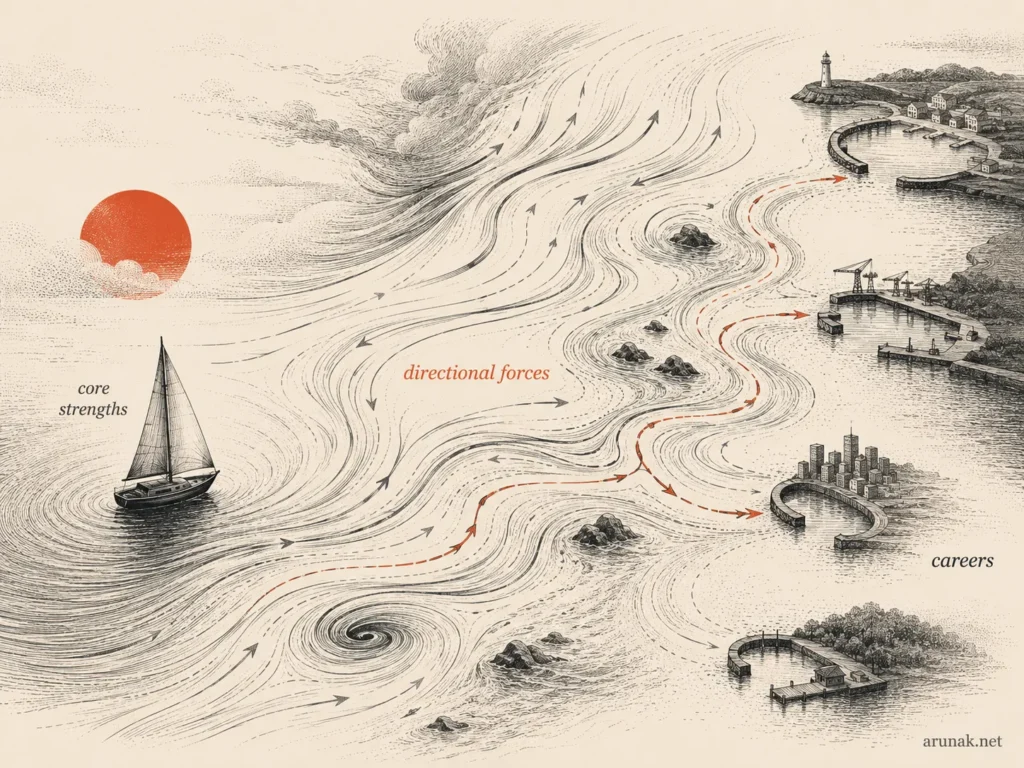
Put another way, talent alone didn’t predict the outcome; exposure and circumstance did.
That’s why I don’t think “try harder” is the fix for a fulfilling career. It should be “understand yourself and your surroundings better.” That’s obviously a much more difficult task, and a rather harsh one to swallow. But good things are rarely easy, and this one’s no exception.
So where do you start?
The Interface
Here’s a simple exercise. Don’t start with “what career should I choose?” Start with these three questions instead.
First: what kinds of things do people always ask for your help with?
These are your skills. They’re not quite the same as your so-called passions, at least not entirely. Passion works inside out, it’s something you feel regardless of anyone else. A skill works outside in. What makes something a skill is that someone else benefits from it.
Once you’ve found the root, you can branch out. Ask: what kinds of problems naturally pull me in? What do I always notice that others usually miss? What kind of work makes me excited, not just productive? What difficulty, in what type of work, do I strangely enjoy?
Second: what forces are shaping my career direction right now?
Am I moving toward something because I truly want it, or because it was the most obvious option given my circumstances? Am I following prestige, family expectation, fear, or convenience? Is someone else shaping my idea of what counts as success?
Third: given my skills, and the forces acting on them, what’s the most fitting translation into actual work?
This way, you’re not blindly looking for the one job you were born to do. You’re looking for a better expression of who you already are.
This is not to say that you have to reinvent yourself. The most fitting career might still be inside what you already do, maybe just one step to the side. Or it could be a completely different path. Or it could be that side hustle you’ve carried for years but never gave a real shot, because you never quite followed through.
Either way, the task is the same: Understand the core strengths, study the forces acting on them, and then execute the translation accordingly.