
One-line takeaway
Our personality traits do not define us. It’s what we do with them that defines us.
What is Personality about?
Daniel Nettle argues that personality is not a type but a position on several continua.
This runs against the stereotypical view of traits like introverted or extroverted, anxious or calm, disciplined or lazy, generous or selfish, and many others.
Nettle looks at personality like it’s height or weight: everyone has some amount of each trait.
Everyone has all of the five factors of personality, just as everyone has a height and a weight. Where we differ is the magnitude of the height and the weight, or the score along each of the five dimensions (p. 24).
So the question isn’t whether you “are” neurotic, conscientious, or extraverted; it’s where you fall on each scale. This seems to be a small shift in perspective, but it changes almost everything, because the common view turns a personality trait into an identity, while this continuum view turns it into a variation instead.
And variation makes us all the more interesting…
It frees us from asking the paralyzing question “Which type am I?” and letting the answer become our fate. Instead, it lets us ask a more constructive one: where do I currently fall on each scale, and what do I want to do with that?
Table of Contents
Ideas and takeaways
Personality traits are sensitive to the environment that we are in
When I first picked it up, it seemed to me that this was a book about the Big Five personality traits: Extraversion, Neuroticism, Conscientiousness, Agreeableness, and Openness.
It is. But Nettle has a couple of chapters before he dives deep into them, where he lays out the theme of the book, that personality variation persists because there is no single best way to react to every situation in life.
Natural selection usually reduces variation when one trait is clearly better than another. But personality does not seem to work like that. A higher level of a trait can be useful in one environment and costly in another.
Nettle uses studies on guppies to make his point. Researchers bred guppies from different parts of the world in a lab with no predators, then introduced a predator to see how they’d react. Even though none of the fish had ever faced a predator before, they reacted the way their group would have in the wild. Guppies from areas with fewer predators took more risks. Guppies from areas with more predators stayed cautious, and survived better for it.
One of the most interesting insights in this chapter is that even if a trait seems all good, it might not be.
For example: a guppy’s low alertness seems to be a weakness at first, but in a low-predator environment it becomes an advantage, because the fish isn’t wasting time on vigilance it doesn’t need and can spend it finding food or a mate instead.
The same logic applies to people.
A highly cautious person might do really well in an unstable or risky environment. A more relaxed person, on the other hand, might do much better where the cost for vigilance is higher than the danger itself.
A very conscientious person may thrive in school, medicine, engineering, or law. But the same person may feel lost when there is no clear ladder to climb.
There is no “all-good” personality trait; it all depends on the environment that people are in.
Every strength comes with a cost
Zooming in on the point made in the previous section, Nettle refuses to sort personality traits into a moral ranking, which is the conventional way we tend to think about them.
For example, Conscientiousness is good, Neuroticism is bad; Extraversion is confidence, Introversion is shyness; Agreeableness is kindness, Low Agreeableness is cruelty.
Instead, Nettle shows that there are tradeoffs to each of these traits. Traits come with tendencies, and tendencies come with opportunity costs.
If you are chasing a new reward, you are also saying no to what you already have, or to something else you could have chosen instead.
If you are highly vigilant, you might notice the dangers that come your way much earlier, but you will be bombarded with many false alarms.
If you are highly disciplined, you probably will achieve more, but there’s also a higher tendency to lose yourself in the plan for success than in the success itself.
No trait is equally good in every situation. They are neither virtues, nor flaws.
This is more optimistic than it seems, because what it really means is that all of us have a chance to make it, whatever that means to us.
Extraversion and reward sensitivity
After these few early chapters, Nettle deep dives into the Big Five, the first one being Extraversion.
Nettle’s first move in this chapter is to separate Extraversion from simple sociability. We usually treat extroverts as more sociable and introverts as shy. Nettle’s argument is that shyness has more to do with anxiety than low Extraversion. That’s an entirely different subject, and it has no direct link to being an introvert.
A low-extraversion person, Nettle suggests, does not necessarily fear social activity. They just simply get less reward from it.
Extraversion, Nettle says, is tied to the responsiveness of positive emotion systems. The high scorer gets a stronger kick from company, excitement, achievement, attention, romance, and status. So, to be able to get a larger reward, they are willing to put in more effort.
This explains why some people chase difficult, uncertain, exhausting paths that would not feel worth it to others.
This also pushes back against a simple “anyone can become great if they spend enough hours” view of talent and achievement. Time and practice dedicated to getting good at something can only take you so far, but the willingness to do it comes from how rewarding the pursuit is to you. And this emotional return is different from person to person.
That said, this is also an area where the book should be read carefully. Some of the genetic claims around dopamine and Extraversion look to me as “handwavy,” especially now that personality genetics is understood as highly polygenic and complex.
Neuroticism as a sensitive alarm system
This chapter, I find, is the most interesting in the whole bunch.
On the surface, Neuroticism is not something to brag about. It’s linked to stronger negative emotions, more stress, more vulnerability, and lower satisfaction in several areas of life.
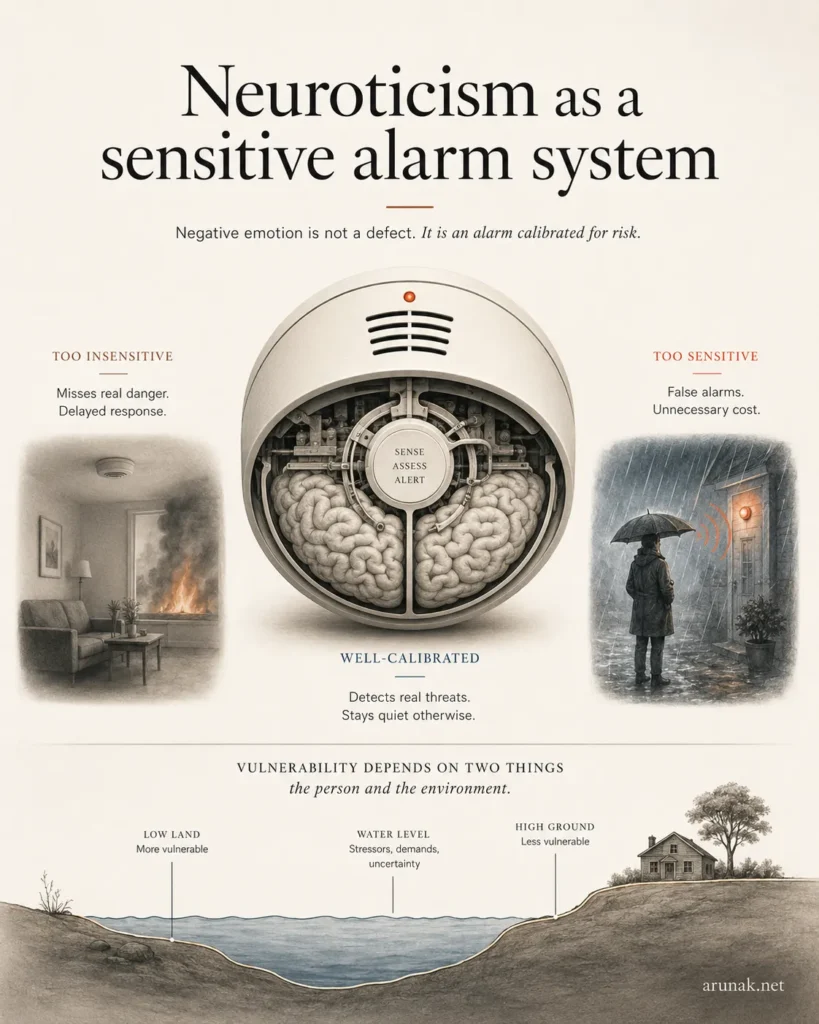
But Nettle’s better point is that negative emotion exists for a reason. Fear, worry, guilt, and sadness are not random defects, rather, they’re alarm systems. Helpful alarm systems.
Nettle uses the “smoke detector” analogy to explain this. A smoke detector that is not sensitive enough would lead to a catastrophe, and one that is too sensitive would make you stand outside in the rain for no reason.
The same rule applies to Neuroticism. Some people are wired in a way that keeps their “neuroticism alarm” more sensitive than everyone else’s.
But mind you, it does not mean worry is secretly pleasant or that people should romanticize anxiety. But it also does mean the trait should not be reduced to weakness.
Does this mean that some people are simply built to be less happy, and more chaotic all the time? Nettle says no, with one of the most fitting anecdotes that I came across throughout the book.
People often ask me whether depression is due to the person or the situation they are in. This makes no more sense than asking whether flooding is due to the height of the water or the height of the land.
So, the same theme resurfaces, that the environment we are in plays a crucial role in all of this.
Some people may be in lower lying ground. This means smaller rises in stress can make them depressed. But even for someone like this, there is one variable that can still make things better: changing their environment.
Put it another way, genetics is not destiny. At worst, it can be just a differential vulnerability.
Conscientiousness helps you win, but with the power to take it all away
Conscientiousness is the trait that most likely would turn into positive life advice: be disciplined, organized, control the impulses, work hard, delay gratification, and all that good stuff.
And Nettle does not deny its advantages. Conscientiousness is one of the strongest personality predictors of occupational success. It helps people show up, prepare, persist, finish things, and avoid self-sabotage. In many modern institutions, this is obviously a huge advantage.
But the chapter becomes all the more interesting when Nettle pushes Conscientiousness to its logical extreme. For example, high Conscientiousness can lead to meticulous planning, even to the extreme where the execution is swallowed by it. This has been such a continuous pattern in recent times that people even coined a name for it: toxic productivity.
Lists, schedules, routines, and rules are supposed to serve life. But, with overly rigid conscientiousness, they can become life. The person becomes loyal to the system even when the system is no longer directed at the original goal.
This is an important correction to be made to the usual productivity mindset. Discipline is only useful when it helps us do meaningful things. But when discipline becomes detached from meaning, it’s just another trap. You are still checking boxes, still doing things “properly,” but the actual point has been completely lost.
This reminds me of the studies on failed prodigy kids. There’s research on child prodigies showing the same pattern: kids who could master algebra or an instrument years ahead of their peers usually stall out as adults, because the skill of mastering rules that already exist is different from the skill of setting new goals for yourself.
The most important point in this chapter is that conscientious people do not only need discipline. They also need aim. Otherwise, they may become very efficient at working on something they did not really choose in the first place.
Fit is the goal, not self-improvement
The most useful takeaway from Personality is that we should not celebrate or condemn personality traits.
Instead, we should put some effort into understanding the conditions under which our traits become our strengths. And there’s a clear variable that we can rely on for this: the environment that we’re in.
If you are low in Extraversion, it’s not effective to force yourself into a life that needs a huge social battery, but things will probably go your way if you pay attention to which environment you tend to thrive in.
If you are high in Neuroticism, you can’t just wish away your sensitivity. What you can do is build a life with fewer unnecessary stressors and better recovery.
If you are low in Conscientiousness, it wouldn’t help you to hate yourself for it. Also, if you are very high in Conscientiousness, being more disciplined is not going to help you tackle all the problems that life will throw at you either.
There’s a balance to all this. There’s no jack of all trades trait.
So, what gives?
It all comes to this: how do we build a life that fits with the set of personality traits we are born with?
There are two answers.
One, these traits do not define us. It’s what we do with them that defines us.
Second, how we go about turning these traits to our advantage depends on many things: culture, class, relationships, health, and opportunity.
Seen this way, this book gives a useful starting point: treat the traits as tradeoffs, no matter how bad or good they seem to look on the surface.
And then, build a life where the water rarely rises high enough to destroy it.
What I didn’t like about the book
This book offers some really good insights when it comes to handling ourselves, as ourselves, not just borrowing someone else’s version of success.
Having said that, I find the book gets overly repetitive in many chapters, which led me to skim most of the final two chapters.
Also, some of the research feels handwavy, not concrete.
For example, there is this idea that extraversion led people (early human beings, because we all come from Africa) to move away from Africa to seek opportunities, which Nettle attributes to the trait Extraversion.
If this is true, I begin to wonder does that in any way explain the current wealth distribution across different continents?
But, this is, at best, speculative.
There are many reasons why early homo sapiens moved out of Africa, the most dominant of which is yet to be determined.
Should you read Personality?
Read this if you:
- want to understand the Big Five personality types without reducing people to fixed into them
- are curious why the same trait can be a strength in one situation and a liability in another
- want a biological explanation of personality that still leaves room for improvement
- are trying to make sense of your own personality patterns around discipline, sociability, empathy, or curiosity
- prefer a short, idea-rich psychology book that explains our difference with no self-help type advice