
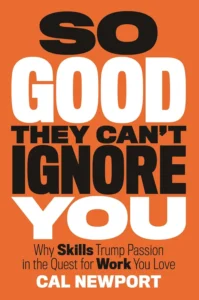
What is this book about?
So Good They Can’t Ignore You by Cal Newport argues that “passion” is a weak strategy for finding a well-fitting career. With many useful ideas, concepts, frameworks, and real-world examples that Newport uses to prove his point, also comes the sense that he overly pushes this idea into its most extreme case, that passion is completely useless, which I don’t agree with.
I think someone will be able to get the best out of this book when they read it this way:
- Passion is a weak career strategy, and so it should not be the defining factor when looking for a well-fitting career.
- A better question than “What is the right work?” is how to focus instead on “mastery.”
- Career capital, or the skillsets that you’ve developed that allow you to actually help other people, matters more than just hoping your “passion” will lead you to your “contribution.”
- It is also important to understand that a well-fitting career, especially in the long run, inevitably becomes fused with some kind of passion, even though the trajectory to get there should not be completely decided by passion alone.
All in all, I find that this book is most persuasive when it reads as “passion is not enough,” and least persuasive when it reads as “passion is unnecessary.”
Passions are not necessarily career paths
When a survey asked a group of Canadian students about what their passions are, the answers they gave were mostly things like dance, hockey, skiing, reading, and swimming. Newport uses this study to point out that most of the passions we have are closer to hobbies than to career paths.
Is that a bad thing? Not necessarily.
But the point he is making here has merit. It’s not wise to try to build a career based on your passions, even though passions can indirectly move you toward a satisfying career. Passion can be quite fragile and unreliable when guiding us to a well-fitting career.
Newport’s point here can be summarized this way: most people’s pre-existing passions are not job-specific enough to provide a useful career plan. They might tell us something about what we enjoy, but they rarely tell us what people will pay us to do, what skills we need to build, or what problems we are equipped to solve.
Jobs, careers, and callings
These are clearly very different things. In practice, however, it is quite hard to distinguish between them. Although I don’t completely agree with the argument Newport is making here, once you get good at a job, any job, you are more likely to see that job as your “calling.” It’s quite clear that it is easy to fool ourselves with the idea that if we follow our passion, we will most likely find our “calling.”
This is obviously not true. But it is worth understanding why…
Let’s say we are passionate about dancing. If we are careless enough to jump to the conclusion that this is our “calling,” we might end up with the most unsatisfactory career in the long run. We might enjoy practicing dancing, but that is not the same as doing it as a career. A career comes with a carriage of other responsibilities and required skills that have to tally with our interest in dancing. We must be able to work closely with people, practice intensely, handle the physical toll, and work in a rather volatile environment all the time. It is possible that even if we love to dance, all the other things that come with turning dance into a career are not our cup of tea.
The point is that to find the best career, or so-called “calling,” we have to experiment…a lot. Passion is not going to help much here because there is nothing in it that forces us to experiment. We just…like it. Liking and doing, especially for a long period of time, with the constraints of the real world, are two very different things.
Working right trumps finding the right work
Working right, without question, will get us into a successful place in life. But I just don’t see how this statement holds in Newport’s examples, or that it supports the logical sequence he is trying to make in this book.
This book, in its most fundamental elements, argues that passion is bad and working hard is good. There is much more to it, of course, but this is the common thread that runs through the entire book. The problem with this argument, and with the idea that “working right trumps finding the right work,” is that even the examples Newport chooses to talk about are people who already have some kind of passion in their minds. It seems that Newport is so bound to his thesis that he makes all the arguments from the second stage of their lives—that is, where they begin to put their asses on the line, working toward that passion. True, during the middle stages, it does not become quite clear that they are following their passion. They are working toward a goal given by their environment and real-life constraints. But eventually, where they end up is very close to what they had in mind before they even began to work hard, which was, in fact, their passion.
Even the opposite side of this argument is valid: if someone starts or embarks on a career path only to make money, even though they become really good at what they do, that does not automatically guarantee that they will come to love what they do, which is the argument Newport is trying to make in this section.
In other words, I don’t think that getting good at something automatically guarantees that passion will follow.
That said, Newport’s argument has its merit, but only when placed within the necessary constraints. Skills, whether we are passionate about them or not, create the conditions for satisfying work. Mastering something, anything, does not guarantee that we will eventually come to love it. Motivation depends not only on skills, but also on autonomy, competence, relatedness, and other subjective experiences.
The sampling problem
One weakness I see in Newport’s argument is a sampling problem. Many of the people he uses as examples are already successful, or at least far enough along in their careers to make the logic look cleaner in hindsight. From that angle, it is easy to say that skill came first and passion followed later.
But this may not fully explain what happens before success. People who keep going long enough to build rare and valuable skills may already have some mixture of interest, obsession, curiosity, social support, financial room, or plain luck that allows them to survive the early stages. If we only study the people who made it through that stage, we might miss the people who worked hard, built skills, and still did not come to love the work.
So I think Newport’s argument is useful, but incomplete. It shows that passion alone is not enough. It does not fully prove that passion is unnecessary, or that mastery reliably creates passion for everyone.
The quality of practice matters more than raw hours
Anders Ericsson and Robert Pool, in their book Peak, introduced the concept of “deliberate practice,” which Newport also discusses quite extensively in this book.
So, what is the difference between “practice” and “deliberate practice”?
Practice is repetition. Deliberate practice is structured improvement. Practice often means doing the same activity again and again, hoping that time and exposure will eventually make us better. Deliberate practice is different because it is designed around a specific weakness, a clear goal, focused attention, immediate feedback, and correction.
Deliberate practice forces us to notice what is not working before repeating it. It asks us to think before repeating.
It significantly emphasizes the idea of “think before repeating.” What we often do when we practice something over and over is repeat the same thing just for the sake of repeating. Then we hope for continuous improvement. Deliberate practice is the counterargument to this kind of unproductive practice. It states that in order for us to get better at anything through repeated practice, after each and every practice run, we need to revise and make the necessary adjustments before moving on to the next.
These adjustments may involve getting external feedback, emphasizing or re-emphasizing certain aspects of the skill, and putting more weight on the weak points.
The control traps
There are two main control traps.
The first control trap is trying to gain more control over your work before you have enough career capital to support it. In that case, control becomes fragile. You might want freedom, autonomy, or independence, but without rare and valuable skills, you do not yet have enough leverage to earn or protect that freedom.
The second control trap only appears after you have built enough career capital. At that point, control becomes valuable, and because it is valuable, other people may resist giving it to you. Employers, institutions, or clients may prefer that you keep using your skills in ways that benefit them, even when greater control would benefit you.
So Newport’s point is that control is one of the most important traits of a fulfilling career, but it has to be pursued at the right time. Too early, and it becomes unrealistic. Too late, and other people may try to keep it from you.
In order to become successful at anything, first, you need to understand what the cutting edge looks like
In Chapter 11, “Missions Require Capital,” Newport makes the argument that, in order for us to succeed at anything, we first need a good understanding of the whole arena of new problems. To be able to see these new problems, we need to be at the forefront of whatever we choose as our career.
He says that a good career mission is usually found in the “adjacent possible,” the region just beyond the current cutting edge of a field. To reach that place, we need career capital: rare and valuable skills that allow us to see and act on opportunities that are invisible to beginners.
I agree that this is partially true. The balance between this statement being true and false is continuously being moved toward “false” as time goes by.
Why?
Because the accessibility of knowledge is getting better and better over time, especially with the advent of AI. The idea of competence is therefore now being moved from simple execution, or identifying a problem for its own sake, toward coordination—that is, how well can you navigate through uncertainties and come up with the best solution possible for a given problem?
In other words, everybody, more or less, is on the cutting edge today. Getting to the cutting edge is not as much of a challenge in today’s world. So, although Newport’s idea that building career capital is important is nonetheless true, it is not true for the reasons he lays out in this section anymore.
Mission requires little bets
One of the ideas that I came to take real interest in is “little bets.” The idea was originally discussed in Peter Sims’s book Little Bets.
It goes like this:
Breakthrough ideas often emerge by trying out simple, low-cost, small steps, one by one, with the uncertainty of what would happen next. They don’t often have a grand plan or one unified foolproof path. I find that this is a great point in general, and also for the argument Newport is trying to make in this book.
Let’s say that we have a deep interest in something and have no idea how to make this interest part of our lives. A reasonable next step would be to plan it out. Think about all the obstacles in our way, the financial burdens, other skills we have to build along the way, the kind of people we might have to connect with, and the work required. Great. Now we go on executing it. But more often than not, these well-thought-out plans never really go as we predict them to go. Life is brutally nonlinear. We don’t know what we don’t know. So what do we do when things go against the plan? We compromise. Instead of going one step up, maybe we have to go half a step up and move to the side a little bit to avoid something that we didn’t plan on tackling in the first place. Sometimes it is even possible that we might have to take a complete step backward, recalibrate, and move forward with caution.
The path to success is messy.
And this concept of “little bets” perfectly captures this inevitable truth. On our path to success, therefore, when we have to turn around and move back, we might not be able to see the finish line in the first place.
Taking little bets relieves the pain of uncertainty in these kinds of pressure points. It is a genius survival strategy toward success.
Or, to put it simply, taking little bets is to embrace the notion that “this too shall pass.”
Now, all this is great. But it seems like Newport missed one important point here. It all starts with a childlike desire, a poorly guided, and might not even be realistic, fantasy that gives us energy to go through all this turmoil, which I think is safe to call “passion.”
But again, I very much agree with the idea that passion is not a good factor on which to base our careers. Most of the best and most successful careers, however, when studied through history, were initiated by a passion.
So, even though we should definitely not base all our career choices on our passions, it might not be wise to completely ignore them either.
Brown cow versus the purple cow
Even though this is more like a standalone idea, in terms of the main thesis of the book, it is not obviously a useless one. Referenced in the book, Seth Godin’s Purple Cow emphasizes the idea that, for any good idea to be useful to other people, it needs to be wrapped around an attention-seeking vessel.
Brown cows are too common to notice. A purple cow definitely draws our attention, even though there are no other differences between the two.
A good idea is well-equipped to become a successful idea when it is also remarkable enough to be talked about.
Newport uses this concept to emphasize the fact that mission-driven projects need to be remarkable and launched in a way that people can notice them easily.