
One-line takeaway
Good decisions and good outcomes are not the same thing.
What is Thinking in Bets about?
Thinking in Bets is a book about learning how to live in a world where outcomes are inevitably unpredictable.
Because outcomes are unpredictable, Annie Duke argues that we should not judge our decisions only by what happened afterward. A good outcome does not always mean we made a good decision. A bad outcome does not always mean we made a bad one either.
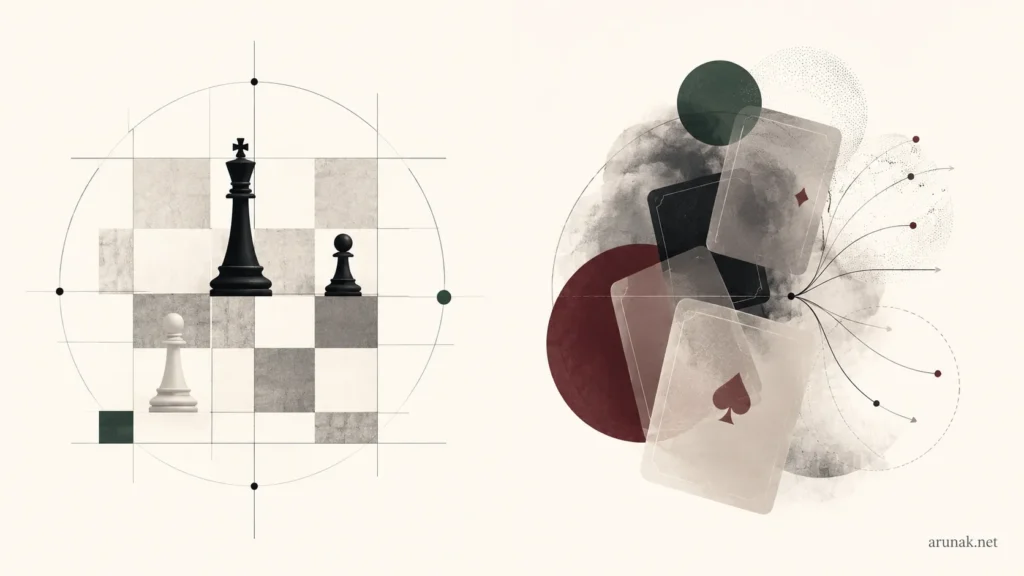
One of the clearest anecdotes she uses to explain this is the difference between chess and poker.
Real life is much closer to poker than chess. We act with partial information, under uncertainty, while luck and other people’s choices significantly influence the result. A bad decision can lead to a good outcome because of luck. A good decision can lead to a bad outcome because of uncertainty.
To navigate life under these conditions, Duke suggests that we need to judge decisions by the quality of the thinking behind them, not only by what happened afterward.
Table of Contents
Ideas and takeaways
Life is more like poker than chess
One of the most eye-opening and interesting insights I came across in the first part of Thinking in Bets is the distinction between poker and chess.
It also challenged the way I had been defining “a game” in day-to-day life.
In this context, a game does not come with complete information. It’s not fully visible from the beginning. So naturally, the possible outcomes are not fully visible either.
This is why, in Duke’s argument, a game like chess is not the best model for real life. True, chess has uncertainty, but it does not have the same kind of hidden information, because the rules are fully defined from the get go.
Nobody walks away from a chess game, frustrated that they lost, and says, “I knew it. The winner was up to something.”
If you lose in chess, the main reason is usually that you were less competent in that particular game than the other player.
But, as we all know, this is not real life. We lose sometimes, without making any mistakes. And poker simulate this really well.
In poker, you make decisions with incomplete information, uncertainty, and hidden variables. And all of that is wrapped in luck.
Seen this way, poker has much more resemblance to real life than a clean, fully visible game like chess.
This is a great segue into the book because it shows why understanding the dynamics of poker is useful far beyond poker itself. Careers, relationships, investing, writing, business, science, health decisions, and many other parts of life all involve uncertainty.
So, to get ahead in a life with uncertain outcomes, Duke suggests that we need to get better at making interdependent decisions under uncertainty, not simply assume that good outcomes will always follow from good intentions, hard work, or competence.
‘Chess is not a game. Chess is a well-defined form of computation. You may not be able to work out the answers, but in theory there must be a solution, a right procedure in any position. Now, real games,’ he said, ‘are not like that at all. Real life is not like that. Real life consists of bluffing, of little tactics of deception, of asking yourself what is the other man going to think I mean to do. And that is what games are about in my theory.’”
Stop “resulting”
“Resulting” means judging a decision only by its outcome.
In real life, it’s easy to see why this becomes our ‘default instinct’, because, of course, it feels natural to judge a decision by its outcome.
“It worked, so it was a good decision.”
“It failed, so it was a bad decision.”
But the part we often overlook is that life is not mechanically linear. Like poker, it’s a game filled with uncertainty, incomplete information, hidden variables, and luck.
Understanding this gives us permission to admit something we often don’t want to admit: it’s okay to not know everything. It’s okay to make the best decision we can and still get a result we did not want.
“Pete Carroll was a victim of our tendency to equate the quality of a decision with the quality of its outcome. Poker players have a word for this: ‘resulting.’”
So the better question to ask after a failure is:
Given what I knew at the time, was this a good bet?
This question shifts the focus back to decision quality. The quality of our decision is something we can examine, improve, and control. Luck is not.
Results and decisions are different. A good decision can produce a bad result, and a bad decision can produce a good result.
Think in probabilities, not certainties
Following the previous point, if it is impossible to be 100% certain about anything, then the more honest approach to decision-making is to deal in probabilities, not certainties.
So instead of saying:
“This will work.”
It is more useful to say:
“I think there is a 70% chance this will work.”
A major point of the book is that we do not need to be certain about everything. We just need to be well-calibrated.
Beliefs are bets
Every belief is a bet on reality.
When we believe something, we are effectively saying:
“I am willing to act as though this is true.”
But the problem is that we treat beliefs as personal identities, when really they are closer to hypotheses.
They should not be engraved into our personalities. We should be able to update our beliefs when new evidence shows that our beliefs and actual reality are not well aligned with each other.
However, more often than not, we tend to stick with our original beliefs.
Beliefs usually come first, and explanations follow afterward.
This is very similar to the argument Jonathan Haidt makes in his book The Righteous Mind. In the book, he uses two powerful metaphors to explain this: the intuitive dog and its rational tail, and the rider and the elephant.
“You can see the rider serving the elephant when people are morally dumbfounded. They have strong gut feelings about what is right and wrong, and they struggle to construct post hoc justifications for those feelings. Even when the servant, reasoning, comes back empty-handed, the master, intuition, doesn’t change his judgment.”
All in all, Duke’s argument here is that we should be wary of this core human tendency to protect our beliefs first and examine the evidence only afterward.
Use “wanna bet?” as a thinking tool
We always tend to throw words around without thinking much about them. Most of them are conclusions.
But when you throw the phrase “wanna bet?” into that habit, it forces us to think again, and think carefully.
For example, when you say, “This person failed because they were lazy,” or even apply that to your own life, are you really coming to that conclusion after considering all the possible explanations, the hidden variables, the uncertainty, and the role of luck?
But if you had to bet on your statement, you would probably ask a different kind of question first, something like:
“Would I bet money that this is the correct explanation?”
This type of reasoning pushes you to consider all the possible explanations before jumping into vaguely constructed conclusions, which will eventually save your time, attention, and emotional energy.
Build a “truth-seeking” group
But for this “wanna bet?” type of reasoning to really take hold in our thinking, Duke suggests that we need a “truth-seeking” group around us.
Because, as the saying goes, you are the average of the people you associate with the most.
We think better when we are around people who challenge our assumptions, and do it honestly.
A good decision group should:
- Reward truth over ego
- Separate decision quality from outcome
- Challenge assumptions
- Ask for evidence
- Avoid just “agreeing to be nice”
True, even though it’s easy to find people who will try to put us in our place, it is extremely hard to find people who do it for our own good.
But without such people, even a couple of them, it’s really hard to be honest with ourselves. As mentioned above, intuition often comes first, and only then do all the logical arguments follow to validate that intuition.
Use mental time travel
One of the most interesting ideas I found in the latter part of the book is Duke’s argument that we are making bets against, or on behalf of, our future selves.
In real-life decision-making, when we bring our past- or future-self into the equation, the space-time continuum doesn’t unravel. Far from turning us into a liquefied blob, a visit from past or future versions of us helps present-us make better bets.
There are two types of time travel she talks about: to the past and to the future.
Backcasting: Imagine you succeeded. Then ask, “What had to happen for this to work?”
Premortem: Imagine you failed. Then ask, “What probably went wrong?”
Both exercises help us see risks, assumptions, and hidden obstacles before committing to anything.
Good decision-making is a feedback system
The take-home message of the book is about building a better learning loop. It goes like this:
Decision → Outcome → Analysis → Belief update → Better future decision
What makes a decision great is not that it has a great outcome. A great decision is the result of a good process, and that process must include an attempt to accurately represent our own state of knowledge. That state of knowledge, in turn, is some variation of “I’m not sure.”
How Thinking in bets changed the way I think
In life, you cannot really plan “everything,” because it is not a game of chess; it is a game of poker.
What you can control, however, is the decision you make now: to make it the best one possible.
Best quotes and passages from Thinking in bets
Poker, in contrast (to chess), is a game of incomplete information. It is a game of decision-making under conditions of uncertainty over time. (Not coincidentally, that is close to the definition of game theory.) Valuable information remains hidden. There is also an element of luck in any outcome. You could make the best possible decision at every point and still lose the hand, because you don’t know what new cards will be dealt and revealed. Once the game is finished and you try to learn from the results, separating the quality of your decisions from the influence of luck is difficult.
What if we shifted our definition of “I don’t know” from the negative frame (“I have no idea” or “I know nothing about that,” which feels like we lack competence or confidence) to a more neutral frame? What if we thought about it as recognizing that, although we might know something about the chances of some event occurring, we are still not sure how things will turn out in any given instance? That is just the truth. If we accept that, “I’m not sure” might not feel so bad.
Away from the poker table, we don’t feel or experience the consequences of most of the decisions we make right away. If we are winning or losing to a particular decision, the consequences may take time to reveal themselves.
Should you read Thinking in bets?
Read this if you:
- want to make better decisions when the facts are incomplete and the outcome is uncertain.
- struggle to separate a bad result from a bad decision.
- want a clearer way to think about luck, skill, risk, and responsibility.
- need a practical framework for becoming less defensive about being wrong.