I grew up reading nothing but novels until my late teens. So, the definition of quality was mostly linked to the writing, not the story.
I never really thought it was a big deal if the writing was a bit lousy.
But a bad nonfiction book is a different beast. Because if it’s badly written, no matter how sound the thesis is, it can bend your sense of reality.
A bad nonfiction book, in other words, is a small act of spreading misinformation.
So being able to find good nonfiction books, and being able to read them the right way, are skills worth investing in, if we actually want to understand the world around us.
Here are some of the lessons I learned reading 30+ nonfiction books a year.
Table of Contents
The nonfiction assembly line
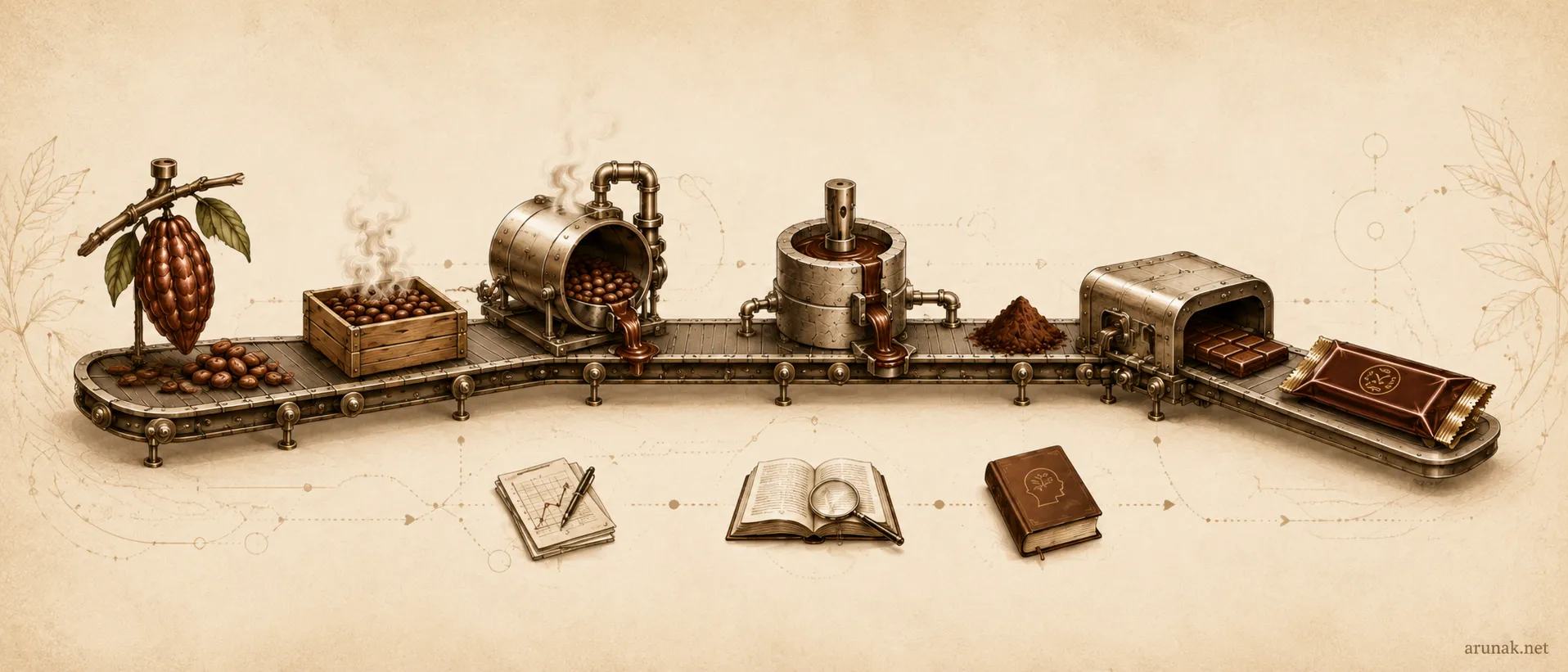
The way I see it, a nonfiction book is like the final product of a long manufacturing process. By the time it reaches us, a lot of transformations have already happened along that process. The raw material gets cleaned up, compressed, translated, and made into a product that we can easily consume.
This is not a bad thing. In fact, that’s the whole point of nonfiction.
For example, let’s say this product is “chocolate”. We’d never eat raw cacao. There’s no way. It’s bitter, tough, and impossible to chew.
So what do we do? We build a production line: we ferment it, roast it, grind it, sweeten it, and turn it into something we can all consume with pleasure.
The same rule applies to nonfiction…
A book takes a messy dataset, a piece of history, experimental data, the lives of others, their failures, their arguments, and turns all of it into a document that’s digestible for another person.
It simplifies the original complexity.
The problem, though, is that sometimes an idea gets processed in a way that distorts the reality it came from.
This is especially obvious in self-help books. Here and there, you read a sentence like “Science says…” and it just sounds too authoritative.
But science can’t actually say anything; it can only predict.
There’s almost always uncertainty attached to the real data. And somewhere along that production line, the uncertainty slowly disappears and turns into facts.
So how do we find nonfiction books that don’t dilute the truth like this?
To do that, we first need to understand how that dilution shows up along the chain of processing.
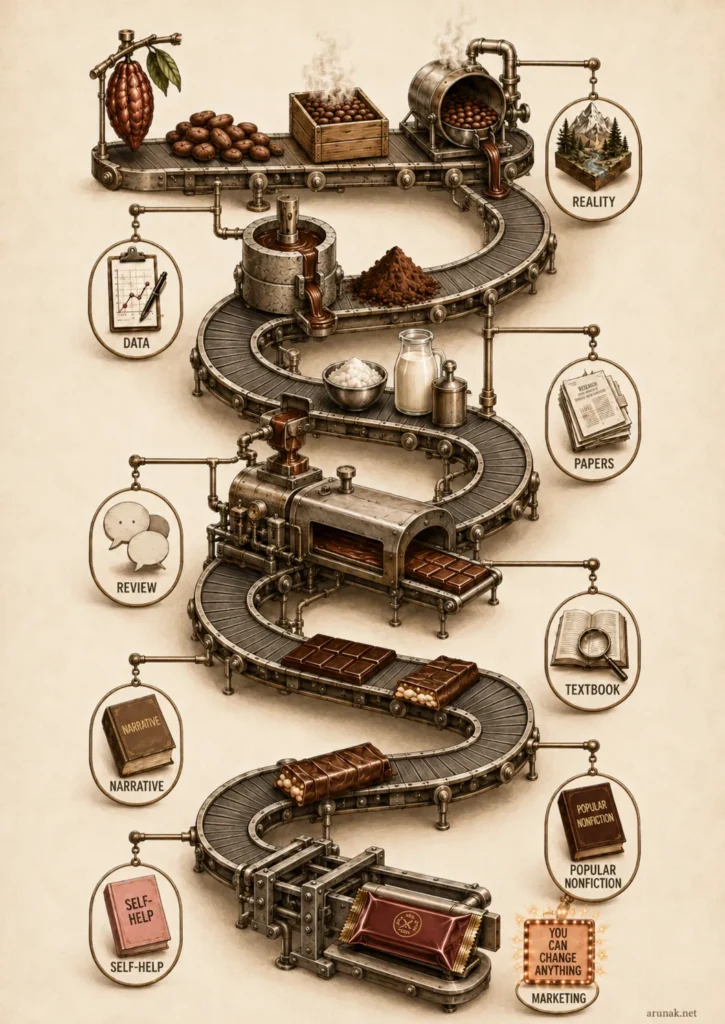
At the very beginning, there’s the reality itself: the experiment, the archive, the fieldwork, the clinical case, the things that actually happened. This is the cacao pod.
Then come raw observations and data. These are the beans.
Researchers, in their respective fields, document these observations. These are the research papers. This is where the bean begins to ferment and dry.
Then comes peer review, replication, debate, and criticism of those publications. This is the roasting.
Then comes reviews and meta-analyses, where many papers are brought together. This is the grinding.
Then these findings get converted into textbooks, where a field decides what’s good enough to teach to students. This is the cocoa powder, the cocoa solids: processed, but still closely tied to the original source.
Then comes what I call serious popular nonfiction, where someone adds narrative, examples, and metaphors. This is the chocolate bar.
Then comes pop nonfiction and self-help, where the ideas turn into advice, habits, rules, and frameworks. Depending on how it’s processed, this can still be a nutritious chocolate bar, or it can turn into a high-calorie, artificially flavored candy bar.
And finally, there’s the most compressed version of all: a quote taken out of context, or a viral takeaway. This is the sugar rush.
The danger of false certainty
I’m not making the point that quality declines with each step. It’s a mistake to think that the lower layers, the ones closely tied to the raw data, are always pure, and the upper layers are always corrupt.
A research paper can overclaim, or an academic textbook can mislead too, not through dishonesty, but by presenting a settled picture of some data that isn’t actually fully settled yet.
Brian Cox, the physicist and BBC science presenter, puts this well: “It is the only human pursuit that succeeds because it is uncertain.”
In other words, good science is disciplined uncertainty. Popular advice usually takes that uncertainty and converts it into 100% confidence, because confidence sells.
Again, simplification isn’t the problem. The problem is using simplification to manufacture false confidence.
This is what we see with most pop-nonfiction books these days.
A study that begins with a simple question becomes a chapter, then becomes a narrative, then becomes a so-called framework, and finally becomes advice.
By the time it reaches us, the original uncertainty has completely disappeared. All the constraints, disagreements, counterarguments are fused into one big block of certainty.
The cautious sentence that says “this does not apply in every case” is now gone.
What’s left is a well-cut, clean idea: a dopamine hit of motivation, that habits are destiny, that trauma explains your future, that personality traits explain how your life will unfold.
As H. L. Mencken, the essayist and critic, puts it, these books are “neat, plausible, and wrong.”
But it’d be ridiculous to say that all nonfiction, or self-help for that matter, is all bad. A significant portion of nonfiction books avoid this trap and deliver the facts without distorting the truth.
So how can we tell a good nonfiction book from a bad one?
The difference between a good and a bad nonfiction book
Careful translation vs borrowed authority
The biggest difference between a good and a bad nonfiction book is that a good nonfiction book only points to the evidence.
They don’t dumb things down; they translate raw facts into a format that a layperson can easily understand.
Having spent my fair share of the last 10 years writing research papers, and more than 5 years writing public-facing articles, in many ways, I came to realize that writing this kind of nonfiction can be even harder than writing a research paper.
On the other hand, bad nonfiction is what happens when the raw facts are translated into books, skipping this skill of translation and stuffing it with overconfidence.
It launders authority. It takes the data of science, history, psychology, economics, or philosophy, and fuses them into a claim that’s much more certain than it actually is.
So the real difference between a good and bad nonfiction book is intellectual honesty.
Francis-Noël Thomas and Mark Turner, in their book Clear and Simple as the Truth, describe this style of writing as “classical style”:
Classic style is, in its own view, clear and simple as the truth. It adopts the stance that its purpose is presentation; its motive, disinterested truth. A successful presentation consists of aligning language with truth, and the test of this alignment is clarity and simplicity. The idea that presentation is successful when language is aligned with truth implies that truth can be known; truth needs no argument but only accurate presentation; the reader is competent to recognize truth; the symmetry between writer and reader allows the presentation to follow the model of conversation; a natural language is sufficient to express truth; and the writer knows the truth before he puts it into language.
- A good nonfiction book is very clear about the claims it’s making, and the constraints under which it’s making those claims; a bad nonfiction book makes everything into a law.
- A good nonfiction book gives you a frame to see the world differently; a bad nonfiction book gives you a formula that claims to have all the answers.
- A good nonfiction book leaves room for our own judgment; a bad nonfiction book replaces judgment with clear-cut rules.
The best writers simplify without clouding the truth
An immediate tell of a nonfiction book that’s badly written is if it’s written with purple prose.
Purple prose is writing that reaches for effect over clarity: ornate, overwrought language that draws attention to itself instead of the idea itself.
The whole point of nonfiction writing is the responsible translation of truth into simplicity.
And sometimes this goes over the author’s own head.
As Thomas and Turner put it: it should be “clear and simple as the truth, but no clearer or simpler.”
Three “two-minute tests” for choosing a good nonfiction book
Here are three two-minute checks to tell a good nonfiction book from a bad one. Altogether, this can be done in about 5 to 7 minutes when you’re standing in the bookstore.
Look for the sources
Having read my fair share of nonfiction books over the years, the first thing I do now is map out where it sits in the production chain. Am I reading raw material, like a textbook, a monograph, or a research-based synthesis?
Or is it more of a “finished product,” a serious nonfiction book that has processed the original raw material but still respects its source?
Or is it mostly a candy bar: clear, easy to read, memorable, but with the possibility of being misleading?
The simplest and quickest way to find this out is by checking the back of the book: the references section, the notes, the bibliography, and the index.
Check whether there are scientific papers, people, cases, archives, interviews, or other sources listed there. If yes, it at least confirms that they did their research.
This is important because even though a nonfiction book doesn’t always need to be academic or too serious about the subject, it should show signs of contact with reality.
Then look at the attitude of the narration
And then I’d look for the style of writing. I’m not talking about word choice or vocabulary, but the attitude of the narration.
The best place to quickly check this is the first two pages of the introduction. Here’s what I’d look for:
- The humility of the prose.
- Does the author define the limits of their claims?
- Are they trying to point toward evidence, or trying to give straight-up advice?
- Does every chapter end in a universal law?
The most important identifier of whether it’s a good nonfiction book or a bad nonfiction book is whether the author is trying to show something, or trying to give advice.
This is where that loss of uncertainty we talked about earlier really shows up.
Putting the tests together
These quick tests give me a clear idea of what kind of nonfiction book this is. And based on that, I’d decide whether to read the book or not.
This also gives me a way to categorize the book, which helps decide how to read it:
- Well written with a good thesis: probably read from cover to cover.
- Well written but no clear thesis: the most dangerous kind, so I’d read or skim it but make a point to question it, take notes, and validate the claims against other sources.
- Badly written with a good thesis: read but skim.
- Badly written with a bad thesis: wouldn’t read.