I’m one of those people who used to believe that it was almost a “sin” not to read a book from cover to cover.
It took several years, and roughly 300 nonfiction books, to get out of this unproductive habit.
I realized that no matter how good a nonfiction book is, most of the time, there will be some bits of information that are not going to be useful to me.
As Francis Bacon, the English philosopher and essayist, wrote: “Some books are to be tasted, others to be swallowed, and some few to be chewed and digested.”
This is all true, and it sounds like the perfect solution: skip what isn’t relevant and spend more time on what’s important to you.
But this is hardly the solution by itself. A big piece of the puzzle is still missing:
- How do you separate the useful bits of a good book from the less useful bits?
- And then, how do you read the useful bits well?
- And finally, how do you integrate them into real life?
Until these questions are answered, reading a nonfiction book is practically just a waste of time, even if you’re reading a really good one.
Here’s the system I use to find the ideas that are relevant, and get more out of nonfiction while still enjoying the reading.
Table of Contents
How to separate the useful parts of a non-fiction book from the non-relevant stuff?
I think a book, even a single idea from a book, can substantially change the course of someone’s life.
It has for me, anyway.
So it’s not unreasonable to spend a couple of minutes doing a quick background check on the nonfiction book you’re about to spend 7 to 10 hours reading.
We spend many hours trying to choose things that are far less critical: what to order on Skip, which movie to watch, which pair of shoes to buy. So why not spend a couple of minutes on a book that might actually change your life?
But what should you spend those minutes on?
Start with a clear-cut goal
After I discovered the idea that there’s no real reason to read the entire book, what I used to do was skip the “boring” parts and read the rest.
Big mistake!
And it took me a couple of books to realize what I was doing wrong.
Just because a part of the book is boring does not mean that it’s irrelevant.
In fact, sometimes that’s exactly where the most useful information lives.
So, instead of simply skimming whatever doesn’t immediately catch my attention, I’ve found that starting the book with a clear-cut goal, something specific I want to get out of it, is by far the most effective way to read nonfiction.
It allows you to:
- Skim with intent
- Separate what is relevant from what is merely interesting
- Spend more time on the ideas that are actually useful to you
Here are some examples:
- When reading The Power Broker, I wanted to understand how Robert Moses accumulated power, kept power, and used power, not memorize every public project he worked on.
- When reading The Rise and Fall of the Great Powers, I had just one question I needed to clarify, which helped me skim most of it and save a lot of time.
- When reading Personality by Daniel Nettle, I wanted to get a good understanding of the Big Five personality model, which allowed me to skip most of the example stories that, for my goals, were not that relevant.
Once you have a goal like this, the next step is really simple: read the introduction and then go to the table of contents and see where the book is most likely to answer it.
Go through the table of contents and the introduction first
Now that there’s a goal in place, it’s quite easy to figure out what’s not important.
What I would do next is read the introduction, which 99% of books have.
This gives me a preview of what comes next, and what to expect.
With that in mind, I scan through the table of contents to eliminate the chapters that clearly do not serve the goal I started with.
A good rule of thumb is to keep the uncertainty on the “read” side. Meaning, if you’re not sure whether a chapter is worth reading or not, read it anyway. Only eliminate the chapters you know for sure are not worthy of your time.
Because we don’t know what we don’t know.
Do some background research
The final step in my pre-reading routine is to do some quick background research on the book that I’m about to read.
You might be wondering, “Is that really necessary? Isn’t it vetted already by the publisher?”
Well…with the current state of the book industry, there are a lot of books that would still waste your time.
I’m not saying that they are necessarily spreading false information, but some of them dress up what would otherwise be common knowledge.
Usually, the idea is presented in the first couple of chapters, and is then dragged on for another 300 pages with unnecessary, handpicked stories and studies.
By the end of it, you’re overwhelmed with random facts, stories, examples, and references, and you’ve forgotten the point they were trying to make in the first place.
These books exist, and unfortunately, they are thriving.
So, how do you avoid them?
I take two quick tests, each of which takes about one minute.
First, I look at the Goodreads rating of the book. But mind you, not the rating itself. The rating distribution.
Distribution is a better way to look past the average and see how readers actually responded to the book. And it’s my understanding that the average reader cannot be fooled that easily.
For example, if a book is skewed dramatically toward the top, where most people rated it 5 stars, it’s highly likely that the author is doing something right.
Here is an examples:
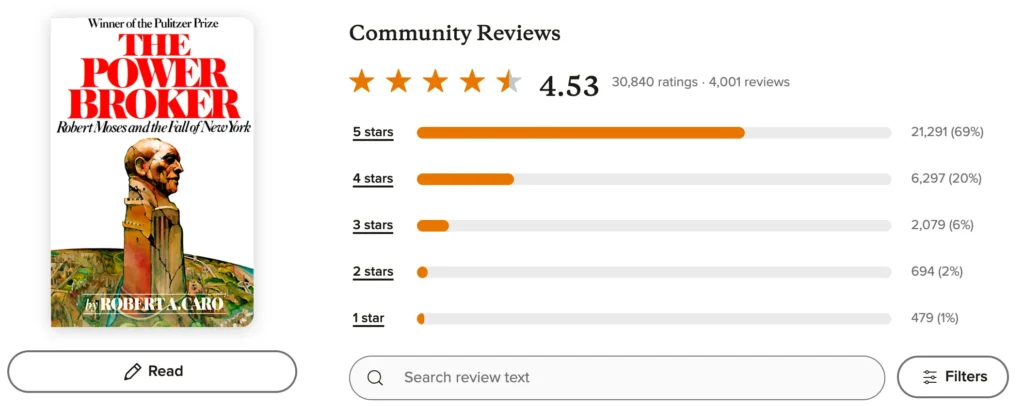
But if the distribution peaks at 4 or 3, I’d be extra careful when reading it.
This does not mean that I would not read a book if the distribution is peaked at a number other than 5.
All I’m doing here is calibrating my attitude before reading the book.
If the distribution makes me skeptical, I go to the next one-minute test: running a simple AI script to do a quick background check on the book.
Using specific phrases like “think really hard about this,” and, if your AI tool has a research mode, “do deep research before answering,” has been, in my experience, quite effective.
Act as a rigorous nonfiction reading advisor, literary researcher, and expert-review analyst.

First, ask me for the book title and author. Do not begin the background research until I provide both.

Once I provide the book and author, think really hard about this. Do deep background research before answering. Do not rely on the publisher’s description, marketing copy, or surface-level summaries. I want a high-value, evidence-based assessment of what serious readers, critics, scholars, domain experts, and well-informed reviewers say about this book.

Your job is not to summarize the book for me. Your job is to help me understand whether the book is intellectually worth taking seriously.

Please answer in fewer than 500 words.

Focus on these questions:

1. What is the central argument of the book, in one clear sentence?
2. What is the author’s background, and are they credible on this subject?
3. What do expert reviewers, scholars, serious critics, or highly informed readers praise about the book?
4. What do they criticize? Look especially for concerns about oversimplification, weak evidence, cherry-picked examples, repetition, exaggeration, ideological bias, or one idea being stretched too far.
5. Is there any serious debate around the book’s argument? If yes, briefly explain the main disagreement.
6. Based on the evidence, what kind of reader is this book best for: beginner, general reader, serious reader, specialist, or mostly entertainment?
7. Final verdict: should this book be treated as essential, useful but limited, introductory, skimmable, or probably not worth much attention? Give a direct reason.

Use relevant sources for your background research. Prioritize expert reviews, serious publications, academic reviews, author interviews, reputable newspapers or magazines, and thoughtful long-form reviews. Avoid relying heavily on Goodreads, Amazon, Reddit, publisher blurbs, or promotional interviews unless they reveal something useful.

At the end, list the sources you used, with links if available.

Be honest, direct, and skeptical. Do not hype the book. Do not dismiss it just because it is popular. Judge it by originality, usefulness, evidence quality, credibility, and whether it is likely to improve how I think.
Here’s a sample reply for Personality by Daniel Nettle. You can find my full review of the book here.
Background check: Personality by Daniel Nettle
Central argument: Nettle argues that human personality is best understood through the Big Five traits, and that each trait carries both advantages and costs rather than being simply “good” or “bad.” Oxford’s description frames the book around the pluses and minuses of personality and “living with the nature you were born with.” (Oxford University Press)
Author credibility: Daniel Nettle is credible on this subject. He has a PhD in anthropology from University College London, has taught psychology at Newcastle, and works across behavioural science, evolutionary biology, anthropology, and cognition. (Newcastle University) His 2006 American Psychologist paper on the evolution of personality variation is highly relevant to the book’s core argument: personality traits persist because they involve trade-offs, not because one trait profile is universally best. (Daniel Nettle)
What serious readers praise: The book seems strongest as a clear, compact, science-based introduction to the Big Five. Publishers Weekly describes it as drawing on Nettle’s own research and others’ work to explain the five dimensions of personality. (PublishersWeekly.com) Serious reviewers praise its clarity, accessible analogies, and evolutionary framing, especially the idea that every personality trait has situational advantages and disadvantages. (Popular Science Books)
What they criticize: I did not find much formal academic review coverage of the book itself, so the criticism has to be inferred partly from debates around the framework. The likely limitation is not that the book is shallow, but that it leans heavily on the Big Five and an evolutionary trade-off explanation. The Five-Factor Model is influential, but not universally accepted as the final structure of personality; some work finds support for alternative models such as HEXACO. (arXiv) So the book may simplify the live debates in personality psychology for a general audience.
Serious debate: The main debate is whether Big Five traits are enough to explain personality, and whether evolutionary stories about trait advantages can always be tested cleanly. Nettle’s own academic work acknowledges that a comprehensive evolutionary framework for heritable behavioural variation was still developing. (Daniel Nettle)
Best reader: Best for a serious general reader or beginner who wants a scientifically grounded alternative to pop personality tests.
Final verdict: Useful but limited. Worth reading if you want a clear Big Five framework for thinking about yourself and others. Not enough, by itself, if you want the full academic debate on personality measurement, culture, change, and competing models.
Sources used: Newcastle University profile; Daniel Nettle’s website; Oxford University Press page; Publishers Weekly review; Nettle’s 2006 American Psychologist paper; PopScienceBooks review; Mary Hrovat review; academic work on Big Five/HEXACO alternatives.
Treat it as a conversation: take notes and highlights as you’re reading
Now that the pre-reading work is done, the actual reading begins.
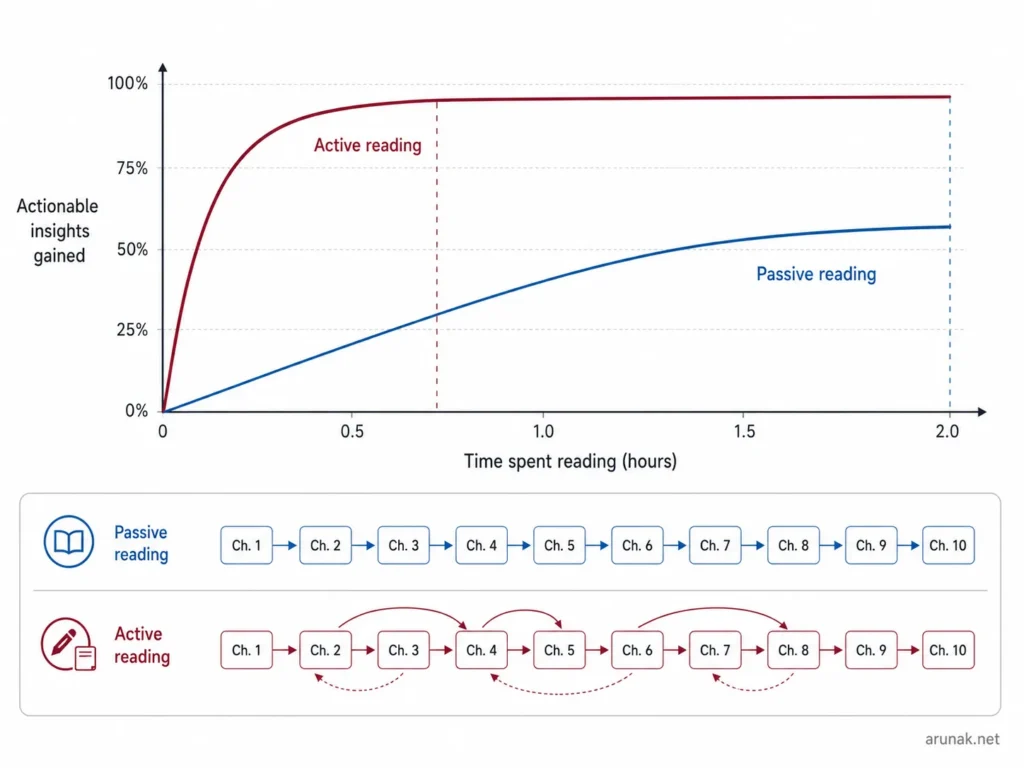
The most important thing I’ve come to realize over the years is this: you get the most out of a book when you read as a participant in a conversation with the author, not as an audience member sitting through a lecture.
And here’s how to do it.
Read like a skeptic
A non-fiction book is well read when you treat it like having a conversation: you listen, but you don’t hand over your judgment just because they sound really confident.
So it’s best to question things, and to ask what’s being left out.
Taking notes and highlighting help you notice what you actually understood versus what you just nodded along to.
If we don’t look up the things we didn’t understand, or the things we need more clarity on, it’s quite easy to fill those gaps with our own wishful thinking.
To put it bluntly: if you’re reading nonfiction like you’re reading fiction, you’re basically reading fiction.
The approach I came up with for this, when reading physical books, is to first define what kinds of things I want to highlight using color coding.
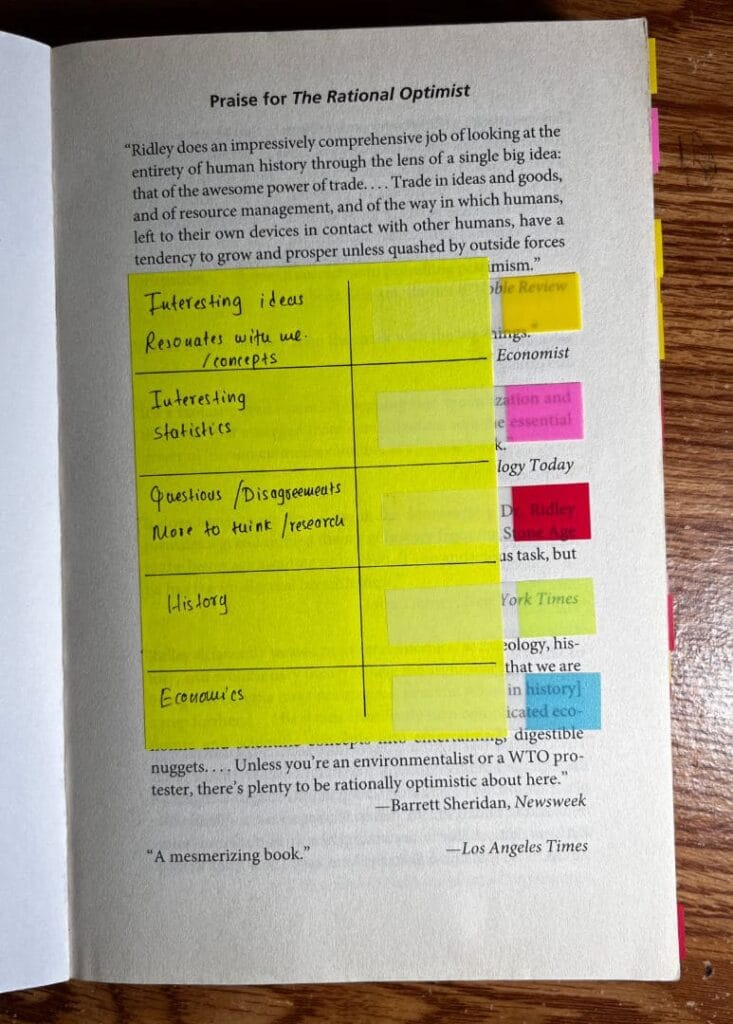
But I must admit, when I’m reading many books at the same time, this does not always go as smoothly as planned. I don’t always obey the color coding.
But nonetheless, having any kind of sticky tab that you can come back to is much better than having no marking system at all.
If I’m reading on a Kindle, especially a Colorsoft, which offers color highlights, I tend to be more consistent. Depending on the device and software version, the colors are usually yellow, orange, blue, pink, and sometimes green.
Here’s my color coding practice when I’m reading on a Kindle, the Kindle app on my phone, or my laptop.
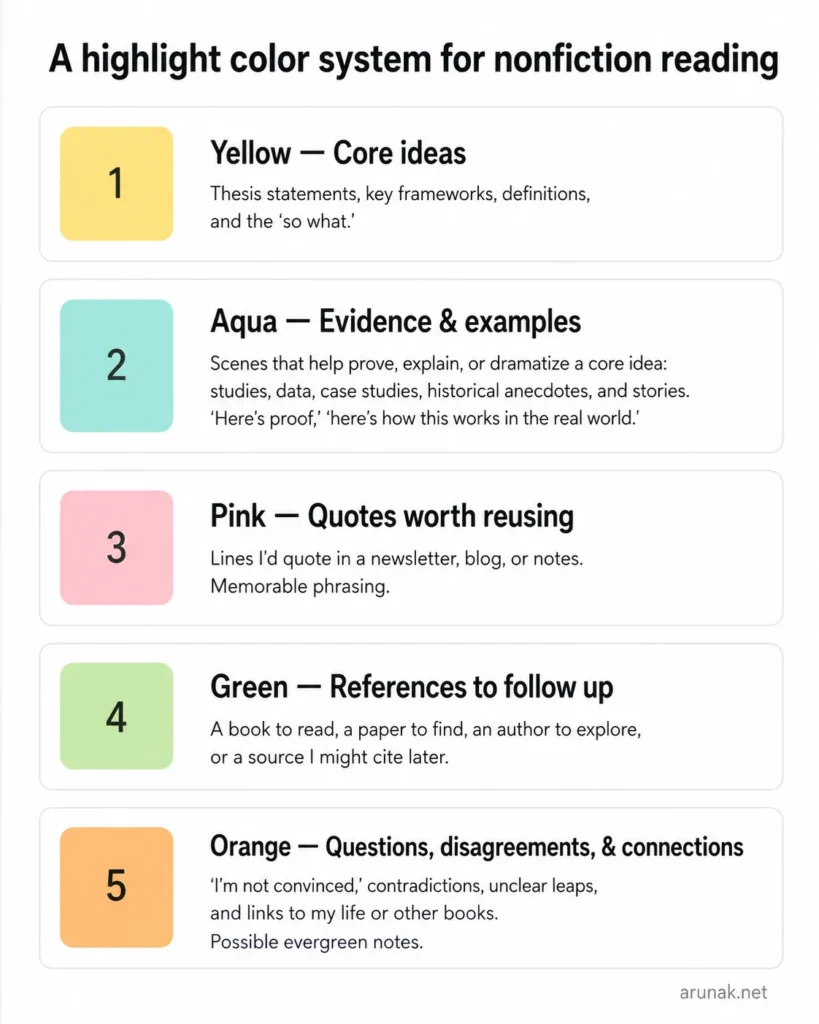
After I finish the book, I transfer these highlights into my note-taking app of choice (Obsidian) and eventually write a review, which I’ll talk about in the final section of this post.
The phrase “science says” should only make us more curious, not obedient
A phrase that repeats itself in nonfiction books is: “science says.”
There’s nothing wrong with this. Obviously, it makes the book more credible, and appealing.
But I don’t think it should end our questioning spirit; it should only begin it.
As Richard Feynman once said, “Science is the belief in the ignorance of experts.”
So when you come across a claim that seems a bit suspicious but is backed up with “science says,” it’s a good idea to check the bibliography at the back of the book and see what the claim is actually based on.
Read to apply, not to collect
There was a time when knowing a lot of stuff was considered enough to make someone knowledgeable, and it genuinely gave them an advantage.
But with the internet, search engines, and especially the advent of AI, that advantage of simply knowing more is now mostly gone.
So, it makes more sense to read nonfiction books to connect the knowledge we already have easy access to, and then apply it in real life to make better decisions, solve real problems, and see the world more clearly.
So active engagement, note-taking, questioning, and reflection are a must if you want to get the best out of a nonfiction book.
And here are some ways to do it.
How to integrate them into real life?
Your highlights and notes are a record of your own attention
About 10 years ago, I made a habit of collecting and sorting the highlights and notes from the books I read.
What I’d do after finishing a book is export these highlights into a note-taking app, read them again after a week or two, and then connect them with different themes.
There’s an obvious benefit to doing this.
I get to apply some of the stuff I read into my day-to-day life, and some of them have been real game changers.
For example, I remember reading Storyworthy by Matthew Dicks, where he talks about daily journaling, which he calls “homework for life.”
This went over my head when I was reading the book. However, out of curiosity, I highlighted this concept more than once.
So, when I was going through the highlights after a couple of weeks, I realized that this could actually be a good daily practice.
And about five years later, this is something that has leveled up my productivity more than almost any other “productivity hack” I’ve tried.
Which brings me to the somewhat elusive benefit of the whole “active engagement” process while reading nonfiction books and then trying to apply them to our own lives.
In a strange way, this process also helps you find yourself, and specifically what would work for you.
When you collect the highlights, and then try to connect them, or even just read them again after some time, you begin to see the patterns. The patterns of your own attention, and maybe even your own subconscious mind, that you’d otherwise not notice at all.
Especially today, with everything moving blazingly fast, I believe this is one of the hardest things to accomplish: to understand who you are, what works for you, and how to use those practices to thrive at work, and ideally, to live a fulfilling life.
And reading nonfiction this way is, I believe, one of the few real life hacks. A shortcut to get you there much faster than reading just to finish another book.
To quote Joseph Addison, “Reading is to the mind what exercise is to the body.” And I believe this is the exercise: not reading for the sake of reading, but reading in a way that helps you think, and notice things that you’d otherwise not notice about yourself.
Keep yourself accountable
One more thing that would really help you bring what you learn from books into real life is to write a short review, even a 200-word one, and share it with others.
There are some websites where you can do this, for example: Goodreads, The StoryGraph, LibraryThing, and Literal.
If you get a real kick out of it, then you can move into your own website, or even a newsletter on a platform like Substack, to take the practice to the next level.
Other than the fact that you will be thinking through and revising the content and the ideas, it does many other things:
- It holds you accountable, so you have to fact-check the ideas before writing about them, which eventually helps you understand them on a much deeper level.
- Writing, in general, forces you to sharpen your thinking, so that’s an added bonus.
- It helps you answer the big questions that you otherwise would not be forced to ask when just reading books, like: What is this book really about? Can you summarize this book in just one line? What are the most important takeaways I can take from this book?
Also, you get the chance to “pay it forward” by sharing what you learned with other people.
If you’re trying to pick a good book to read, here are some of the book notes I’ve been writing. I hope they’ll help you find a good one.
And if you have your own system for reading nonfiction, I’d genuinely love to hear it. Let me know in the comment section. I’m always trying to improve mine.
Happy reading.