
One-line takeaway
In investing, gunning for average is your best shot at finishing above average.
What is The Little Book of Common Sense Investing about?
This book is a great starting point for anyone who’s just dipping their toes into investing, index fund investing in particular.
It’s written by the founder of Vanguard, one of the world’s largest investment management companies.
The core insight of the book is that the most sensible way to invest is to buy a low-cost index fund and hold it for decades on end.
Why I picked up this book
The need to learn more about the whole investing arena came to me while reading another book, The Psychology of Money by Morgan Housel.
I was fairly certain how to go about investing money after reading it: buy a low-cost index fund and just hold it for as long as you can.
This book by Bogle confirmed it, and I was also able to learn more about the whole idea behind index funds and why they have consistently held up so well against active strategies like day trading and stock picking.
Ideas and takeaways
There’s a clear difference between “investing” and “beating the market”
It’s quite tempting to buy into the idea that investing is just another name for gaming the market.
At the very beginning of the book, Bogle deliberately tries to debunk this myth.
Investing, as we know it, can be thought of in two parts: investing in businesses and speculating on their prices. Bogle calls these the “real market” and the “expectations market.”
So what’s the difference?
The real market is where all the economic activity takes place. This is where businesses make decisions, some rational and some irrational, and with them, their profits fluctuate, capital is allocated, and revenues grow over time.
In the expectations market, on the other hand, all those underlying dynamics are just speculated on. The decisions made in this market are mostly about whether to invest, and if so, how much.
Bogle’s point is that, over the long run, there’s no way those businesses can completely predict how the overall economy will fluctuate and align all their decisions with it.
When Shakespeare wrote that “it is a tale told by an idiot, full of sound and fury, signifying nothing,” he could have been describing the inexplicable daily, month-by-month, or even annual swings in stock prices.
So how could someone else predict whether a particular business will do well or go downhill over the long haul?
It’s impractical.
Trying to beat the market, Bogle says, is a fool’s game.
The humble arithmetic of investing
To understand this, let’s look at how the stock market really works.
Investors own shares in companies, and collectively, those shares make up the stock market. So the gross return of these investors must equal the gross return of the entire market itself.
To outperform someone else in a zero-sum game, obviously, the amount of outperformance must be matched by someone else’s underperformance.
In other words, investors as a group can’t beat the market.
Then come the management fees, trading costs, taxes, currency exchange fees, and other minor expenses.
Once those costs are added, investors as a group are playing a negative-sum game rather than a zero-sum one.
It simply comes down to humble arithmetic.
There’s no additional market return created by investors trading with each other. What the businesses produce is what investors, collectively, get before costs.
As Warren Buffett recently wrote, “When trillions of dollars are managed by Wall Streeters charging high fees, it will usually be the managers who reap outsize profits, not the clients.”
So the way the middlemen make money is through these costs and commissions.
That’s customers’ money (our money!), not market return.
The winner’s game: Index funds
That begs the question: “So is there any point in investing at all in this case?”
Is there a winner’s game?
There is.
That is to first cut out as much of the middleman and the associated costs as possible, and then bet on the market rather than trying to pick individual stocks.
How do you cast your lot with business? Simply by buying a portfolio that owns shares of every business in the United States and then holding it forever. This simple concept guarantees you will win the investment game played by most other investors who—as a group—are guaranteed to lose
An index, in this context, is basically a basket of securities chosen to represent a market, or a particular part of one. The S&P 500, for example, represents the biggest U.S. companies and covers about 80% of the entire U.S. market.
But there’s no money in an index itself. You can’t directly buy the S&P 500. That’s where an index fund comes in. The fund actually owns the stocks and tries to mirror the index as closely as possible. VFV, for example, is a Canadian-listed Vanguard ETF that tracks the S&P 500.
Simply put, the ETF is an index fund designed to facilitate trading in its shares, dressed in the guise of the traditional index fund
The philosophy behind investing in an index fund is really a refusal to pick winners and losers in the market.
It’s an admission that you don’t have all the answers.
So instead of trying to solve a problem that you’ll never know the answer to, you just refuse to answer it entirely.
Smart move, according to Bogle.
But there’s still an unanswered question here: “Why would this work?”
Well, first, the evidence behind the success of index funds is overwhelming. According to S&P’s 2025 SPIVA report, 97.1% of Canadian U.S. equity funds underperformed the S&P 500 over the last 10 years. That’s remarkable, but at the same time, makes a lot of sense.
And this growth is fairly consistent across similar index funds in the market.
- Take VFV. Over the 10 years ending June 30, 2026, it returned 16.19% per year, after fund expenses.
- Or take VEQT, which is an even more globally diversified index fund. Since VEQT launched in 2019, its annualized return through June 2026 was 14.59%. Over the previous five years, it returned 13.83% per year.
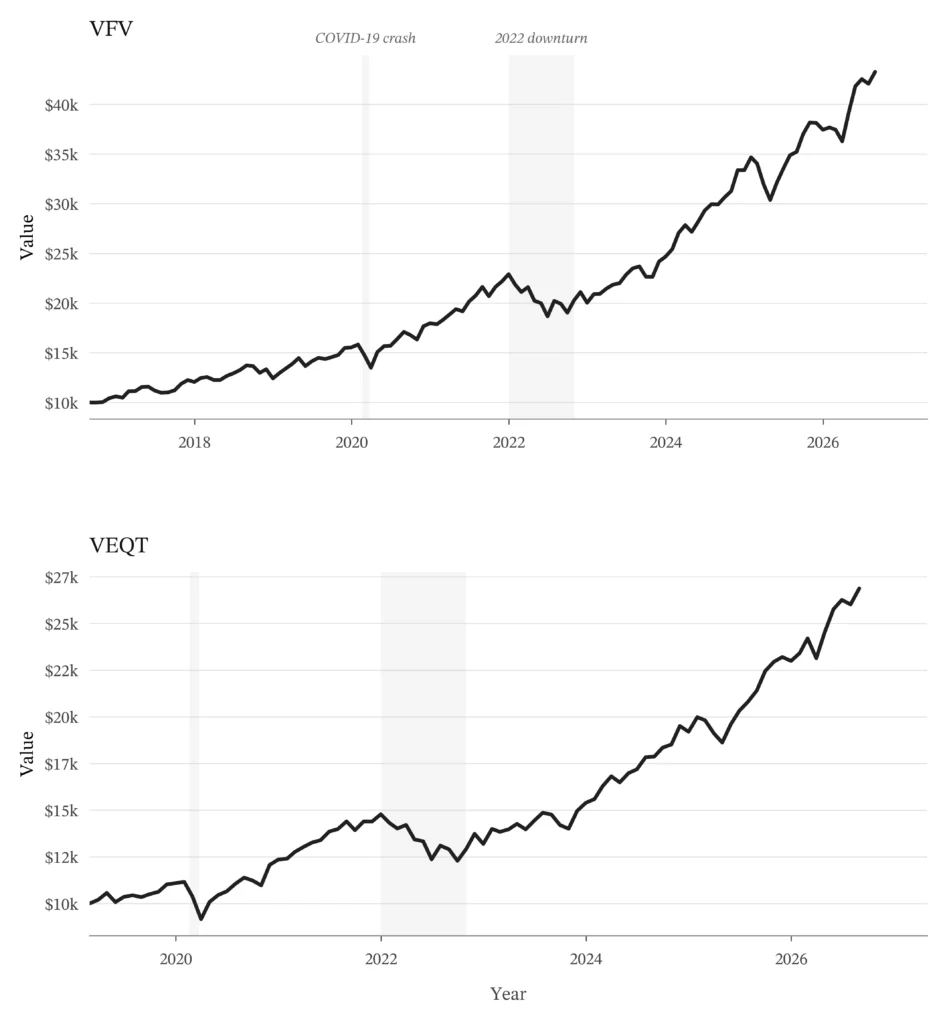
yfinance Python library and sampled at monthly intervals. No additional contributions are assumed. Figure created by the author.But that’s not the whole story. Even index funds can go down, especially when the global economy is rattled by an unexpected event, for example, the global pandemic in 2021.
In response to this, in 2022, VFV fell 12.69%. VEQT fell 10.92% that same year.
But they recovered fairly quickly.
VFV returned 23.25% in 2023 and 35.24% in 2024, while VEQT returned 16.95% and 24.87%.
Zooming out further down the line, it’s clear that this has happened many times over the last 30 years.
But overall, index funds have historically tended to go up over the long run, which is exactly Bogle’s point: the one who wins this game is the one who’s least active.
It’s the one who buys an index fund, doesn’t panic and sell their shares when the market dips, and just holds the fort.
The winning formula for success in investing is owning the entire stock market through an index fund, and then doing nothing. Just stay the course
What is a “low-cost index fund”?
With that question settled, another one takes the stage: “What index fund, or funds, should I choose?”
After reading this book and a few others around the same subject, it’s quite easy to answer this, though I admit I’ve spent an unnecessary amount of time “researching” before finally landing on one.
The short answer is this: any index fund that is well diversified and has a really low cost.
And then just let it be while compounding works its magic. Quite simple.
So, there are two important boxes to check: (1) well diversified, and (2) low cost.
“Don’t look for the needle in the haystack. Just buy the haystack!”
Well diversified means that the shares are spread across a huge number of companies. This is the “haystack” that Bogle was referring to. Ideally, the shares should also be spread through different industries, different company sizes (emerging markets and well-established ones), and different regions.
For someone investing through U.S.-listed ETFs, a few examples are:
- VTI, Vanguard Total Stock Market ETF, which tracks about 80% of the U.S. stock market. Its expense ratio is 0.03% as of April 2026.
- ITOT, iShares Core S&P Total U.S. Stock Market ETF, another U.S. market fund, with an expense ratio of 0.03% as of August 2026.
- VT, Vanguard Total World Stock ETF, which goes a step further and diversifies its investments across global stock markets. Its expense ratio is 0.06% as of February 2026.
For someone in Canada, which I’m more interested in, there are also many options to choose from:
- VEQT, Vanguard All-Equity ETF Portfolio. Its latest published MER is 0.22%, although as advertised, Vanguard cut its management fee to 0.17% in November 2025.
- XEQT, iShares Core Equity ETF Portfolio, with an MER of 0.20% as of August 2026.
- ZEQT, BMO All-Equity ETF, with an MER of 0.18% as of August 2026.
That said, there’s nothing wrong with buying a fund or stock that trades in a foreign currency. But if, say, you have Canadian dollars and buy something listed in U.S. dollars, it’s important to pay attention to the additional cost incurred during the currency conversion.
As mentioned before, it all comes back to what Bogle called the “relentless rules of humble arithmetic.” Gross market return minus the costs of investing is what ultimately ends up in our pockets.
Secondly, and equally importantly, the index fund should be low cost.
In Canada, one of the numbers to look for is the MER, or Management Expense Ratio. In simple terms, it’s the fund’s management fee added to its operating expenses, expressed as a percentage of the fund’s assets. In the U.S., this is more commonly expressed as an expense ratio.
A rough benchmark for what makes an index fund a low-cost index fund is an MER below 0.2%, or around this value.
This is important because the costs add up over the long run.
For example, the difference between a 1.0% and 0.2% MER might not seem huge.
But compounding goes both ways: it could be positive as well as negative.
Say you start with $10,000, then add $500 every month for 30 years into your portfolio, and the investments return 7% a year before fees. To keep this simple, let’s assume the only difference between the two funds is their annual cost.
With a 0.2% annual cost, your effective return would be roughly 6.8%. After 30 years, your portfolio would grow to about:
$662,916
With a 1% annual cost, your effective return would be roughly 6%, leaving you with about:
$562,483
In both cases, the amount contributed was exactly the same: $190,000 over those 30 years.
But the difference in fees leaves you with about $100,000 less in the higher-cost fund.
Big difference!
As Bogle puts it, “In the investment field, time doesn’t heal all wounds. It makes them worse”.
Smoothing out portfolio returns with bonds
For a simple portfolio like the ones we’re talking about here, there are two main asset classes to think about: stocks and bonds.
The fundamental difference between the two comes down to “ownership.” When a stock is bought, you own a small piece of that particular company. Buying a bond, on the other hand, means that you are “lending” money to a government or company. You don’t own a piece of it. This is done in exchange for interest payments and the eventual repayment of the principal. The interest is essentially the return you earn for lending them the money.
All the index funds mentioned above were 100% stock-based, and stocks have a reputation for being capricious because their prices are constantly being repriced.
Bonds, on the other hand, tend to be less volatile because the borrower is contractually obligated to make interest payments and repay the principal. They aren’t risk-free, though. The best and the quickest way to understand why is to watch the movie: The Big Short.
But this stability comes with a price, literally.
Historically, bonds have produced lower long-term returns than stocks. It’s a fact. Vanguard’s global data from 1901–2022, for example, show an average annual return of 8.1% for an all-stock portfolio compared with 4.7% for an all-bond portfolio, with stock prices swinging back and forth considerably more than bond prices.
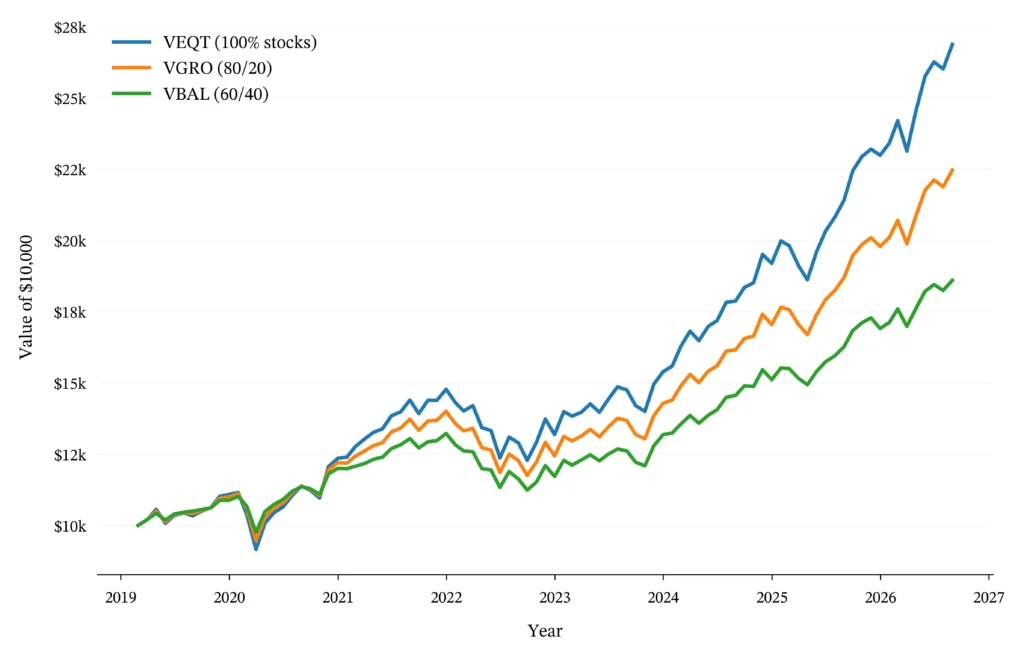
yfinance Python library and sampled at monthly intervals from February 2019 onward. The x-axis shows year, and the y-axis shows the hypothetical portfolio value in Canadian dollars. Figure created by the author.For this reason, Bogle suggests that if you want some stability in your portfolio, it’s a good idea to hold some bonds alongside stocks. In this book, he suggests investing more in stocks when you’re younger and allocating more to bonds as you get older.
I hardly intended such an age-based rule of thumb to be rigidly applied. For example, surely many young investors beginning their first full-time jobs might as well regularly invest not 75 percent, but 100 percent of their savings in equities during those early years of investing
What bonds do is smoothen out some of the ups and downs. But because bonds tend to return less than stocks over the long run, the final return will also tend to be lower than if the portfolio was made out of 100% stocks.
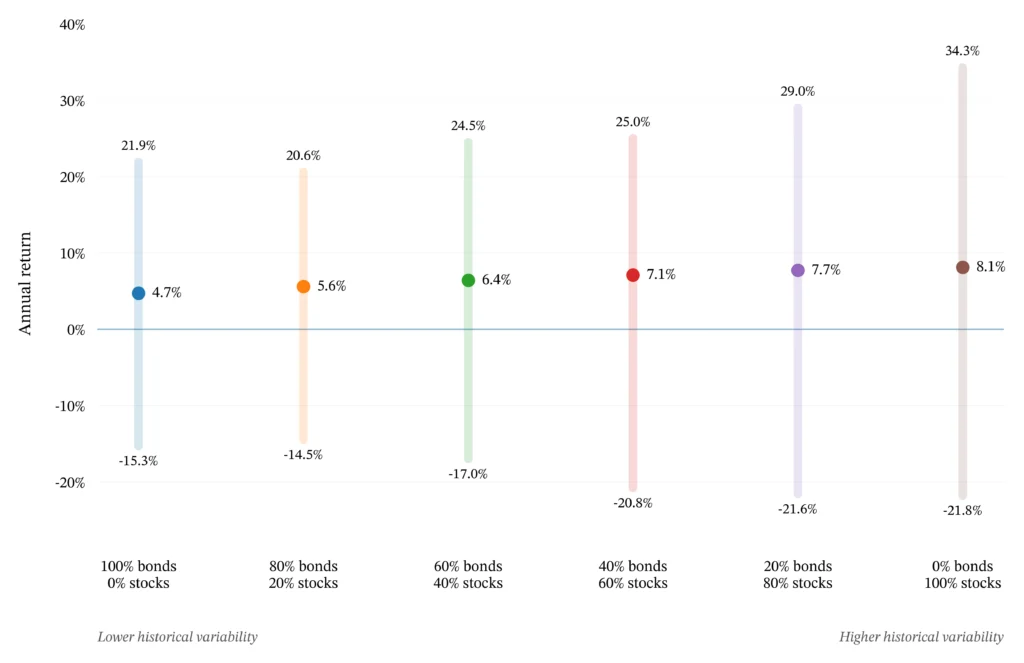
That said, this mostly comes down to our own risk tolerance, time horizon, financial situation, need for income, and how soon we expect to use the money.
If someone’s in their early 20s, granted that their financial situation is steady and they won’t need the money anytime soon, it may not make much sense to load up a portfolio with 40% bonds and 60% stocks.
But it makes much more sense that the same person might gradually shift toward something like 40% bonds and 60% stocks by age 65.
There’s no one perfect ratio.
How The Little Book of Common Sense Investing changed the way I think
The most important action to take in investing is inaction.