
One-line takeaway
The hardest part of investing is learning to “do nothing.” The more actively people trade, the less they tend to earn.
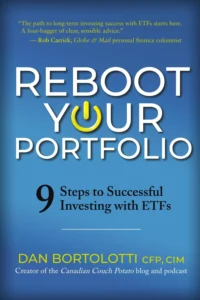
What is Reboot Your Portfolio: 9 Steps to Successful Investing with ETFs about?
This is a straightforward, evidence-backed investing guide, especially for ETF investors. It’s custom-tailored to the Canadian market, though the basic principles discussed apply to anyone across the globe.
The chapters are organized with one clear piece of guidance in each. All the advice is backed up with statistics and examples of how the market has behaved over the past century.
Some of the topics covered include why you should choose ETFs over stock picking, how to balance stocks and bonds, how to choose ETFs, and how to stay the course over the long haul.
It’s a great read for anyone who’s just starting their investing journey.
Step 1: Stop Trying to Beat the Market
Stock picking seems strategic in the moment, but over the long haul, it’s a losing game for most investors. When we pick stocks, we’re betting on one company’s decisions and future performance, neither of which we really have control over. The solution is to bet on the entire market through index funds.
The fact is, identifying companies that will outperform is far more difficult than it sounds.
Step 2: Set Your Financial Goals
Financial goals depend on four variables:
- How much money do you need?
- When will you need it?
- How much are you willing to save each month or year?
- What rate of return will you need to reach your target?
Of these, your saving rate is the most important. If you spend more than you earn, it doesn’t really matter how much your investments return. You’ll still be losing money.
Investing can be fun, while saving is just hard work.
An indexing strategy can help you earn everything the markets have to offer at a very low cost. But the fact is, whether your portfolio earns 2% or 12% makes no difference if you’re spending more money than you earn.
Step 3: Find the Right Mix of Stocks and Bonds
There’s no such thing as a “risk-free investment.” The goal is to align your portfolio with your risk tolerance by adjusting the mix of stocks and bonds.
Stocks are generally more volatile than bonds. The greater the stock allocation in your portfolio, the more volatile it becomes. Adding high-quality bonds can smooth out some of those swings.
If your risk tolerance is high and your time horizon is long, you can allocate more of your portfolio to stocks. If you’re close to retirement or expect to need the money soon, you may want to allocate more to bonds to reduce volatility.
The tradeoff is that stocks have historically returned more than bonds. When you replace some stocks with bonds, you’re giving up some expected return in exchange for more stability.
According to the Credit Suisse Global Investment Returns Yearbook¹, between 1900 and 2019, US stocks returned 9.6% annually, compared to 4.9% for bonds. A dollar invested in bonds in 1900 would have grown to $327 by the end of 2019. That same dollar invested in stocks would have grown to more than $58,000 over the same period.
Step 4: Fine-Tune Your Asset Allocation
Diversifying your portfolio, as mentioned in Step 1, can easily be misunderstood. Diversification for its own sake doesn’t lead to any meaningful advantage.
For example, buying the same asset class through two different index funds usually doesn’t add any real benefit. What it often adds is more complexity and, depending on how you trade, additional transaction costs. Each asset class needs a specific role in your portfolio.
Canadian, US, international developed, and emerging-market stocks, combined with high-quality bonds, already make up a well-balanced portfolio. There are many index funds that combine all of these into one diversified portfolio: VFV, VEQT and XEQT, to name a few.
Adding redundant asset classes is like packing three pairs of boots for your island vacation when one pair would do just fine. The other two pairs just make your suitcase harder to carry and more expensive to stow on the plane.
Step 5: Select Your ETFs
What index funds do is mirror an index by following the same company weightings as closely as possible. In a traditional market-cap-weighted index, this means the money allocated to each company depends on its market capitalization.
One Canadian-listed index fund mentioned in the book is VFV, Vanguard’s S&P 500 Index ETF. It tracks the S&P 500 Index, which represents the top 500 US companies.
Step 6: Open Your Accounts
As mentioned before, the success of investing boils down to how well you can balance the cost between spending and investing. The most important factor in the spending part is the management expense ratio, or MER, that determines how much of your return you actually get to keep. Having a robo-advisor or financial adviser allocate and rebalance your portfolio usually means paying a separate management fee on top of the MERs charged by the ETFs themselves.
With online brokerages such as Wealthsimple and Questrade, managing a simple ETF portfolio yourself has become quite easy. At Wealthsimple, for example, clients currently pay an annual fee of about 0.5% for managed investing, while self-directed stock and ETF trades have zero commission fees. If two otherwise identical $50,000 portfolios earned 6% a year before fees, that extra 0.5% would leave the managed portfolio about $38,000 behind after 30 years, assuming no additional contributions.
So just managing the portfolios by yourself is one of the most sensible and cost-effective ways to invest.
Step 7: Build Your Portfolio
The execution should be more boring than the planning. This means:
- Choose a low-cost index fund with high diversification across different sectors and geographic regions.
- Reinvest any dividends or distributions. On platforms like Wealthsimple, dividend reinvestment can be set to happen automatically.
- Review your portfolio every six months to a year, and make changes only if they’re genuinely needed.
Step 8: Keep It in Balance
Rebalancing means calibrating and bringing back your portfolio to its target mix (sector- and region-based allocations). But this target should largely be based on two parameters: your time horizon, which shortens as you age, and your priorities.
As you get closer to retirement or another major financial goal, it naturally makes sense to allocate more to bonds, accepting lower expected returns in exchange for higher stability. Your priorities can change too, and with them, a portfolio built for long-term growth may need to be adjusted.
Step 9: Stay the Course
The hardest part of investing is learning to “do nothing.” The more actively people trade, the less they tend to earn.
We are constantly bombarded with market predictions, hot ETFs, stock tips, and the next big opportunity. But over the long run, none of this gives you much reason to change course, provided you already have a well-diversified portfolio that matches your needs and goals. Most of the time, doing absolutely nothing and continuing to hold the portfolio is a huge part of the strategy.
