
The story phase
On a showery Tuesday in September 1821, Michael Faraday, a laboratory assistant at the Royal Institution in London, finds himself racking his brain over an experiment.1
The aim was to understand how an electric current acted on a magnet. The apparatus was quite simple: a metal wire next to a magnet, with the wire intended to spin around it. But the wire would move for a bit, only to strike the magnet and stop.
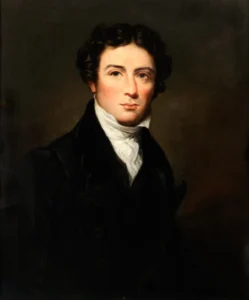
After some trial and error, Faraday realised that the problem was how he had positioned the magnet. It should not interfere with the wire’s path. Instead, the wire should spin around the magnet like a rider on a merry-go-round, with the central pole in the middle.
Realising this, Faraday set up a new apparatus where the metal wire was buoyed by a cork and suspended from above, much like a chain carrying a rider around a swing carousel. And then Faraday fixed the magnet upright in a basin of mercury.2
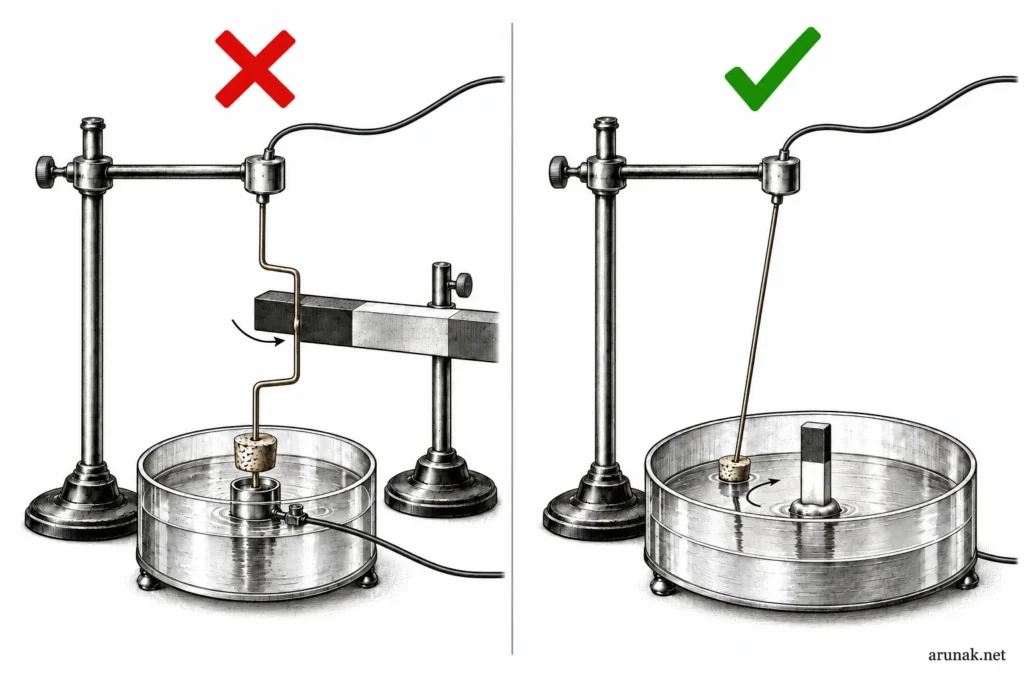
When the electrical connection was made, the cork attached to the wire started to “ride” around the magnet.
And it kept going.
Little did he know that this experiment would later help revolutionise the world of engineering and make him one of the most important scientific figures ever to live.
But there’s something else that is equally remarkable about this story.
This was 1821. This was a time when only the wealthy, the elite class of society, were given access to run experiments like this, let alone to be a part of a prestigious establishment like the Royal Institution.
Born the son of a blacksmith, Faraday was nowhere near this elite class. He was at the bottom of it.
How did he get here against all odds?
His rebellion against these odds started at a very young age. At about 12 years old, he realised that he had a mind suited to more than just physical labour. He had a curious mind: curious about religion, art, nature and literature.
But who would help a blacksmith’s son pursue such curiosities?
His social class seemed to have permanently blocked his access to exploring such things. But Faraday still refused to accept defeat.
In his free time, he would wander around town, until one day, he stopped at a bookshop. He went in.
At this time, the only book he had read was the Bible. But the enthusiasm with which he talked about books and his interest in literature charmed the shopkeeper. So the shopkeeper let Faraday hang around the bookshop a bit longer.
Faraday visited the bookshop many times over the next couple of days, until the shopkeeper offered him a job as a delivery boy.
Faraday finally got what he wanted: access.
And there was a lot of it in this bookshop; it had more books than a typical public library.3
So he started reading. After reading a fair share of books, there was no doubt in Faraday’s mind about what he wanted to do in life. He wanted to be a scientist.
But again, there was the same problem: who would give him the access and resources to become a scientist?
A blacksmith’s son wanted to be a scientist? How was that possible in the 1800s?
Realising that the odds were stacked against him, Faraday turned to the only source of answers he had access to at the time: books.
One day, he came across a book that would provide a solution. It was called The Improvement of the Mind, by Isaac Watts: a self-help guide to improving how we learn and think.
Faraday absorbed this book, carrying it with him at all times, until he found what was holding him back. The missing piece, he came to notice, was action.
At this point, he knew a great deal about scientific theories and experiments, but he still needed practical experience and guidance. He needed an apprenticeship.
So with the shopkeeper’s blessing, Faraday started attending lectures in London.
One day, impressed with this young man’s enthusiasm and work ethic, the shopkeeper introduced Faraday to William Dance, a customer of the shop and a member of the Royal Institution, a highly prestigious institution that promoted the latest advancements in science.4
Dance eventually invited Faraday to attend a lecture series given by none other than Humphry Davy, one of the world’s leading scientists at the time.
And Faraday would not let this opportunity go to waste.
He took detailed notes at his lectures and sent them to Davy, along with a request for scientific employment. Impressed with his work, in March 1813, Davy recruited Faraday as a laboratory assistant at the Royal Institution.
With Davy’s training behind him, Faraday went on to make many groundbreaking scientific discoveries and inventions, one of which was the electromagnetic motor he had worked so hard on that showery Tuesday in 1821. This invention alone would go on to influence many of the electrical devices we use and rely on today, all the way from washing machines, electric fans and refrigerators to electric cars and high-speed bullet trains.
The structure phase
In a situation like the one Faraday found himself in, where we have to find a way forward with limited resources, it’s quite natural to fixate on what we don’t have.
Competitive advantage is a real constraint. It exists. Some have more money, time, or support behind them than others.
But getting hung up on it doesn’t help solve the problem at hand. What truly matters is how we respond to it, and build and carve an advantage for ourselves.
Sounds inspirational, but can we really do it?
Faraday’s story proves that we can. Anybody can.
He invested in expanding his access: access to books, then access to people (shopkeeper → William Dance → Humphry Davy), and finally access to science.
As sociologist Nan Lin, whose research focused on social networks and social capital, wrote in his well-cited paper, Social Networks and Status Attainment:
“For the disadvantaged to gain a better status, strategic behaviors require accessing resources beyond the usual social circles”
In other words, access cultivates advantage.
The interface
So what resources do we have access to regardless of the scarce resources that we’re dealing with?
Here are some of them:
Access to knowledge
It baffles me how ignorant we are5 about the resources available to us through public libraries.
A free membership from your local library gives you access not only to books, but also ebooks you can read on your phone and, in some cases, unpublished archival material you will never find online.
Some of the other resources are MIT OpenCourseWare, Open Yale Courses and OpenLearn, not to mention YouTube and educational podcasts.
Access to people
People who are among the very best in their domains are often the ones who know best how hard it is to get there. So they’re more willing to give someone a hand than anybody else. Reaching out to them through LinkedIn, email or just introducing yourself in person could go a lot further than you might think.
Access to experience
Experience is cheap these days. And it is getting cheaper by the day.
In Faraday’s time, he still had to first work in a bookshop and gain access to an institution through the people he met there to keep things moving forward.
But today, we don’t really have to.
We can take on a volunteer role, contribute to an open-source project or build something of our own on the internet to chip away at the barriers that hold us back from getting wherever we want to go in life.
- Weather: Luke Howard, The Climate of London (1833), vol. III, p. 60, records 4 September 1821 as “Fine: showery.” Date and experiment: Faraday’s diary, pp. 49–52. ↩︎
- Mercury was a deliberate choice because it is a liquid metal that conducts electricity. ↩︎
- Robert Greene, Mastery (2012). See my book notes. ↩︎
- Robert Greene, Mastery (2012). See my book notes. ↩︎
- and I include myself in this ↩︎