
The Story Phase
In 1995, at 40 years of age, Katalin Karikó, a biochemist who had spent years working on mRNA, found herself at one of the lowest points of her career. At the time, mRNA wasn’t seen as the promising therapeutic platform that it is today. So, with her research seemingly going nowhere, she was given a brutal choice by the University of Pennsylvania: leave, or accept a demotion with a substantial pay cut.
She was born into a modest family in a small town in Hungary, and making it this far after all the adversity she’d already pushed through was no small feat, to say the least. And now, in a flash, all that hard work was about to disappear into thin air.

To make matters worse—way worse—she had just found out that she had been diagnosed with cancer and was about to face two operations. It’s impossible to even imagine the mental state Karikó was in at this point in her life.
But she found a way to move forward. By taking a step back…
She accepted the demotion, moving from her faculty position to become a senior research investigator. For the next 18 years, she’d continue to push against the current. Now demoted, she’d continue running experiments, many of them hitting dead ends, and eventually begin working with Drew Weissman, an immunologist who joined Penn in 1997.
That continued until 2013, when she finally decided to leave Penn after the university declined to restore her faculty position. But she refused to give up her life’s work. So she’d carry it somewhere else: BioNTech, then a relatively small German biotechnology company working heavily on mRNA-based therapies.
Another 10 years passed, and the recognition she’d waited so long for finally came. In 2023, Karikó and Weissman received the Nobel Prize in Physiology or Medicine for their discoveries that helped develop mRNA vaccines against COVID-19.
Looking back from the vantage point of her success, it’s quite obvious how important all that work had been, and that she more than deserved the recognition.
But shift that vantage point back to 1995, when both her personal and professional lives were at their lowest, and nobody—not even Karikó, especially Karikó—could have predicted just how high that road would eventually take her.
She had to get comfortable with the fact that there was no way to tell a real downfall apart from progress.
So she decided to do the most sensible thing she could: fail forward.
The Structure Phase
But failing forward isn’t for the faint-hearted. It’s far more comforting to turn around and settle for a life you know with certainty falls short of what you might have lived.
The trap behind this is our crude instinct to judge whether something is working by looking for evidence that it is working.
Sometimes, it is working under the surface, but we just can’t see it yet. There’s no evidence to prove that it is.
This is called latent learning, first coined by Hugh Blodgett in 1929 as a type of learning that takes place without an immediate reward.
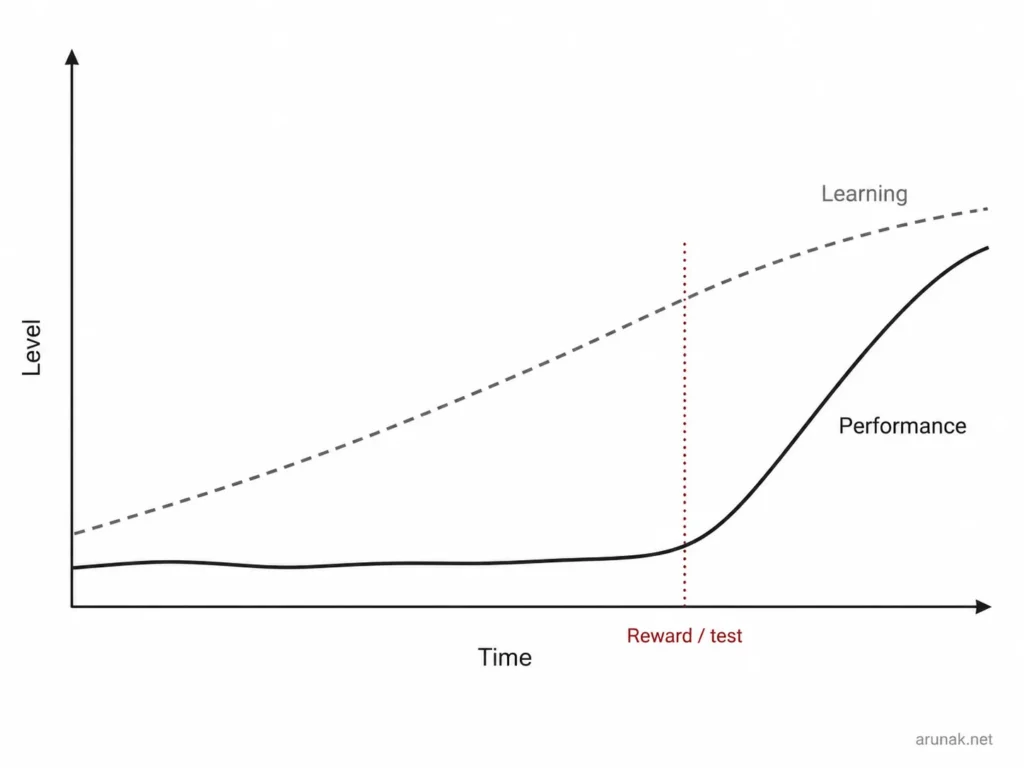
In 1930, Tolman and Honzik repeated and expanded on Blodgett’s work with rats. They placed groups of hungry rats in a maze. One group received no food in the maze for the first ten days and was rewarded starting on day 11. For those first ten days, their error rate had barely budged. No signs of improvement.
But when food was introduced on day 11, things took a dramatic turn. Their errors dropped sharply. They suddenly found their way through the maze much more easily. This showed that they had already learned much more about the maze than their performance had shown during the first ten days.
It had just happened quietly.
This experiment and a later 1954 experiment by Harold Stevenson with children helped reinforce a really important distinction between learning and performance. What you’ve learned so far and what you can show for it aren’t always in lockstep. Performance can suddenly catch up later, while learning has been building gradually over time.
So sometimes, it’s worth holding on a little longer rather than giving up on something you’ve already poured years of your life into.
Because sometimes, a seed takes quite a while to take root before breaking the surface. So it’s not that foolish to wait another season before judging whether the field has gone barren.
The Interface
But it’s easier said than done. It’s better to have at least some confirmation that things aren’t going completely off the rails. Here are some of the guardrails that can keep us on course:
- When there’s no clear outcome in sight, focusing on building skills gives us something concrete to hold onto.
- Before the promotion, recognition, and all the glory, ask yourself: “Do I have the capacity to hold on to them when I finally have them?” If not, better revisit skill building!
- Testing yourself from different angles—different times, different intensities, different contexts, different constraints, and different environments—gives you a pretty good idea of whether you’re on the right track, even when there’s no clear outcome in sight.