
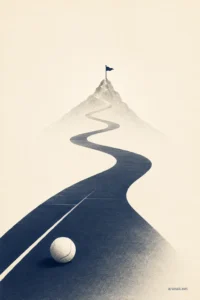
The Story Phase
On a warm, windy South Florida afternoon, two men took to the court at Crandon Park in Key Biscayne, going head-to-head with the No. 1 men’s tennis ranking hanging in the balance. Andre Agassi, then 24 years old, was one of these men.
Right from the start, things didn’t seem to be going his way. His opponent, Pete Sampras, won the first set 6–3 and seemed well on his way to taking control of the match.
What happened next was nothing less than remarkable.
Agassi went on to save all three break points, then won 17 points in a row to close out the second set. The new momentum had built, and Agassi now had the grip on it. He won the first two points of the third set as well, bringing the streak to 19 consecutive points.
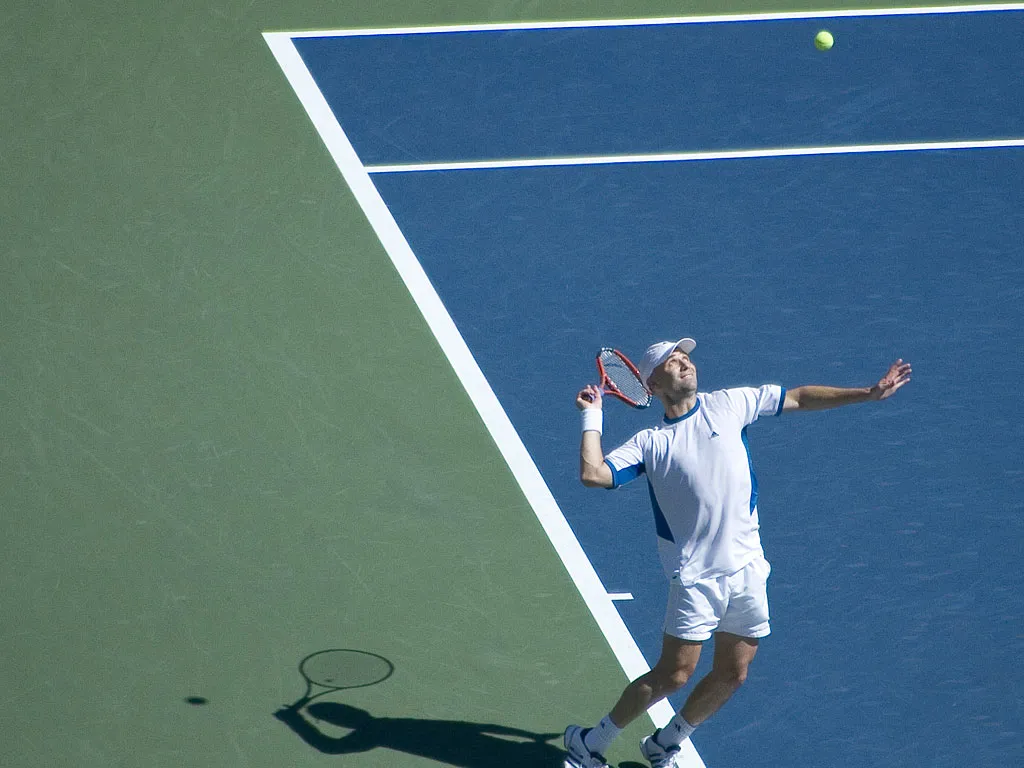
On match point, Sampras drove a backhand down the line, only for it to sail wide. Agassi stayed on his feet, clenched his fist, and roared. For the first time in his life, he was now sitting atop the men’s tennis rankings. A few moments later at the trophy ceremony, Agassi was grinning with excitement, holding his newly won Lipton trophy over his head like a crown.
At the top of the world, he was. Or so it seemed…
Nearly 15 years later, in his memoir, Open: An Autobiography, Agassi describes his disillusionment with winning:
“I’ve been let in on a dirty little secret: winning changes nothing. Now that I’ve won a slam, I know something very few people on earth are permitted to know.”
His career trajectory after this historic win would go on to bear that out almost to a tee. He came crashing down from the summit. Almost immediately. By November 1997, barely two years and seven months after his match with Sampras, Agassi had fallen all the way to No. 141.
No. 141!
It’s almost surreal to picture a tennis world champion playing at lower-tier venues less than two years later, picking up his own balls and updating the scoreboard all by himself. But this is the painful reality that Agassi had to face.
He even considered retirement at this point. Only he didn’t.
Instead, he chose to retire his mindset, the mindset that had taken him through this rollercoaster ride in the first place. Later, reflecting on this tumultuous period of his life, he described his new career focus in three simple words: “one day better.”
With this newfound sense of purpose, he kept playing, kept grinding his way back up the rankings one match at a time. In July 1999, just over four years after first reaching No. 1—and almost immediately hitting rock bottom—Agassi made it back again to the top.
But this time, he’d done it with a newfound appreciation of what winning really is.
And this was no short-lived comeback either. Agassi went on to become one of the most celebrated tennis players in history by winning 26 ATP Tour-level titles, including five more Grand Slams, finishing 1999 as the year-end world No. 1, returning to No. 1 twice more in 2003, and winning his 60th and final career title in 2005.
The Structure Phase
Though it might not always be this intense, we all go through emotional rollercoasters like this once in a while in our lives and find ourselves “lost” at the summit.
There’s almost a perfect parallel in mathematics that mimics this behaviour: gradient ascent.
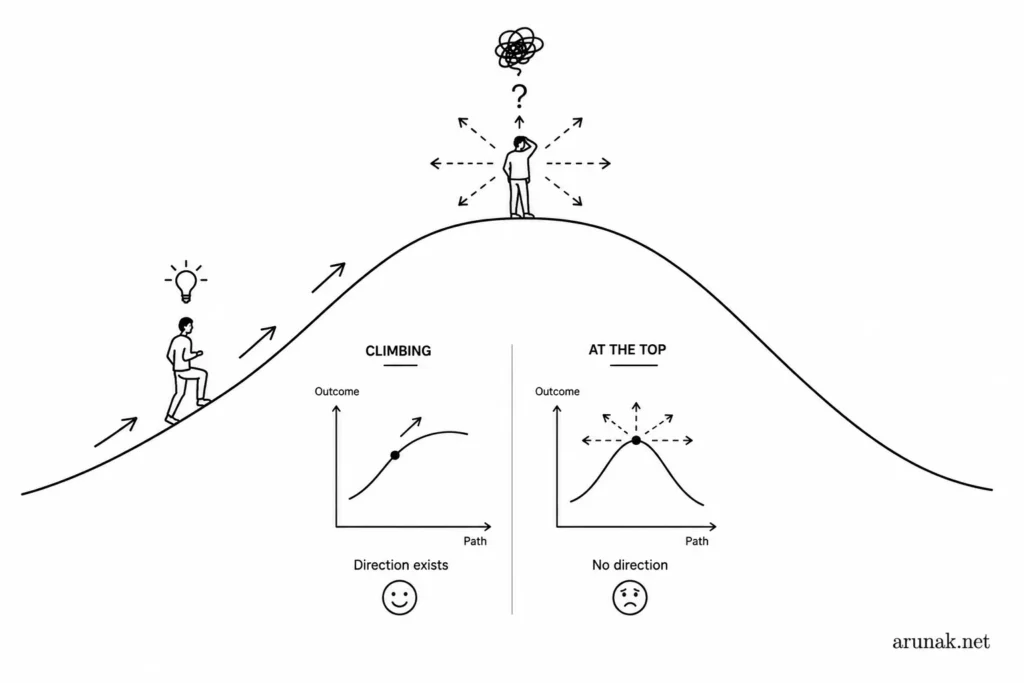
Imagine that you’re climbing a mountain. At any given point, you have a clear-cut goal: reach the summit. The gradient gives us direction, much like a purpose does in life.
But when you finally reach the top, the gradient becomes zero.
The sense of direction disappears.
Where to next, we wonder?
This loss of direction can throw us off balance and, if we’re not careful, send us tumbling back down the hill pretty quickly.
Looking back at my own life trajectory, I, too, have noticed that at the end of any big project comes a strange sense of unevenness. And it’s quite unsettling to think about, because what if the summit we’re so eager to plant our flag on is not what we really want in life?
As Tony Robbins puts it:
This is the ultimate failure. ‘Cause if you go at something and you fail and you’re an achiever, you don’t fail. You go, ‘I learned something. I’ll just try something else. I’m going to still get there.’ But when you succeed and you’re not happy, you’re technically screwed.
I think the answer to avoiding this trap is also hidden in Robbins’ statement itself: to keep a relationship with something that will never come to its finality.
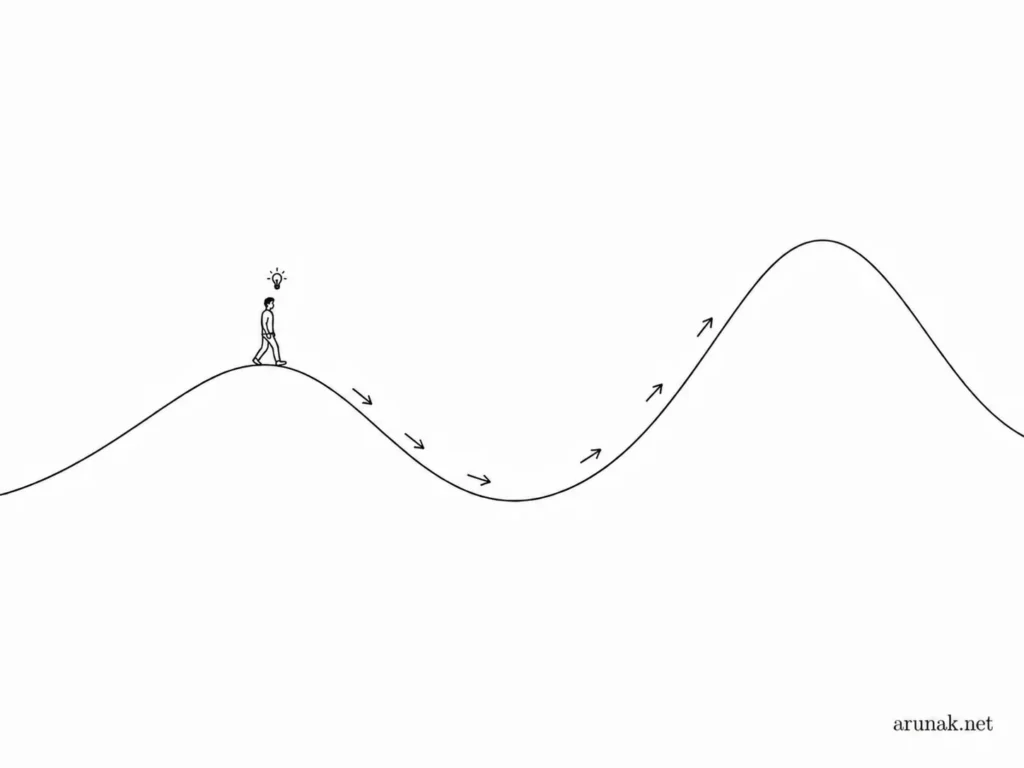
A never-ending pursuit.
To live by the notion that the end of one peak is the beginning of another.
The Interface
So what does this look like in practice?
It means having an endless pursuit behind every finite goal.
- A finite peak might be to publish a book; the endless pursuit is to become a good writer.
- A finite peak might be to get promoted at work; the endless pursuit is to become the absolute best at what you do.
- Or, in a case like Agassi’s, the finite peak can, in fact, be becoming world No. 1. But what makes it more sustainable over the long haul is anchoring it to the pursuit of “greatness.”
“Focus on getting better, not on winning or losing.” — Andre Agassi